


By Q4 2026, UK SMEs utilising automated governance will reduce operational overhead by 30% while meeting FCA resilience standards, leaving manual-heavy competitors to struggle with rising cloud debt and key-person dependency.
The gap between high-performing UK businesses and the rest is now defined by one metric: the ability to deploy secure code in under an hour without human intervention.
Organisations that treat DevOps as a leadership-level operating model will achieve predictable growth, while those treating it as a toolset will face stagnant delivery and spiralling costs.
Executive Summary for CEOs and CTOs
- The Bottom Line: DevOps is now a financial and risk management strategy, not a technical preference.
- Operational Resilience: Cloud migration is your shield against regulatory scrutiny and disruptions.
- Risk Mitigation: Automation reduces delivery risk as significantly as it increases speed.
- Profitability: Infrastructure management must be continuous to prevent “Cloud Drift” from eroding margins.
Beyond Speed: Why 2026 DevOps is a Profit Margin Strategy
The global DevOps market is projected to grow from $19.57 billion in 2026 to $51.43 billion by 2031, reflecting a compound annual growth rate (CAGR) of 21.33%. (source: Mordor Intelligence)
DevOps used to be about speeding up releases. In 2026, it is about controlling change.
UK SMEs face three pressures at once:
- Customers expect frequent updates
- Regulators expect stronger controls
- Cloud costs continue to rise.
⭐ Delivery speed is not defined only by tools and automation; it also depends on the network layer that moves data between environments, builds, and cloud regions. This is explained in a deep dive on how network infrastructure affects DevOps and CI/CD performance.
Where DevOps Now Sits: The Business Control Layer for Growth and Risk
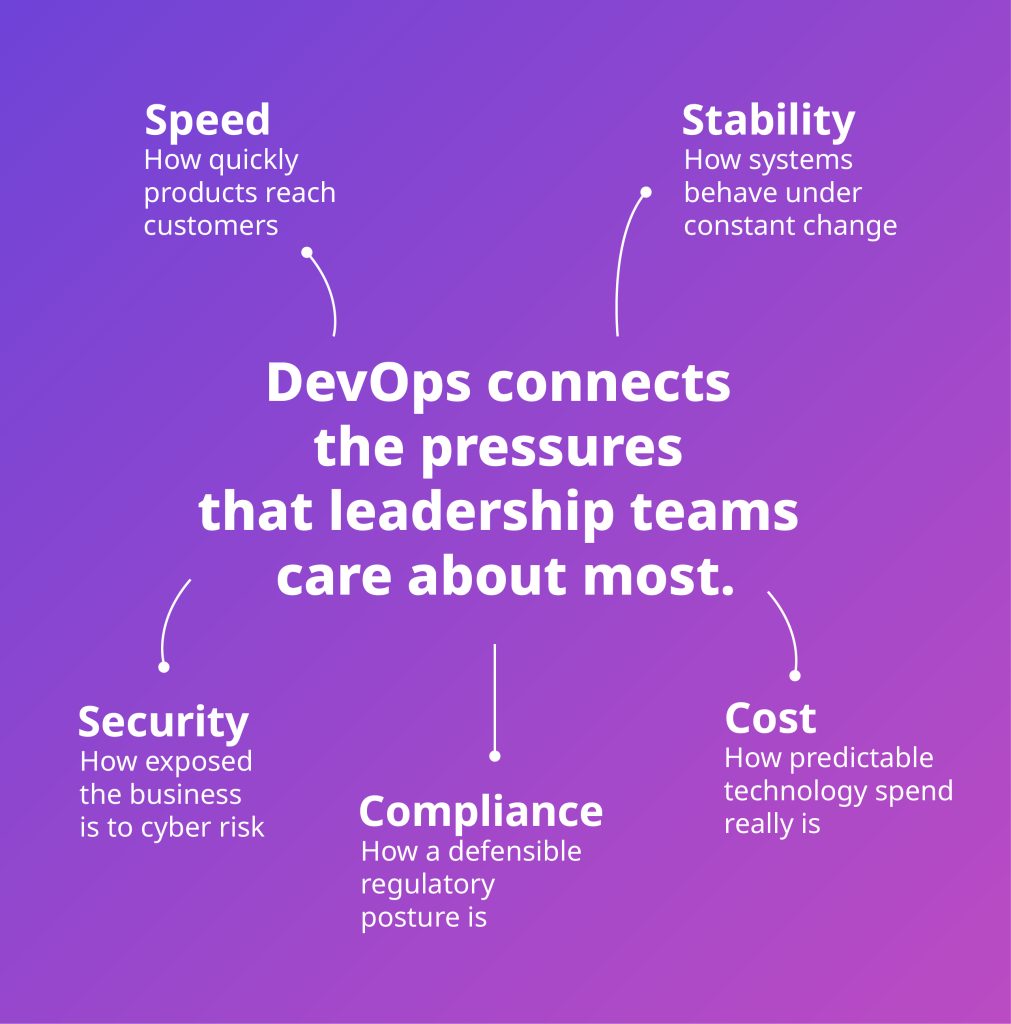
DevOps as a managed service has moved from improving engineering efficiency to strengthening business resilience.
FCA and Operational Resilience: Turning Compliance into a Competitive Edge
For UK Financial Services and regulated SMEs, moving to the cloud is now a matter of legal survival under the FCA’s Operational Resilience framework. It is no longer enough to move workloads; you must prove your architecture remains within impact tolerances during a crisis.
By mapping your migration framework to critical business services from day one, you transform compliance from a manual audit burden into an automated, defensible asset.
Your migration framework must ensure your platform is mapped to critical business services from day one, providing the automated evidence required for your 2026 self-assessment submissions.
Eliminating Shadow Ops: Governance as a Service
In 2026, cloud infrastructure management means handling identity, networks, security, costs, and observability as one system.
The global cloud management platform market is expected to grow from about $13.96 billion in 2026 to $28.47 billion by 2032, expanding at roughly a 12.4 % CAGR over that period. (source: Research and Markets)
Managed cloud services have evolved to provide the structure (monitoring, cost control, and security baselines) that internal teams often lack the bandwidth to maintain.
The shift from managing machines to managing behaviour ensures that new service launches don’t create hidden security liabilities or unbudgeted cost spikes.
Governance at Speed: Making Deployment an Audit-Ready Non-Event
Software deployment is now a governance problem.
As systems become more distributed and regulated, the risk is no longer slow releases but uncontrolled change.
Manual deployment will survive in small systems, but it will fail in environments that must prove reliability, security, and compliance.
Automation is becoming the control layer for change. Instead of engineers deciding when releases occur, policies define how software moves from code to production. Tests, builds, environments, deployments, and rollbacks become enforced workflows, not best practices.
For customer-facing and regulated systems, this shifts deployment from fast to defensible. Every release can be traced, repeated, and reversed. That makes software behaviour explainable under audit and predictable under pressure.
DevOps automation is evolving into a control mechanism for managing operational risk.
In the future, the most valuable pipelines will be the ones that make change safe by design.
⭐ Even when dashboards look healthy, delivery risk can still be buried inside CI/CD workflows, where automation hides fragile handoffs and manual dependencies. This pattern is explored in detail in the analysis of hidden delivery risk within CI/CD pipelines.
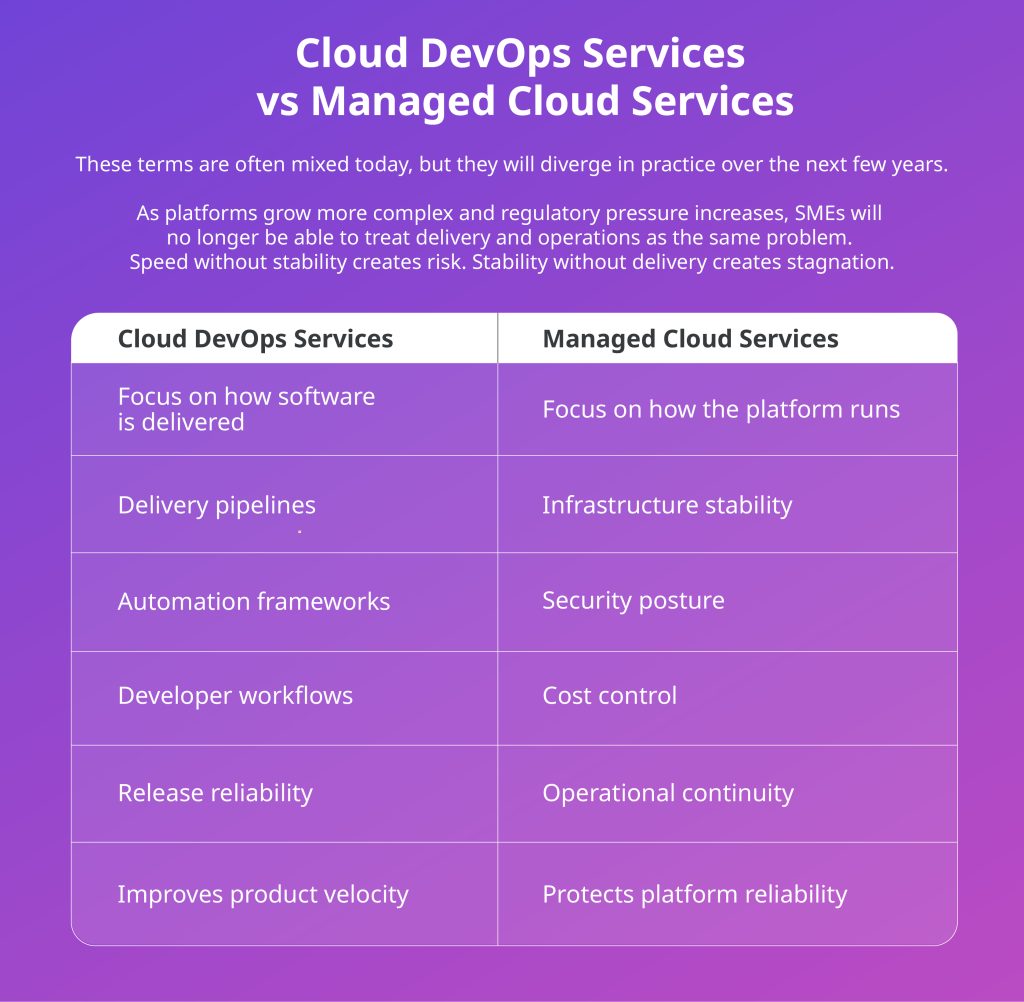
Modern UK SMEs are increasingly combining both. The emerging model is:
- Cloud DevOps services optimise product velocity
- Managed cloud services protect operational stability
This separation will matter more in the future than it does today because leadership teams will need to manage delivery risk and operational risk independently. It also reduces dependence on individual engineers, a growing exposure as systems and compliance requirements expand.
Key Trends Shaping DevOps and Cloud Services in 2026
The End of Hero Culture: Shifting from People to Platforms
The next constraint in DevOps is not tooling. It is people. Google’s DORA research shows that high-performing teams rely on automated systems rather than individual expertise to maintain reliability and speed.
Systems that rely on specific engineers are fragile by design. When critical knowledge lives in individuals instead of in systems, it becomes an operational risk.
Software delivery is becoming standardised through platforms rather than personal setups. Teams use shared deployment paths with built-in guardrails and central services instead of one-off scripts.
Standardising delivery through shared platforms with built-in guardrails ensures your delivery pipeline survives audits, growth, and the inevitable key-person resignation.
The result is fewer single points of failure, less uncontrolled automation, and fewer changes that cannot be explained.
Practical actions for 2026:
- Replace custom pipelines with one governed delivery model
- Encode operational knowledge into platform rules and workflows
- Build approval, rollback, and audit trails into automation
- Invest in systems that remain stable through staff turnover and audits
Sustainable DevOps (GreenOps) Is Becoming a Delivery Concern
As cloud usage grows, environmental impact follows technical design. Inefficient architectures consume more compute, more storage, and more energy. What looks like a performance choice is also a sustainability choice.
In 2026, sustainability is part of how delivery is judged. Systems are evaluated on their efficiency in using resources. Overprovisioned environments and always-on workloads will be treated as operational waste.
Gartner predicts that by 2027, 25% of CIO compensation will be tied to sustainability impact, including IT and cloud efficiency.
Treating efficiency as a core delivery metric allows you to right-size infrastructure continuously, shrinking both your carbon footprint and your monthly cloud bill.
Practical actions for 2026:
- Measure resource usage by service and environment
- Automate scaling and shutdown of idle workloads
- Design for right-sizing instead of peak-only capacity
- Treat efficiency as a delivery metric
DevSecOps Will Not Be Optional in the Following Years
As delivery becomes more automated, security can’t sit outside the pipeline. Dependencies, configurations, and release steps are part of the attack surface. If security is added later, the risk is already live.
In 2026, the NCSC’s Software Security Code of Practice makes “Secure by Design” a baseline commercial requirement. Manual security gates are replaced with automated policy-as-code aligned with the Cyber Security and Resilience Bill. This means every deployment becomes defensible by default, with encryption standards and dependency integrity verified automatically before code reaches production.
Security integration is already a performance differentiator. DORA research shows that high-performing teams are 2.6× more likely to integrate security into their delivery process rather than treating it as a separate function.
In the next several years, checks, policies, and access controls will run automatically inside pipelines. Systems that can prove how changes were built and approved become defensible. Systems that cannot become liabilities.
Practical actions for 2026:
- Run security checks inside delivery pipelines
- Enforce access and policy rules as code
- Expose security outcomes to delivery teams
- Keep audit trails for every production change
Eliminating Human Error: Why GitOps is the New Standard for UK IT Heads
Manual changes become risky as systems grow. When code and reality diverge, control is lost. GitOps fixes this by making Git the single source of truth for apps and infrastructure.
According to the Cloud Native Computing Foundation survey, more than three-quarters (77%) of organisations have adopted GitOps to some degree as part of their cloud-native practices.
Adopting GitOps turns your infrastructure into a transparent control plane where every change is versioned, reviewed, and easily reversible, eliminating the risk of configuration drift.
The shift is from managing environments directly to managing intent through code.
Practical actions for 2026:
- Use Git as the source of truth for infrastructure and configuration
- Apply changes through pull requests, not console access
- Reconcile the declared and actual state automatically
- Use version history for rollback and audit
FinOps: Moving Cloud Costs from the CFO to the Engineer
Cloud costs are driven by technical decisions. Architecture, scaling, and release patterns shape the bill. When teams can’t see how changes affect spend, budgets drift, and delivery loses control.
About 60% of organisations report having implemented FinOps practices to manage cloud costs, and adoption has roughly doubled over the past two years. (source: IDC)
Implementing FinOps ensures that engineering teams see the real-time cost impact of their architectural choices, typically recovering 20-30% of wasted cloud budget in the first quarter.
Practical actions for 2026:
- Track spend by service and environment
- Review cost per sprint, not just per month
- Give delivery teams ownership of usage and cost
- Show cost impact in engineering dashboards
- Assess architecture changes for budget impact
AIOps Will Reshape How Operations Are Run
As systems grow more complex, human monitoring does not scale. Logs, metrics, and alerts multiply faster than teams can interpret them. The problem is no longer a lack of data but too much of it.
While exact adoption statistics vary, multiple reports show that AIOps tools are increasingly discussed and deployed in modern IT operations.
Shifting from manual firefighting to AIOps-guided response allows your senior talent to focus on innovation instead of being buried under a mountain of false-positive alerts.
Practical actions for 2026:
- Centralise logs, metrics, and traces
- Use anomaly detection to cut alert noise
- Link incidents to recent changes
- Record root causes to improve detection
- Keep human approval for automated fixes
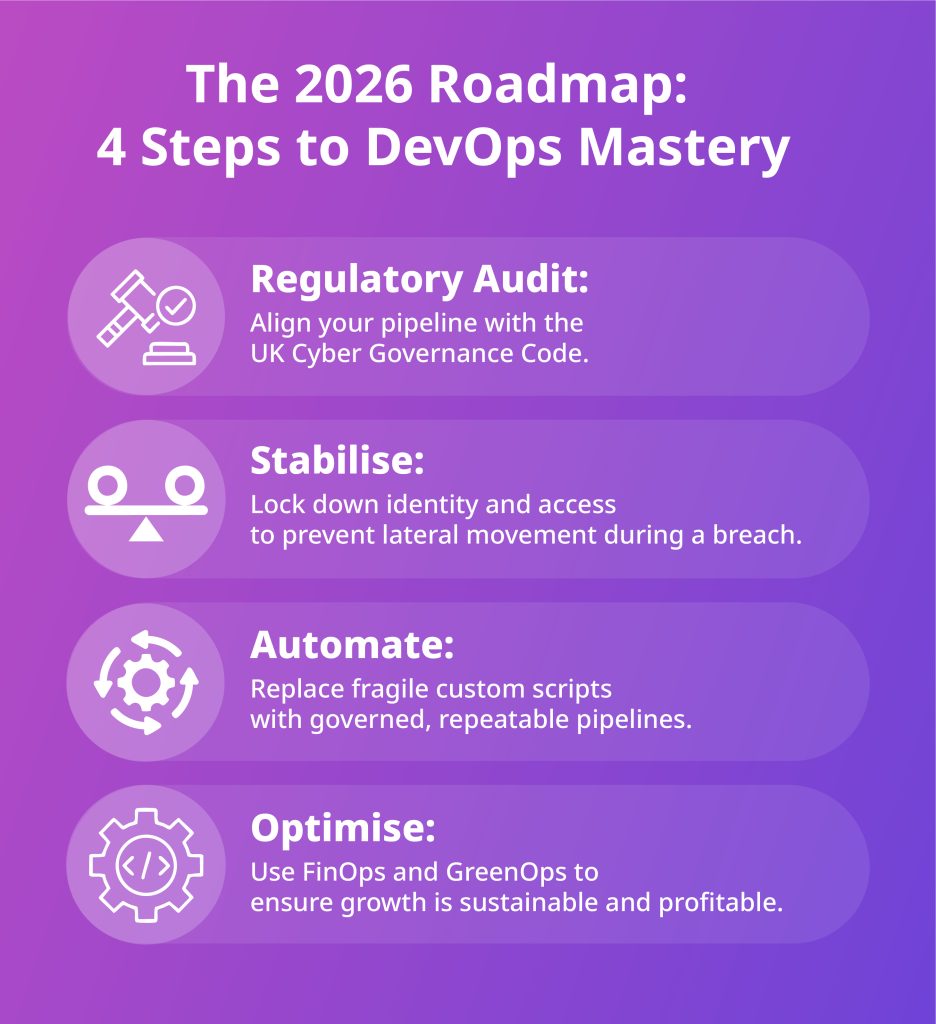
DevOps in 2026: From Tools to Operating Model
The next phase of DevOps is about changing how delivery, risk, cost, and ownership are organised.
Key takeaways for UK SMEs:
✔️ Shift from team-specific setups to shared delivery systems
✔️ Treat cloud, security, and cost as design inputs, not side effects
✔️ Replace reactive fixes with built-in controls
✔️ Measure success by stability and predictability, and not just speed
✔️ Build platforms that survive audits, growth, and staff turnover
The real change ahead is that DevOps is no longer something engineers do. It is something the business runs on.
Sprint-Based Delivery and Full-Stack Squads in Practice
Sprint-based delivery and full-stack squads change how quickly teams learn, how much waste they create, and how much risk they carry.
When the same team owns build, infrastructure, and delivery, progress becomes visible every sprint and problems surface early, before they turn into delays or cost overruns.
Two real projects show what this looks like in practice.
Zilch (UK Fintech)
Zilch needed to deliver complex API integrations under extreme time pressure. Deployflow’s dedicated full-stack squad handled infrastructure, delivery pipelines, and application work together, working in tight delivery cycles instead of long handoffs.
Results:
- Complex API integrations delivered in 1 month
- 2× faster environment setup through automation
- New environments are instantly replicable
- Faster adaptation to supplier and security changes
Positive Impact Concept (SaaS MVP)
Positive Impact Concept (PI Concept) needed to turn an Excel-based model into a live platform without rework. One team owned UX, backend, cloud, and logic end-to-end, delivering in short sprints instead of staged phases.
Results:
- MVP designed, built, and launched in 10 weeks
- 75% reduction in manual data processing
- Full product, UX, and cloud stack delivered together
This is how modern DevOps services will be run.
Deployflow delivers it through AI-supported systems and full-stack delivery squads that work remotely or on-site, embedded into your business. Instead of ad hoc pipelines and isolated specialists, you get a sprint-based delivery model where engineering, automation, and operations are owned by one accountable team.
- AI is used to reduce operational noise and speed up decisions.
- Full-stack squads remove handoffs between build and run.
- Sprint-based delivery makes progress, cost, and risk visible every cycle.
Move from hoping DevOps keeps working to running a delivery system built to survive growth, audits, and change.
Book a short DevOps assessment to see where your delivery pipeline creates risk and cost today, and what needs to change to make it stable, compliant, and scalable for the next stage of growth.
Frequently Asked Questions About DevOps for UK SMEs
How much does DevOps cost for a small or medium-sized business in the UK?
DevOps costs vary widely depending on scale, cloud usage, and how much work is automated versus manual.
For UK SMEs, the real cost is usually not tools but people, rework, and outages caused by fragile delivery. A small setup may start with a few thousand pounds per month, while managed models replace unpredictable internal costs with a stable service fee. The important shift is from project spend to operating cost. Over time, DevOps should reduce wasted cloud spend, failed releases, and recovery effort. That is where the return is created.
Do UK SMEs really need DevOps, or is it only for large enterprises?
UK SMEs need DevOps for speed, stability and control.
Smaller teams feel failures more sharply because they have fewer people to absorb incidents and rework. DevOps reduces dependence on individuals by turning delivery into a system. It also helps SMEs meet security and compliance expectations without building large internal teams. The size of the company matters less than the complexity of its software and data. If your system runs revenue, DevOps is no longer optional.
What skills are hardest to hire for DevOps in the UK market?
The hardest roles to hire for are experienced DevOps engineers who understand cloud, security, and automation.
Most candidates specialise in one area but lack the full delivery picture. This creates gaps between development, operations, and compliance. That is why many UK SMEs move toward managed or embedded squad models instead of hiring individuals. The problem is not just skill shortage but continuity. Delivery systems must survive turnover.
How long does it take to see results from DevOps changes?
You can usually see early results within the first few sprints if changes are focused on automation and standardisation.
Deployment speed and failure rates improve first, followed by stability and cost control. Cultural changes take longer because teams must adapt to new ownership and workflows. Full impact is typically visible within three to six months for most SMEs. The key factor is whether DevOps is treated as a system change or just a tooling upgrade. System change produces lasting results.
How do we justify DevOps ROI when cloud budgets are already under pressure?
In 2026, ROI is measured by the reduction in TCO (Total Cost of Ownership). Manual processes carry hidden costs: engineer burnout, technical debt, and cloud drift. By implementing FinOps and automated right-sizing, UK SMEs typically see a 20-30% reduction in cloud wastage within the first quarter. You aren’t increasing spend; you are reallocating waste budget into growth architecture.
How does DevOps reduce key person risk in a tight UK talent market?
When critical infrastructure knowledge sits with one senior engineer, your business is one resignation away from an operational freeze.
DevOps moves that knowledge out of people’s heads and into code. By standardising environments and automating delivery, infrastructure becomes engineer-agnostic. The system continues to run even when staff change.
Explore our BLOG
Recent articles

How can a DevOps team leverage the power of AI?
Your CI/CD pipeline is automated, but it still can’t see trouble coming. Alerts land after...
read full article

Why Regulated Industries in the UK Are Getting AI Wrong
Your pilot works. It has worked for months. It still cannot go live, and every...
read full article

What Is AI Foundry, and Why Should CTOs Care?
Somewhere in your Azure tenant, an AI workload is running that nobody formally approved. It...
read full article