



Your CI/CD pipeline is automated, but it still can’t see trouble coming. Alerts land after users notice, flaky tests block releases, and on-call engineers triage by hand at 3am.
Closing that gap is how a DevOps team can leverage AI. This guide shows where AI pays off in the pipeline, the four hurdles that stall adoption, and a five-step plan to start without rebuilding your stack.
How Can a DevOps Team Take Advantage of AI?
A DevOps team can leverage AI to handle the work humans can’t do at scale: reading every signal, reviewing every change, and spotting the release that will break before it ships. That work is in four places: incident detection, code review and testing, CI/CD optimisation, and infrastructure provisioning.
- Incidents caught before the page: anomaly detection across logs, metrics, and traces spots slow degradation, like creeping latency or memory growth, before a static threshold alert fires.
- Code review that never gets tired: models check every pull request for bugs, insecure patterns, and missing tests, so senior engineers review design instead of syntax.
- Pipelines that know which tests matter: AI runs the tests most likely to fail first, quarantines flaky ones, and scores canary releases to trigger rollback without waiting for a human call.
- Infrastructure drafted, not typed: assistants write and review Terraform and CloudFormation modules against your own standards, so new environments stop queuing behind one IaC expert.
Start where your engineers lose the most hours each week. Prove the gain there, then expand.
Why AI for DevOps Over Traditional Approaches?
Traditional DevOps automation runs on rules written in advance: a threshold alert, a fixed test suite, a deployment gate. It works until the system changes faster than the rules do. Then alerts fire late, test runs grow, and engineers fill the gap by hand.
AI-powered DevOps replaces fixed rules with models that learn what normal looks like for your system and flag what deviates.
Adopting AI does not guarantee a return. DORA’s ROI of AI-Assisted Software Development report (2026) describes a J-curve: most organisations hit a temporary productivity dip before the gains arrive. The dip comes from three sources:
- the learning curve,
- the time spent verifying AI output,
- testing and change approval processes built for lower code volumes.
More code moving faster can also overwhelm existing pipelines and review gates, so the report recommends automated testing, continuous integration, and small batches. That is why the order of work below matters.
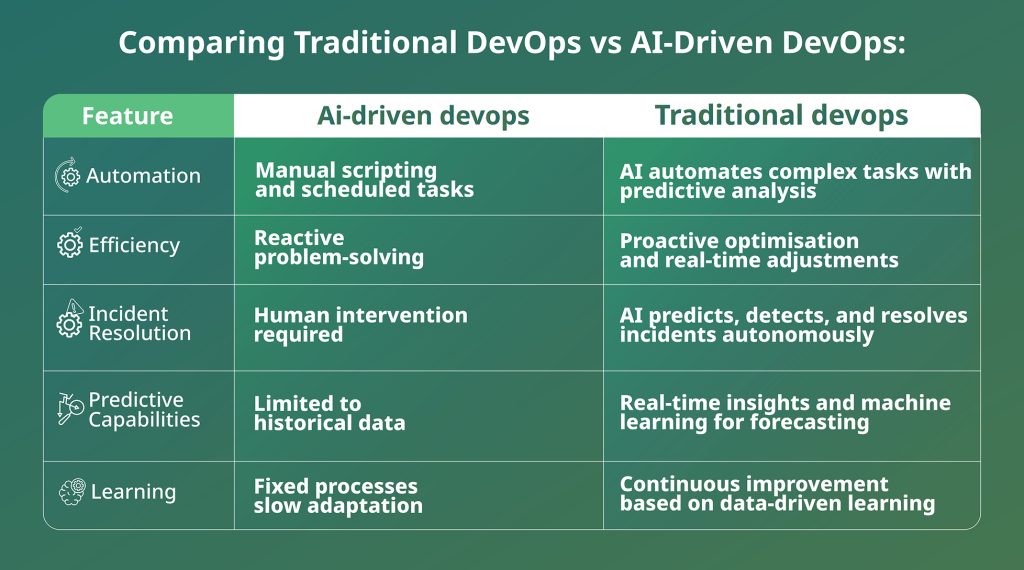
“AI doesn’t just replace manual tasks in DevOps workflows; it revolutionises the entire approach by enabling smarter decision-making in real time. Traditional DevOps methods are reactive, but with AI, we can anticipate issues before they even arise, allowing us to be proactive instead of scrambling to fix problems.”
Prakash Pilley, CEO of Deployflow
Key Challenges in AI Adoption for DevOps
Of course, the transition from traditional DevOps to AI-powered DevOps isn’t without its challenges. Here are a few common hurdles and how to overcome them:
1. Data Quality Issues
AI needs data, and it needs good data. If your data is incomplete, inconsistent, or unstructured, it’ll affect the accuracy of AI models.
Solution:
- Invest time in cleaning and structuring data before feeding it into AI models.
- Implement strong data governance practices to ensure consistency.
2. Integration Complexity
Integrating AI with existing DevOps tools and pipelines can be tricky, especially if legacy systems are involved.
Solution:
- Take a phased approach: start by incorporating AI into smaller, less complex areas before scaling.
- Choose tools that plug into the stack you already run. AWS DevOps Agent, for example, connects with Amazon CloudWatch, Datadog, Dynatrace, New Relic, Splunk, GitHub, GitLab, ServiceNow, Slack, and PagerDuty.
3. Security Risks
AI-driven automation can introduce new security vulnerabilities if not properly managed, such as exposing sensitive data or providing an attack surface for malicious actors.
Solution:
- Regularly audit AI models and their outputs.
- Establish clear security protocols for AI tools and maintain robust monitoring systems.
- Give AI agents least-privilege, read-only access by default, and require human approval before they change production.
4. High Learning Curve & Resource Constraints
AI technologies often require specialised knowledge, which can create a steep learning curve for DevOps teams not already familiar with AI.
Solution:
- Focus on training and upskilling your team, or partner with AI experts to ensure a smooth integration.
- Leverage AI platforms with user-friendly interfaces that allow DevOps teams to start small and scale as they become more comfortable.
“Data quality is one of the biggest roadblocks when adopting AI in DevOps. Without high-quality data, even the most advanced AI tools will underperform. That’s why we emphasise the importance of investing in solid data infrastructure before diving into AI-powered DevOps.”
Ajdin Garibovic, DevOps Engineer at Deployflow
AI-Driven DevOps Workflow: 5-Step Process
Five steps take most teams from first pilot to production use without rebuilding the pipeline.
Step 1: Assess AI-readiness and Data Infrastructure
- Evaluate your current data quality and infrastructure.
- Ensure you have a reliable pipeline for collecting, processing, and storing data.
- Record baseline DORA metrics (deployment frequency, lead time for changes, change failure rate, and time to restore service) so you can prove the gain later.
Step 2: Identify AI Use Cases in CI/CD, Security, and Monitoring
- CI/CD: Automate code reviews, testing, and deployment pipelines.
- Security: Use AI to detect vulnerabilities, monitor security events, and mitigate risks.
- Monitoring: Predict performance bottlenecks and optimise resource allocation.
Step 3: Select AI Tools and Integrate with DevOps Pipelines
- Pick tools that extend your current stack rather than replace it: GitHub Copilot for pull request review, Datadog or Dynatrace for anomaly detection, and AWS DevOps Agent for incident investigation.
Step 4: Implement AI for Automation, Testing, and Incident Resolution
- Let AI recommend first. Allow automatic remediation only for low-risk, reversible actions, such as rolling back a failed canary or restarting a pod.
- Automate testing to reduce human error and speed up development cycles.
Step 5: Optimise AI-Driven DevOps Processes Through Continuous Learning & Monitoring
- Track how often AI alerts and suggestions are right, retune them as your system changes, and drop tools that add noise.
- Make iterative improvements to the AI-driven workflow, ensuring it evolves as your DevOps processes change.
“Our 5-step approach isn’t just theoretical; it’s how we’ve seen DevOps teams thrive. The key to AI success in DevOps is not just choosing the right tools but integrating them into your existing workflow in a thoughtful, incremental way. This ensures smoother adoption and better outcomes.”
Prakash Pilley, CEO of Deployflow.
Future Trends: How AI is Shaping the Next Generation of DevOps
AI is not just a game-changer for today. It’s paving the way for the future of DevOps. Here’s how it’s going to shape the next generation:
- Agentic Incident Response: AI agents now investigate incidents instead of just flagging them. AWS DevOps Agent became generally available on 31 March 2026 and can investigate applications across AWS, Azure, and on-premises environments by correlating telemetry, code, and deployment data. On-call engineers will increasingly review an agent’s findings rather than start from a blank dashboard. See our agentic AI development services.
- AI-powered observability: Observability platforms are moving from dashboards to answers: they correlate signals, name a probable root cause, and propose a fix for an engineer to approve. Incidents get shorter, and humans still own the change.
- AI in GitOps & AIOps: In GitOps, Git is the source of truth for infrastructure, which gives AI a safe way to act: it detects drift or an anomaly, then opens a pull request with the fix. Every change stays reviewable, versioned, and easy to revert.
- Explainability & AI Governance in DevOps: As agents gain write access to pipelines and infrastructure, teams need to know why a model acted. Audit trails, approval gates, and named owners for every AI-driven change will become standard.
Building Transformative AI-Powered Solutions With Deployflow
Deployflow, a leading cloud consultancy, has teamed up with GenFutures Lab to create transformative AI-powered solutions for businesses. This partnership combines GenFutures’ generative AI and strategy expertise with Deployflow’s prowess in implementing large-scale data-driven solutions.
Together, we will provide co-advisory services that help companies navigate their digital transformation, overcome disruptions, and stay ahead in the competitive digital landscape. This collaboration aims to deliver innovative generative AI solutions that drive business growth, enhance security, and improve efficiency across industries.
Through this partnership, Deployflow and GenFutures Lab will leverage their combined knowledge to help businesses unlock new AI opportunities and accelerate their journey toward innovation.
Deployflow’s cloud migration and DevOps expertise, paired with GenFutures’ strategic approach to AI, will allow companies to build future-ready, scalable solutions that improve decision-making and open new revenue streams. As both companies work together, they are setting a new standard for how businesses can harness AI to create impactful, market-leading solutions in today’s evolving digital world.
Learn more about it here.
Deployflow Vision for the Future
“As AI continues to shape the future of DevOps, we’re particularly excited about AI’s role in observability and proactive issue resolution. In the next few years, DevOps teams won’t just react to problems. They’ll use AI to predict and prevent them from ever occurring. It’s a game-changer for reliability and uptime.”
Thomas Radosh, Co-Founder and CTO at Deployflow
How Can Deployflow Help You Unlock the Power of AI?
AI-driven DevOps is more than just a buzzword—it’s a tangible evolution in how software is developed, tested, and deployed. With AI, teams can unlock a new level of efficiency and agility, staying ahead of the curve in an ever-evolving tech landscape. So, is your DevOps team ready to make the leap into AI-powered workflows?
At Deployflow, we specialise in automating and streamlining software development and IT operations using cutting-edge tools like CI/CD pipelines, Infrastructure as Code (IaC), and automated testing. By embracing DevOps managed services, we’ll help you increase efficiency, boost collaboration, and scale your business effortlessly.
Focus on what matters most—your core activities—while we ensure faster delivery and continuous innovation. Contact Deployflow today to unlock the full potential of your DevOps workflows!
AI for DevOps Teams: Frequently Asked Questions
How can DevOps take advantage of AI?
DevOps takes advantage of AI by applying machine learning to pipeline and production data to predict incidents, review code, optimise CI/CD runs, and generate infrastructure as code.
How can a DevOps team leverage artificial intelligence (AI)?
A DevOps team leverages AI by first checking data quality, selecting a use case in CI/CD, security, or monitoring, integrating AI tools into existing pipelines, and monitoring model performance over time.
How does AI enhance DevOps security and compliance?
AI enhances DevOps security by detecting vulnerabilities, automating security testing, and ensuring policy compliance through continuous monitoring and real-time threat detection.
What AI tools are best for DevOps automation?
Tools such as AWS AI DevOps, Google Cloud AI, IBM Watson AIOps, and Dynatrace are excellent for automating DevOps processes, offering features like predictive analytics and smart automation.
How can AI reduce operational costs for DevOps teams?
AI reduces operational costs by automating scaling, performing predictive maintenance, and optimising workloads to ensure resources are utilised efficiently and downtime minimised.
What’s the future of AI in DevOps?
The future of AI in DevOps includes the rise of AI-driven self-healing systems, advanced predictive analytics for proactive issue resolution, and AI-powered observability tools that autonomously monitor and fix issues.
Explore our BLOG
Recent articles
ISO 42001 Explained: Requirements, Certification and What Your Engineering Team Must Build
ISO 42001 is the international standard that demonstrates your organisation governs AI properly, and enterprise...
read full article

Is Claude Down? Anthropic Outage: Protect Your Cloud Infrastructure
Claude went down across every surface on 29 September 2026. From 14:00 to 14:59 UTC,...
read full article
Top 10 Healthtech Companies in 2026: What Their Growth Means for AI and DevOps
Every software change that reaches a hospital has to clear regulatory, legacy system, and clinical...
read full article