



Somewhere in your Azure tenant, an AI workload is running that nobody formally approved. It touches data. It costs money. Nobody can produce an audit trail for either.
Executive Summary
- Microsoft Foundry puts models, agents, retrieval and policy inside one Azure resource you already govern.
- Azure AI Foundry is the same product under an old name. The rename happened in January 2026.
- Every hosted agent now gets its own identity. Somebody in your organisation has to own that.
- Pricing is layered, not licensed. Token spend is rarely the biggest line item by production.
- The platform solves governance. It does not solve capability, and that is where most programmes fail.
What Foundry asks in return is not budget, which is why this decision lands on your desk and not your architect’s.
What Is Microsoft Foundry? The Short Version
Microsoft Foundry is a single Azure resource for building, deploying and governing AI applications and agents. It holds the model catalogue, the agent runtime, the tool catalogue, grounding against your own data, and the evaluation layer around all of it.
Calling a model is not the point. Any API does that. The point is that inference, agent execution, retrieval and policy sit behind one boundary, so identity, networking and audit apply the same way to every workload. That is the difference between a pilot on someone’s laptop and a system your security team will sign.
Azure AI Foundry vs Microsoft Foundry: What Changed in January 2026
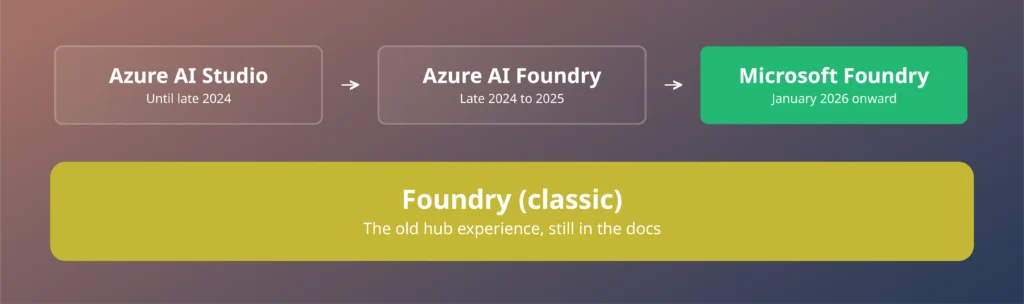
Nothing functional. The January 2026 Product Terms update was a rename, folding Azure AI Foundry, Azure AI Studio and Azure AI Services into one resource and one portal. The old hub-based experience is now Foundry (classic).
One thing to flag before you brief anyone: NVIDIA sells an unrelated service under the same “AI Foundry” label. In an Azure conversation, assume Microsoft.
What Is Included in Microsoft Foundry? 4 Core Components
Four components, each solving a problem your team has probably already hit.
- Models. The catalogue runs past 11,000 entries, covering OpenAI, Meta’s Llama, Mistral, DeepSeek, xAI’s Grok and image models including FLUX from Black Forest Labs. Azure OpenAI has not gone anywhere. It now sits inside Foundry as one supplier among many, which is the point: you can swap models without rewriting the surrounding plumbing.
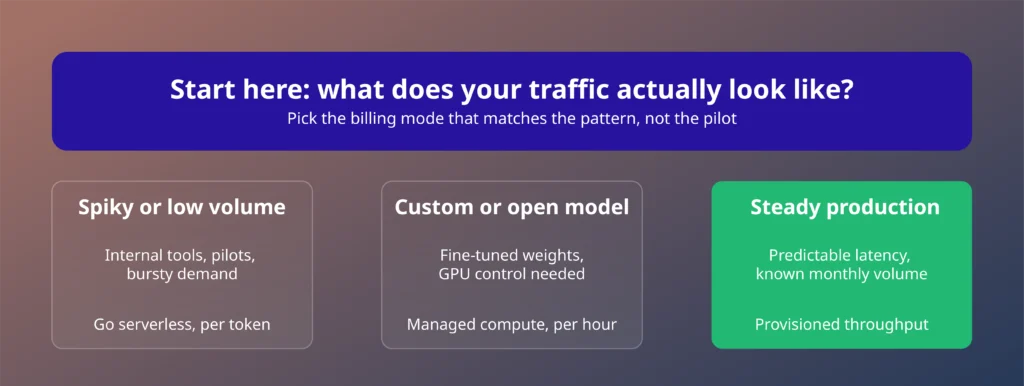
- Deployment. Two modes. Serverless bills per token. Managed compute bills per hour on dedicated GPUs across the A100, H100, H200 and MI300 families, scaling automatically with no hardware to run.
- Agents. Foundry Agent Service runs agents in customer-dedicated containers with scaling, observability, security and governance built in. The hosted runtime was rebuilt in April 2026 with per-session hypervisor isolation and a dedicated Microsoft Entra identity for every agent.
- Grounding. Foundry IQ connects agents to sources such as OneLake and SharePoint through knowledge bases reachable over the Model Context Protocol. The tool catalogue holds more than 1,400 MCP-enabled tools.
Every agent is three things combined: a deployed model, versioned instructions, and the tools it is permitted to call. That structure is what makes an agent auditable. Most in-house frameworks skip it, which is why they fail their first security review.
Microsoft Foundry for CTOs: Five Decisions You Cannot Defer
Foundry does not settle these questions. It forces them, usually in the first month.
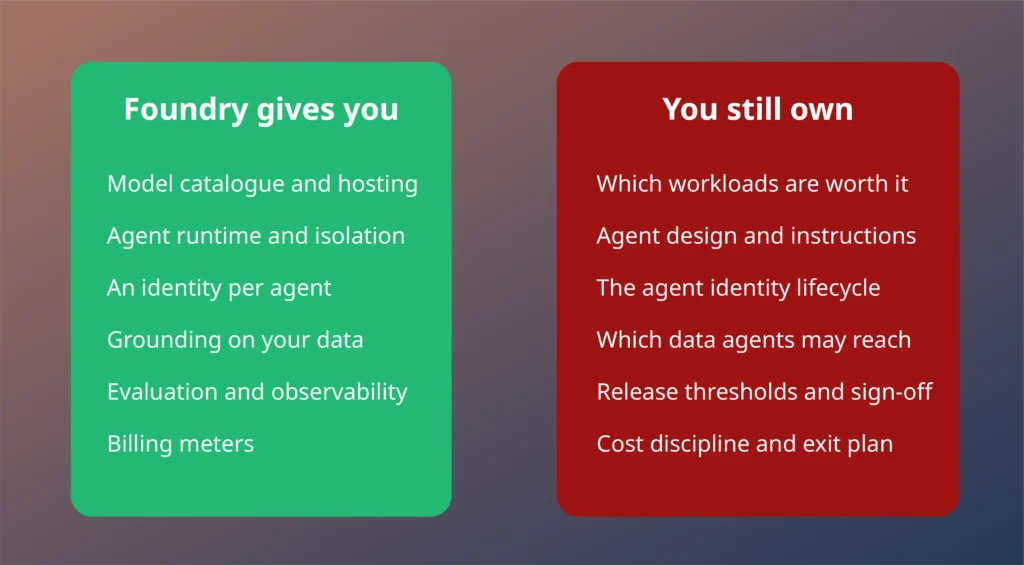
Do you build the orchestration layer or rent it? Foundry is infrastructure. It’s not a finished product. It serves models and runs agents. It will not design your customer-facing experience or maintain it, so that layer stays on your roadmap either way.
Who owns an agent’s identity? Every hosted agent gets its own Entra identity. Provisioning, permissions, rotation and deprovisioning now apply to a population of non-human actors. In most organisations, no team has that in its remit, and the gap surfaces during the first access review.
Who controls AI spend? Foundry turns AI from a licence line into a metered architecture. Engineering decisions drive the invoice now, not procurement decisions, which means your cost owner and your cost driver are different people.
How much of your estate goes to one vendor? Consolidation buys a coherent identity and policy. It also raises your exit cost. Make that trade deliberately, not eighteen months in when the migration estimate arrives.
Who signs off on an agent release? Foundry supplies evaluation and observability tooling. It does not decide who reads the output, what score blocks a release, or who is accountable when an agent regresses in production.
If you are still sizing which agent workloads justify the effort, Deployflow’s guide to agent ROI covers the business case.
Do You Need Foundry If You Already Run Azure OpenAI?
Often not. Azure OpenAI already sits inside Foundry, so the question is not whether you have access. It is whether you need the platform layer on top of it.
If you are calling a chat endpoint and nothing more, direct API calls stay simpler. Foundry’s orchestration tooling carries a real learning curve, and teams running a single endpoint tend to find it over-engineered.
Three things change that. Orchestration across several models or tools. Versioned deployments with evaluation gates before release. Grounding against internal data with an audit trail.
Hit any one of those, and building the equivalent yourself costs more than adopting the platform.
Microsoft Foundry vs AWS Bedrock vs Google Vertex AI
Compare these three on where your estate already sits, not on catalogue size. Model counts change monthly and rarely decide anything.
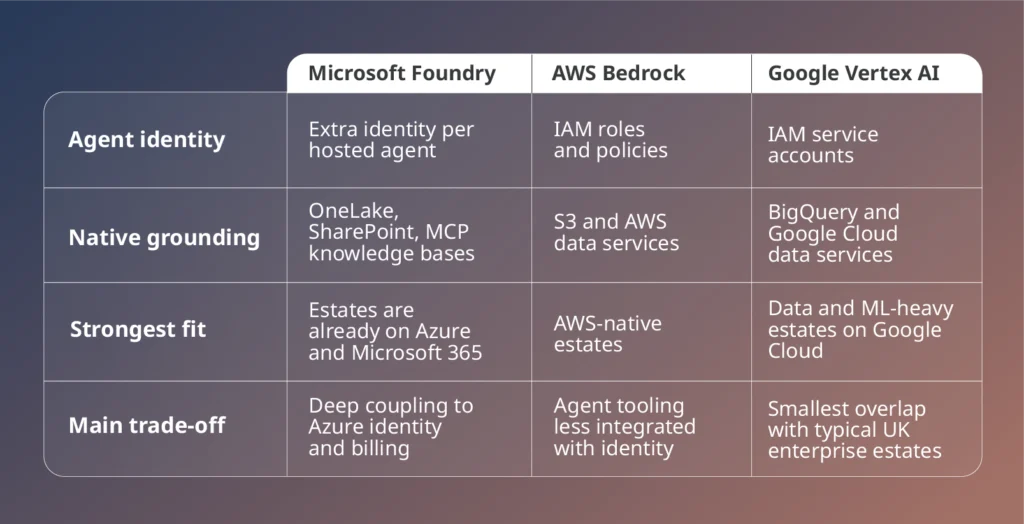
For an organisation already committed to Azure, the grounding and identity rows usually settle it before anyone opens a model comparison.
How Much Does Microsoft Foundry Cost? Pricing Explained for 2026
More than your token estimate. Foundry is not a flat licence. It orchestrates Azure services, so the bill is shaped by model usage, compute, agent orchestration, data access, retrieval and governance.
The FinOps Foundation’s State of FinOps 2026 found that AI cost management is now the most sought-after skill across FinOps teams of every size, driven by how fast AI spend grows and how badly it resists allocation.
The published figures give you the shape. Provisioned throughput starts at 15 units for most models, roughly $1 per unit-hour on Global and $1.10 on Data Zone. A 15-unit block runs about $260 a month, or $2,652 on an annual reservation, saving about 15%.
Cached input tokens are typically half price. Data Zone adds around 10%. File search vector storage costs $0.11 per gigabyte per day, with the first gigabyte free. Hosted agents bill at $0.0994 per vCPU-hour with genuine scale-to-zero.
Two things will catch you out. Model deployment pricing changed on 1 September 2026, so any earlier business case needs to be rerun. And billing details never appear in the Foundry portal. They live in Cost Management and Billing, which is where your FinOps function should be looking. If spend is already drifting, the analysis of cloud waste in DevOps covers where the leak starts.
Microsoft Foundry Security and Compliance: Four Checks for Regulated Firms
The April 2026 hosted agent rebuild gave auditors the two things they ask for first: per-session isolation and a distinct identity per agent. Four gaps remain before regulated workloads go near it.
- First-party and third-party models carry different terms. Partner and community models are classified as Non-Microsoft Products under Microsoft’s Product Terms. Microsoft still hosts the infrastructure, acts as a data processor, and states that prompts and outputs are not used to train models. Under UK GDPR, you remain the controller, and the ICO is explicit that controllers carry the highest level of compliance responsibility, including for the compliance of their processors. That makes the processor chain for each model you deploy something to document individually. A model-by-model register, not a platform-level assumption.
- Know which boundary your inference crosses. Foundry offers Global, Data Zone and Regional deployments, and they are not interchangeable for compliance purposes. Data Zone constrains processing to a defined geography and costs roughly 10% more. Global is cheaper because it is not constrained. If your DPIA assumes a processing location, the deployment type is the setting that enforces it, and it is set per model deployment rather than per resource.
- Content safety filters block legitimate work. The default filter flags professional content in security, medical and legal contexts. Microsoft offers a modified configuration on documented justification, and approval takes two to four weeks. Raise it in week one, or it becomes a delivery blocker in week six.
- API versions change often, and behaviour changes with them. New versions can alter response formats. Pin your version in production, test upgrades in staging, and treat the pin as a change-controlled artefact. Unpinned versions are the most common cause of agent regressions nobody can explain.
Retrofitting a processor register, a filter exception and version control onto a live agent estate costs more than building them in. That is why Deployflow’s agentic AI development work starts with the control layer and not the agent.
What Governed AI Infrastructure Looks Like on Azure
A national-scale energy client asked us to build an AI platform inside critical national infrastructure. The constraints were absolute:
- Azure subscriptions air-locked, reachable only from the customer network
- Petabyte-scale subsurface data, processed on H100 GPU clusters
- A rigid multi-account model that could not slow developer velocity
- Strict internal security controls on every environment
The build ran on Azure AI and Azure ML workspaces, with Kubernetes and ArgoCD for GitOps delivery, managed through Terraform. A modular infrastructure-as-code framework replaced manual provisioning entirely.
What that produced:
- Zero manual steps. Every environment inherits its security, networking and governance policies automatically.
- Every change is tracked through GitOps, which is what satisfied the regulatory requirement.
- New AI workloads land on the platform without re-engineering the core.
The platform predates Foundry, but the principle transfers directly. Governance was designed into the provisioning path rather than added at review time, which is why the estate scaled without a second security programme.
Read the full case study or see how Deployflow approaches agentic AI development.
Common Microsoft Foundry Problems and How to Avoid Them
The problems are rarely technical. They come from assuming a team already fluent in Azure will be fluent in Foundry.
Practitioner reviews of the platform are consistently positive. Well integrated, with governance, observability and security that hold up in enterprise use. The friction is elsewhere:
- A steep initial learning curve
- Documentation volume that overwhelms new teams
- Custom integrations that take real effort
Budget for it. Two engineers spending a fortnight on orientation costs far less than six months of a team half-using the platform.
Is Microsoft Foundry Right for Your Organisation?
The question is whether your estate, your compliance posture and your delivery capability make Azure the right place to run agents. For most organisations already deep in Azure, it will be. For anyone weighing genuine multi-cloud optionality, the exit cost deserves a harder look than it usually gets.
Either way, the platform decision is the easy half. The half that stalls programmes is deciding which work is worth handing to an agent at all, and Foundry has no opinion on that.
Book a Foundry readiness assessment. We map your AI estate, model the production cost of one candidate workload, and give you a written build-versus-platform recommendation. Two weeks, fixed scope, no pilot theatre.
Already running agents? Send us the architecture. We will review identity, cost and audit posture and tell you what an auditor would flag.
AI Foundry: Frequently Asked Questions
What is the difference between Microsoft Foundry and Copilot Studio?
They sit at different layers. Copilot Studio is a low-code platform for building conversational agents tied to Microsoft 365, using a visual canvas rather than code. Foundry is for developers who need control over models, orchestration, deployment and the underlying stack. Most enterprises run both: Copilot Studio as the user-facing layer in Teams, Foundry powering the capability behind it. Microsoft supports connected-agent scenarios, so agents built in each can work together. Choose by who will maintain it, not by feature list. The shift from chatbots to agents is what changes the answer for most engineering teams.
Does Microsoft Foundry replace Azure Machine Learning?
No. Azure ML remains a separate service, and Microsoft still sells both. Azure ML covers the classic machine learning lifecycle: training, experiment tracking and MLOps for models your team builds. Foundry targets generative AI applications and agents built on models somebody else trained. If you already run Azure ML pipelines, the Foundry rename changes nothing for them. Nobody should assume consolidation savings without checking first.
Can you run Foundry models offline or on-premises?
Yes, through Foundry Local, generally available since 9 April 2026. It runs open-weight models on the user’s own hardware with no Azure subscription and no network connection at runtime. The runtime adds roughly 20 MB to your application package and exposes an OpenAI-compatible API, so the same code runs locally or in the cloud with a base URL change. For enterprise-scale on-premises inference, Foundry Local on Azure Local runs as an Arc-managed Kubernetes workload, currently in preview by request.
Do you need an Azure subscription to use Microsoft Foundry?
For the cloud platform, yes. Foundry is free to explore, but building and deploying require a subscription, and you pay for the services you consume rather than a platform fee. Foundry Local is the exception. This matters for procurement timing: teams often start experimenting before finance approves anything, then find the pilot has created billable resources nobody tagged. Set up a dedicated subscription with a budget alert before the first deployment.
What is Microsoft Agent Framework, and how does it relate to Foundry?
It is the open-source SDK for building agents. Foundry hosts and governs them. The framework provides Python and .NET libraries, published by Microsoft on GitHub. That split matters for lock-in. Your orchestration logic sits in an open-source library you control, while hosting, identity, and billing commit you to Azure. Teams weighing exit costs should keep business logic in the framework and treat the platform underneath as replaceable.
Explore our BLOG
Recent articles

Is Claude Down? Anthropic Outage: Protect Your Cloud Infrastructure
Claude went down across every surface on 29 September 2026. From 14:00 to 14:59 UTC,...
read full article

Top 10 Healthtech Companies in 2026: What Their Growth Means for AI and DevOps
Every software change that reaches a hospital has to clear regulatory, legacy system, and clinical...
read full article

How to Build an AI Engineering Capability Without Hiring 20 People
You don’t need 20 hires to run AI in production. Three to five people can...
read full article