



Your pilot works. It has worked for months. It still cannot go live, and every review raises the same question: where is the evidence?
That question is the whole problem. UK rules on automated decisions loosened in February 2026. The FCA supervises AI through frameworks you already meet. Permission is available. What most regulated firms cannot produce is a system that generates audit trails, decision logs and human review records on its own.
Five engineering mistakes cause this, and each one has a fix you can apply during design.
Key Points
- February 2026 opened the door. Solely automated decisions are now allowed under conditions.
- Those conditions are build requirements, not policy documents.
- The FCA is testing production AI in live market conditions.
- Fewer than half of UK firms fully understand the AI they already run.
- Five engineering failures explain most stalled pilots.
AI Adoption in UK Financial Services: High Usage, Low Understanding
UK financial services have already adopted AI. What it has not done is put much of that AI into production.
Adoption is not the gap. 75% of UK financial services firms already use AI, up from 58% in 2022, with another 10% planning to adopt within three years. Insurance leads. International banks are close behind.
Understanding is. Only 34% of those same firms report complete understanding of the AI they run. Another 46% report partial understanding. That is a governance problem wearing a technology costume.
Both figures come from the Bank of England and FCA survey of AI in UK financial services.
The FCA supervises AI within its existing framework. No new rulebook is coming to unblock you.
What Changed in UK AI Rules in 2026
Three developments reset the compliance picture this year.
Automated Decisions Became Conditionally Allowed in February 2026
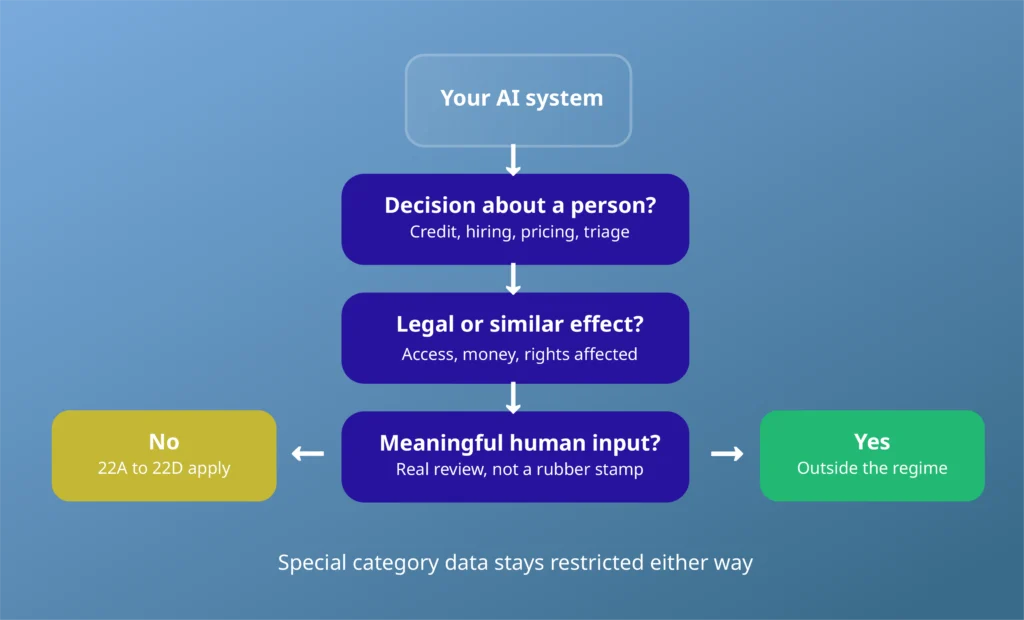
Section 80 of the Data (Use and Access) Act 2025 took effect on 5 February 2026, replacing Article 22 of the UK GDPR with Articles 22A to 22D. Significant decisions can now be made by solely automated means on most lawful bases, including legitimate interests. Special category data stays more tightly restricted.
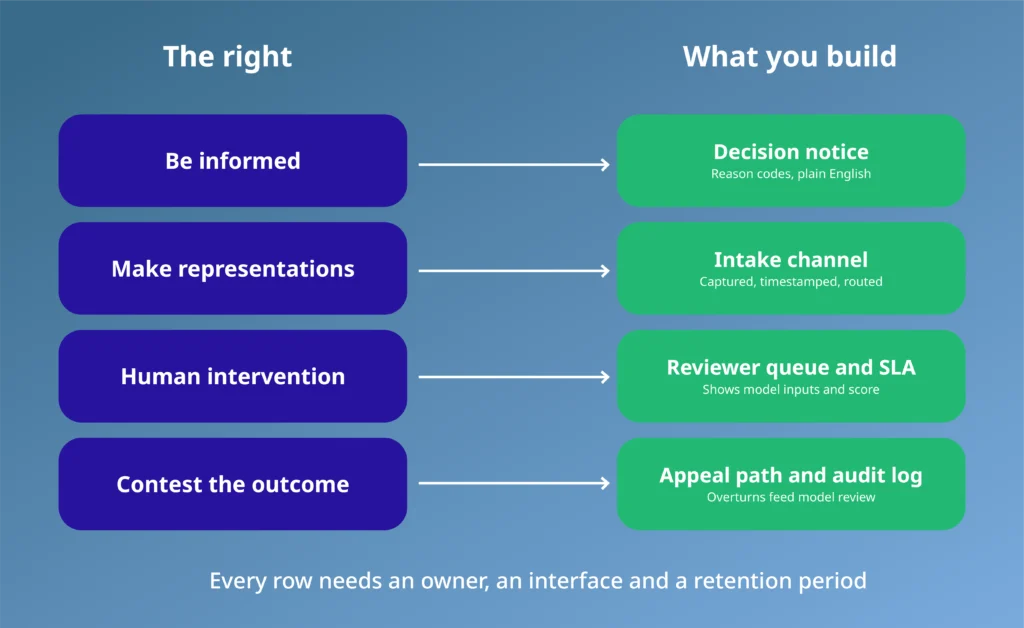
Four safeguards come attached. The individual must be:
- told the decision was automated
- able to make representations
- able to obtain human intervention
- able to contest the outcome
The statutory test turns on whether meaningful human involvement exists in taking the decision. Nothing in the wording lets a passive approval step carry that weight.
Read the four safeguards again as a sprint. Every line is an interface, a queue or a log.
ICO AI Guidance and Code of Practice: What Lands in 2026
Draft guidance on automated decision-making went to consultation in spring 2026, aimed at DPOs, compliance professionals and technical leads with oversight of ADM systems. Final version due later this year.
Separate regulations require a statutory code of practice on AI and automated decision-making, covering development and use, with a mandatory children’s data component. A statutory code carries weight in enforcement and in court.
Hiring is the ICO’s first stated concern: employers running automated decision-making and classifying it as something else. Penalties reach £17.5 million or 4% of global turnover.
How the FCA Supervises AI in Financial Services Today
Eight firms sit in the FCA’s second AI Live Testing cohort, including Barclays, Experian, Lloyds Banking Group and UBS. Use cases cover agentic payments, anti-money laundering detection and Know Your Customer.
Testing runs to the end of 2026. Evaluation report due Q1 2027.
The FCA built the programme to help firms escape proof-of-concept paralysis. Your supervisor named the problem first and is now collecting evidence on who has fixed it.
Mistake 1: Compliance Treated as a Sign-Off
Governance that arrives after the prototype forces a retrofit. Audit trails, data lineage, and model explainability exist only if the system was designed to emit them. Teams either rebuild the pipeline at their own cost or ship without evidence and hope nobody asks.
Write the requirements as acceptance criteria in sprint one:
- Financial services: FCA-aware governance, model explainability, decision-level audit trails
- Healthcare: GDPR, DSPT, patient data protection, clinical oversight separation
- Government: ISO 27001 controls, data sovereignty, full auditability
The DPIA is your forcing function. It is mandatory for systematic profiling that produces legal or similarly significant effects, and it must be completed before processing begins. Run it in discovery, and it surfaces the intervention route, the retention period and the lawful basis while they are still cheap to change. Run it after the prototype, and it becomes a document that justifies decisions already made.
A story that cannot produce its evidence is not done. That test sits at the centre of AI consulting for regulated delivery.
Mistake 2: Pilots That Skip Your Systems of Record
Most pilots are designed to succeed. They run on a data extract. They leave out the core banking platform, the patient administration system, and the case management queue.
The demo performs beautifully. The integration then becomes the real project.
What the extract hides is everything that makes production hard: record-level access controls, latency under real load, reconciliation with the system of record, and what happens when the upstream schema changes without warning. None of it appears in a sandbox. All of it appears in month four.
Build the prototype on real data, inside the real environment. Six weeks of that tells you more than six months of demos.
Mistake 3: A Human Intervention Route Nobody Built
The new rules bite hardest here, and implementations are thinnest here.
A right to obtain human intervention has to exist as working software:
- a queue that routes flagged decisions
- a reviewer interface showing model inputs and score
- a record of what the reviewer actually saw
- a logged outcome and a response SLA
Build quality determines your legal position. The statute asks whether meaningful human involvement existed in taking the decision. A reviewer clearing 400 cases an hour, blind to the model’s reasoning, will not meet that test.
Design the review route in the same sprint as the decision logic. Give the reviewer the model’s inputs, its score and its confidence, then log what they saw and what they decided. That log is the only evidence you will have when someone contests an outcome.
Mistake 4: Shipping the Model and Stopping There
Compliance evidence decays with the model.
Data drifts. Populations change. Upstream systems get patched. A model that matched its documentation at launch diverges from it quietly over the following eighteen months, and nobody flags it because nobody is watching. The gap surfaces during an audit, a complaint or a supervisory review.
Set drift thresholds before launch and wire them to an alert with a named owner. Put the retraining cadence in the same plan. Then treat every retrain as a documentation event, so the model and its paperwork move together.
This protects the business case as much as the audit position. A degraded model erodes the savings that justified the spend, months before anyone notices the numbers slipping.
Mistake 5: Strategy and Engineering Bought Separately
The most expensive pattern in regulated AI.
A strategy firm delivers a roadmap. A separate integrator builds something adjacent to it. Your team inherits a model nobody can explain, with no documented audit position and no named owner.
Ask both suppliers who signs off the audit position and watch each one point at the other. Split accountability always resolves to the CTO. Deployflow’s breakdown of partner versus consultant covers where that seam opens.
Contract for one accountable party across strategy, build and run. If you split the work, name the owner of the production outcome in writing before either supplier starts.
AI Governance by Sector: Financial Services, Healthcare, Public Sector
Financial services. Fraud detection, risk modelling and compliance automation. The differentiator is explainability treated as a deliverable with an owner, not a research task deferred to phase two. This piece on AI squads in regulated fintech covers the delivery model.
Healthcare. Models that look strong on retrospective data often underperform in prospective use. Live validation carries the weight, and clinical oversight needs separation of duties written into the workflow rather than assumed.
Government and public sector. Casework processing, resource allocation and demand forecasting. Data sovereignty constrains the architecture from day one, which rules out several deployment patterns before you start designing.
How to Move an AI Pilot Into Regulated Production
Sequencing determines the outcome. About four to five months from the first workshop to the live system, in four stages.
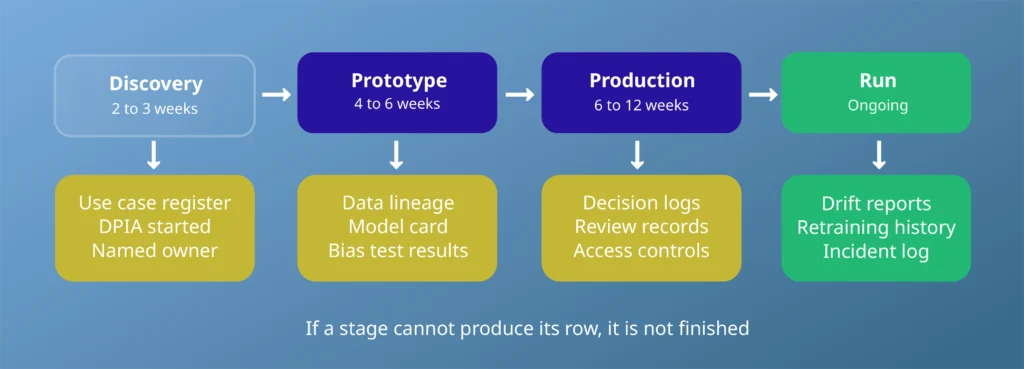
Two things that the pattern gets right. The intervention route and logging design appear in the prototype stage, so the production build inherits them instead of retrofitting them. And every stage hands over evidence, which means an audit at month nine draws on records created at month two.
Deployflow delivers this as an ISO 27001- and Cyber Essentials-certified partner across AWS, Microsoft Azure, and Google Cloud. See it in practice in AI engineering and automation.
AI Pilot Approval Checklist: 7 Questions for CTOs
- Which decisions about people will this system make, and how significant are the effects?
- Who reviews those decisions, in what interface, within what service level?
- What evidence does the system produce by default, without anyone compiling it?
- Which systems of record must it touch in production, and are they in the pilot?
- What happens when the model drifts, and who gets alerted?
- What is the cost of a wrong decision, and who absorbs it?
- Which single party is accountable from strategy through to live support, and still will be in eighteen months?
More than two uncertain answers mean the pilot needs design work before it needs approval.
Regulated AI Delivery Proven in Production
If your AI sits between an encouraging prototype and a live system, the blocker is architectural.
National-Scale Energy Operator: Governance Built Into the Platform
Deployflow built the platform layer for AI running inside critical national infrastructure, on air-locked subscriptions reachable only from the customer network. Every environment auto-inherits its security, networking and governance policies, with zero manual steps. Every change is tracked through GitOps, which is what satisfies the regulatory requirement.
New AI workloads now land on the platform without re-engineering the core.
Little Journey: Compliant Environments in Two Hours
Deployment of new environments for this paediatric eSupport platform dropped from several days to two hours, an 80% reduction, with complete data segregation and compliance with medical regulations.
Manual labour fell by 70%.
“Their strategic approach has greatly enhanced our platform’s security, consistency, and overall efficiency, allowing us to better serve our users with a robust and user-friendly solution.”
Azim Palmer, CTO at Little Journey
Both projects put the controls in the architecture at the start. That is the difference between a system you can defend and a pilot you keep explaining.
Book a free consultation. Two to three weeks of discovery gives you prioritised use cases and a delivery plan grounded in your data, your systems and your regulatory position.
AI in Regulated Industries: Frequently Asked Questions
Does the EU AI Act Apply to UK Companies?
Yes, in many cases. The EU AI Act applies on a territorial basis, so your place of registration carries little weight.
If you place an AI system on the EU market, or the output of your system is used inside the EU, you are likely in scope. A UK bank serving EU customers falls under it. So does a UK software vendor selling to European firms. Obligations vary by risk classification, with high-risk systems carrying the heaviest documentation, oversight and monitoring duties. Running UK and EU compliance as one programme usually costs less than maintaining two separate ones.
Do We Need to Hire AI Specialists to Run AI in Production?
Most organisations can run production AI with their existing platform and data engineers. The condition is that knowledge transfer forms part of the delivery from the start.
Your team needs documentation it can act on, monitoring it can read, and retraining procedures it can follow without the original builders present. Dedicated AI specialists become worthwhile once you run several models with distinct lifecycles. Hiring them before anything reaches production is a common and costly sequencing error. Ask any partner to explain the handover process in detail before you sign.
What Is the Difference Between AI Consulting and AI Engineering?
AI consulting decides what to build and why. AI engineering builds it, integrates it and keeps it running.
Consulting output is typically a prioritised set of use cases, a feasibility view and a delivery plan. Engineering output is working software inside your infrastructure, with pipelines, monitoring and controls. Regulated projects fail most often at the join between the two, where the strategy assumed conditions the build could never meet. Buying both from one accountable party closes that seam. If you buy them separately, agree in writing on who owns the production outcome.
Can Regulated Firms Use Public LLMs With Sensitive Data?
Yes, under an enterprise agreement with UK or EU data residency and a contractual no-training commitment.
Consumer tiers are not viable for regulated data. Above that baseline, the deployment pattern depends on sensitivity. Lower-risk workloads run on the hosted enterprise service. Higher-risk ones need private deployment, retrieval patterns that keep sensitive records out of prompts, or redaction before anything crosses your boundary.
Supervisors treat model providers as third-party dependencies, so run the same due diligence you would apply to any critical supplier and document the assessment. Your DPIA should name the provider, the data categories involved and the residency position.
Does ISO 27001 Cover AI, or Do We Need ISO 42001?
ISO 27001 covers information security management. It remains the baseline that most regulated buyers and public sector frameworks expect.
ISO/IEC 42001 is the AI management system standard, covering governance of AI development and use, including risk assessment, oversight and lifecycle controls.
The two standards work together. Most organisations certify to ISO 27001 first, then add 42001 once AI becomes material to operations. Both sit separately from UK GDPR obligations on automated decisions, which carry their own safeguards and apply regardless of your certification status.
Explore our BLOG
Recent articles

ISO 42001 Explained: Requirements, Certification and What Your Engineering Team Must Build
ISO 42001 is the international standard that demonstrates your organisation governs AI properly, and enterprise...
read full article

Is Claude Down? Anthropic Outage: Protect Your Cloud Infrastructure
Claude went down across every surface on 29 September 2026. From 14:00 to 14:59 UTC,...
read full article

Top 10 Healthtech Companies in 2026: What Their Growth Means for AI and DevOps
Every software change that reaches a hospital has to clear regulatory, legacy system, and clinical...
read full article