


CI/CD pipelines slow down when the network becomes unpredictable.
Builds fly one day and stall the next, despite no changes in code or tooling. Teams tune pipelines and scale resources, yet inconsistency persists below the monitoring layer.
TL;DR
CI/CD pipelines can slow down and destabilise even when code, tools, and compute stay exactly the same.
The root cause often sits below monitoring, testing, and optimisation layers—where most teams rarely look.
This guide explains when controlling the network path becomes a delivery requirement, not an infrastructure upgrade.
Dark fibre networks sit below Kubernetes, CI/CD tools, and cloud abstractions, yet they directly shape artifact speed, environment stability, and trust in automation.
For DevOps organisations pushing high-throughput pipelines, hybrid cloud architectures, or regulated workloads, network control becomes a delivery constraint.
Enterprise adoption is accelerating: the global dark fibre market is forecast to grow from USD 4.22 billion in 2025 to nearly USD 12 billion by 2032 at around 16 % CAGR, reflecting rising demand for dedicated connectivity in data-centric operations. (source: Zayo)
This guide breaks down what dark fibre actually changes for DevOps teams, where it removes hidden bottlenecks, and how to decide if it’s a strategic advantage or an unnecessary layer.
Read on if:
- CI/CD performance varies without clear root causes
- Network issues appear late, during incidents, not in planning
- Delivery reliability matters more than theoretical peak speed
- Infrastructure decisions need to support long-term DevOps maturity
This article is about removing a class of problems that undermines modern delivery.
Why CI/CD Pipelines Fail Without Predictable Network Performance
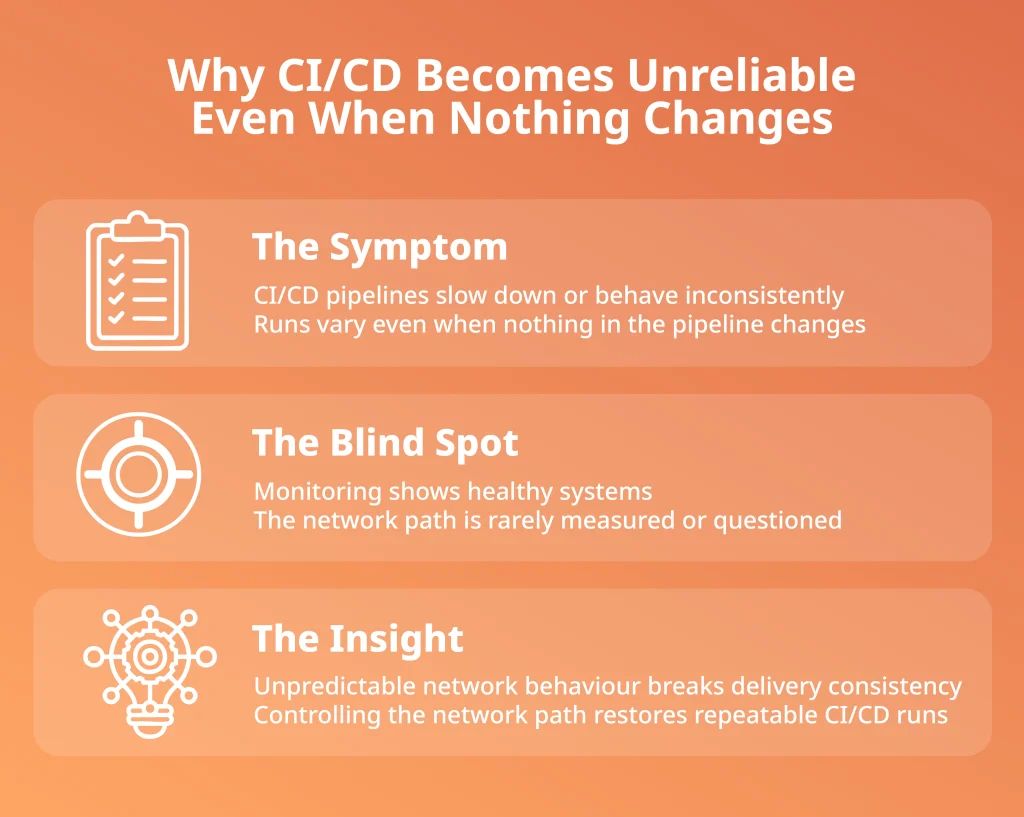
A pipeline that usually finishes in eight minutes suddenly takes twenty, despite no changes in code or tooling. The same jobs eventually pass, but releases slip, and no one can explain why.
This is what unpredictable network performance looks like inside CI/CD. Latency stretches routine steps like artifact uploads and dependency pulls. Parallel jobs lose their advantage because they no longer start and finish together. The pipeline still runs, but it no longer runs consistently.
Jitter makes the situation worse. Tests that rely on timing or service availability start failing at random. Engineers rerun jobs, increase timeouts, or mark failures as flaky just to keep delivery moving. The signal in the test results fades, replaced by speculations.
Packet loss adds friction without ever triggering a clear incident. Retries pile up, connections reset, and stages run just slowly enough to miss deployment windows. Because nothing fully breaks, the issue rarely shows up in alerts or postmortems.
Over time, teams adapt in the wrong direction. Pipelines grow more defensive. Manual checks creep back in. Automation loses authority, not because it’s poorly designed, but because the environment underneath it can’t be trusted.
CI/CD doesn’t collapse when the network is unpredictable, but it loses the one thing it depends on most: consistency.
What Dark Fibre Networking Really Means for DevOps Teams
Dark fibre gives delivery teams direct control over how their traffic moves, instead of relying on shared, provider-managed networks.
Rather than purchasing a fixed bandwidth tier and accepting variable behaviour, organisations lease or own unused fibre and light it themselves. This puts speed, routing, redundancy, and traffic priorities under internal control.
That control changes how delivery systems interact for IT engineering teams. Build pipelines, artifact repositories, test environments, and deployment targets that communicate over network paths that behave consistently, even during peak usage elsewhere.
Dark fibre doesn’t replace cloud services or CI/CD tooling. It stabilises the layer underneath them, removing variability before it reaches automation, pipelines, or monitoring systems.
In practice, dark fibre turns the network from an external constraint into a predictable part of the DevOps stack.
Dark Fibre vs Leased Lines and MPLS for High-Throughput DevOps Workloads
| Capability | Dark Fibre | Leased Lines | MPLS |
| Bandwidth control | Full control, defined internally | Fixed by contract | Fixed and provider-managed |
| Scalability | Scale by upgrading optics or lighting more fibre | Requires contract changes | Requires provider reconfiguration |
| Latency consistency | Highly predictable | Generally stable, varies under load | Stable, but influenced by provider routing |
| Jitter and packet loss | Minimal, controllable | Moderate under congestion | Low, but not fully transparent |
| Routing control | Fully customer-defined | Provider-defined | Provider-defined |
| Provisioning speed | Fast once fibre is in place | Slow (weeks to months) | Slow (weeks to months) |
| CI/CD suitability | Ideal for sustained high-throughput pipelines | Adequate for moderate workloads | Adequate but inflexible |
| Operational flexibility | High | Low | Medium |
| Cost model at scale | Optimised long-term | Increasing OPEX | High OPEX |
How Dark Fibre Eliminates Latency and Jitter in CI/CD Pipelines
CI/CD pipelines struggle when the network behaves differently from one run to the next.
On shared networks, delivery traffic is constantly competing with other workloads. Routes change, queues form, and timing shifts in ways pipelines can’t predict or observe. The result is uneven execution that makes builds, tests, and deployments feel unreliable.
Dark fibre keeps traffic on dedicated paths with fixed capacity. Nothing else is competing for bandwidth, and nothing is rerouting requests behind the scenes. Each pipeline run moves through the same network conditions as the one before it.
Even at the speed of light, optical links introduce physical delay: typical fibre adds about 5–5.5 µs of delay per kilometre, meaning every 1000 km round trip adds roughly 11 ms, which is a measurable latency layer for distributed systems. (source: Research Nester)
That consistency matters more than speed. When latency and timing stay stable, parallel stages stay in sync, timeouts mean something, and failures point to real issues instead of network noise.
In simple terms, dark fibre gives CI/CD pipelines a steady floor to stand on. Once the ground stops shifting, automation can finally be trusted to behave the same way every time.
Accelerating Build, Test, and Deployment Stages with Dark Fibre Connectivity
Where pipelines lose time is rarely subtle. It’s in the transfers.
Builds slow down when dependencies and artifacts move unpredictably between runners and storage. What should be a fixed step stretches or shrinks based on network conditions, not build logic. Dark fibre stabilises those transfers, turning build duration back into a known quantity.
Tests are more sensitive to inconsistency than raw speed. When environments respond unevenly, suites take longer, and results become harder to trust. With steady throughput, tests are completed at a consistent pace, making optimisation and parallelisation meaningful again.
Deployments expose network weaknesses at the worst possible moment. Large images, configuration payloads, and rollout traffic all converge under time pressure. Dark fibre keeps deployment traffic moving at a predictable rate, reducing rollout drift and last-minute delays.
Taken together, these gains compound. Each stage becomes easier to plan, easier to tune, and easier to trust, without throwing more compute at a problem that isn’t computational in the first place.
Using Dark Fibre to Power Hybrid Cloud and Multi-Cloud DevOps Architectures
With more than half of organisations prioritising digital resiliency and hybrid/multi-cloud connectivity as core transformation goals, reliable inter-environment networking has become a strategic requirement.
Hybrid and multi-cloud environments often struggle because the connections between environments behave inconsistently.
In a typical setup:
- CI/CD pipelines span on-prem and cloud systems
- Artifacts, backups, and replicas move constantly
- Performance depends on links shared with traffic you don’t control
Dark fibre introduces a different model for how environments connect.
By creating dedicated, private paths between on-prem infrastructure and cloud entry points, dark fibre turns multiple environments into a single, predictable delivery surface. Connectivity behaves the same way during peak hours as it does during off-hours, across regions and platforms.
For infrastructure and operations teams, this unlocks practical freedom:
- Pipelines can cross environments without timing risk
- Data-heavy stages don’t need artificial co-location
- Replication and failover follow schedules, not best-effort paths
Dark fibre simplifies hybrid or multi-cloud by stabilising network behaviour, the most difficult variable to plan for.
Why Dark Fibre Improves Security and Compliance in Regulated DevOps Environments
In regulated environments, security issues rarely start with an exploit. They start with unclear boundaries.
Shared networks blur responsibility. Traffic crosses infrastructure you don’t fully control, visibility is partial, and audit questions turn into diagrams and assumptions. For technical teams operating under compliance pressure, that ambiguity becomes a risk in itself.
Dark fibre tightens those boundaries. Data moves over private, dedicated paths with no third-party workloads in between. Network ownership is clear, traffic flows are known, and access points are deliberate rather than inherited from provider defaults.
Auditors can verify network boundaries without assumptions. CI/CD systems that handle sensitive data can demonstrate where traffic goes, how it’s isolated, and who controls it. Network segmentation happens at the physical layer, reducing reliance on layered workarounds and compensating controls.
For regulated DevOps environments, dark fibre simplifies the security story. When the network is owned, predictable, and auditable, compliance starts being a property of the system itself.
For teams that want to go deeper into structuring controls without slowing delivery, this guide on DevOps risk governance frameworks explains how security, compliance, and speed can be designed together.
Operating Dark Fibre Networks with DevOps Automation and Observability
Running dark fibre successfully comes down to treating the network like production infrastructure, not a special asset managed on the side.
- Automate provisioning and changes first. Dark fibre links, routing policies, and failover paths should be defined in configuration, stored in version control, and deployed through the same change workflows used for infrastructure and CI/CD. Manual network changes are slow, hard to audit, and easy to forget. Automated changes are repeatable and reversible.
- Instrument the fibre layer directly. Application metrics won’t show early network degradation. Engineers need continuous visibility into latency, packet loss, error rates, and optical signal health. These metrics should be collected per link and per path, not averaged across the network.
Small shifts here often explain pipeline slowdowns before anything times out. Teams are already using machine learning in DevOps automation to spot performance drift and abnormal patterns earlier than traditional thresholds allow.
- Tie network metrics to delivery impact. Not all traffic is equal. Deployment traffic, artefact transfers, backups, and replication have different tolerance levels. Tagging network paths and correlating them with CI/CD stages makes alerts actionable. A few milliseconds of extra latency might be irrelevant for backups but unacceptable during deploys.
- Test failover like a deployment. Redundancy only works if it’s exercised. Fibre failover paths should be tested regularly, using controlled scenarios that mirror real traffic. If switching links requires manual intervention or tribal knowledge, it will fail under pressure.
- Plan capacity upgrades before pipelines feel them. Because dark fibre capacity scales through optics and wavelengths, teams can expand throughput without redesigning pipelines. The key is acting on trends, not incidents. When utilisation climbs steadily, upgrade early rather than waiting for CI/CD performance to degrade.
When automation and observability are in place, dark fibre stops being a concern for networking. It becomes another predictable, measurable component of the DevOps system, one that can be changed, monitored, and improved with confidence.
When Dark Fibre Makes Sense for CI/CD at Scale and When It Doesn’t
Dark fibre isn’t an upgrade you add because pipelines feel slow once or twice. It becomes relevant when delivery depends on the network behaving the same way, every hour of every day.
Where Dark Fibre Starts to Make Sense
Consider a product team running dozens or hundreds of CI/CD jobs daily. Container images are large, builds run in parallel, and artifacts constantly move between build systems, registries, test environments, and deployment targets. Pipelines don’t just run during releases; they run continuously.
This is common in:
- FinTech platforms that rebuild and deploy services multiple times a day
- Media or data platforms that package large images and datasets on every commit
- SaaS products with many microservices sharing the same CI/CD backbone
In these environments, network variability stops being a minor annoyance. A few inconsistent minutes per pipeline quickly add up to missed release windows, slower incident response, and teams quietly padding schedules to compensate.
Dark fibre also fits organisations where timing matters more than flexibility. For example:
- Regulated platforms that must deploy within fixed maintenance windows
- Systems where releases are coordinated across regions or environments
- Teams that need predictable rollback and recovery times
Owning the network path removes a class of uncertainty that shared connectivity can’t fully eliminate.
Where Dark Fibre Usually Does NOT Make Sense
Now contrast that with a small or mid-sized team shipping a monolithic application. CI/CD runs a few times a day, builds are lightweight, and pipelines sit idle for long stretches. When something slows down, it’s usually traced back to the test scope, build configuration, or tooling choices.
This is typical for:
- Early-stage startups iterating quickly but deploying infrequently
- Internal platforms with limited users and modest data movement
- Teams still refining the pipeline structure and test coverage
In these cases, dark fibre doesn’t solve the real problem. Improving caching, reducing test sprawl, or fixing pipeline design delivers far more value at a fraction of the complexity.
Cost: Scale Changes the Equation
Dark fibre changes how and how much you pay. It replaces variable monthly network charges with long-term ownership and operational responsibility.
Industry projections consistently show dark fibre poised for major growth, with forecasts estimating a global market north of USD 11 to 13 billion by 2030, reinforcing the trend toward dedicated, controllable connectivity in data-intensive environments. (source: Grand View Research)
At a small scale, that’s unnecessary overhead. At a sustained scale (where CI/CD traffic is constant and growing), it often becomes simpler and cheaper than repeatedly upgrading managed connectivity, renegotiating contracts, and chasing performance regressions.
A Practical Rule of Thumb
If CI/CD performance issues keep resurfacing after tooling, compute, and pipeline design have already been addressed, the network is no longer a background detail. It’s part of the delivery system.
If pipelines are already stable, dark fibre isn’t necessary.
Dark Fibre as a Long-Term DevOps Infrastructure Strategy
Dark fibre delivers real value only when it’s treated as part of a broader DevOps infrastructure strategy, not as a standalone network upgrade.
At that level, the question shifts from “Is dark fibre faster?” to “How does the network support how we build, ship, and operate software over the next three to five years?” Teams that succeed with dark fibre align it with delivery goals such as predictable CI/CD performance, controlled growth, and infrastructure that scales without constant redesign.
From Network Upgrade to Delivery Strategy
Dark fibre touches networking, cloud architecture, CI/CD design, security, and operations. Without coordination, it risks becoming an underused asset or a siloed responsibility. With the right operating model, it becomes a stable foundation that supports continuous delivery at scale.
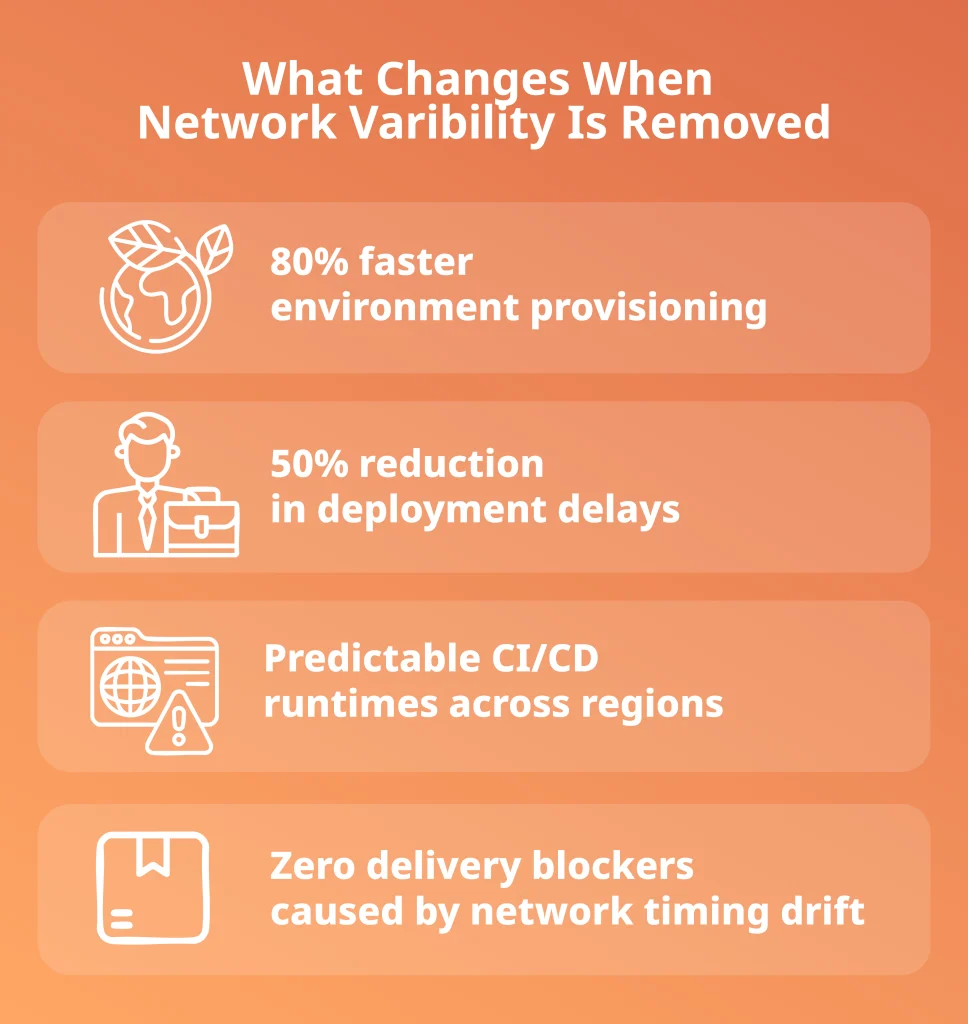
Execution matters. In regulated environments like Little Journey, a paediatric healthcare platform, Deployflow helped design and operate secure, fully segregated cloud environments that reduced deployment times by 80%, eliminated ad-hoc infrastructure changes, and enabled rapid, compliant rollout of new environments.
Similarly, at Zilch, a fast-growth FinTech platform operating under extreme delivery pressure, Deployflow’s DevOps delivery squads automated infrastructure and CI/CD workflows, cutting environment setup time in half and enabling the platform to scale reliably while meeting strict security and integration demands
In both cases, the technology mattered, but the strategy mattered more. Network behaviour was designed alongside pipelines. Capacity planning followed delivery patterns, not static bandwidth assumptions.
For organisations running complex delivery environments, this usually means moving beyond ad-hoc toolchains and disconnected teams. It requires a combination of strategic services:
- DevOps managed services & full-stack delivery squads that align networking, cloud, CI/CD, and operations into one coordinated system
- CI/CD services that optimise pipelines, automate repeatable delivery workflows, and ensure that build–test–deploy stages are reliable, observable, and tied to business outcomes
Instead of treating networking, CI/CD, cloud, and operations as separate concerns, Deployflow’s integrated DevOps as a managed service approach makes each layer part of a cohesive delivery strategy.
Dark fibre becomes another controllable layer in the delivery stack. It is planned, automated, monitored, and evolved in step with the platform itself.
As a long-term infrastructure strategy, dark fibre removes network uncertainty from DevOps operations and replaces it with infrastructure that scales predictably and supports growth without friction.
That shift allows engineering organisations to focus on delivery instead of building compensation tactics around unstable foundations.
When the network, tooling, and delivery practices are designed as part of the DevOps system, dark fibre becomes an advantage that compounds over time.
Frequently Asked Questions About Dark Fibre Networks for DevOps & CI/CD
Who is responsible for managing and maintaining dark fibre?
The organisation leasing or owning dark fibre is responsible for operating and managing it.
This includes lighting the fibre, monitoring performance, handling routing, and coordinating maintenance. Unlike managed services, there’s no provider making day-to-day decisions on your behalf. For platform engineering teams, this means greater control but also a need for operational maturity. Many organisations address this through DevOps managed services or delivery squads that combine networking, cloud, and CI/CD expertise.
How long does it take to deploy dark fibre?
Deploying dark fibre typically takes longer upfront than activating a leased line, but far less time to scale later.
Initial provisioning depends on fibre availability and physical access, which can take weeks or months. Once in place, increasing capacity is usually fast, involving optics or configuration changes rather than new contracts. For teams planning long-term CI/CD growth, that trade-off often pays off.
Does dark fibre replace cloud provider networking?
No, dark fibre complements cloud networking rather than replacing it.
Cloud-native networking still handles intra-cloud traffic, service discovery, and managed routing. Dark fibre strengthens the paths between environments, such as on-prem to cloud or region-to-region connectivity. Used together, they create a more predictable hybrid or multi-cloud delivery foundation.
What skills do DevOps teams need to run dark fibre effectively?
Teams need a blend of networking, automation, and observability skills, rather than relying on traditional network administration alone.
Successful setups treat fibre as code, integrate metrics into existing monitoring, and regularly test failover. The challenge is operating the network with the same discipline as CI/CD and infrastructure. This is where full-stack DevOps delivery teams often add the most value.
Explore our BLOG
Recent articles

ISO 42001 Explained: Requirements, Certification and What Your Engineering Team Must Build
ISO 42001 is the international standard that demonstrates your organisation governs AI properly, and enterprise...
read full article

Is Claude Down? Anthropic Outage: Protect Your Cloud Infrastructure
Claude went down across every surface on 29 September 2026. From 14:00 to 14:59 UTC,...
read full article

Top 10 Healthtech Companies in 2026: What Their Growth Means for AI and DevOps
Every software change that reaches a hospital has to clear regulatory, legacy system, and clinical...
read full article