


4 Structural Fixes to Automate ISO27001 Compliance and Reclaim 70% of DevOps Effort
Eliminate the Green Pipeline Paradox and reclaim 25 engineering hours per week by shifting from fragile automation to a system-driven delivery model. Automation alone often hides significant CI/CD delivery risk.
While standard CI/CD dashboards report “Green,” they often mask structural SPOFs and manual dependencies that lead to the £3.11m average costs in data breaches.
This guide shows four structural fixes to automate ISO27001 compliance and restore delivery.
Executive TL;DR
- The Green Lie: Why perfect metrics often mask hidden CI/CD delivery risk and looming production failures.
- Operational SPOFs: How “Hero Culture” and manual dependencies create invisible single points of failure.
- Architectural Resilience: Using Ephemeral Staging, Policy-as-Code, and GitOps to make high-stakes releases routine.
- The CTO Result: Achieve ISO27001 automation and reclaim engineering velocity without increasing headcount.
See where CI/CD delivery risk hides and why standard metrics fail.
This strategic analysis shows how UK teams uncover structural weaknesses before they trigger incidents, stabilising delivery and automating compliance without rebuilding pipelines or increasing headcount.
If releases feel fragile despite healthy pipelines, or if delivery confidence depends on specific people rather than systems, this guide explains:
- What to assess
- What to fix first
- How to regain control without slowing teams down
The False Security of Green Builds: Why Pipelines Fail at Scale
Green builds only prove that the code passed a pipeline. They don’t confirm that environments are consistent, access is controlled, rollbacks are safe, or releases are fully owned.
That gap is why delivery can still feel risky even when CI/CD metrics look healthy.
Case Study: Stabilising CI/CD Delivery for a Regulated UK Platform
The problem wasn’t broken CI/CD, but hidden delivery risk.
Little Journey, a UK-based eSupport platform operating in a regulated environment (HealthTech), already had automated deployments and CI/CD pipelines in place.
Builds passed. Deployments worked. On the surface, delivery looked healthy.
The risk appeared as the platform scaled. Manual environment setup, inconsistent controls between environments, and limited DevOps capacity introduced uncertainty that CI/CD metrics did not reveal. Release confidence depended too heavily on people and workarounds rather than repeatable systems.
The fix focused on DevOps maturity instead of more automation.
Deployflow stabilised delivery by introducing infrastructure as code, standardising environments, and removing manual dependencies across the release process. This reduced variation between environments and removed fragile, undocumented steps that increased risk during releases.
The results were immediate and measurable:
- Environment setup reduced from days to hours
- Manual DevOps effort reduced by 70%
- Delivery confidence restored under regulatory pressure
By reducing manual DevOps effort by 70%, the engineering team reallocated roughly 25 hours per week back to core product development, accelerating their roadmap without increasing headcount.
This case demonstrates the article’s core message: green pipelines alone don’t guarantee safe delivery. Passing builds and successful deployments can hide structural risk in environments, access controls, and manual dependencies.
DevOps maturity (clear ownership, repeatable infrastructure, and predictable release processes) is what turns CI/CD from working into reliable delivery.
The Visibility Gap: 5 Places Delivery Risk Hides (That Dashboards Miss)
A deployment succeeds, tests pass, and the pipeline turns green. Yet, the release still causes disruption. The issue isn’t the pipeline, but what happens around it.
CI/CD dashboards report build and test status, but they don’t reflect the safety of releasing, recovering, or auditing a system. Delivery risk usually sits in areas that the pipeline never measures. Failing to address these structural gaps often leads to neglecting DevOps CI/CD best practices, ultimately resulting in slower releases, inflated costs, and persistent deployment issues.
Common sources of hidden risk include:
- Environment drift between development, staging, and production
- Over-permissioned service accounts with unclear access ownership
- Manual approval steps that slow down releases or bypass safeguards
- Release processes that rely on specific engineers being available
- Rollback paths that exist in theory but fail under pressure
These gaps break confidence.
Over time, they turn working CI/CD into a fragile delivery process that only holds together when everything goes right.
The Tooling Trap: Why the 19% Elite Performers Don’t Just Buy Better Tools
CI/CD delivery risk is a DevOps maturity problem and not a tooling one.
Modern tools like GitHub Actions, GitLab CI, Azure DevOps, and Jenkins all support reliable delivery.
Risk appears when CI/CD grows organically without clear architecture, ownership, or governance. In those cases, pipelines automate deployment, but the surrounding processes remain fragile, undocumented, and dependent on individuals.
Changing tools rarely fixes this, but improving DevOps maturity does.
Despite widespread CI/CD adoption across the industry, only about 19 % of organisations achieve elite DevOps performance, a level defined by rapid delivery, low failure rates, and fast recovery. (source: 2024 DORA State of DevOps Report)
This gap shows why tooling alone is not enough to guarantee reliable delivery.
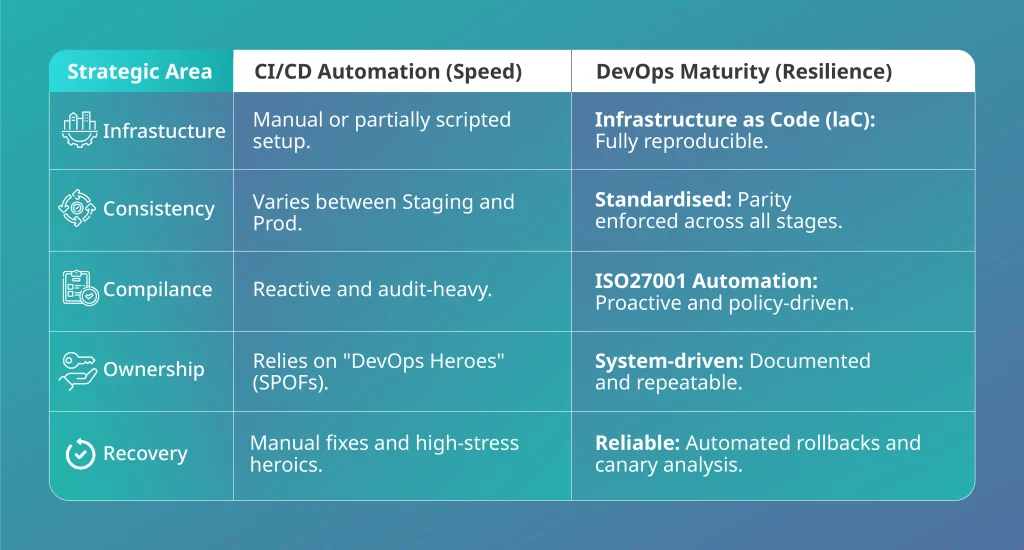
DevOps Maturity vs CI/CD Automation
Automation is about speed, but maturity is about stability. This comparison identifies the structural gaps that transform a standard CI/CD pipeline into a resilient, system-driven delivery machine.
The DevOps Maturity Roadmap: 4 Structural Fixes for High-Stakes Delivery
A DevOps audit shows why delivery still feels fragile even when CI/CD is automated. It goes beyond pipelines and focuses on how releases actually work in practice.
Below are the issues that audits most often uncover.
Achieving Environment Parity via Infrastructure as Code (IaC) and Ephemeral Staging
The Problem: “It worked in staging” is still the most common lie in software delivery. Static staging environments slowly drift away from production, giving teams a false sense of confidence when pipelines show green.
The CTO-Level Fix: Transition from static staging to Dynamic Environment Provisioning using Terraform or Pulumi. By spinning up environments per Pull Request (PR), you ensure the infrastructure is defined by code instead of manual tweaks.
The Outcome: Staging becomes a 1:1, disposable clone of production. Configuration drift is eliminated by design, ensuring that if it passes in the PR environment, it will pass in production.
Leveraging Policy-as-Code for ISO27001 Automation
The Friction: Manual approvals and security gatekeeping are the primary bottlenecks for regulated UK platforms. Relying on human oversight for compliance is a scaling risk.
🚩UK Compliance Risk: With the average UK breach cost hitting £3.11m, manual approvals are no longer just slow but a liability. (source: IBM)
The CTO-Level Fix: Embed automated governance into your CI/CD via Policy-as-Code (e.g., Open Policy Agent or Kyverno). This allows you to hardcode security guardrails (like “no public S3 buckets” or “required encryption at rest”) directly into the pipeline.
The Outcome: Regulatory and security rules are enforced at the commit level. For UK platforms, Policy-as-Code automates the evidence collection required for ISO27001 and SOC2 compliance. Violations fail builds automatically, shifting security left and removing the audit anxiety that plagues most CTOs.
Eliminating Hero Culture via Self-Service Portals and GitOps
The Friction: Even with CI/CD, releases often rely on manual steps, a script run on a local machine or a specific engineer’s know-how. This creates an Operational Single Point of Failure (SPOF), where your delivery pipeline is only as resilient as the availability of a specific engineer.
By 2026, 80% of large software engineering organisations will have established platform engineering teams to provide reusable services and tools, up from 45% in 2022 (source: Gartner Strategic Technology Trends 2026). As 80% of firms move to platform engineering, those relying on hero culture will find it increasingly impossible to attract and retain top-tier UK engineering talent who expect modern developer experiences.
The CTO-Level Fix: Implement GitOps (via ArgoCD or Flux) and Self-Service Developer Portals (like Backstage). GitOps ensures the source of truth is always in the repository, not in an engineer’s head. Self-service portals allow any authorised developer to trigger complex, safe deployments without needing a DevOps hero.
The Outcome: You move from hero-based delivery to system-based delivery. Manual steps are codified into the platform, making releases repeatable, documented, and, most importantly, boring for everyone involved.
Automated Rollback & Canary Analysis
The Friction: Relying on all-at-once deployments creates a high-stress race against the clock whenever a bug hits production.
The CTO-Level Fix: Implement Canary Deployments using a service mesh (Istio, Linkerd) or Argo Rollouts. This allows for incremental traffic shifting (e.g., 5% of users) combined with automated health monitoring.
The Outcome: If latency spikes or 5xx errors occur, the system triggers a sub-second automated rollback. Your Mean Time to Recovery (MTTR) drops to near zero without requiring an engineer to be online.
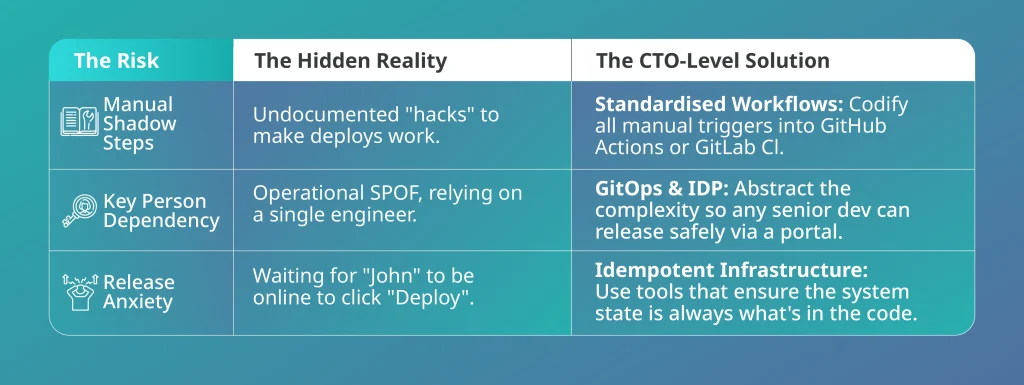
Implementing these structural fixes moves a department beyond simple automation and into true DevOps maturity. The transition removes manual dependencies that inflate CI/CD delivery risk, ensuring that growth no longer relies on individual experts.
For a UK CTO, this is the path to a defensible, auditable release cycle. It turns infrastructure and compliance into repeatable code, allowing the engineering team to focus on innovation rather than release-day firefighting.
When Should UK CTOs Review CI/CD and DevOps Maturity?
You should review your CI/CD and DevOps maturity when delivery confidence depends on people rather than on systems you can rely on.
DevOps maturity means you can deploy without fear, recover quickly from failures, and prove to auditors and stakeholders that your systems behave predictably.
Even when CI/CD automation is in place, pipelines can still produce broken releases, skipped checks, and production incidents because automation alone does not remove the underlying risks.
A recent industry article published on Medium highlights that many pipelines are effectively manual underneath. Tools run tasks, but teams still rely on late-night fixes, skipped checks, and human judgment to get releases done, and as a result, deployment failures still happen despite green dashboards.
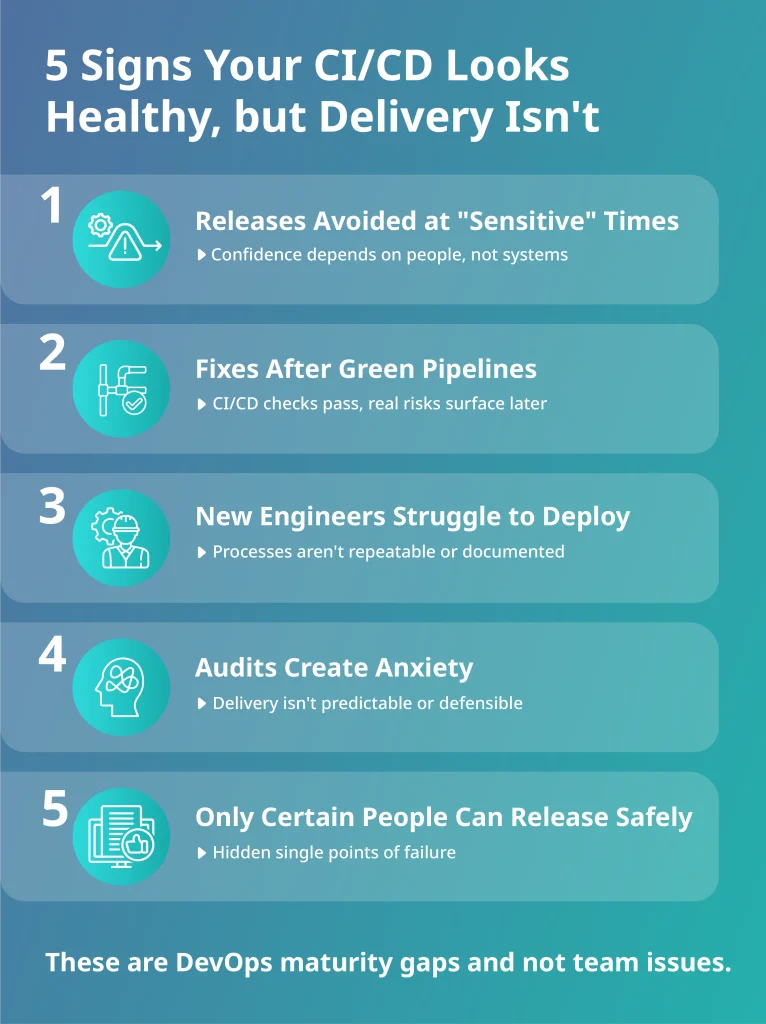
Below are clear signals that your CI/CD or DevOps maturity needs a checkup now:
How DevOps Audits Improve Release Reliability
DevOps audits harden your release cycle by uncovering and fixing the specific technical gaps that fail under pressure.
For example, a pipeline may deploy code perfectly, but production still behaves differently because environments aren’t truly the same.
Or a release goes wrong and recovery stalls because rollback depends on one engineer being available. These are gaps in how delivery is designed.
A good DevOps audit focuses on those gaps:
- It standardises environments, so releases behave the same way every time.
- It makes ownership clear, so problems don’t bounce between teams.
- It removes manual steps that only work when someone remembers to do them.
The outcome is fewer surprises during releases, quicker recovery when something does go wrong, and delivery that feels routine instead of stressful.
A Practical Starting Point for UK CTOs: Validate Before You Add
The safest place to start is not new tools, platforms, or more automation. It’s understanding whether what you already run is actually reliable.
That means validating a few fundamentals:
- Are environments genuinely repeatable, or do small differences creep in over time?
- Do rollback and recovery procedures work in practice, not just on paper?
- Where does delivery still depend on specific people rather than systems?
This kind of early assessment will reduce delivery risk without slowing your team down. It protects engineering velocity by fixing structural weaknesses before they turn into incidents, delays, or uncomfortable conversations with auditors and stakeholders.
Partnering with UK CTOs, Deployflow looks beyond the dashboard to trace delivery failures back to their root causes, whether that is environment design, broken access controls, or unclear ownership.
The process is finding exactly where configuration drift occurs and where delivery still relies on individual experts rather than resilient systems. Once these gaps are identified, senior DevOps specialists provide hands-on support to fix them at the source.
This results in safer releases and predictable delivery without the need to replace your existing tools or slow down your engineering roadmap.
When Releases Become Boring (in a Good Way)
A green CI/CD pipeline is a bit like a “check engine” light that’s not on. It’s reassuring, but it doesn’t mean the car is ready for a long drive in the rain at night with passengers in the back.
If you’re an IT leader or CTO, you know this feeling. The pipeline is green, tests pass, nothing looks broken, but releases still make people slow down, double-check, or wait for that one engineer to be around.
That tension is telling you something. CI/CD is doing its job, but the surrounding setup is still carrying more risk than it should.
CI/CD tells you the code went through the system.
DevOps maturity tells you the system can handle change without drama.
The takeaways worth remembering:
- Pipelines can be technically fine and still leave teams uneasy about releasing.
- Delivery risk usually hides outside CI/CD dashboards
- If timing and people matter too much, the system isn’t ready
- More tools rarely help; clearer ownership and repeatability do
- DevOps audits work because they surface uncomfortable truths early
Scaling Without Friction: The Deployflow Approach
Establishing high-stakes delivery resilience does not require an internal overhaul or a freeze on your current roadmap.
Deployflow provides sprint-based delivery through full-stack engineering teams designed to integrate seamlessly with your existing workflows.
This model allows your IT team to maintain their normal operations without disruption while foundational work to reduce CI/CD delivery risk runs in parallel.
Whether collaborating on-site or remotely, these squads focus on a deliberate knowledge transfer process, ensuring your internal team understands and owns the new infrastructure once it is deployed.
Moving from fragile automation to a resilient release culture requires a structural shift in how your system handles change. To see these principles in action, examine the frameworks used in professional DevOps CI/CD services to solve complex delivery bottlenecks.
“Their strategic approach has greatly enhanced our platform’s security, consistency, and overall efficiency, allowing us to better serve our users with a robust and user-friendly solution.”
Azim Palmer
CTO at Little Journey
When environments match, access is sane, and rollbacks work without heroics, releases become boring. And boring is exactly what you want.
That’s when green no longer means “nothing exploded today,” but “this system knows how to behave.”
Most pipelines are just automated legacy processes. Is yours? Request a 48-hour DevOps stress test to find the gaps your dashboard is hiding.
CI/CD Delivery Risk: Frequently Asked Questions
How do you measure CI/CD delivery risk beyond standard DORA metrics?
Delivery risk is measured by assessing the gap between pipeline automation and environmental reality. While DORA metrics like deployment frequency and lead time measure speed, they often overlook “ghost risks” such as manual configuration drift or undocumented security bypasses.
A robust risk assessment involves auditing environment parity, testing automated rollback reliability, and identifying operational single points of failure where knowledge is trapped in a single head. By quantifying how often green builds require manual intervention after deployment, you gain a clear picture of your system’s resilience. This holistic view ensures that high-speed delivery doesn’t come at the cost of stability or compliance.
What is the difference between CI/CD automation and true DevOps maturity?
Automation focuses on the mechanics of moving code, whereas DevOps maturity focuses on the resilience and predictability of the entire delivery system.
True maturity integrates Infrastructure as Code (IaC), automated governance, and self-service capabilities that allow any developer to release safely. It transforms the pipeline from a simple script into a defensible, auditable process that functions independently of specific individuals. Ultimately, maturity is what allows a CTO to scale the engineering team without scaling the operational chaos.
How does Infrastructure as Code (IaC) reduce deployment failures in regulated industries?
Infrastructure as Code reduces failures by ensuring that every environment (from staging to production) is an identical, version-controlled clone. In regulated sectors like HealthTech or FinTech, manual environment tweaks are a primary source of audit failure and production downtime.
By defining infrastructure through tools like Terraform or Pulumi, you eliminate human error and ensure that security guardrails are enforced by default. This approach allows for disposable environments that can be destroyed and recreated in minutes, providing a clean slate for every release. Consequently, you achieve a level of consistency that satisfies both internal performance standards and external regulatory requirements.
Can you achieve ISO27001 compliance through CI/CD pipeline automation?
You can automate the vast majority of ISO27001 evidence collection and control enforcement by integrating Policy-as-Code directly into your CI/CD pipelines.
Rather than relying on periodic manual audits, automated guardrails check every commit for encryption, access controls, and vulnerability scans in real-time. This continuous compliance model ensures that security is a prerequisite for deployment, not an afterthought. When an auditor asks for proof of process, your Git history and pipeline logs provide a tamper-proof, chronological record of every change and approval.
Explore our BLOG
Recent articles
ISO 42001 Explained: Requirements, Certification and What Your Engineering Team Must Build
ISO 42001 is the international standard that demonstrates your organisation governs AI properly, and enterprise...
read full article

Is Claude Down? Anthropic Outage: Protect Your Cloud Infrastructure
Claude went down across every surface on 29 September 2026. From 14:00 to 14:59 UTC,...
read full article
Top 10 Healthtech Companies in 2026: What Their Growth Means for AI and DevOps
Every software change that reaches a hospital has to clear regulatory, legacy system, and clinical...
read full article