



A tech startup rushed to launch an app but overlooked CI/CD pipelines, leading to chaotic manual testing and costly last-minute fixes. Launch day has arrived with a buggy app, frustrating users and damaging their reputation.
Lessons Learned:
- Prioritise CI/CD Services: Implementing CI/CD pipelines from the start is crucial to ensure stability and streamline development.
- Avoid rushing: Speed should never come at the expense of quality; thorough testing is essential.
- Automate early: Automation reduces errors and saves time, preventing last-minute chaos.
- User trust is fragile: A buggy launch can severely damage user trust and your brand’s reputation.
- Continuous improvement: Learning from failures and adapting processes is key to long-term success.
Imagine you are working in a team of professionals who need to deliver the features at a rapid speed while maintaining quality and high performance. This means that all the developers need to work simultaneously to be able to deliver the expected results in a designated timeframe. This is not only stressful but also inefficient as it may lead to many errors and delays.
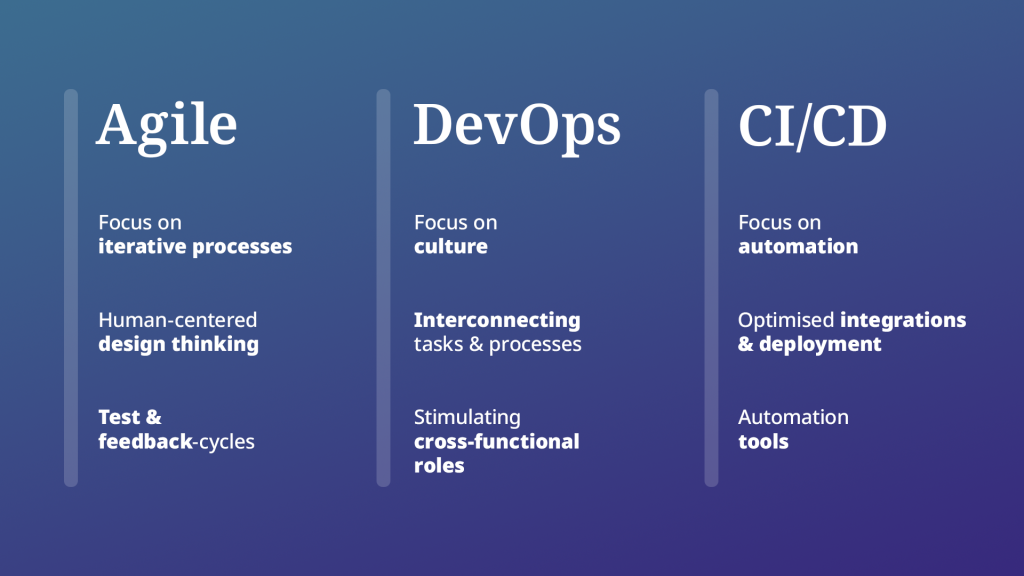
CI/CD was invented to solve this challenge and help developers streamline coding processes, delivery, and deployment. CI, continuous integration refers to frequently merging code changes into one shared branch and CD refers to continuous deployment or delivery which automates rollout and the release of the application. CI and CD are usually practiced in agile development and their purpose is to improve the DevOps approach.
What is Continuous Integration?
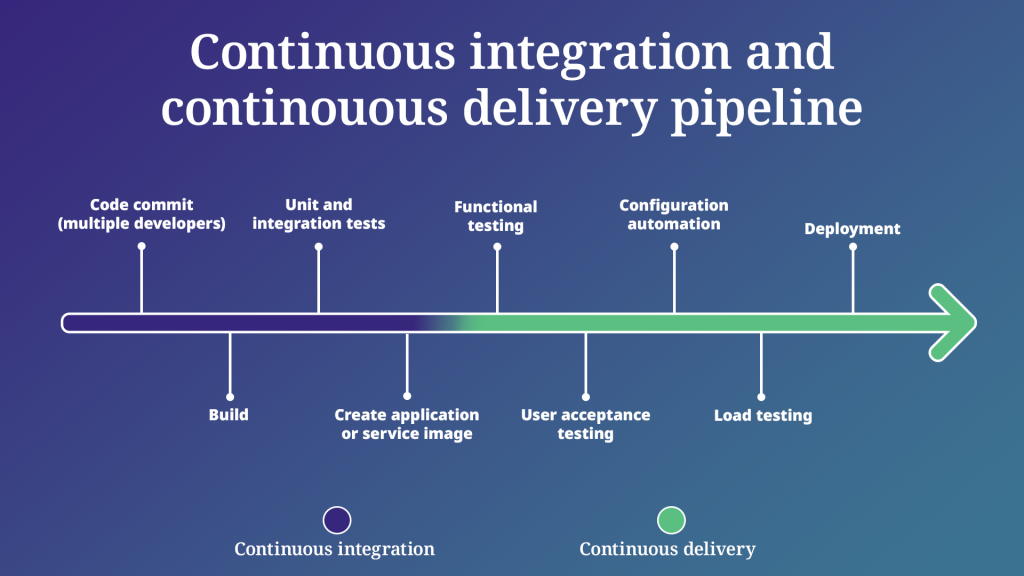
Continuous Integration is an automation strategy that introduces workflows that compile code changes continuously, build the app, and test bugs and errors. Organisations usually start building their CI/CD pipelines by focusing on Continuous Integration first.
What is Continuous Delivery?
Continuous delivery is the next level of automation in the software development lifecycle. Its goal is to help improve communication between operation and development teams by accelerating the speed of the software delivery process. Continuous delivery only makes sense if Continuous Integration is implemented.
What is Continuous Deployment?
Continuous deployment takes continuous delivery to a whole new level – once the code is pushed into the repository it is deployed to production in the same process. Continuous deployment also enables smaller updates in case some changes are made along the way.
Explore our DevOps services to learn how we can help you deliver applications at the pace of your business.
Why is CI/CD important for DevOps?
As we have already mentioned, the overreaching goal of using CI/CD is to enhance coding, testing and deployment processes, accelerate delivery, and increase the team’s productivity and efficiency. Let’s dive deeper into all the benefits of CI/CD.
CI/CD enables you to:
- Reduce risks – Testing the product continuously will remove any bugs from the production, improve the quality of the product, and provide customers with better services. Finally, the development team will spend less time fixing bugs.
- Enhance productivity – By automating processes with CI and CD, teams no longer have to waste time building, testing, and releasing software. This allows them to focus on things that matter like writing a better code.
- Standardize processes – Automation ensures that coding, testing, deployment, and delivery are all following the same pattern and structure which means that all of the processes are standardized each time the new product is released. On the other hand, manual processes can lead to a number of errors and issues.
- Ship high-quality software quickly – One of the biggest benefits of CI/CD pipelines is that they allow teams to move applications from the coding process to deployment at higher speed, ensuring that the development pace matches the business needs
- Create faster user feedback – CI/CD removes all the barriers for the development teams, allowing them to release new features much faster and provide users with what they need, thus increasing customer satisfaction. This also helps teams get an invaluable insight into the capabilities that users value allowing them to work on creating new features and capabilities on future projects.
What are the advantages of the CI/CD pipeline?
Let’s first explain what the CI/CD pipeline is.
The Continuous Integration/Continuous Delivery (CI/CD) pipeline is an agile DevOps workflow designed for frequent and reliable software delivery. Unlike linear approaches, this iterative methodology enables DevOps teams to collaboratively write code, integrate it, run tests, release updates, and deploy changes in real time.
Let’s explore the main benefits of the CI/CD pipeline:
- Better code quality – Making small changes requires less coding, meaning that there is no need for a lot of testing for each change. This allows the teams to check the code more thoroughly before it reaches the testing phase.
- Improved teamwork – With CI/CD smaller teams work on specific items without having to worry about what other parts of the team are focusing on.
- Reduced costs – Fast development, testing, and deployment significantly reduce costs associated with traditional software development – less time is spent on development which means less costs.
- Continuous feedback for improvement – Since the CI/CD pipeline includes the continuous cycle of build, test, and deploy, this allows developers to gather feedback, take action, and enhance the code continuously.
- Reducing time to deployment with automation – automation helps reduce the number of bugs, and the length of software delivery, makes the development more efficient, and allows developers to make changes to a cloud application to go live within minutes.
Shift to Continuous Delivery with Deployflow
Application delivery has gone through a transformation – from project-based implementations to continuous evolution. DevOps plays a critical part in connecting development and operation teams and streamlining IT through automation.
Deployflow DevOps team of experts can help you have greater business agility, increase your team’s performance, reduce costs significantly, and continuously evolve. All of this will enable your business to focus on other things that matter and deliver much faster.
Explore our DevOps services to learn how we can help you deliver applications at the pace of your business. Reach out to our team of experts to discuss ways how we can help you transform your business with DevOps.
Explore our BLOG
Recent articles

ISO 42001 Explained: Requirements, Certification and What Your Engineering Team Must Build
ISO 42001 is the international standard that demonstrates your organisation governs AI properly, and enterprise...
read full article

Is Claude Down? Anthropic Outage: Protect Your Cloud Infrastructure
Claude went down across every surface on 29 September 2026. From 14:00 to 14:59 UTC,...
read full article

Top 10 Healthtech Companies in 2026: What Their Growth Means for AI and DevOps
Every software change that reaches a hospital has to clear regulatory, legacy system, and clinical...
read full article