


Cloud is everywhere. Nearly half of the UK population (46%) relies on cloud storage in some form. (source: AAG)
It powers your apps, your data, and probably most of your customer interactions. But running in the cloud isn’t the same as running well in the cloud.
Smooth deployments, zero-downtime releases, and airtight security don’t just happen. They need someone to pay attention to the details.
That’s the job of the cloud operations engineer. They’re the ones who keep your environment stable, resilient, and ready for growth.
In the next few minutes, you’ll discover:
- What cloud ops engineers actually do beyond the basics of admin work.
- How their work directly benefits your business, from uptime to efficiency.
- What a real engagement looks like, so you can see the role in practice.
- How cloud ops differs from DevOps and where the two overlap.
- Why outsourcing this role can be smarter than hiring in-house for many SMBs.
If your business depends on the cloud (and most do), this guide gives you a clear picture of why cloud ops engineers matter, and how they prevent small technical issues from turning into costly downtime.
What Is a Cloud Ops Engineer? Defining the Role in Modern IT
Think of a cloud operations engineer as the person who makes sure your business doesn’t just “exist” in the cloud but thrives there. They’re the ones turning cloud platforms from a fancy storage locker into a reliable, always-on engine for your business.
And no, they’re not just “cloud admins” clicking buttons on AWS or Azure dashboards. Their role is far bigger and directly tied to how your company delivers value, keeps customers happy, and avoids expensive mistakes.
Here’s what they actually do:
- Keep the pulse of your infrastructure. Monitoring and scaling systems so they spot problems before you feel the pain of downtime.
- Maintain consistency everywhere. Configuration management ensures servers, containers, and services behave the same across environments, no more “it works in staging but breaks in prod.”
- Support deployments that stick. They provide all-round CI/CD services so releases don’t just go out fast but go out reliably.
- Bridge the silos. Working side by side with DevOps, developers, and security engineers to keep your platform stable and secure.
In short, cloud ops engineers are the guardians of everyday reliability.
They’re the ones who quietly prevent small issues from snowballing into outages, making sure your tech stack keeps pace with your ambitions, without slowing you down.
Why Cloud Ops Work Matters: Key Benefits for Your Business
For SMBs, the cloud is both a lifeline and a headache. It promises speed and flexibility, but unmanaged, it can turn into outages, rising costs, and sleepless nights. Cloud operations engineers make the cloud an enabler instead of a risk.
With 96% of enterprises now using some form of cloud service, uptime and stability have become universal priorities and not just technical details. (source: ITDesk)
Here’s what that looks like in practice:
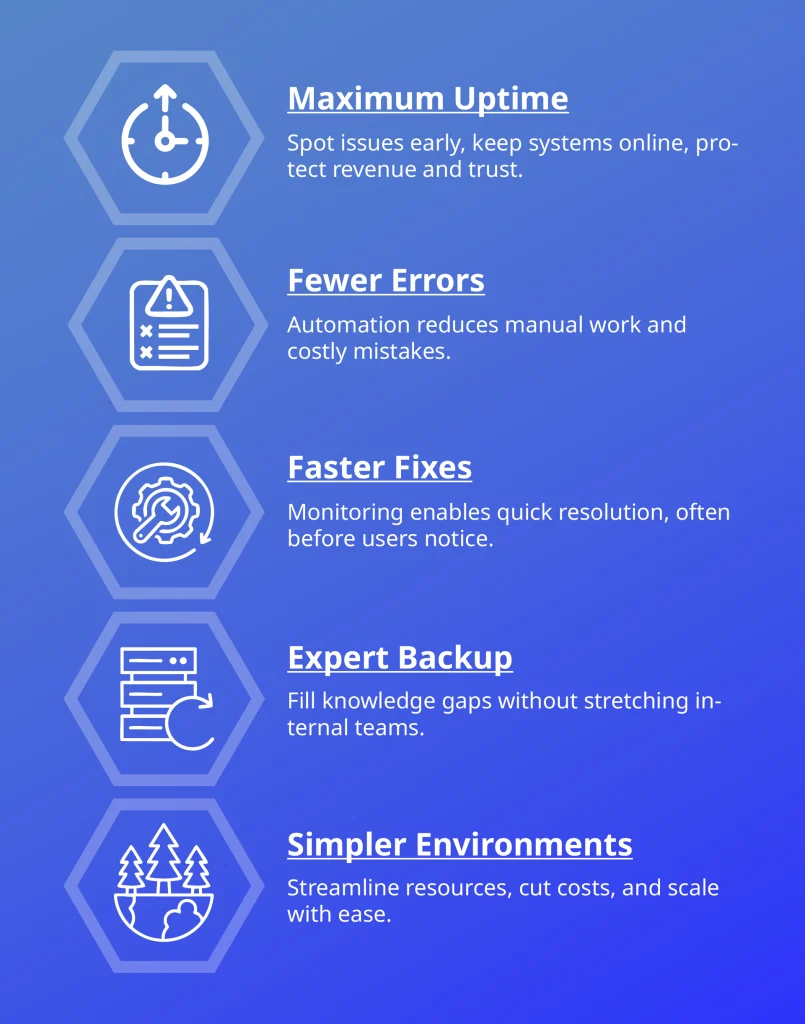
Fewer interruptions for customers, smoother releases for developers, and leadership teams that can focus on growth instead of firefighting.
What a Typical Cloud Ops Engagement Looks Like
So what actually happens when you bring in a cloud operations engineer?
It isn’t just troubleshooting when things go wrong, but a structured approach that strengthens your entire environment.
Here’s what a typical engagement looks like for an SMB:
- Cloud health assessment. First comes a full review of your setup. Weak spots, wasted resources, and hidden risks get mapped out so you know exactly where attention is needed.
- Monitoring and alerting. Next, tools are deployed to give real-time visibility into performance and security. Instead of waiting for a customer to flag an outage, issues are spotted and addressed before they escalate.
- Automation. Infrastructure as Code (IaC) scripts are introduced to replace manual provisioning. Every new environment is created the same way, every time, consistent, secure, and fast.
- Ongoing patching and updates. Systems stay compliant and protected without downtime. Updates happen smoothly in the background, so your team isn’t disrupted by late-night emergencies.
- Deployment support. Releases are no longer a gamble. Cloud ops engineers stabilise the CI/CD pipeline, making sure new code moves into production without breaking live services.
The result is a balance of proactive maintenance and rapid response.
Your business gains resilience without the cost and overhead of a large in-house operations team, and your developers can focus on building instead of firefighting.
If you’re planning a wider transformation, our guide on building the right cloud strategy and architecture outlines how to align technology with long-term goals.
Cloud Ops vs DevOps: What’s the Difference and Where They Overlap
Short answer: they’re not the same.
DevOps is the accelerator. It designs and automates the pipeline that takes code from a developer’s laptop into production. Think continuous integration, automated testing, and deployment strategies that make releases fast and repeatable.
Cloud ops is the stabiliser. Once the code is live, cloud ops keeps the environment healthy day after day.
To put it simply: DevOps builds the highway; cloud ops maintains it. Without DevOps, you’ll never deliver fast enough. Without cloud ops, the first crack in the road will bring traffic to a standstill.
Where things get interesting is in the overlap. The two functions constantly touch the same systems from different angles:
- Infrastructure as Code: DevOps writes templates, cloud ops ensures they remain secure and consistent.
- Observability: DevOps instruments services, cloud ops manages dashboards, and incident response.
- Security: DevOps enforces policies in pipelines, and cloud ops enforces them in production.
For SMBs, the key takeaway is to avoid framing it as a choice. DevOps accelerates innovation, and cloud ops safeguards it. When they work together, you get both speed and resilience, and that’s what gives a business room to scale without burning out.
Why Outsourcing to a Cloud Ops Team Like Deployflow Makes Sense
Hiring senior cloud operations engineers in-house is expensive, and for most SMBs, unnecessary. Unless you’re running workloads at enterprise scale, a full-time hire often means paying for expertise you don’t use every day.
Outsourcing gives you access to the skills you need, when you need them, without carrying the overhead.
Here’s why it works:
- Immediate expertise. Outsourcing gives you instant access to engineers who already know the ins and outs of AWS, Azure, GCP, and hybrid environments. There’s no waiting through months of recruiting, onboarding, and training. You start benefiting from hard-won knowledge right away.
- Broader experience. External teams work across multiple industries and architectures, which means they’ve seen edge cases your business may never encounter until it’s too late. They bring proven fixes and best practices drawn from dozens of other projects, something a single internal hire simply can’t match.
- Cost efficiency. Hiring senior cloud engineers in-house is expensive once you factor in salaries, benefits, and ongoing training. With an outsourced model, you pay for what you need, when you need it, whether that’s a short engagement to stabilise your pipeline or ongoing support to keep systems compliant.
- Faster response times. Downtime is a drain you can’t afford. For UK businesses, IT outages cost an average of £4,300 per minute, depending on industry and size. (source: Clyk) With 24/7 monitoring and dedicated incident response, external cloud ops teams dramatically reduce that risk by catching issues before they become customer-facing outages.
- Focus where it matters. Every hour your internal team spends troubleshooting is an hour lost on building new features, serving customers, or driving growth. Outsourced cloud ops takes the weight of stability and maintenance off their shoulders so they can get back to innovation.
With the UK cloud market projected to grow at 18.4% CAGR through 2030, demand for skilled engineers will only intensify, making flexible outsourcing models even more valuable for SMBs. (source: GrandViewResearch)
The real advantage, though, comes from the way this support is delivered. At Deployflow, cloud ops isn’t a side service; it’s embedded in sprint-based delivery squads.
A delivery squad is a small, cross-functional team that works in short, focused sprints.
Instead of vague promises of “ongoing support,” you get:

The outcome is a model that combines stability with speed. Every deployment is secure, every environment is consistent, and every release benefits from the experience of a team that lives and breathes cloud resilience.
When internal teams are stretched thin, this blog on sprint-based delivery squads explains how they can fill gaps and keep delivery moving without disrupting existing workflows.
This isn’t theory. When Zilch, a UK fintech now valued at over $2 billion, needed to deliver complex API integrations in under a month, Deployflow embedded a dedicated squad. By combining Terraform automation, streamlined pipelines, and QA at every stage, Zilch achieved:
- A one-month turnaround on integrations critical to survival
- 2× faster environment setup through automation
- The ability to replicate environments instantly across teams
- Full adaptability to supplier and vendor challenges
For SMBs, it’s outsourcing with structure, the kind that de-risks your cloud while giving your developers the freedom to innovate.
If you want cloud operations that are stable, secure, and built to scale, our Cloud Management services are designed for exactly that. From sprint-based delivery squads to ongoing optimisation, we help SMBs grow without the chaos.
Why Cloud Ops Is the Hidden Driver of Growth
Cloud operations engineers rarely sit in the spotlight, but their work powers everything behind the scenes. They prevent downtime, streamline deployments, and give your business the confidence that cloud systems won’t fail when you need them most.
For SMBs and mid-market businesses, the real decision isn’t if you need cloud ops support — it’s how you’ll get it: by stretching internal teams thin, or by partnering with a squad that can scale alongside you.
Key Takeaways: Why Cloud Ops Drives Business Growth
- Cloud ops is more than admin work. It serves as the backbone of uptime, security, and compliance.
- DevOps and cloud ops work hand in hand. One accelerates delivery, while the other safeguards operations.
- Sprint-based delivery squads add structure. They provide fast wins, clear priorities, and built-in collaboration.
- Outsourcing makes expertise accessible. You gain senior-level support without the expense of hiring full-time engineers.
If you’re ready to stabilise and scale your cloud operations, contact our team and let’s map out the best approach for your business.
Strong cloud ops today means faster growth and bigger opportunities tomorrow.
Frequently Asked Questions: Cloud Ops and DevOps Explained
How do cloud operations engineers improve security in the cloud?
Cloud ops engineers build security into the daily workflow instead of treating it as an afterthought. They enforce least-privilege access and rotate credentials through vaults, automate vulnerability and image scanning, and use policy-as-code to block non-compliant deployments.
Centralised logging and anomaly alerts mean suspicious activity is caught fast. This proactive model shortens the window for attacks and ensures every deployment meets compliance standards by default.
Security should guide every decision in the cloud, and this article on navigating the cloud with cybersecurity as your compass shows how to stay resilient against evolving threats.
What metrics should SMBs track to measure cloud operations success?
The most useful metrics go beyond simple uptime. Availability and SLA compliance confirm systems are delivering as promised, while Mean Time to Detect (MTTD) and Mean Time to Respond (MTTR) show how quickly issues are spotted and resolved. Change Failure Rate (CFR) highlights how often deployments cause outages or rollbacks.
Finally, cost efficiency metrics (such as normalised spend per workload) reveal whether resources are being used effectively. Looking at these together gives a balanced view of stability, responsiveness, and financial performance.
Can cloud ops help reduce cloud costs?
Absolutely. Cloud ops teams integrate cost control into everyday operations. By monitoring usage, tagging resources, and applying rightsizing, they prevent idle capacity from inflating bills.
Auto-scaling policies help workloads flex with demand, while dashboards and anomaly alerts give real-time visibility into spending patterns. Many SMBs find these practices deliver significant savings, often cutting double-digit percentages from monthly bills without reducing performance.
Managing costs is as critical as scaling workloads. Our post on optimising cloud cost management breaks down practical steps to save money without sacrificing performance.
How do cloud ops engineers support compliance in regulated industries?
In regulated sectors, compliance is survival. Cloud ops engineers keep systems audit-ready by enforcing encryption in transit and at rest, maintaining immutable logs, and automating backups and disaster recovery drills.
They also apply data segregation policies to keep sensitive workloads isolated and document incident response plans with evidence that regulators can review. The result is a cloud environment that can demonstrate resilience and security at any moment, rather than scrambling to prepare when auditors call.
Explore our BLOG
Recent articles

ISO 42001 Explained: Requirements, Certification and What Your Engineering Team Must Build
ISO 42001 is the international standard that demonstrates your organisation governs AI properly, and enterprise...
read full article

Is Claude Down? Anthropic Outage: Protect Your Cloud Infrastructure
Claude went down across every surface on 29 September 2026. From 14:00 to 14:59 UTC,...
read full article

Top 10 Healthtech Companies in 2026: What Their Growth Means for AI and DevOps
Every software change that reaches a hospital has to clear regulatory, legacy system, and clinical...
read full article