



Conventional machine learning gives you feedback in hours. A farm gives you one harvest a year. That gap is why most agritech AI stalls in pilot, and why the usual ML playbook will not save it.
Farm AI only pays off when it changes a decision in the field. Anything short of that is a dashboard nobody trusts.
The good news is the hard part is engineering you already understand. A modern farm is a live distributed system: thousands of sensors, patchy connectivity, and data running from soil to supply chain. Treat it as one, and four engineering decisions separate the pilots that ship from the ones that stall.
Executive Summary: Modern Farm AI Engineering
- Why seeing a farm as a live distributed system changes how farm AI gets built
- How to capture and move field data at the edge, where connectivity is never guaranteed
- How to engineer models around a feedback loop that turns once a year
- Which AI use cases close the loop and act on the field: yield forecasting, crop health, input control
- How to run farm AI in production and keep the cloud bill in check
- When to build in-house, buy, or bring in a delivery partner
Treat the Modern Farm as a Distributed System
See the farm as infrastructure, and the engineering falls into place.
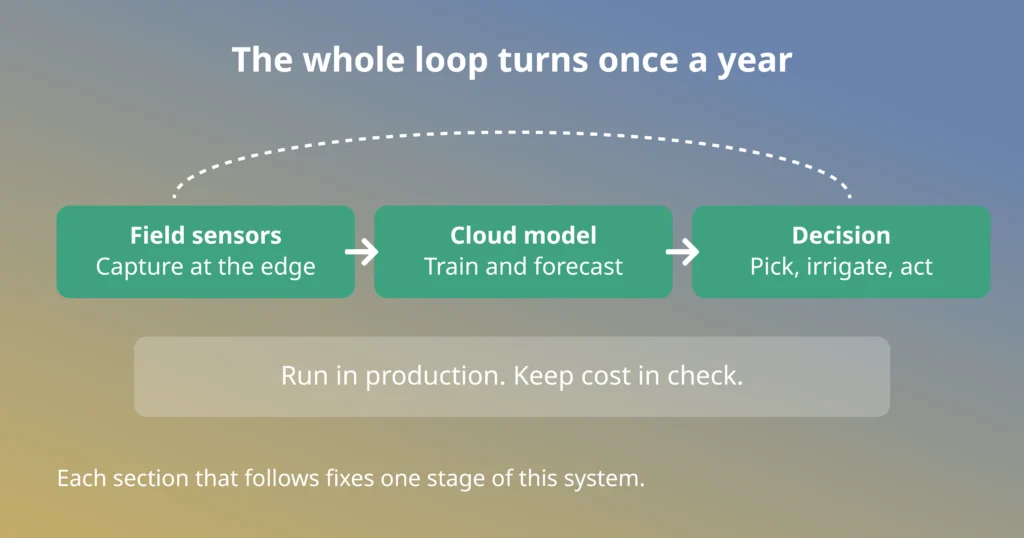
Farm AI stalls when teams build for the lab and ship to the field. A model trained on a tidy sample wins the demo, then meets a working site and breaks.
Gartner found that by the end of 2025, at least 50% of generative AI projects had been abandoned after proof of concept, blamed on poor data quality, weak risk controls, runaway cost and unclear business value. The technology differs from a yield model. The four failure modes do not. Agriculture hits every one of them, harder than most sectors.
A farm is a distributed system, and you already have a name for each of its problems. Sensors and machines are edge nodes. Intermittent signal is a store-and-forward problem. Soil probes, cameras and weather feeds are heterogeneous data arriving on different clocks. A shifting climate is a non-stationary input. None of that is new to you. It has just never worn hi-vis and wellies before.
Cloud already does much of this work on farms today, and you can see where it earns its place in these seven cloud computing use cases in agriculture.
So, the discipline transfers. Bring the rigour you would give any distributed estate, from edge capture to cost control, and the work that looks like farming turns back into engineering you can plan, budget and own.
Data at the Edge: Where Farm AI Actually Lives
Your data problem starts at the edge, long before the model.
The data defeats most farm AI before the model gets a say. It comes from kit scattered across acres of low-signal ground. Capturing it reliably is an architecture decision, and you make it before training a single model. Get the decision wrong, and the cleanest algorithm still forecasts on gaps.
The first call is streaming versus store-and-forward. Streaming assumes a link that a working field rarely provides, so on low-connectivity sites the system has to capture locally and sync when signal returns. That choice sets your reliability floor. It is worth settling early, because retrofitting it across deployed hardware is slow and expensive.
The second call is whether to build edge data capture or buy it. Building fits when your sites are unusual enough that no platform matches them, and it commits you to owning the hardest, least visible layer in the stack. Buying moves faster and hands the reliability problem to a vendor, provided you can verify they have solved it.
That verification rests on lineage. Every reading needs a timestamp and a traceable source, so a forecast can be defended back to the exact sensor and moment behind it. Treat lineage as an audit trail, the risk control any model driving six-figure calls has to have.
When a model drives a six-figure call on labour or irrigation, you have to prove where the number came from, and a team or supplier that cannot show that has not finished the job.
Engineering for a Feedback Loop That Turns Once a Year
Farming breaks the ML playbook. Build for its clock.
Conventional machine learning runs on fast feedback: ship, measure within days, retrain, repeat. You learn whether a yield model was right a full season after it made the call, so you cannot iterate your way to accuracy the way you would with a web model.
The ground also moves under the model. Weather, soil and pests shift year on year, and a model trained on five strong seasons can still miss when the pattern breaks. Design for that drift from day one.
Three moves make a model survive the annual clock:
- Use transfer learning. The model borrows signal across sites and seasons instead of starting cold each spring.
- Ship a confidence range with every forecast. A grower reads the uncertainty rather than trusting a false exact number.
- Keep an agronomist able to override it. One bad season does not turn into one bad decision.
Close the Loop: Farm AI That Acts on the Field
A forecast only pays off when it changes a decision on the ground.
The value in farm AI sits in the return trip. A model turns your field data into a prediction, and that prediction has to reach the decisions that follow: when to pick, where to irrigate, how much labour to book, what to promise a retailer. Wire it in, and it earns money. Leave it as a chart on a screen, and it earns nothing.
The opportunity is large. McKinsey puts the prize at more than $500 billion added to global GDP by 2030, a 7-9% productivity lift for one of the least digitised industries anywhere. Much of that value sits in crop use cases, from monitoring to precision inputs to yield, the exact problems a working forecast addresses.
Which loop to close first depends on your data.
Yield forecasting is the usual starting point, since it sharpens labour planning, packing and retailer commitments, where a small error carries a high cost.
Computer vision comes next, reading crop disease, ripeness and quality grade from images faster and more evenly than any manual check.
Input control tunes irrigation, fertiliser and labour to match what the crop actually needs.
Rank them by data readiness and payback, then build the one that clears both bars first.
Run Farm AI in Production Without the Bill Running You
Shipping the model is half the job. Keeping it live and affordable is the rest.
Treat production at the edge as its own build, with three things in place before launch.
- Set up MLOps first. Your model has to run through a full season, retrain as fresh data lands, and flag its own drift, across cloud and field, without someone nursing it. Automate deployment, monitoring and retraining now, or you will be doing all three by hand at harvest, when you have no time for it.
- Put cost controls in from day one. AI workloads burn compute in ways that blindside finance teams, and runaway cost is one of the top reasons these projects get cancelled. Set budgets, tag every resource, and right-size on a managed cloud, so spend stays visible before it stays large.
Deployflow saw the same principle hold beyond AI: moving Hall Hunter, a UK berry grower, to managed cloud cut IT costs by around 30% and gave its team a stable base to build on.
- Name an owner before you finish. Someone inside the business has to run the system, understand it and improve it, and most projects skip this until it is too late to hand over cleanly. Budget for documentation, handover and training, plus the security and compliance controls any serious data platform needs.
Build, Buy or Partner: How to Resource Agritech AI
You do not need a data science department to ship farm AI.
Match the route to the shape of the work. Farm AI runs hard for a season, then goes quiet, and that rhythm should decide how you resource it.
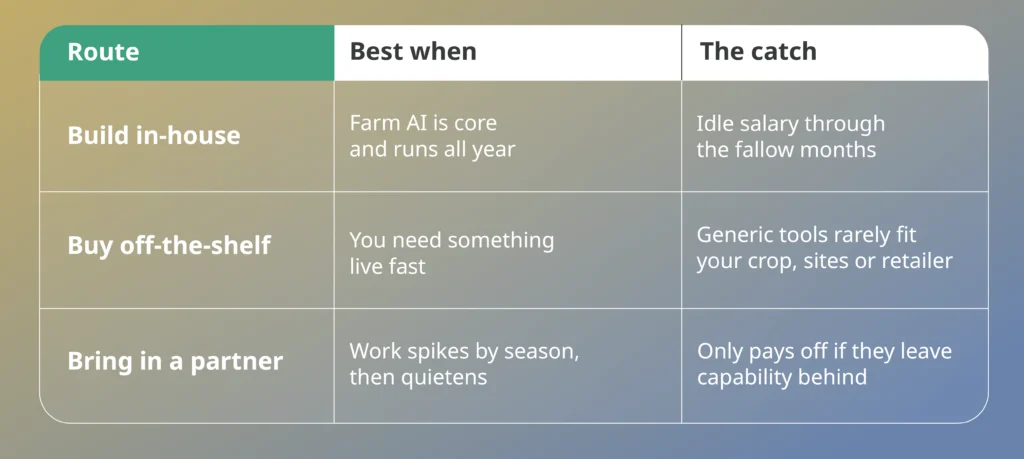
The third route fits most growers, because the work arrives in bursts. The sequence is fixed. Assess. Prototype. Harden into a system your own people run. Done well, the partner leaves capability behind, with no lock-in, which is what separates it from open-ended staff augmentation.
Vet the partner on evidence: production systems still live years after launch, cost outcomes you can verify, and a written handover plan.
Deployflow works this way as a transformation delivery partner, and its agritech AI engineering opens with a short conversation or cost review. You keep a system that stands on its own, long after the partner has gone.
Where Is Your Farm AI Stuck?
Four symptoms, four gaps. Diagnose yours before you build.
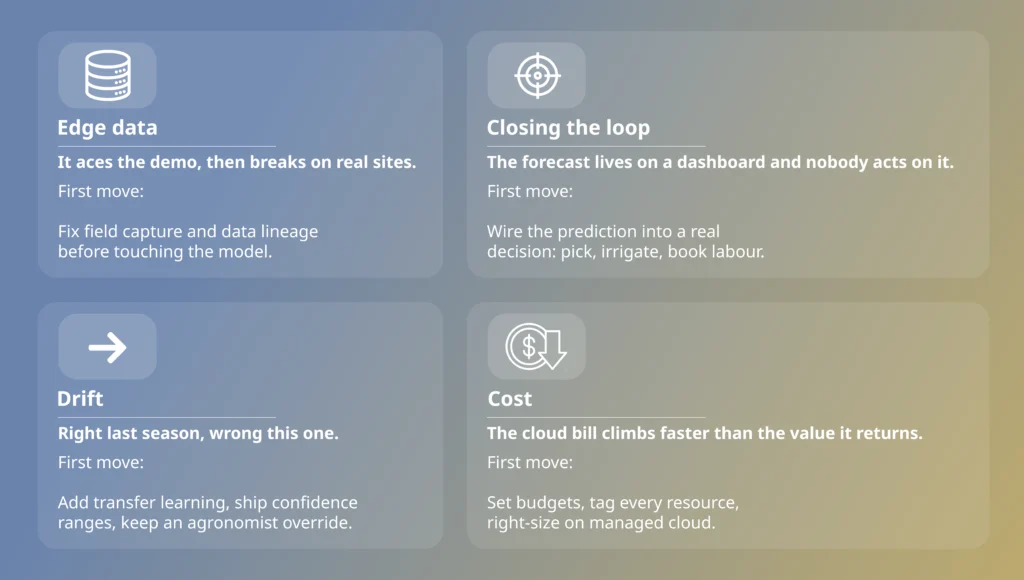
Your First Step From Field to Algorithm
Every idea in this article points to one move: start small, prove it, then scale.
A farm is a distributed system, so the hard part is capturing field data at the edge before any model runs. Feedback comes once a year, so you engineer for drift and ship uncertainty. Value only lands when the forecast changes a decision on the ground. And none of it holds unless the cost stays controlled and your own team ends up owning the system. If you get that order right, a pilot becomes infrastructure that earns its place season after season.
That order also tells you where to begin. You do not start with a model. You start by finding which gap is actually blocking you, whether it is edge data, model drift, an unclosed decision loop or cost, because fixing the wrong one wastes a season you cannot get back.
A short consultation finds that gap and shows where the fastest return sits, for little outlay and no commitment to a full build. From there, a validated prototype proves the value before you spend on scale.
If your yield forecasting is stuck in pilot, or your cloud bill is climbing faster than the value it returns, book a free consultation with Deployflow’s experts. You leave with one clear diagnosis, honest numbers and a plan you can act on. The gap from field to algorithm is an engineering problem, and it has an engineering solution.
Frequently Asked Questions About Farm AI Engineering
Why do agritech AI projects fail?
Agritech AI usually fails for four reasons: unreliable field data, an unclear payoff, cloud costs that spiral, and no one inside the business owning the system after launch.
Gartner attributes AI project failures to weak data quality, poor risk controls, runaway cost and unclear value, and agriculture amplifies all four. Sensors sit on low-signal ground, feedback arrives once a season, and pilots rarely get handed over cleanly. The projects that survive fix the data and the decision loop before touching the model.
Can AI predict crop yield accurately?
Yes, AI can forecast crop yield well enough to plan labour, packing and retailer commitments, but only if you treat accuracy as a range rather than a single number.
One season of feedback per year means the model learns slowly, so accuracy rests on three things: transfer learning to carry signal across sites and seasons, a confidence range on every forecast instead of a single figure, and an agronomist who can override the model when a season breaks the pattern.
Do you need a data science team to use AI on a farm?
No. You can ship useful farm AI without an in-house data science department, and for most growers a permanent team is the wrong fit, because the work runs hard for a season then goes quiet.
Three routes exist: build in-house when farm AI is core and runs all year, buy off-the-shelf when you need something live fast, or bring in a delivery partner when the work spikes by season. The partner route suits most operations, provided the sequence is assess, prototype, then harden into a system your own people run. A good partner hands over a system your team runs alone, with no ongoing dependency on them.
How much does it cost to run AI on a farm?
The build is rarely the expensive part. The recurring cost that catches teams out is cloud compute for retraining and inference, which climbs quietly until finance notices.
Rough order of magnitude: compute for retraining and inference can run into four or five figures a month at scale if left unmanaged. Control it with budgets, resource tagging and right-sizing on managed cloud from day one, and budget separately for MLOps, handover and security controls.
Where should a farm start with AI?
Start by finding which gap is blocking you (edge data, model drift, an unclosed decision loop or cost), then run a small pilot on the use case with the best data and payback.
Yield forecasting is the usual first move, since it sharpens labour planning, packing and retailer commitments where small errors cost the most. Crop health (computer vision) tends to come next, then input control for irrigation and fertiliser. A short assessment finds the real blocker and shows where the fastest return sits, for little outlay and no commitment to a full build, which beats spending a season fixing the wrong problem.
Explore our BLOG
Recent articles

ISO 42001 Explained: Requirements, Certification and What Your Engineering Team Must Build
ISO 42001 is the international standard that demonstrates your organisation governs AI properly, and enterprise...
read full article

Is Claude Down? Anthropic Outage: Protect Your Cloud Infrastructure
Claude went down across every surface on 29 September 2026. From 14:00 to 14:59 UTC,...
read full article

Top 10 Healthtech Companies in 2026: What Their Growth Means for AI and DevOps
Every software change that reaches a hospital has to clear regulatory, legacy system, and clinical...
read full article