


When millions move through your platform every second, one failed transaction is not a bug but a liability. Payment gateways freeze, trading engines stall, and customers lose trust faster than systems can recover.
That’s why FinTech platforms rely on Go: a language purpose-built for speed, concurrency, and uptime.
Golang doesn’t rely on fragile threads or slow interpreters; instead, it runs thousands of lightweight processes in parallel with predictable speed and memory efficiency.
While most users see the polished dashboards and mobile apps, the real work happens elsewhere. Go services run quietly in the background, authorising payments, reconciling balances, and keeping systems synchronised across regions.
This guide will show you:
- Why Go dominates FinTech production environments
- How it outperforms Python and Node.js in concurrency, transaction handling, and uptime
- The operational advantages it brings to regulated, always-on businesses
Keep reading to see why Go has become the language of choice for systems that can’t afford to fail, where performance, trust, and uptime define the bottom line.
Why FinTech Needs More Than “Fast Code”
Speed means nothing if a system crashes in the middle of a transaction. In finance, one second of downtime can freeze millions of dollars mid-transfer and trigger a chain of failures that no “hotfix” can undo.
According to Splunk’s 2024 report, downtime costs financial organisations an average of $152 million annually, with nearly a quarter of that loss coming directly from revenue interruptions. FinTech needs code that never breaks stride.
Every API call, balance update, and payment confirmation has to be precise, consistent, and repeatable, no exceptions. That’s why the true challenge isn’t speed but stability under pressure.

Languages like Python and Node.js handle business logic well enough, but when transaction volumes explode and milliseconds matter, Go is the one that keeps the lights on.
Go’s Design Philosophy: Built for Concurrent Transactions
Money moves in parallel. A payment gateway might be authorising cards, reconciling balances, checking fraud signals, and writing ledgers, all at the same time.
Go was shaped for exactly this kind of load: lots of small, independent tasks that must run safely in parallel and finish fast.
Goroutines: Tiny, Fast, and Many
In Go, each incoming request typically runs in its own goroutine, a lightweight, managed thread the runtime multiplexes onto a small pool of OS threads. This pattern (one request to one goroutine) is the default in Go servers and makes high-concurrency I/O simple to reason about.
Goroutines start with a very small stack (about 2 KB) that grows and shrinks automatically, so you can run hundreds of thousands of them without blowing up memory.
In a typical Go server, every incoming request is handled in its own goroutine. The loop is simple, and that simplicity is the secret to Go’s scalability:
for {
conn := listener.Accept()
go serveConn(conn)
}
or
for {
req := getRequest()
go serveRequest(req)
}
Each new request spawns a goroutine that runs independently, allowing the server to handle tens or even hundreds of thousands of simultaneous connections.
However, this flexibility comes with a cost: every time a new goroutine grows its stack, the runtime spends extra CPU cycles on memory resizing (newstack calls).
In high-load FinTech systems (where thousands of connections can appear within a second), this can cause brief CPU spikes.
As Uber’s engineering team observed in their own large-scale Go infrastructure, understanding and tuning stack growth can significantly improve throughput under extreme concurrency.
That’s the trade-off Go optimises elegantly: tiny, independent execution units with dynamic memory growth, managed automatically by the runtime scheduler.
Once goroutines handle concurrency, channels handle coordination.
Channels: Safe Hand-Offs and Backpressure
Go’s channels give goroutines a built-in, thread-safe way to pass data without locking, mutexes, or shared-state chaos. You can think of them as typed pipelines; one goroutine deposits data, another collects it.
This design does more than simplify communication; it controls the pace of work. When a receiving goroutine is busy or a buffer fills up, the sender automatically waits. That built-in pause (known as backpressure) is crucial for financial systems where slowing down is safer than breaking down.
In payment flows, for example, a temporary database delay shouldn’t cause dropped transactions or race conditions. Channels make this behaviour automatic: they synchronise the flow of money-related data the same way traffic lights coordinate intersections, keeping movement steady, safe, and predictable.
The following example shows how Go handles large-scale transaction checks in parallel without risking data loss or race conditions:
// Fan-out / fan-in pattern for fraud detection
func detectFraud(transactions []Transaction) {
in := make(chan Transaction)
out := make(chan Result)
// Fan-out: start workers
for i := 0; i < 5; i++ {
go func() {
for tx := range in {
out <- checkFraud(tx)
}
}()
}
// Feed transactions
go func() {
for _, tx := range transactions {
in <- tx
}
close(in)
}()
// Fan-in: collect results
for i := 0; i < len(transactions); i++ {
result := <-out
log.Println(“Fraud check:”, result)
}
}
This pattern shows how Go’s concurrency model scales intelligently for fraud detection and transaction monitoring. By using fan-out (multiple goroutines checking transactions in parallel) and fan-in (aggregating their results safely), financial systems can handle thousands of checks per second without locking or race conditions.
In FinTech, this means real-time fraud detection pipelines can stay both fast and safe, distributing heavy workloads automatically while maintaining strict data integrity and timing guarantees.
For a deeper look at how channels evolve into full streaming pipelines (with fan-in, fan-out, and built-in cancellation signals), check the official Go Blog post Go Concurrency Patterns: Pipelines and Cancellation by Sameer Ajmani (long-time Google engineer and part of the Go core team at Google).
It’s an excellent deep dive into how Go’s concurrency model handles real-world failures, resource cleanup, and graceful shutdowns, exactly the kind of resilience production-grade FinTech systems depend on.
What Google’s Engineers Taught Us: Context and Controlled Concurrency in Go
Real-world Go servers coordinate goroutines predictably.
As Sameer Ajmani explains in the Go Concurrency Patterns: Context post, each request in a Go server runs in its own goroutine, often spawning others to call databases, APIs, or ledgers.
The context package allows all of these to share deadlines, cancellation signals, and authorisation data, ensuring that when one part of a transaction fails, every related goroutine exits cleanly.
In FinTech systems, this prevents resource leaks, stalled transactions, and half-finished writes, the exact kind of inconsistencies that can cost real money.
To understand why this scales so well, you need to look at Go’s scheduler.
The Scheduler: M-P-G Keeps Throughput High
Under the hood, Go runs on a three-part scheduling model, M-P-G, short for Machine, Processor, and Goroutine.
- G (Goroutine) represents the lightweight unit of work: a request, transaction, or background job.
- M (Machine) maps to an actual operating-system thread.
- P (Processor) is an internal scheduler that binds goroutines to available threads and distributes them across CPU cores.
This architecture allows Go to execute hundreds of thousands of goroutines efficiently without overloading the kernel. When one goroutine blocks on I/O, the scheduler immediately parks it and assigns another ready goroutine to that thread, keeping CPU utilisation near optimal.
Here’s a simple way to visualise how Go manages sudden transaction spikes using its built-in scheduler:
// Simulating transaction bursts under load
func handleTransactions(stream <-chan Transaction) {
for tx := range stream {
go process(tx) // Each transaction runs in its own goroutine
}
}
In simple terms, Go’s scheduler ensures no CPU sits idle, even when thousands of requests compete for attention.
Each incoming transaction runs in its own goroutine, allowing the runtime to balance load dynamically across CPU cores.
When hundreds or thousands of requests hit at once (like during a trading surge or peak payment window), Go automatically parks blocked goroutines and assigns ready ones to available threads. That means CPUs stay busy, queues stay short, and latency remains predictable even under pressure.
In practical terms, FinTech platforms built on Go can process massive bursts of concurrent activity (payment authorisations, order executions, balance reconciliations) without the cascading slowdowns common in thread-heavy architectures like Java or Python.
For FinTech systems, this means that a burst of market orders or concurrent payments doesn’t clog your servers. The scheduler maintains fairness and balance, high-priority tasks like transaction commits keep running smoothly, while blocked or slow tasks yield automatically.
It’s concurrency without chaos, and it’s one of the reasons Go services deliver high throughput on fewer cores, cutting both latency and infrastructure costs.
Concurrency Showdown: Go vs. Python vs. Node.js
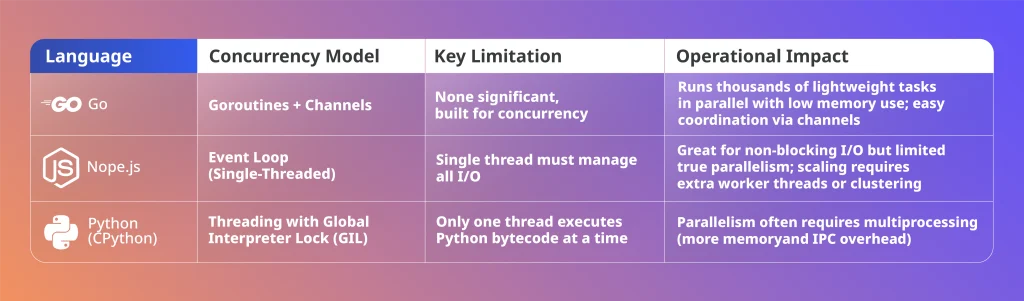
Why This Excels in Finance
- Low latency under pressure: Go doesn’t wait for its turn in an event loop. Goroutines spin up instantly and handle requests as they come. That means transaction approvals, quotes, and confirmations happen in real time, not in the next CPU cycle.
- True high concurrency: Each goroutine starts with just a few kilobytes of memory, and Go’s cooperative scheduler distributes them efficiently across all cores. The result is seamless fan-out for thousands of simultaneous payments, market updates, and ledger operations without choking the system.
- Operational safety by design: Built-in patterns like channels, contexts, timeouts, and deadlines make it easy to stop, cancel, or retry operations safely. Errors don’t cascade; they propagate predictably, preventing half-completed transfers or locked accounts.
Go’s concurrency model mirrors how financial systems themselves operate; thousands of micro-transactions, fraud checks, and reconciliations all happening at once, safely and continuously. It’s concurrency built for confidence, not chaos.
Transaction Safety and Error Handling in Go
In finance, invisible errors are the most expensive kind. Go’s strict type system, compile-time checks, and explicit error handling make silent failures almost impossible.
- Precision first: Go avoids floating-point drift by encouraging fixed-point and decimal arithmetic, essential when fractions of a cent can break compliance.
- Predictable concurrency: Goroutines don’t share memory; they communicate through channels, eliminating race conditions that could corrupt account balances or ledgers.
- Transparent failures: Instead of hidden exceptions, Go returns errors explicitly, forcing every failure to be acknowledged, logged, or retried.
- Real-world impact: A Go-based payment gateway can process micro-batches of transactions in parallel while guaranteeing zero duplication or missed states, a level of reliability few languages achieve by design.
Reliability and Uptime: Go in Production
Even brief downtime in finance (a stalled order matching engine, a failed payment sweep, or delayed reconciliation) can erode trust, open regulatory risk, and incur significant costs.
Go brings several production-grade strengths to help financial systems stay live under pressure:
- Compact, single-binary deployments. Go services compile into self-contained binaries, which reduces dependency complexity and makes rollbacks or hot fixes much safer.
- Predictability from static typing. Many categories of runtime errors are eliminated before the code ever runs. In high-stress environments, that means fewer surprises.
- Memory and CPU efficiency. Because goroutines and stacks stay lightweight, your cluster can support higher instance density, which gives more cushion under spikes.
- Built-in coordination and cancellation. Go’s context support lets services cancel operations cleanly when part of a transaction fails or times out, preventing resource leaks or partial states.
In practice, teams running Go services in production report both clear advantages and important lessons learned. For example, in Lessons From Running Go Services in Production for 2+ Years, engineers observed latency spikes under heavy load due to GC pauses. It’s a reminder that monitoring, tuning, and observability are critical companions to Go’s strengths.
Another strong real-world signal: engineers at Uber built a high-QPS service in Go that reportedly handled 170,000 queries per second with 35% CPU usage across its nodes, and achieved “super reliable” uptime, estimated at 99.99%, apart from edge bugs. Learn more about Uber and other Golang use cases.
Reliability doesn’t just happen. It’s the result of Go’s architecture working hand in hand with good engineering habits: strong monitoring, clear alerting, and smart failure isolation. When you align those, Go helps financial systems minimise downtime, recover fast, and maintain trust under load.
Go vs. Python vs. Node.js: Operational Comparison
In FinTech, language choice directly affects uptime, cost, and customer trust. What matters isn’t syntax but how fast a service starts, how efficiently it runs, and how clearly it fails when something breaks.
To see how Go stacks up against its peers, here’s how it performs in the key operational metrics that define financial reliability.

Go is built to keep systems running. In production environments where uptime, predictability, and cost per transaction matter, that difference becomes business-critical.
The Business Impact of Choosing Go in Financial Systems
Every millisecond and CPU cycle translates to real cost. Go’s lean runtime means fewer containers and cheaper scaling, especially in Kubernetes clusters processing high-frequency transactions.
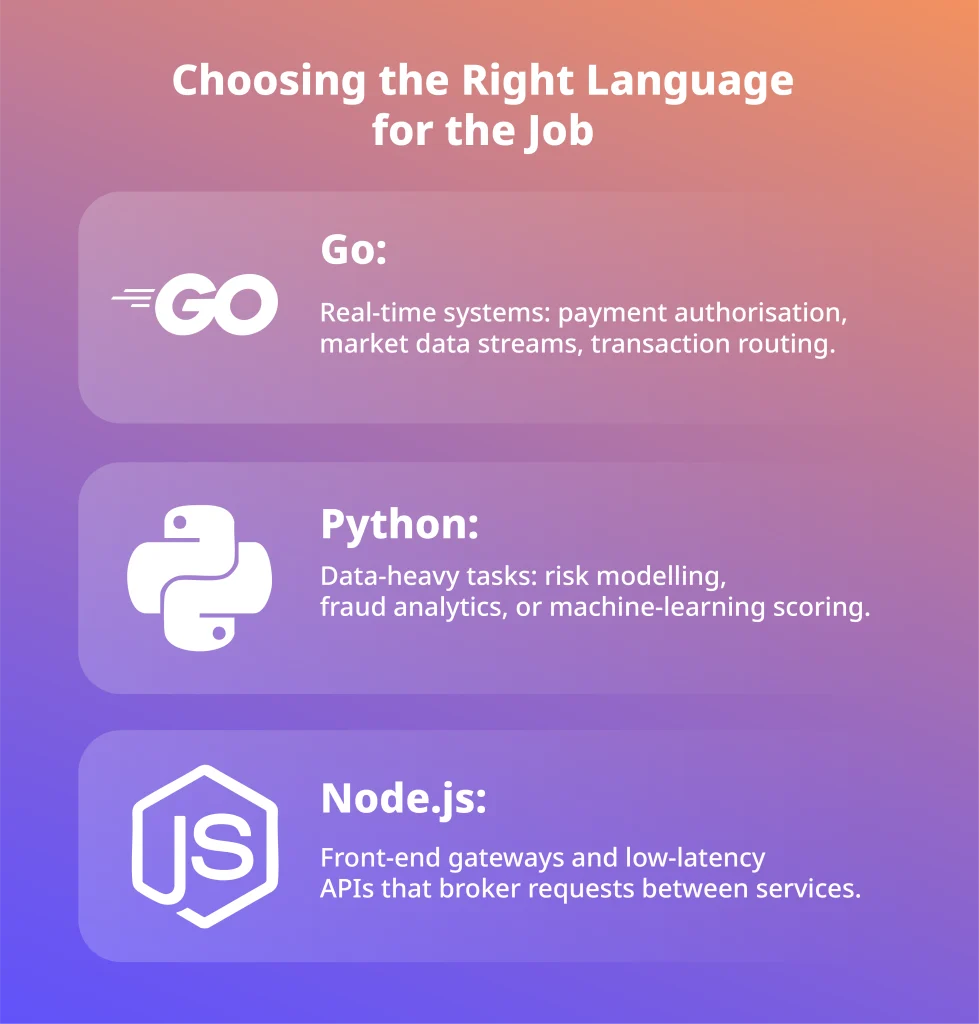
A Python-based fraud detection service might shine in analytics, but its runtime lag makes it risky for live payment flows.
Node.js can handle bursts of I/O, yet struggles with thousands of simultaneous account reconciliations that demand true parallelism.
Example:
A trading platform running Go microservices can execute thousands of concurrent order updates with consistent latency under 20 ms. In a similar Node.js setup, event-loop contention often pushes latency above 100 ms during peak trading, while Python processes might queue tasks until new workers spin up.
Ultimately, Go stands out because it was built for production predictability: fewer moving parts, faster recovery, and lower operational overhead. In FinTech, that translates to a faster, safer, and more cost-efficient path to uptime.
Who’s Using Go in FinTech (Mini Case Studies)
From cloud-native banks like Monzo and Curve, to payment giants like American Express, PayPal, and MercadoLibre, Go has become the quiet foundation of modern finance.
Even institutions like Capital One, which once relied entirely on Java, have adopted Go to bring speed, safety, and concurrency into production. Behind nearly every instant payment, API authorisation, or digital card transaction, there’s a high chance that some part of the process runs on Go.
How American Express Uses Go to Power High-Speed Payments and Rewards
At American Express, Go was introduced to modernise and future-proof the company’s massive payment and rewards infrastructure. Handling millions of transactions daily requires extreme reliability and real-time performance; two areas where Go excels.
After testing multiple languages, Amex engineers found Go’s concurrency, static typing, and built-in testing tools unmatched for their needs.
The result was faster, safer transaction routing and load balancing, along with significantly improved developer productivity.
Today, many of their services run within a Kubernetes-based internal cloud powered by Go technologies like Docker and Prometheus, giving Amex a modern, resilient backbone for global operations.
Curve’s Cloud-First Banking Platform Built with Go
Curve, on the other hand, uses Go to make banking simpler for users and developers alike. Its goal (merging multiple cards into one app) demands fast, test-driven, and scalable systems.
Go’s simplicity lets Curve train developers in just weeks, often converting Java or PHP engineers into full-time Go advocates. The language’s compact memory footprint and single-binary architecture make containerization effortless, while its automated formatting and testing tools keep development clean and consistent.
Combined, these features allow Curve to iterate faster, deploy securely, and scale with confidence as it expands its cloud-first banking model.
PayPal’s Modernisation Journey: Scaling Global Payments with Go
At PayPal, Go has become a cornerstone of modernisation across infrastructure and payments.
When the engineering team rewrote its complex NoSQL system in Go, they achieved cleaner, maintainable code with about 10% lower CPU usage and far easier scaling.
Over 100 PayPal developers now use Go to build internal systems (from build pipelines to SDN tools), benefiting from rapid compilation and explicit error handling that keeps production environments stable.
The move to Go has also paved the way for broader Kubernetes adoption, helping PayPal scale automatically with demand while minimising operational overhead.
These FinTech leaders prove that Go is a production workhorse designed for systems that can’t fail. Whether it’s authorising a payment in milliseconds, balancing transactions across regions, or scaling banking APIs globally, Go powers the real-time reliability that keeps today’s digital finance ecosystem running without interruption.
Building a Future-Ready FinTech Stack with Go
FinTech companies live and die by how fast and reliably they can move money. Go fits naturally into this world, not just as a programming language, but as an operational foundation for modern engineering teams.
Built for concurrency, security, and speed, Go integrates effortlessly with the tools that power today’s cloud-native environments.
Its design aligns perfectly with DevOps automation. Go’s lightweight binaries deploy instantly in Kubernetes clusters, allowing financial systems to scale up or down without downtime.
Continuous integration pipelines become faster and easier to maintain, since every build is quick, consistent, and easy to test. Even version control and dependency management stay predictable, helping teams release updates safely across distributed environments.
This simplicity is what makes Go so effective in regulated finance. It minimises technical debt, keeps latency low, and supports strict security controls without slowing delivery. Teams can roll out new services, fix issues, or update compliance logic in minutes and do it with confidence.
Many of these advantages align with broader DevOps trends predicted in Deployflow’s 2026 DevOps Forecast, where CTOs highlight automation, compliance, and cloud-native efficiency as top investment priorities.
This focus on dependable, scalable systems is what companies like Zilch leveraged with Deployflow’s engineering support, proving how the same principles that make Go reliable can transform real-world financial platforms.
Deployflow has already proven its value as Fintech development company in high-stakes financial environments.
Proven FinTech Delivery: Deployflow’s Track Record
When Zilch, the UK-based Buy Now, Pay Later company, needed to scale fast, Deployflow built a dedicated delivery squad that automated AWS infrastructure, streamlined CI/CD with Terraform and Octopus, and delivered complex API integrations in just one month.
The result was faster releases, resilient systems, and smooth scaling to support Zilch’s $2B valuation.
“They assembled a dedicated workforce, enabling us to transform our vision into reality. Their seamless team-building and thorough knowledge transfer have been instrumental in bringing our product to life.”
Sean Hederman, CIO at Zilch
That same sprint-based precision now powers Deployflow’s sprint-based Go squads. Teams that embed within FinTech companies to deliver production-grade Go environments built for 99.99% uptime and compliance from day one.
To understand how these agile delivery teams accelerate real-world Go adoption, explore how sprint-based Golang squads help FinTechs modernise faster.
For growing financial platforms, it’s a proven way to modernise faster, deploy safer, and stay ahead in a market where reliability is everything.
Each squad works iteratively, turning complex infrastructure into clean, maintainable pipelines that keep payments flowing, ledgers synced, and audits effortless.
In short, Go makes entire financial platforms more dependable. For FinTech leaders balancing innovation with compliance, it’s the backbone of a stack that’s built to last.
Learn more about how Deployflow’s DevOps managed services help FinTech teams deploy Go-based environments with greater predictability, scalability, and long-term cost efficiency.
Go’s biggest strength isn’t just speed but peace of mind. When your code runs like a Swiss watch, your team finally gets to do what every FinTech engineer dreams of: push to production on a Friday and still sleep soundly that night.
Frequently Asked Questions About Go in FinTech Development
Why are FinTech companies migrating legacy systems to Go?
Financial institutions are replacing legacy Java, C++, or .NET systems with Go because it simplifies concurrency and scales horizontally without increasing operational complexity.
Go’s single-binary deployment model reduces dependency management issues, and its memory efficiency cuts cloud costs, critical for platforms handling thousands of microservices. Companies like PayPal and Capital One report faster builds, fewer outages, and easier CI/CD integration after migration.
Is Go suitable for building compliance-heavy financial systems (PCI DSS, PSD2, or FCA-regulated)?
Yes, Go’s static typing, explicit error handling, and deterministic builds make it ideal for audit-ready codebases. Its clarity reduces the risk of undocumented side effects, and Go’s built-in tooling (testing, formatting, race detection) supports continuous compliance.
When paired with IaC tools like Terraform and CI/CD automation, Go enables consistent, verifiable deployments that meet regulatory standards without slowing release cycles.
How does Go compare to Rust or Java in transaction-heavy systems?
Rust offers tighter control over memory and zero-cost abstractions, but it has a steeper learning curve and slower team onboarding.
Java, though battle-tested, suffers from heavier runtimes and higher GC latency. Go strikes the balance: fast compilation, safe concurrency, and developer productivity. In FinTech, where every millisecond and developer hour counts, Go wins on total cost of ownership and operational reliability.
Can Go support AI or data-driven workloads in FinTech?
Absolutely. While Go isn’t a data science language like Python, it integrates smoothly with AI microservices written in other languages through REST, gRPC, or Kafka streams.
Many FinTechs use Go for real-time decision engines (fraud detection, credit scoring, or transaction routing) where performance and concurrency matter more than statistical modelling. The ecosystem also includes libraries for ML inference (like Gorgonia) and GPU integration, allowing Go to serve as the production backbone for AI-powered finance applications.
How does Go improve DevOps efficiency and CI/CD performance in FinTech?
Go’s static binaries and fast compile times make it ideal for continuous integration and delivery pipelines. Each build is self-contained (no dependency hell, no lengthy packaging steps), which shortens deployment cycles across cloud environments.
In FinTech, Go’s predictability allows seamless containerization and automated testing. Teams can push updates multiple times a day without risking broken builds or unstable releases, a major advantage over interpreted languages in production-heavy payment systems.
Can Go help reduce cloud infrastructure costs in FinTech?
Yes. Go’s lightweight concurrency model lets companies handle more transactions per server, lowering compute costs. Its smaller binaries and reduced memory footprint make scaling on AWS or GCP more cost-efficient than with Python or Node.js.
Explore our BLOG
Recent articles

ISO 42001 Explained: Requirements, Certification and What Your Engineering Team Must Build
ISO 42001 is the international standard that demonstrates your organisation governs AI properly, and enterprise...
read full article

Is Claude Down? Anthropic Outage: Protect Your Cloud Infrastructure
Claude went down across every surface on 29 September 2026. From 14:00 to 14:59 UTC,...
read full article

Top 10 Healthtech Companies in 2026: What Their Growth Means for AI and DevOps
Every software change that reaches a hospital has to clear regulatory, legacy system, and clinical...
read full article