


Your Go project isn’t stuck in development; it’s stuck in hiring.
What once felt like a simple scaling decision now drains time, money, and energy. Golang developer hiring has become one of the biggest slowdowns in modern software delivery; unpredictable, expensive, and painfully slow to pay off.
If that sounds familiar, it’s time to look beyond traditional hiring.
In this guide, you’ll learn:
- How traditional Golang developer hiring limits speed, scalability, and ROI.
- Why sprint-based engineering squads deliver faster with AI-powered sprint planning and DevOps integration.
- What real-world metrics prove the difference in cost, delivery time, and flexibility between these two models.
By the end, you’ll see how replacing slow hiring pipelines with ready-to-deploy squads can turn stalled delivery into sustainable momentum.
This blog explores how sprint-based engineering squads outperform traditional hiring models for FinTech and other regulated industries.
It shows how ready-to-deploy Golang developers, combined with built-in DevOps automation and AI-driven sprint planning, help teams deliver faster, scale efficiently, and cut delivery costs.
The Real Costs of Traditional Golang Developer Hiring
Hiring new developers should move projects forward, not slow them down.
According to JetBrains’ Developer Ecosystem Data Playground, 4.1 million professionals used Go in the past year, and about 1.8 million of them rely on it as their primary programming language.
That growth shows no signs of slowing. The 2025 Stack Overflow Developer Survey found that 16.4% of all respondents use Go, and among professional developers, usage climbs to 17.4%, up from 13.5% in 2024.
That global demand shows why hiring experienced Go engineers has become so competitive. The best talent is booked months in advance, and even well-funded companies struggle to fill roles fast enough to keep delivery moving.
For many tech leaders, the process of bringing in Golang talent feels like an endless cycle of interviews, onboarding, and catch-up work.
On paper, it’s just another hire.
In reality, it’s weeks of lost momentum and mounting costs before a single feature goes live.
That’s where the cracks in traditional hiring start to show.
Beyond Salaries: The Hidden Costs of Hiring Go Developers
Hiring talent is both expensive and disruptive.
Go’s popularity has climbed fast. The TIOBE Index ranked it 7th worldwide in late 2024, its highest position ever. That rise has a cost: competition for Go talent is fiercer than ever, with salaries and lead times climbing in parallel (source: InfoWorld).
The Stack Overflow Developer Survey shows that 13.5% of all developers now use Go. It’s no longer a niche skill but a mainstream engineering language powering everything from payments to cloud infrastructure.
That broad adoption means hiring pipelines are slower, not because companies aren’t competitive, but because demand simply outpaces supply.
Most teams only see the salary line, not the silent delays eating into delivery speed.
Here’s what rarely makes it into the hiring budget:
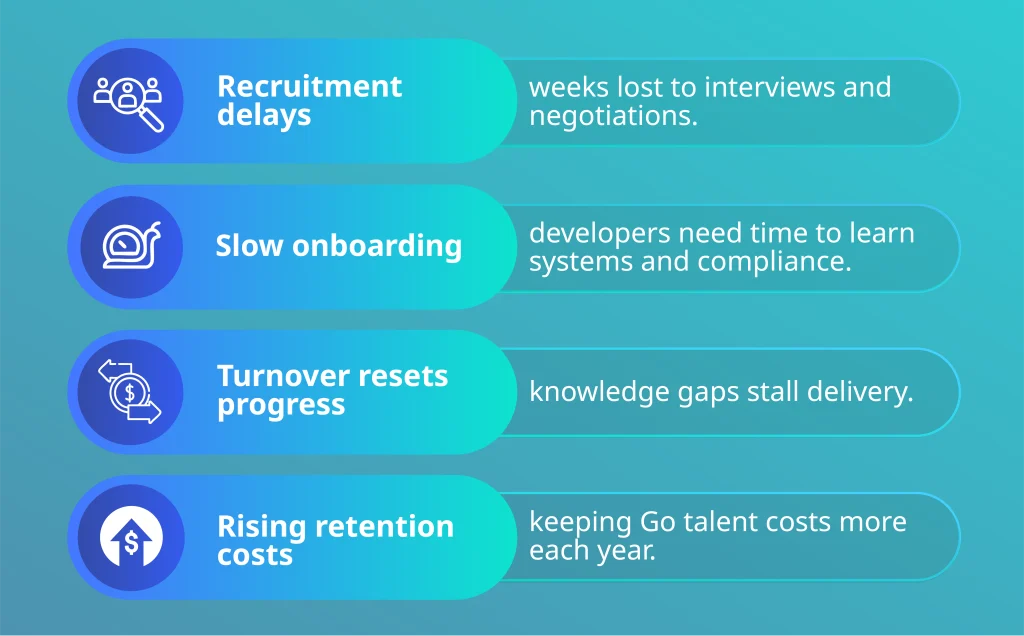
Recruitment drains momentum as agency fees, interviews, and endless negotiations take over the time that should be spent on sprint planning and delivery.
Onboarding then slows everything down further. Even highly skilled developers need weeks to understand existing pipelines, infrastructure, and compliance requirements before they can contribute at full speed.
When turnover hits, progress resets; unfinished tasks pile up, knowledge gaps widen, and the team loses rhythm just as it starts to find momentum again.
And with Go engineers in high demand, competition only makes things harder; retaining top talent often costs more than hiring them in the first place.
By the time a new hire is truly contributing, your product roadmap may already be behind schedule.
The Real Price of Hiring Go Developers
The surge in Go adoption isn’t limited to global surveys; it is also visible in the job market.
In the UK alone, the number of permanent roles requiring Go has jumped from 561 in 2024 to 948 in 2025, while the language’s ranking among all tech skills climbed 169 places year over year.
Salaries have followed the same trend: the median Go developer salary rose to £90,000, up 12.5% in a single year, with senior engineers earning as much as £142,500 (source: IT Jobs Watch).
That kind of growth shows why traditional hiring pipelines can’t keep up. As Go continues to rank among the most in-demand backend languages in finance, SaaS, and cloud infrastructure, finding and retaining skilled developers becomes more expensive with every quarter.
The Time Trap: How Long It Really Takes to Get a Golang Developer Productive
Time is the one cost most teams underestimate. Hiring doesn’t end when a contract is signed; that’s when the waiting really begins.
It usually takes 8–12 weeks for a new Golang developer to reach full productivity.
Background checks, training, and access setup drag on while projects sit idle. HR and compliance approvals add even more friction, especially in industries like FinTech and HealthTech, where every environment must be vetted before a single line of code is written.
Then comes cultural alignment: learning the tools, communication style, and sprint rhythm of a new team. It’s not unusual for that adjustment to last longer than the onboarding itself. Meanwhile, deadlines keep slipping, and roadmaps stay frozen.
Full-stack delivery squads arrive already aligned, fully tooled, and ready to deliver from Sprint 1, without waiting, downtime, or slow start.
Why Traditional Hiring Slows Delivery

How Sprint-Based Golang Squads Redefine Delivery
Hiring one developer at a time can’t keep up with modern delivery speed. Projects evolve fast, priorities shift, and customers don’t wait for teams to hire, train, and catch up.
P-Suite engineering squads were built for this new reality, designed to start fast, adapt instantly, and deliver results that traditional hiring models simply can’t match.
Cross-Functional Teams Built for Speed and Scale
Every squad is custom-built for the project it joins. Instead of hiring one developer at a time, you get a complete delivery unit, the exact mix of engineers, testers, DevOps specialists, or product experts your roadmap demands.
These squads don’t need time to “find their rhythm.” They arrive ready to build. With tools, workflows, and communication already aligned, they start contributing from day one, not week six. The result is less setup, fewer blockers, and faster releases from the start.
Sprint-Based Go Squads for Aligned, Predictable Delivery
Instead of hiring one engineer and hoping they fit, Golang delivery squads embed directly into your team, working in sprints that match your roadmap, priorities, and compliance standards.
Each squad combines mid-to-senior Go developers with DevOps, QA, and delivery management, ensuring every release moves from plan to production without friction.
Unlike static hires, these squads scale fluidly with your workload, expanding when delivery accelerates and streamlining when priorities shift. That’s how regulated FinTechs maintain speed, traceability, and trust without sacrificing control.
On-Demand Capacity That Scales With Your Product
Modern projects rarely move in straight lines. Some weeks need five developers; others, two.
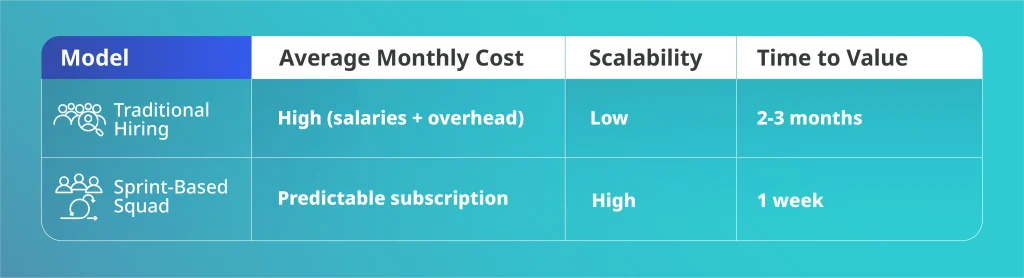
With the sprint-based model, teams can scale up or down in weeks instead of months. There’s no waiting for contracts, interviews, or onboarding.
Compared to fixed headcount models, sprint-based delivery teams offer a fluid, flexible way to grow: the right skills, at the right moment, without the long-term overhead.
In short, P-Suite-powered engineering squads give organisations what traditional hiring can’t: speed, adaptability, and predictable delivery. Instead of managing people, leaders manage outcomes.
Cost, Speed, and Flexibility: A Clear Comparison
How Sprint-Based Squads Helped Zilch Scaled FinTech Delivery at Record Speed
Zilch entered the rapidly expanding Buy Now, Pay Later (BNPL) space with one mission: to make flexible payments effortless for online shoppers.
The idea was clear, the market timing perfect, but the execution window brutally short. Zilch’s leadership knew they had just one shot: deliver complex API integrations within a single month or risk losing investor confidence and market momentum.
Hiring a team wasn’t an option; it was too slow. The company needed a fully equipped delivery force that could build, test, and launch at startup speed without compromising reliability or compliance.
At that critical moment, Deployflow joined the mission, bringing structure and speed to an already ambitious vision.
Deployflow assembled a dedicated, sprint-based engineering squad tailored to Zilch’s needs: engineers, architects, QA specialists, and delivery managers aligned under one delivery rhythm.
Using Terraform for AWS automation, combined with Bitbucket pipelines and Octopus deployment, the team built a fully automated infrastructure that enabled remote collaboration without losing speed.
The Results: Faster Integration, Lower Overhead, and 2× Delivery Speed
The impact was immediate:
- 1 month to complete complex API integrations, a milestone most teams would take a quarter to achieve.
- 2× faster environment setup, powered by automation and reusable templates.
- 100% adaptability to supplier and vendor challenges after launch.
Sean Hederman, Zilch’s CIO, summed it up perfectly:
“Deployflow assembled a dedicated workforce, enabling us to transform our vision into reality. Their seamless team-building and thorough knowledge transfer have been instrumental in bringing our product to life.”
That partnership became the foundation for Zilch’s exponential rise, scaling from MVP to a double unicorn valued at over $2 billion, proving that when engineering speed meets structure, FinTech innovation has no ceiling.
This approach has already proven its impact in regulated sectors like FinTech, as shown in Deployflow’s deep dive on AI-powered engineering squads, where automation and structured delivery models helped teams ship compliant, production-ready software in record time.
Why Modern CTOs Choose Squads Over Hiring Pipelines
For most CTOs, moving from traditional hiring to sprint-based Golang squads is a shift in how delivery is managed.
Recruitment pipelines can fill roles, but they don’t guarantee releases. They focus on people, not outcomes.
Dev squads are different. They come built for delivery, already aligned, already equipped, already moving. For technology leaders, that means fewer unknowns, clearer forecasts, and faster results.
Predictable Output and Transparent ROI
Traditional teams track hours; high-performing teams track progress.
Sprint-based squads work in measurable cycles, every release, test, and deployment recorded in real time. For CTOs overseeing complex Go systems, that visibility replaces guesswork with certainty.
Budgets finally tie to delivery, not headcount. Roadmaps reflect what’s actually achievable. Instead of waiting for annual performance reviews, leaders get live sprint reports and clear delivery metrics, proof that their Go services are shipping on schedule and adding value.
With reliable sprint forecasting, they don’t have to ask when things will be done. They can see it, sprint by sprint.
Many CTOs discover that missed deadlines aren’t caused by weak teams but by outdated delivery structures, a point explored in Deployflow’s article on the delivery model problem, which outlines how traditional hiring models slow execution long before the first sprint even begins.
Future-Proof Talent That Evolves With Golang and Cloud Tech
Technology never stands still, and neither should the people building it.
While internal teams often struggle to keep pace with new frameworks, tooling, and best practices, sprint-based squads evolve continuously.
Their model rewards learning in motion, sharing Go performance optimisations, Kubernetes patterns, or CI/CD refinements as part of everyday delivery.
For CTOs, that means no retraining pauses, no sudden skill gaps, and no slowdowns when technology shifts. They gain steady progress from teams that grow alongside the product, keeping every Go deployment secure, modern, and fast.
It’s not about hiring more developers. It’s about keeping the right ones focused on what matters — building, shipping, and improving with every sprint.
When (and When Not) to Use P-Suite Go Squads
Sprint-based squads aren’t meant to replace every hiring model. They exist to make growth predictable when Golang teams need to scale quickly without adding long-term overhead.
They work best when clarity meets urgency: the vision is solid, the roadmap is defined, and what’s missing is the engineering power to turn that plan into production-ready Go services.
Best Fit: Fast-Growing SaaS, FinTech, API-First Teams and Regulated Businesses
They shine in fast-scaling SaaS, FinTech, HealthTech, AgriTech, PropTech, and API-driven startups and SMBs, where performance, compliance, and reliability are non-negotiable.
In these environments, deadlines move fast, and customer expectations move faster; sprint-based squads extend the in-house Go team’s capacity without slowing it down.
Many companies use them alongside core engineers who focus on architecture and long-term product direction, while the delivery squad handles execution: building, testing, and shipping Go features in tight, reliable cycles.
When Freelancers or Contractors Make More Sense
That said, they’re not the right fit for every situation.
Small, one-off fixes, quick prototypes, or limited-scope scripts don’t need a full delivery squad; freelancers or short-term contractors are often a better choice.
The same goes for very early-stage startups still shaping their product-market fit. Squads thrive where goals are clear, not where they’re still being defined.
Used in the right context, sprint-based squads give Golang teams exactly what they need: focused speed, reliable execution, and a structure that keeps innovation moving without the drag of constant hiring.
For teams already stretched thin, adding sprint-based capacity can make the difference between burnout and breakthrough. Deployflow’s guide to filling delivery gaps explains how flexible squads strengthen existing teams without disrupting momentum or adding overhead.
Key Takeaways: Smarter, Faster, and Built for Growth
The future of Golang delivery isn’t about hiring more people but building the right rhythm around them.
Traditional recruitment can’t match the pace of modern software delivery, especially when projects demand immediate results and flawless scalability. Growth now depends on how fast your Go code moves from idea to production, not how long it takes to fill a role.
The Future of Engineering Isn’t Hiring, It’s Assembling Golang Squads
Modern engineering teams are evolving. Instead of waiting months to onboard new developers, forward-thinking companies are assembling sprint-based Golang squads, ready-made units that come with DevOps, QA, and delivery expertise baked in.
This model changes the game:
- You cut hiring friction and speed up Go delivery cycles.
- You pay for outcomes, not idle headcount.
- You scale safely, backed by built-in infrastructure, automation, and compliance expertise.
The companies thriving today aren’t just writing great Go code. They’re structuring teams that can ship it faster, cleaner, and more predictably than ever before.
If you’re ready to move beyond hiring delays, talk to Deployflow about launching your first sprint-based Golang engineering squad and see how quickly your next Go project can reach production.
Download the P-Suite whitepaper to see how sprint-based Golang squads are transforming delivery speed, quality, and scalability for teams just like yours.
After all, the future of engineering is about building teams so good that even your backlog starts behaving.
Frequently Asked Questions About Golang Developer Hiring
Is Golang still worth investing in for backend development in 2025?
Absolutely. Go continues to rank among the top 10 programming languages globally, and it’s now used by over 17% of professional developers according to the 2025 Stack Overflow Developer Survey. Its strengths (concurrency, scalability, and simplicity) make it a favourite for modern backend systems, APIs, and microservices.
Leading companies in FinTech, SaaS, and cloud infrastructure rely on Go for performance-critical workloads, so investing in Go developers is a strategic, future-proof decision.
How much does it cost to hire a Golang developer in the UK or Europe?
Hiring costs vary by region and experience level.
Across the UK, median salaries have risen to around £90,000 (up 12.5% year-on-year), with senior developers in London earning £76,000–£100,000. For teams hiring Go developers across several of these regions without setting up a local entity in each one, working with an employer of record is often the simplest way to manage payroll, tax, and compliance in each country.
In Central and Eastern Europe, rates typically range from $35 to $160 per hour. As demand for Go specialists keeps rising, companies should plan for higher budgets and longer recruitment timelines compared to other languages.
What should I look for when interviewing Golang developers?
Beyond syntax knowledge, prioritise developers who understand Go’s concurrency model, memory management, and microservices architecture.
Experience with Kubernetes, Docker, and CI/CD pipelines is a strong advantage, as Go often sits at the heart of containerised systems.
Look for engineers who also emphasise testing and maintainability. Go’s simplicity makes it easy to write code quickly, but long-term quality depends on disciplined development habits.
Why is it so difficult to hire experienced Golang engineers right now?
The challenge comes from a mismatch between supply and demand. Go adoption has grown faster than the number of senior developers available. Many skilled engineers are already employed by high-growth startups or large enterprises using Go for cloud-native infrastructure. As a result, recruitment cycles stretch out, salaries rise, and retention becomes more competitive.
For teams that need to move quickly, this often pushes them toward hybrid or sprint-based delivery models that give access to Go expertise without lengthy hiring delays.
How can I retain Golang developers once they’re hired?
Retention depends on growth opportunities and engineering culture. Go developers value clean architectures, automation, and modern tooling environments that let them build efficiently and keep learning.
Encourage technical ownership, offer mentorship or open-source contribution time, and maintain updated toolchains. Since Go developers are highly sought-after, stability, autonomy, and meaningful projects are often stronger retention tools than salary alone.
Explore our BLOG
Recent articles

ISO 42001 Explained: Requirements, Certification and What Your Engineering Team Must Build
ISO 42001 is the international standard that demonstrates your organisation governs AI properly, and enterprise...
read full article

Is Claude Down? Anthropic Outage: Protect Your Cloud Infrastructure
Claude went down across every surface on 29 September 2026. From 14:00 to 14:59 UTC,...
read full article

Top 10 Healthtech Companies in 2026: What Their Growth Means for AI and DevOps
Every software change that reaches a hospital has to clear regulatory, legacy system, and clinical...
read full article