


Budgets are tightening. Pipelines are expanding. And CTOs are learning the same hard truth: you can’t fix delivery bottlenecks by hiring more engineers or buying another tool.
The fundamental shift in 2026 will come from how teams are structured and how automation is applied, not how much they spend.
Sprint-based squads, AI Ops, and platform engineering are turning DevOps into a measurable business function instead of an endless workflow.
In this blog, you’ll discover what’s shaping 2026 and how to stay ahead:
- Where CTOs are actually investing in 2026, from AI-driven monitoring to delivery automation.
- Why sprint-based squads are outperforming traditional DevOps teams.
- How platform engineering and AI Ops are redefining speed, security, and scale.
- What top-performing companies are doing to stay compliant and cost-efficient.
- How Deployflow’s engineering model helps organisations future-proof delivery with measurable outcomes.
As the 2026 DevOps Forecast makes clear, the coming year belongs to teams that can deploy faster, spend smarter, and stop firefighting their own pipelines.
Why 2026 Will Redefine DevOps Strategy
The past year exposed what every CTO already knew, but few were willing to admit: DevOps isn’t breaking because of bad tools but because of bad structure.
Teams are overextended, pipelines keep multiplying, and cloud bills are eating into innovation budgets. The result is often slower delivery, higher stress, and constant firefighting disguised as progress.
2026 is the year this changes. The industry is shifting from more automation to measurable outcomes.
Instead of chasing deployment speed, forward-thinking leaders are asking tougher questions:
What’s the business impact of every sprint? How do we measure value, not just velocity?
Recent reports from Gartner, Forrester, and DORA all point to the same conclusion: the next wave of DevOps maturity will blend security, automation, and engineering culture into a single discipline.
It’s not about shipping faster but about building a delivery system that’s reliable, auditable, and scalable by design.
That’s why the smartest teams are moving toward engineering-first DevOps cultures, where small, focused squads own their outcomes from code to cloud. It’s a model built for resilience, and it’s the same model Deployflow has been refining for years.

AI Ops Takes the Lead: Predictive Monitoring and Self-Healing Systems
Automation isn’t new. What’s new is that it’s starting to think ahead of the engineers who built it.
In 2026, AI Ops will predict deployment risks, detect drift, and fix errors before humans even notice something’s wrong.
According to Gartner’s AIOps Market Guide 2025, 73% of enterprises are already implementing or planning to adopt AIOps by the end of 2026. This is a clear sign that predictive, self-healing operations are moving from experimentation to enterprise standard.
A recent ResearchGate study on AI-driven self-healing infrastructure demonstrated just how close we are to that reality, showing that AI models can predict failures with over 90% accuracy and autonomously resolve up to 80% of incidents.
That’s proof that intelligent pipelines are capable of keeping systems healthy long before on-call engineers ever get the alert.
For companies embracing this shift, downtime will disappear quietly in the background, handled by systems built to heal themselves.
This evolution turns what used to be a firefighting routine into a proactive, data-driven safety net.
Deployflow has already seen this shift firsthand. By combining AI Ops with automation frameworks, their clients have reduced downtime by around 60% and dramatically shortened mean time to recovery (MTTR) across critical workloads.
It’s not magic. It’s intelligent observability done right: pipelines that measure, learn, and self-correct in real time.
The company leading in DevOps won’t be the one that reacts faster in the near future. They’ll be the ones whose systems heal themselves before anyone even opens the dashboard.
Platform Engineering Becomes the DevOps Backbone
Every major shift in DevOps starts with too many tools, too many pipelines, and not enough structure.
That’s why platform engineering is quickly becoming the backbone of modern delivery. It’s a return to order; a way to give developers a self-service foundation that’s fast, secure, and consistent.
The “Platform as a Product” mindset is defining 2026. Instead of juggling ad-hoc scripts and environment requests, engineering teams are building internal developer portals; curated platforms that bundle everything a squad needs to deploy, test, and monitor in one place.
The result is standardisation without friction:

This approach fits perfectly with sprint-based delivery. Squads don’t rebuild from scratch each time. They build once and scale everywhere, leveraging the same infrastructure components across every sprint.
Deployflow has taken this concept further with its modular infrastructure blueprints, giving engineering squads plug-and-play building blocks for any environment. What used to take days to configure now takes hours.
For new teams, onboarding is a single command that launches a full, compliant environment ready to deploy.
In 2026, the organisations thriving in DevOps will be the ones who treat their platform as a living product, built to evolve, scale, and serve every engineer who touches it.
This trend isn’t isolated. Gartner predicts that by 2026, 80% of software development companies will adopt internal development platforms (IDPs) to unify tools, automate governance, and accelerate delivery.
It confirms what high-performing teams have already discovered: platform engineering is the new foundation of DevOps.
Engineering Squads Replace Fragmented Teams
The old way of running DevOps (separate teams for development, operations, and security) simply can’t keep up with today’s delivery pace.
Handovers slow things down. Miscommunication multiplies risk. By the time an issue reaches the right person, the sprint is already behind schedule.
That’s why 2026 marks the rise of engineering squads, small, cross-functional units that own delivery from idea to deployment.
Each squad blends engineering, DevOps, and security expertise into a single delivery engine. No silos. No waiting for approvals. Just accountability and measurable outcomes every sprint.
Deployflow’s P-Suite squad model is built around this principle.
P-Suite is Deployflow’s proprietary delivery framework that determines the ideal squad structure and number of sprints for each project.
It unites people, process, and platform into one operational unit, a ready-made engineering squad equipped with automation frameworks, QA, security, and delivery playbooks.
Instead of adding more people to a problem, P-Suite adds clarity and structure, defining who’s needed, how long delivery should take, and what success looks like before the first line of code is written.
Every sprint then runs as a closed loop: plan, deploy, measure, improve, a rhythm that turns complex initiatives into predictable outcomes.
See how this approach accelerates results in regulated sectors through AI-powered engineering squads for FinTech delivery.
DORA Research confirms how effective structural alignment can be: high-performing DevOps teams deploy 973 times more frequently and recover 6,570 times faster from incidents than low performers.
Studies show DevOps teams embracing cross-functional practices and internal platform models significantly shorten cycle times and reduce friction. For example, IDPs help eliminate duplicate work and promote reuse, accelerating release cycles across teams (source: CNCF).
This model turns DevOps into a living, modular system; one where people, processes, and automation work as one squad, not three departments.
For CTOs focused on measurable outcomes, our insights on proving DevOps ROI through delivery squads break down how structured teams directly translate engineering effort into business value.
And in the near future, that’s the difference between teams that deliver on time and those still chasing tickets.
Secure Pipelines Become Non-Negotiable
Speed once defined DevOps success. In 2026, it’s security that decides who stays online.
With cyberattacks now targeting CI/CD pipelines directly, DevSecOps has shifted from a best practice to a foundational requirement. Every line of code, build artefact, and environment variable is now part of the attack surface, and CTOs know they can’t afford blind spots.
To understand how major UK brands like Jaguar Land Rover, Heathrow Airport, and Co-op faced these same security gaps, explore our analysis of recent UK cyberattacks and their DevSecOps lessons.
GitLab’s Global DevSecOps Report 2025 found that 67% of organisations admit to introducing security vulnerabilities during CI/CD because of inconsistent controls and a lack of visibility. That’s a clear wake-up call for teams treating pipeline security as an afterthought.
The new standard is secure-by-design delivery.
That means encryption from commit to deploy, compliance written directly into pipelines, and automated audit trails that verify integrity in real time. It’s about designing systems where checks are built in, invisible, and constant.
Deployflow implements this philosophy across projects in regulated industries, where audit readiness is regulated.
Through compliance automation and immutable CI/CD security layers, teams can release faster while meeting frameworks like FCA, GDPR, and NHS DSPT without manual intervention.
By embedding policies, access controls, and anomaly detection inside every pipeline, Deployflow transforms security from an afterthought into a market leverage.
When every deployment is verifiable, encrypted, and compliant by default, innovation no longer competes with safety but depends on it.
Cloud Strategy Evolves: From Cost Control to Smart Scaling
After years of chasing discounts and spot instances, CTOs are finally realising that cost control isn’t a strategy, scalability is.
According to the Flexera 2025 State of the Cloud Report, 67% of tech leaders still cite cloud costs as their biggest pain point, but the smartest ones are now solving it through visibility, not cuts.
The new cloud mindset is about smart scaling, or letting AI and automation continuously adjust workloads, environments, and storage based on real usage patterns. This means right-sizing without downtime and balancing performance with spend instead of choosing between them.
By applying Infrastructure-as-Code (IaC) and automated scaling policies, Deployflow teams have achieved up to 30% lower operational costs and near-instant environment spin-ups. However, the real win isn’t just savings but the freedom to scale at will without friction or financial guesswork.
As hybrid and multi-cloud adoption deepens, cross-cloud consistency is emerging as a top priority. Teams want the same deployment logic to work across AWS, Azure, and GCP, and Deployflow’s automation frameworks make that possible.
The future will reward companies that treat cloud management as an evolving system, where scalability becomes a built-in quality.
Developer Experience (DevEx) Becomes a Boardroom Metric
Forget ping-pong tables and free snacks.
Developer experience is now a performance metric, not a perk.
As toolchains grow more complex, retaining DevOps talent has become harder than hiring it. The best engineers aren’t chasing higher salaries; they’re chasing clarity, flow, and autonomy.
From Tool Chaos to Empowerment
2026 will mark a turning point where CTOs stop adding tools and start curating ecosystems.
The focus is shifting toward toolchains that empower, not overwhelm; systems that remove friction, standardise workflows, and give developers full visibility from commit to deploy.
A well-built pipeline is about mental bandwidth, confidence, and creative momentum.
Measuring the Invisible: DevEx KPIs
Deployflow’s sprint-based delivery squads are structured around measurable DevEx indicators like lead time, change failure rate, and mean time to restore.
Every sprint becomes a feedback loop, measuring how easily engineers can do their best work, and how the delivery structure either amplifies or blocks it.
The Human Factor in High Performance
Human-centric DevOps will define which teams stay ahead. When engineers feel supported and in control, innovation compounds naturally.
That’s why forward-thinking companies are now reviewing DevEx metrics in board meetings alongside delivery and financial data, because when developers thrive, business performance follows.
Managed DevOps Services Go Mainstream
Cloud environments are evolving faster than internal teams can keep up.
Toolchains multiply, compliance rules tighten, and the demand for round-the-clock delivery never stops.
For many CTOs, the smartest move in 2026 is partnering with specialists who already have the expertise, frameworks, and automation in place.
Industry projections show the DevOps as a Service (DaaS) market growing at a compound annual rate of 22.8% between 2024 and 2030, fuelled by demand for automation, scalability, and 24/7 managed operations (source: Grand View Research).
Companies are turning to managed DevOps partnerships not just to save time, but to transform how they scale.
A strong example comes from Little Journey, a digital health platform supporting pediatric patients and families.
By adopting a managed DevOps framework, they reduced deployment time by 80%, increased infrastructure scalability by 50%, and achieved full data segregation and compliance within a tightly regulated medical environment.
This shift was about building a secure, automated foundation that enabled rapid scaling without compromising compliance.
When DevOps services are structured around automation, security, and repeatability, companies gain both velocity and confidence, a rare combination in complex cloud ecosystems.
In 2026, outsourcing DevOps will mean gaining consistency, resilience, and expertise on demand, a faster, smarter route to continuous delivery.
The growing complexity of cloud ecosystems and the demand for constant delivery are driving the widespread adoption of DevOps managed services across small and midsize enterprises.
Instead of building entire delivery pipelines from scratch, businesses tap into managed DevOps platforms that scale instantly, stay compliant, and operate with total transparency.
2026 Playbook: Where to Invest (and What to Sunset)
Every year, DevOps budgets reveal a simple truth: the smartest investments are in structure.
The 2026 roadmap will belong to teams that build systems capable of learning, scaling, and securing themselves, while letting go of the processes that slow them down.

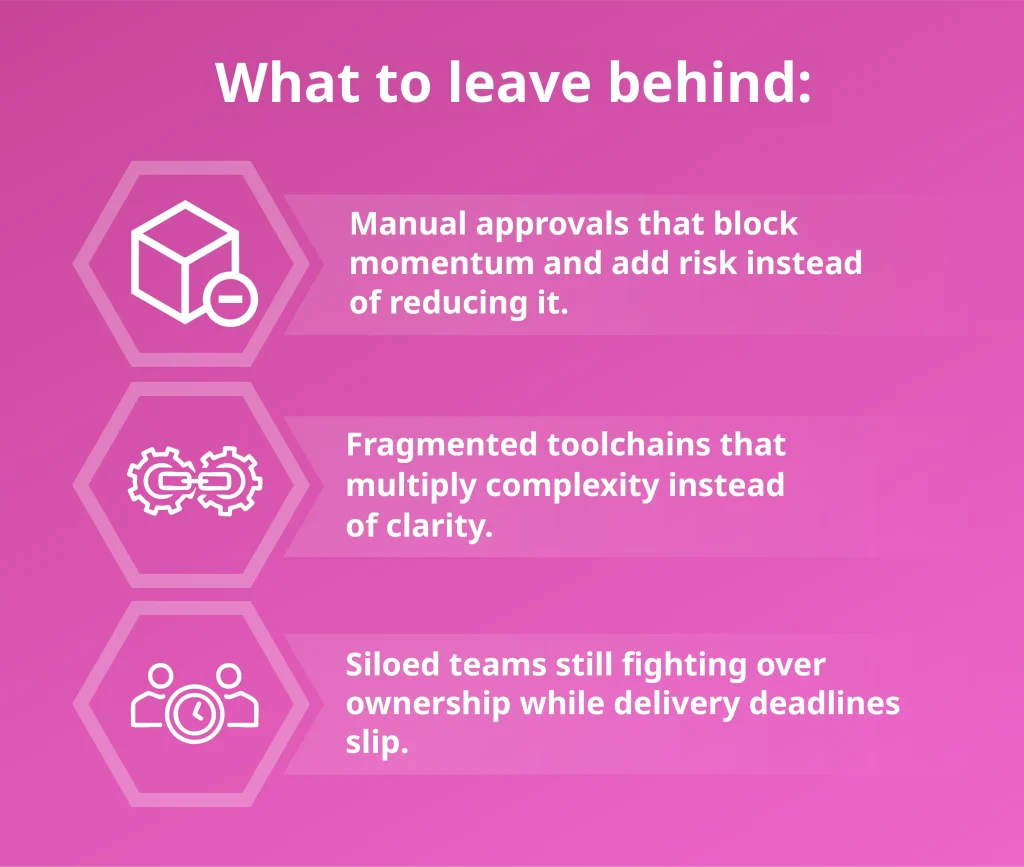
2026 will reward leaders who build adaptive delivery systems that think ahead, protect themselves, and grow with every sprint.
Build a future-ready delivery model. Download the DevOps Whitepaper to see how it’s done.
And if your pipelines still rely on sticky notes and good intentions, this might be the perfect year to automate both.
Frequently Asked Questions About the 2026 DevOps Forecast
How will AI Ops change the daily work of DevOps engineers?
AI Ops will fundamentally reshape the DevOps workflow by automating judgment.
By 2026, most teams will depend on AI-driven systems that predict failures, detect configuration drift, and self-correct in real time.
Engineers will shift focus from firefighting to curation, training AI models, refining observability data, and improving system design.
What skills will DevOps professionals need to stay relevant in 2026?
The DevOps engineer of the future blends technical mastery with business awareness.
To stay ahead, focus on:
- AI-driven observability and automation frameworks
- Security-as-code and compliance automation
- Infrastructure-as-Code (IaC) expertise in Terraform or Pulumi
- Platform engineering and developer portal design
- Collaboration and communication, especially between Dev, Sec, and Ops teams
Those who can tie delivery metrics to business value (not just system uptime) will define the next generation of DevOps leadership.
How do engineering squads improve delivery compared to traditional DevOps teams?
Unlike traditional teams divided by roles, engineering squads function as complete delivery units that own outcomes end to end.
Each squad includes developers, DevOps engineers, QA, and security specialists working together toward a single sprint goal.
This model delivers:
- Faster feedback loops
- Clear accountability
- Continuous improvement baked into every release
By eliminating handoffs and silos, squads reduce delays and increase the predictability of each sprint, turning DevOps into a measurable business function, not just an engineering process.
To see how this works in practice, explore our blog on how sprint-based squads fill gaps without disrupting flow. It’s a closer look at scaling delivery without slowing momentum.
How can companies measure the ROI of DevOps initiatives in 2026?
In 2026, DevOps ROI is defined by business performance, not deployment speed.
Forward-thinking CTOs track metrics like:
- Lead time for changes
- Change failure rate
- Mean time to recovery (MTTR)
- Cost per successful deployment
These KPIs reveal how efficiently teams deliver secure, stable, and scalable outcomes.
When mapped against revenue impact or customer satisfaction, they prove the tangible value of DevOps maturity, turning technical excellence into business advantage.
Explore our BLOG
Recent articles

ISO 42001 Explained: Requirements, Certification and What Your Engineering Team Must Build
ISO 42001 is the international standard that demonstrates your organisation governs AI properly, and enterprise...
read full article

Is Claude Down? Anthropic Outage: Protect Your Cloud Infrastructure
Claude went down across every surface on 29 September 2026. From 14:00 to 14:59 UTC,...
read full article

Top 10 Healthtech Companies in 2026: What Their Growth Means for AI and DevOps
Every software change that reaches a hospital has to clear regulatory, legacy system, and clinical...
read full article