


Weeks slip away. Investors lose patience. Deals stalled. Features are stuck in endless reviews, and competitors ship first.
For FinTech leaders, that’s the reality of building products in one of the world’s most heavily regulated industries.
Every innovation runs into a wall of compliance (from FCA approvals to GDPR checks and PSD2 requirements), turning speed into a luxury few can afford.
Let me show you a way forward. AI-powered engineering squads are changing the game, combining the discipline of DevOps with the intelligence of automation. They deliver faster without cutting corners, keeping regulators satisfied and customers engaged.
Here’s what you’ll learn in the next few minutes:
- How AI squads accelerate tech delivery in regulated FinTech
- A real-world success story from Zilch
- Practical benefits like automated compliance, faster scaling, and reduced risk
You’ll see why companies that once felt trapped by regulation are now using AI-driven squads to launch faster, stay compliant, and outpace their competition.
FinTech Compliance Challenges That Slow Down Delivery
Regulation is the price of trust in FinTech, but it often feels like the price of progress, too.
Customers expect instant, seamless digital experiences, yet regulators demand bulletproof security, airtight data handling, and audit trails that leave no stone unturned. For ambitious FinTech companies, these two forces are constantly in conflict.
Here’s why delivery gets stuck:
- Overlapping regulatory frameworks: FinTechs juggle FCA oversight, GDPR data protection, PSD2 payment services rules, and PCI DSS card standards. Each has its own reporting requirements, testing needs, and approval cycles. Missing one step can mean fines, reputational damage, or even losing the license to operate.
- Manual-heavy audits: Traditional compliance relies on humans filling out spreadsheets, chasing approvals, and running static tests. This slows every release cycle, turning what should be days into weeks.
- Repetition and rework: Because rules change and interpretations shift, features often bounce back and forth between legal, compliance, and tech teams. Every extra round of review costs time and momentum.
- Documentation bottlenecks: To stay safe, teams overcompensate by producing piles of reports and sign-offs. While essential for regulators, they add almost no direct value to the customer experience.
Legacy IT delivery models only make things worse. They were built on handovers; developers pass code to testers, testers hand it to compliance, and compliance waits for approvals. Each step adds friction. In a regulated industry, that friction multiplies.
The outcome can be missed deadlines, frustrated stakeholders, higher burn rates, and the constant fear of a compliance breach. Innovation slows to a crawl, and the FinTech that promised agility suddenly feels like a bank stuck in the past.
This is exactly the gap AI-powered engineering squads are designed to close.
This isn’t just theory because real data shows the impact. Teams with streamlined DevOps toolsets are five times more likely to deploy in under an hour (66% vs 12%), and five times less likely to need a full day (5% vs 25%) (source: Gearset’s DevOps Report 2025).
For FinTechs battling compliance delays, that kind of speed can mean the difference between being first to market or forgotten.
What Are AI-Powered Engineering Squads?
Picture a small, focused team where AI clears away the usual roadblocks.
Instead of big departments working in silos, an AI engineering squad is a cross-functional unit that owns the delivery end-to-end. What makes it powerful is the mix of people inside and the way AI supercharges their output.
With Deployflow’s P-Suite model, squads bring together:
- Front-end and back-end engineers: turning ideas into reliable, user-friendly applications and building on solid code foundations.
- Solution architects: designing systems that stay secure, scalable, and ready for tomorrow’s growth.
- Project managers: keeping delivery on track and aligning technical work with business goals.
- Testers and QA specialists: running detailed checks that ensure every release meets the highest quality standards.
- DevOps engineers: automating infrastructure, creating repeatable environments, and eliminating bottlenecks in release cycles.
P-Suite allows you to estimate the right squad size for a specific project, map out how many sprints will be needed, and forecast delivery timelines with precision.
Instead of guessing, leaders can plan based on real capacity, adjust resources on demand, and keep every stakeholder aligned from day one.
On top of that, AI acts like an invisible teammate:
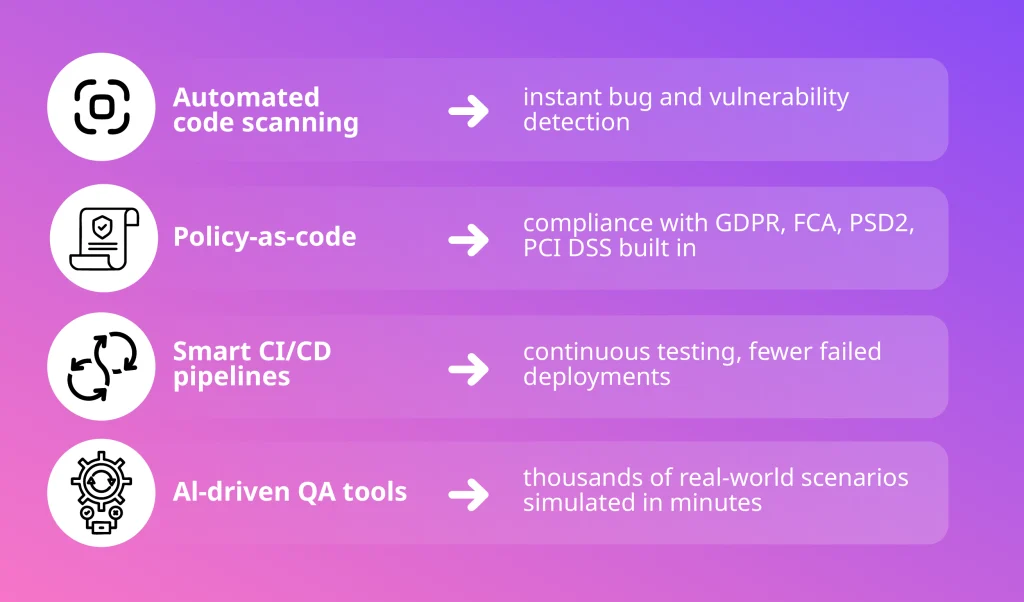
Together, this setup means squads can ship features quickly, stay compliant in real time, and adapt on demand.
The DORA framework has become the global benchmark for engineering performance, measuring deployment frequency, lead time, failure rate, and recovery time. These metrics show exactly why AI-powered squads matter: they improve the very outcomes that define high-performing teams (source: Google Cloud’s guide to the four DORA metrics).
For FinTech leaders, it means that speed no longer competes with regulation. Speed is built into the delivery model.
Case Study: How Zilch Scaled FinTech Delivery With Deployflow
When survival depends on speed, there’s no room for delay.
That was the situation facing Zilch, a Buy Now, Pay Later (BNPL) pioneer aiming to disrupt the payments sector.
To stand out, Zilch needed to integrate complex APIs, launch fast, and prove compliance, all within a single month.
Anything slower risked falling behind competitors and losing investor confidence.
Deployflow took over with a dedicated P-Suite squad, blending front-end and back-end engineers, solution architects, project managers, testers, and DevOps specialists. AI powered the squad at every step: automated pipelines, Terraform for cloud infrastructure, and policy-as-code for compliance checks.
The results were great:
- 1 month for complex API integrations that most teams would take quarters to deliver
- 2× faster environment setup through automation and reusable templates
- 100% adaptability to supplier and vendor challenges after launch
Sean Hederman, Zilch’s CIO, called it a turning point:
“Deployflow assembled a dedicated workforce, enabling us to transform our vision into reality. Their seamless team-building and knowledge transfer were instrumental in bringing our product to life.”
In less than a year, Zilch scaled from MVP to a double unicorn valued at $2+ billion, which is proof that with the right squad structure, even heavily regulated FinTechs can move at startup speed.
Why FinTech Leaders Choose the AI-Powered Squad Model
Choosing how to scale development isn’t just about filling gaps but about trust, cost, and confidence in delivery.
Many FinTech leaders don’t miss deadlines because of poor engineering talent, but because the delivery model itself slows them down.
- Contractors are risky and expensive. Plenty of leaders have tried hiring contractors only to find the costs spiral and the results fall short. Contractors may deliver short-term fixes, but they rarely bring the long-term stability or compliance awareness that regulated FinTechs need.
The squad model eliminates that risk. Instead of piecing together temporary hires, companies get a dedicated, ready-made team that works as one unit.
- The squad model scales at the speed of growth. When new features or integrations are urgent, businesses can’t afford to spend months building internal teams.
Squads solve this by being flexible and ready to go. They scale development capacity in weeks, not quarters, while still staying aligned with existing workflows and compliance needs. For fast-moving FinTechs, that agility is often the difference between leading the market and playing catch-up.
- Confidence built on proven results. Perhaps the strongest reason companies choose this model is trust. Having seen the results of Deployflow squads with brands like Zilch, leaders know they’re getting a team that has already delivered at scale in a high-pressure, regulated environment.
When internal development capacity is maxed out, handing projects to an experienced squad doesn’t feel like outsourcing but like plugging in extra horsepower.
In short, businesses choose AI-powered squads because they want speed without risk, capacity without the overhead, and results they can measure against real-world success stories.
Benefits of AI-Powered Squads for Regulated FinTech Delivery
Speed without the shortcuts. Security without the roadblocks. Audits without the stress.
Here’s what AI-powered squads actually bring to the table:
Speed: Release Cycles That Match Ambition
Instead of waiting weeks for environments or approvals, AI removes the slowest steps. New test environments spin up in minutes, pipelines run automatically, and compliance checks happen in real time. Features that once crawled through delivery now move on a steady sprint rhythm.
Security: Baked In From the Very First Commit
Security isn’t a final gate at the end of delivery, but rather a part of every step. AI code scanners catch vulnerabilities before they’re merged, dependency risks are flagged instantly, and compliance rules are enforced continuously. Teams release with confidence, knowing nothing slips through the cracks.
And since security is non-negotiable in FinTech DevOps work, Deployflow also provides cloud security expertise that ensures compliance and protection are built into every environment.
Scalability: Squads That Flex With the Workload
With Deployflow’s P-Suite, squads aren’t fixed. They expand when a project demands extra firepower and shrink back when things stabilise. That makes planning easier: you estimate the number of sprints needed, size the squad accordingly, and always know exactly what resources are in play.
When in-house teams are already stretched thin, sprint-based Dev squads can step in to add capacity without breaking the flow of ongoing projects.
Audit-Readiness: Evidence That Builds Itself
No more scrambling for paperwork before regulators arrive. Every deployment, test result, and approval is logged automatically. Dashboards show compliance status live, so audits become a matter of sharing a link instead of assembling binders.
And the stakes aren’t just about speed but rather financial. In the 12 months to October 2024, UK fintech firms lost between £1M and £5M in a single year (source: Alloy). It’s proof that delays in compliance and security don’t just slow innovation but create costly risks.
The real value lies in FinTech teams stopping to treat compliance as a blocker and instead treating it as part of the delivery process, one that is predictable, automated, and built for speed.
Key Takeaways for FinTech CTOs and Leaders
Big teams don’t always mean big results.
In regulated industries, it’s often the small, focused squads that move fastest, especially when they’re powered by AI.
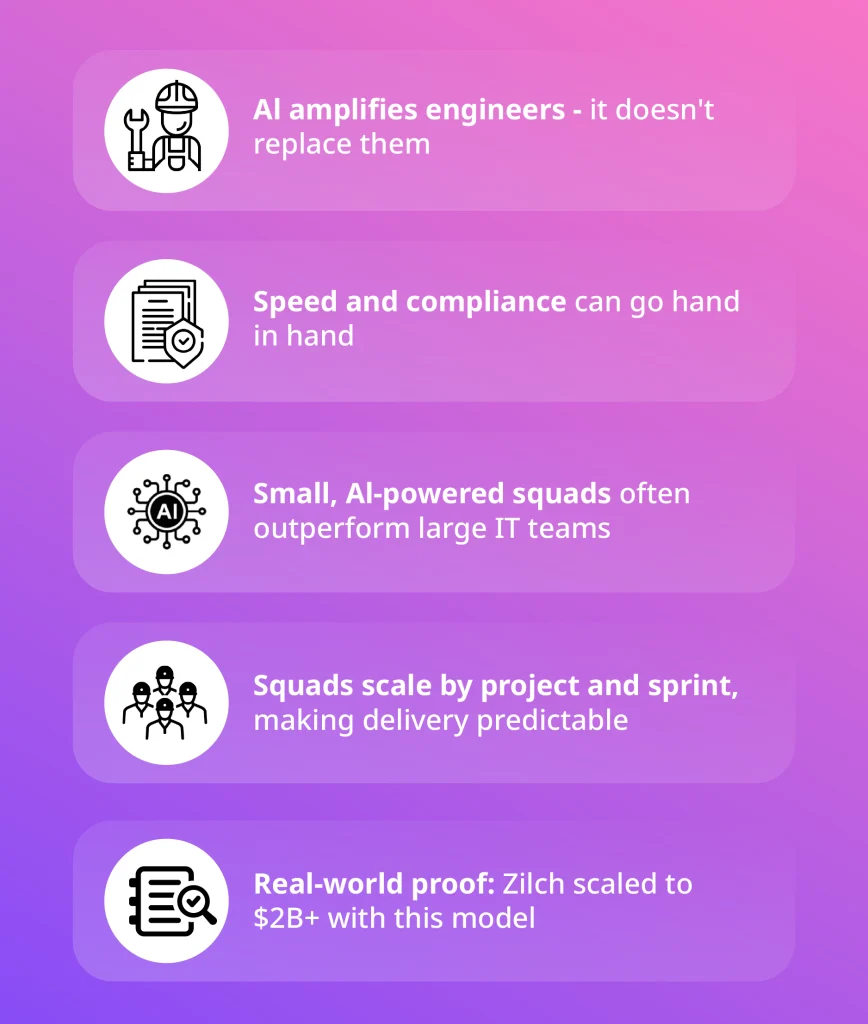
- AI is an amplifier, not a replacement. It makes engineers quicker, safer, and more compliant without removing the human judgment FinTech requires.
- Speed and trust can go hand in hand. Automated compliance and secure pipelines mean you don’t have to sacrifice regulation for innovation.
- Smaller squads can outperform larger teams. With the right mix of people, automation, and sprint planning, a lean AI-powered unit often outpaces traditional IT departments weighed down by process.
For FinTech leaders, the message is that the future of delivery isn’t about adding more people but about building smarter squads. Organisations looking for long-term support can rely on Deployflow’s DevOps managed services to keep delivery fast, secure, and consistent beyond individual projects.
Key Takeaways
Next Step: Accelerate Your FinTech Delivery With Deployflow
Slow delivery doesn’t have to be the norm. Whether you’re battling compliance bottlenecks, struggling with full dev capacity, or simply trying to get features into customers’ hands faster, there’s a smarter way forward.
Deployflow’s AI-powered squads are already helping startups, scale-ups, and established enterprises move faster without compromising security or trust. From FinTech and HealthTech to PropTech and beyond, the model adapts to your industry and your stage of growth.
Here’s how you can explore what it means for your team:
- Download our P-Suite whitepaper: clear, practical, and lighter than your average compliance manual.
- Message or call Deployflow: no jargon, no hard sell, just an honest chat about how squads can make delivery smoother.
Speed and compliance were never meant to be enemies. With the right squad, they become partners, giving you the freedom to innovate quickly while proving to regulators, investors, and customers that you can be trusted at every step.
Frequently Asked Questions About AI-Powered Squads in FinTech
How do AI-powered squads differ from traditional outsourcing?
Outsourcing usually means hiring contractors or agencies that sit outside your team, work on fixed contracts, and often lack visibility into your long-term goals. That model is slow to adapt and usually comes with higher costs than expected.
AI-powered squads are different. They act as an extension of your company, built around cross-functional expertise; engineers, architects, testers, DevOps, and project managers working together in sprints. With AI removing bottlenecks like manual code reviews, repetitive testing, and compliance checks, these squads stay faster, more integrated, and more predictable than external contractors ever could.
Can AI-powered squads really handle strict compliance like FCA and GDPR?
Yes, and that’s one of their biggest strengths.
In a regulated environment, compliance often slows delivery because it relies on manual audits and late-stage sign-offs. AI-powered squads build compliance into the process itself. Policy-as-code ensures every change meets FCA and GDPR standards as it’s made. Audit logs and test evidence are captured continuously, so when regulators or investors need proof, it’s available instantly.
This shift from reactive to proactive compliance means projects don’t stall while waiting for approvals, but move forward with built-in guardrails.
Are AI-powered squads only for large FinTech companies?
No. In fact, smaller companies often benefit most.
Startups and scale-ups rarely have the resources to build entire DevOps or compliance departments in-house, but they still face the same regulatory hurdles as banks and enterprise players. AI-powered squads give them enterprise-level delivery without enterprise-level overhead.
For larger organisations, the value is in flexibility: instead of hiring dozens of new engineers or relying on multiple contractors, they can spin up a squad for a specific product, market launch, or compliance-heavy project, then scale down once the work is complete.
How do you measure the success of an AI-powered squad?
Success isn’t measured in headcount or hours billed — it’s measured in delivery outcomes. The most widely recognised benchmarks are the DORA metrics:
- Deployment frequency: how often new code makes it to production.
- Lead time for changes: how long it takes from commit to release.
- Change failure rate: the percentage of releases that cause issues.
- Mean time to recovery: how quickly the team can fix a problem when it happens.
AI-powered squads consistently improve these metrics by automating testing, reducing manual approval loops, and catching security or compliance issues early. In practice, this means features reach customers faster, regulators get evidence without delays, and recovery from incidents is measured in hours instead of weeks.
Explore our BLOG
Recent articles

ISO 42001 Explained: Requirements, Certification and What Your Engineering Team Must Build
ISO 42001 is the international standard that demonstrates your organisation governs AI properly, and enterprise...
read full article

Is Claude Down? Anthropic Outage: Protect Your Cloud Infrastructure
Claude went down across every surface on 29 September 2026. From 14:00 to 14:59 UTC,...
read full article

Top 10 Healthtech Companies in 2026: What Their Growth Means for AI and DevOps
Every software change that reaches a hospital has to clear regulatory, legacy system, and clinical...
read full article