


When luxury cars stop rolling off the line, flights get grounded, and supermarket checkouts freeze across the country, you know cybercriminals are having a good year.
In 2025, three very different UK giants, Jaguar Land Rover, Heathrow Airport, and Co-op, found themselves in the headlines for the same reason: devastating cyberattacks that disrupted operations, rattled customers, and exposed weak spots in their digital defences.
These incidents weren’t isolated flukes. They were part of a wider trend: ransomware targeting manufacturers, data breaches striking transport hubs, and point-of-sale systems becoming easy prey in retail.
Attackers are faster, smarter, and more automated than ever, and they’re proving that even the most recognisable brands can be brought down in hours.
This blog unpacks what happened at JLR, Heathrow, and Co-op, and more importantly, what DevSecOps leaders can learn from their missteps.
You’ll discover:
- Why old security models failed to protect critical systems.
- How DevSecOps practices could have prevented some of the chaos.
- A practical playbook to make sure your business doesn’t repeat their mistakes.
By the end, you’ll see how the right mix of secure pipelines, automated compliance, and security-first squads can turn 2025’s painful lessons into long-term resilience.
JLR, Heathrow, and Co-op Under Attack: What Went Wrong in 2025
Jaguar Land Rover: Production Frozen by Ransomware
Jaguar Land Rover (JLR) learned the hard way what happens when ransomware slips into a production pipeline. Assembly lines went silent, deliveries stalled, and the company faced mounting financial losses by the hour.
Industry data shows that manufacturing firms hit by ransomware lose on average $1.9 million per day of downtime (source: CompariTech).
While this figure comes from global studies rather than UK-only data, it highlights just how costly production stoppages like JLR’s can become
For JLR, each hour of frozen assembly lines was a direct hit to revenue and global supply commitments.
For a manufacturer that relies on just-in-time supply chains, every day of downtime meant millions lost and global headlines about vulnerability instead of luxury.
Heathrow Airport: Data Breach and Passenger Chaos
Heathrow Airport faced its own crisis when system outages and a major data breach hit simultaneously. Flights were delayed, passengers were stranded, and regulators circled.
Heathrow processes over 200,000 passengers daily, meaning even a single day of disruption can cascade into tens of thousands of missed flights and regulatory penalties.
With GDPR fines reaching up to 4% of annual global turnover, the potential financial exposure was as damaging as the reputational hit.
The breach exposed customer information while the outages highlighted fragile infrastructure, the worst possible combination for Europe’s busiest airport. Trust was shaken, fines were looming, and chaos rippled across international travel.
Co-op: Retail Reliability Undermined
Co-op saw thousands of tills grind to a halt when ransomware hit its point-of-sale systems. Customers walked out empty-handed, supply chains were disrupted, and stores scrambled to keep basic services online.
For a retailer with 2,500+ stores nationwide, tills going offline meant millions in lost sales within hours. Co-op’s CFO later confirmed that cyber insurance would not cover most of the back-end operational losses, leaving the company to absorb the full cost of disruption.
For a retailer built on everyday convenience, the attack struck directly at its identity: reliability.
Deep pockets and strong brand reputations didn’t protect these firms.
Without embedding security into their delivery pipelines, even the UK’s most established names were left exposed, and attackers knew exactly where to hit.
Why These Cyberattacks Matter for UK Businesses
Digital transformation promised speed and efficiency, but for JLR, Heathrow, and Co-op, it also widened the attack surface faster than security could keep up. Shiny new systems were rolled out, yet the foundations weren’t built to withstand modern threats.
Attackers are no longer just lone hackers. They’re running AI-driven phishing campaigns that outsmart employees, using supply-chain exploits to sneak into trusted software, and deploying ransomware kits that can lock up a global business overnight. The pace of their innovation is faster than the pace of most companies’ security upgrades.
For UK businesses, the message is clear: if world-class manufacturers, airports, and retailers can be brought to their knees, nobody is immune.
Every sector, from finance and healthcare to logistics and education, now faces the same reality: you either embed security into delivery, or you gamble with brand reputation, customer trust, and millions in losses.
The danger of treating transformation as a tech refresh rather than a delivery shift has already played out elsewhere. The Hertz collapse showed how even global firms can lose tens of millions by rushing digital initiatives without aligning delivery and compliance from the start.
UK FinTechs can draw valuable lessons from that story of digital transformation failure, because the same missteps (fragmented systems, rushed rollouts, and overlooked governance) mirror the gaps exposed in the JLR, Heathrow, and Co-op breaches.
Cybersecurity Gaps Exposed: From Manufacturing to Retail to Aviation
The JLR, Heathrow, and Co-op incidents all looked different on the surface, but the cracks underneath were the same: unpatched systems, weak monitoring, and siloed security teams.
These gaps made it easier for attackers to move fast, while the victims were forced into reactive damage control.
Jaguar Land Rover (JLR) admitted just how disruptive a ransomware hit can be:
“We took immediate action to mitigate its impact by proactively shutting down our systems. We are now working at pace to restart our global applications in a controlled manner. At this stage, there is no evidence any customer data has been stolen but our retail and production activities have been severely disrupted.”
Those words reveal the reality: “shutting down our systems” and “severely disrupted” highlight how unprepared manufacturing operations were for a modern ransomware assault. The lack of embedded, automated recovery options meant the only move left was to power everything down.
Heathrow’s ordeal showed that even airports, built on layers of regulation, aren’t immune. Security specialists were quick to point out that the real vulnerability lay not just in Heathrow’s systems, but in its network of suppliers and partners:
“This alleged Collins Aerospace cyber incident serves as a stark reminder of the critical need to secure not just internal systems, but also the supply chain. … Supply-chain attack vectors now require the same level of diligence as those dedicated to protecting organisational-specific cyber controls.”
— Rimesh Patel, Cyber Specialist (Science Media Centre)
We can see that when compliance is treated as paperwork instead of code, third-party risk slips through unnoticed. DevSecOps leaders can’t afford to treat suppliers as afterthoughts; every dependency is a potential breach point.
The Heathrow case also underlines a bigger trend: when orchestration depends too heavily on third parties, fragility spreads across the whole pipeline. We saw this risk in the Astronomer crisis, where vendor dependence exposed hidden single points of failure.
For UK airports and retailers relying on outsourced systems, the key lesson is that control over orchestration layers must be an integral part of every resilience strategy.
Co-op’s ransomware attack added another painful angle: operational losses that cyber insurance wouldn’t cover.
“We had the front-end elements of cyber insurance in place … but we don’t believe we will be claiming on insurance for back-end losses.”
— Rachel Izzard, Co-op CFO (Reuters)
Even worse, the breach didn’t start with sophisticated malware. It began with someone pretending to be a colleague.
“They impersonated a colleague to access their account.”
— Rob Elsey, Co-op CDIO (Reuters)
This isn’t just a technology failure; it’s a failure of awareness and integrated defence. When identity checks are weak and anomaly detection is missing, a single impersonation can ripple across thousands of stores.
Across all three cases, one truth emerges:
From car plants to airports to high-street tills, delayed patching, shallow monitoring, and siloed security teams left companies scrambling after the fact.
In modern pipelines, those silos are fatal. Security that isn’t automated and embedded from sprint one will always lag behind both attackers and developers.
DevSecOps Lessons From the 2025 UK Cyberattacks
The stories of JLR, Heathrow, and Co-op prove that no industry is safe. Cars stopped rolling off production lines, flights were grounded, and tills froze in supermarkets, all because security wasn’t embedded deeply enough into delivery pipelines.
Each case highlights a different weakness, but together they show the urgent need for DevSecOps practices across UK businesses.
DevSecOps Lessons From the JLR Cyberattack
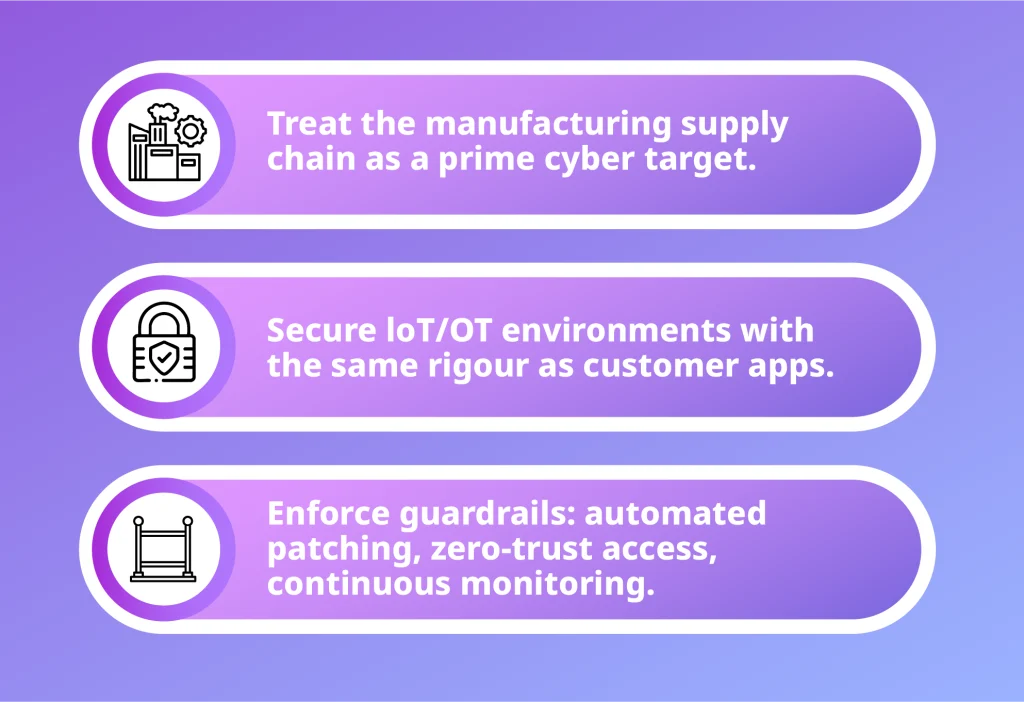
When ransomware hit Jaguar Land Rover, production lines ground to a halt and deliveries stalled worldwide. Just-in-time supply chains collapsed, costing millions each day. With IoT and OT systems now central to manufacturing, one breach was enough to shut down entire operations.
What this means for DevSecOps in practice:
DevSecOps Lessons From the Heathrow Airport Breach
Heathrow Airport suffered both outages and a major data breach, leaving passengers stranded and regulators circling. The fallout was not just operational but reputational, with GDPR fines looming. The weakness stretched beyond Heathrow’s walls; third-party systems opened the door.
Cloud-first delivery only works if the foundations are secure. Strong cloud security practices like continuous monitoring, identity enforcement, and policy-as-code ensure that attackers can’t exploit misconfigurations or weak access points.
For UK businesses moving workloads across AWS, Azure, and GCP, this isn’t optional; it’s the difference between scaling confidently and becoming the next headline.
Critical priorities for DevSecOps teams:

DevSecOps Lessons From the Co-op Ransomware Attack
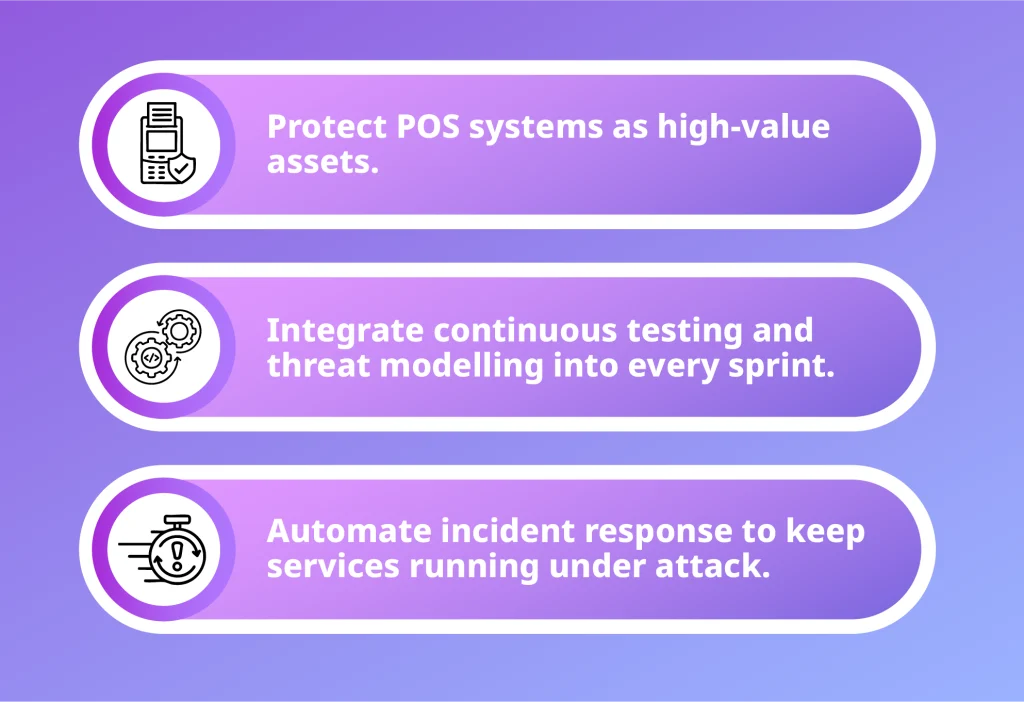
For Co-op, tills froze as ransomware shut down point-of-sale systems across stores. Customers left empty-handed, and supply chains faltered. The breach didn’t start with malware but with impersonation; attackers tricked their way in and exposed the lack of identity defences.
Practical steps to strengthen DevSecOps:
What ties these cases together is the gap between paper compliance and practical defence. Many organisations still see compliance as paperwork to sign, rather than safeguards that run automatically with every sprint.
A more robust approach is outlined in Deployflow’s guide on aligning DevOps with compliance, which shows how policy-as-code turns regulatory requirements into continuous safeguards instead of last-minute bottlenecks.
Building a UK DevSecOps With Delivery Squads in 2025 and Beyond
The cyberattacks on JLR, Heathrow, and Co-op show that waiting for security checks at the end of delivery is a losing strategy.
Resilience has to be part of the pipeline from the first sprint. At Deployflow, sprint-based engineering squads align development, operations, and security so resilience grows with every sprint.
Instead of security teams working in isolation, these squads embed developers, operations, and security engineers together.
Every sprint delivers features and security improvements, scans, compliance checks, and monitoring baked directly into the work. It means faster releases, fewer bottlenecks, and a culture where security isn’t an afterthought but a shared responsibility.
Deployflow’s credibility comes from running these squads across highly regulated sectors like FinTech, HealthTech, and PropTech, where compliance can’t be compromised.
By using sprint-based squads, they’ve helped companies cut release cycles from months to weeks while staying fully audit-ready.
One example is Little Journey, a paediatric support platform working with hospitals across the UK. Their growth was slowed by heavy NHS Digital compliance checks, with new environments taking days to approve.
Deployflow’s sprint-based squads automated compliance with policy-as-code and used infrastructure as code for audit-ready environments. The result was that setup times dropped from days to hours, and compliance preparation was reduced by more than 70%, without delaying patient support.
If a HealthTech platform can cut compliance prep by 70% without slowing delivery, imagine what that could mean for your business. The fastest way to get there is by embedding security into every sprint through DevOps managed services.
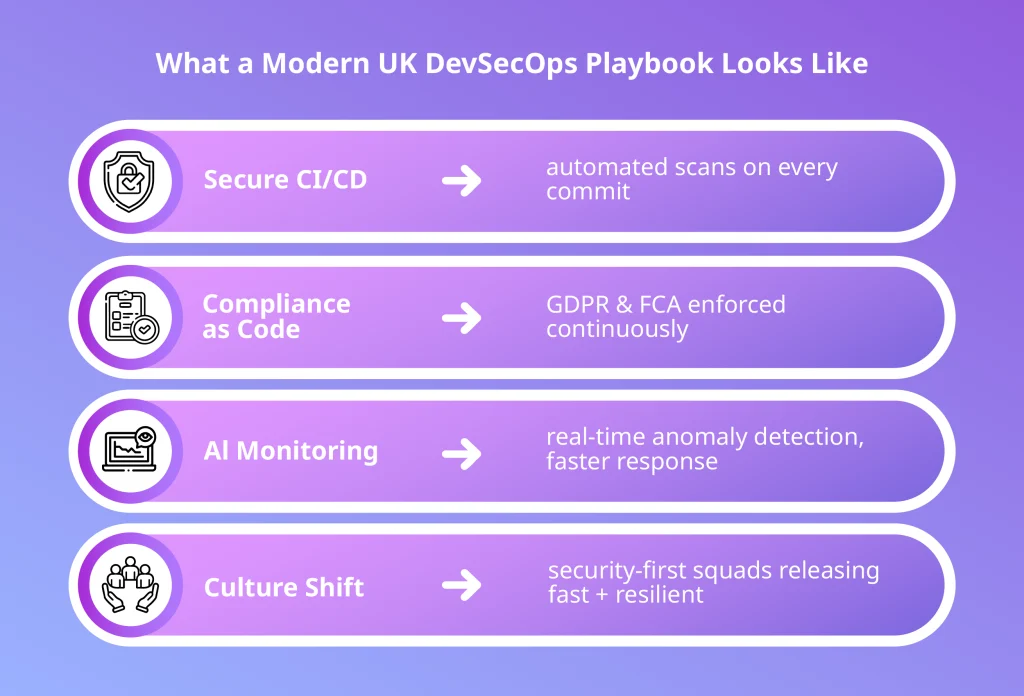
This is the model UK businesses need in 2025 and beyond: fast, secure, and audit-ready by design.
DevSecOps Checklist for UK Leaders in 2025
- Audit supply-chain dependencies monthly to catch hidden risks before attackers exploit them.
- Automate SAST and DAST so every pipeline run includes security testing by default.
- Train squads to recognise AI-powered phishing, because human awareness remains a frontline defence.
- Run chaos engineering and red-teaming to expose weaknesses under real-world attack conditions.
- Align incident response with NCSC guidance to ensure compliance and consistency across the organisation.
Turning UK Cyberattack Lessons Into a 2026 DevSecOps Strategy
The cyberattacks on JLR, Heathrow, and Co-op showed that even the UK’s biggest brands can be brought down when security is treated as an afterthought.
The companies that survive the next wave of attacks will be the ones that build security into their delivery rhythm.
DevSecOps has become the standard for UK businesses that want to move fast, stay compliant, and protect customer trust.
Those who adapt will turn 2025’s failures into a competitive advantage in 2026. Those who don’t risk joining the next round of headlines.
2026 will reward the companies that build resilience into every sprint.
The attacks on JLR, Heathrow, and Co-op proved that speed without security is a liability and not an advantage.
Now is the time to reengineer delivery pipelines so that security, compliance, and innovation move in tandem.
Ready to see how your organisation measures up? Talk to Deployflow experts and learn how sprint-based DevSecOps squads can keep your business ahead of the next attack.
Hackers may keep trying, but in 2026, the resilient companies will be too busy shipping, scaling, and celebrating to notice.
Frequently Asked Questions on UK Cybersecurity and DevSecOps in 2025
Why are UK businesses such frequent targets for cyberattacks in 2025?
The UK has a dense concentration of high-value industries like finance, healthcare, aviation, and retail, all undergoing rapid digital transformation.
Attackers know these sectors process sensitive data and can’t afford downtime, making them prime ransomware targets.
At the same time, regulatory pressure (GDPR, FCA, NHS Digital) creates complex compliance requirements that many organisations struggle to automate. Attackers exploit these gaps, especially in legacy systems that weren’t designed for today’s threat landscape.
What role does DevSecOps play in preventing ransomware attacks?
DevSecOps prevents ransomware from spreading by embedding security directly into the pipeline. Automated scans catch vulnerabilities before release, policy-as-code ensures compliance at every stage, and continuous monitoring detects anomalies early. Crucially, DevSecOps eliminates the delays between development, operations, and security teams. This shortens the window attackers have to exploit known flaws and ensures patches are applied quickly, reducing the risk of widespread lockouts like those seen at JLR and Co-op.
How can UK companies balance speed of delivery with strict regulations like GDPR or FCA rules?
The balance comes from automation and not compromise. With policy-as-code, compliance checks become part of every pipeline run, not a separate, manual process at the end.
This means teams can release features quickly while still producing audit-ready evidence.
Deployflow has delivered similar results in PropTech with Strike, where sprint-based squads increased deployment frequency fourfold while keeping GDPR compliance continuously enforced.
What practical first steps should UK leaders take to build cyber resilience in 2025?
- Start with a clear baseline: audit supply-chain dependencies, review patch cycles, and map where security checks currently happen.
- Then introduce automation in high-impact areas: SAST/DAST in pipelines, monitoring tied to incident response, and policy-as-code for regulatory requirements.
- Train squads on new threat vectors like AI-powered phishing, and run red-team exercises to test resilience.
These steps create a foundation where DevSecOps practices can scale across the organisation without disruption.
Explore our BLOG
Recent articles

ISO 42001 Explained: Requirements, Certification and What Your Engineering Team Must Build
ISO 42001 is the international standard that demonstrates your organisation governs AI properly, and enterprise...
read full article

Is Claude Down? Anthropic Outage: Protect Your Cloud Infrastructure
Claude went down across every surface on 29 September 2026. From 14:00 to 14:59 UTC,...
read full article

Top 10 Healthtech Companies in 2026: What Their Growth Means for AI and DevOps
Every software change that reaches a hospital has to clear regulatory, legacy system, and clinical...
read full article