



Your agent pilot has a ceiling, and your systems set it. Every manual trigger, ticket queue, and human-only screen sitting between an agent and the work is a point where execution stops.
Between now and 2030, Gartner expects agents to bypass the software interfaces you pay for, exposing up to $234 billion of enterprise application software spending. The teams that capture that shift share one trait: agents can execute across their pipelines and infrastructure without a human relaying every step.
Here is how to build that, and how to find the faults before a pilot does.
Executive Summary
- Keep the software budget agents are about to put at risk.
- See where your agent pilots will stall before they cost you.
- Score your estate against six foundations in an afternoon.
- Hold on to the operational advantage your agents create.
- Leave with a staged roadmap you can start this quarter.
Agentic Arbitrage: What Gartner’s $234bn Forecast Means
You are increasingly buying software for agents, not for people, and your contracts stay exposed until they catch up.
Gartner defines agentic arbitrage as the point where agents complete tasks across many systems at once, so staff stop working through individual interfaces.
“Agentic AI changes the economics of software,” says George Brocklehurst, Managing Vice President at Gartner.
Brocklehurst frames the break clearly. For two decades, software has been judged on interface and experience, on usability, workflow and training. Once agents become the primary user, that basis of comparison depreciates, seat-based pricing weakens, and value stops tracking headcount.
Gartner puts the exposed share at roughly 20% of enterprise application SaaS spending by 2030, and frames the wider effect as a redefinition of the Saaspocalypse: the disaggregation of the legacy SaaS market as it stands today.
Read it as a warning about economics. The pressure runs estate-wide, but it bites first in your execution layer, where manual work already slows delivery.
Why Your Pipelines and Infrastructure Block Agents First
An agent is only as capable as the systems it can reach, and execution is where most estates stall.
The walls will be familiar to any engineering leader. A CI/CD pipeline that needs a human to trigger each stage. Infrastructure changes that wait on a ticket queue. Incident response that depends on the one engineer who knows the runbook.
You will know the symptoms. Staff copy state between tools by hand. Releases wait on manual gates that add no safety. Every new integration adds fragility rather than reach. Pilots demo well, then fail in production, because execution was built around people.
Cost follows the same path. Money flows into agent tooling while the real blockers go untouched, so the promised productivity never lands.
Left unchecked, ungoverned AI spend erodes engineering ROI long before anyone thinks to question the pilot itself.
What AI Agents Deliver Across CI/CD and Infrastructure
Replace the handoffs between strategy, build and run with one execution system that agents own end-to-end.
The shift is from three layers to one. Strategy, build, and operations stop passing work between teams, and agents take over execution directly inside your pipelines and infrastructure.
Deployflow builds exactly this: agents that plan and act across your CI/CD, monitoring and cloud environment, sitting inside your stack rather than replacing it. Deployflow’s leading AI engineers and enterprise automation cover the full path, from picking which workflows to hand over first through to running the agents in production.
Engagements target up to 70% less manual operational effort. Incident response in minutes instead of hours. Continuous optimisation across pipelines and infrastructure as systems adapt in real time.
Agents are introduced incrementally, which keeps the risk low. They start on lower-risk workflows, run within guardrails and fallback logic, and escalate rather than act when they cannot execute with confidence. Human oversight stays where it matters, especially in the early stages.
Sequencing decides how far that gets, and the same staged approach applies when you deploy multi-step AI systems into live environments.
The proof sits in production. Two national-scale programmes show what an agent-ready execution layer looks like when the stakes are highest.
Case Study: AI Agent Infrastructure for a National Energy Client
A UAE national energy client needed to turn decades of geological research into real-time drilling intelligence, inside critical national infrastructure. Deployflow embedded in the platform engineering function and built a governance-first DevOps architecture on Kubernetes, ArgoCD and Terraform, with GitOps-driven delivery across H100 GPU clusters.
The results held under the tightest constraints in the sector:
- More than 1PB of subsurface data processed in real time across H100 GPU clusters.
- 100% air-locked subscriptions, reachable only from the customer network.
- Zero manual steps, as every environment auto-inherits security, networking and governance policies.
- One platform, so new AI workloads land without re-engineering the core infrastructure.
When execution is codified as infrastructure, agents can run at scale inside even an air-gapped, heavily regulated environment, and every change stays tracked and auditable.
Case Study: Automated AI Pipelines for a Public-Sector Body
A multi-billion-dollar UAE public-sector organisation was drowning in fragmented data across surveys, spreadsheets and regional platforms, with no real-time view of community and policy outcomes. Deployflow designed a decision intelligence platform that consolidated those sources into a single AI-powered layer.
The headline outcomes show manual work giving way to autonomous execution:
- Automated AI pipelines replaced manual data classification across every source.
- 24/7 real-time data ingestion and signal monitoring at national scale, in place of manual reporting.
- One unified data layer merging disconnected systems into a single intelligence platform.
- A six-to-twelve-month path from proof of concept to full national-scale deployment.
The takeaway applies far beyond the public sector. Once pipelines run themselves, leadership gets continuous visibility rather than periodic snapshots, and the people who used to move data by hand move on to higher-value work.
The pattern holds outside national infrastructure. Strike, the UK property platform now trading as Purplebricks, brought Deployflow in after losing its internal DevOps team.
“Their help and advice in improving our continuous integration and continuous deployment (CI/CD) pipelines has drastically increased the reliability of our releases and the platforms.”
Dan Rafferty, CTO at Strike
The Six Foundations of AI Agent Readiness
Score your estate against six foundations, and you will know exactly where agent execution will stall. Each one maps to a capability you either already have or need to build, from spotting the workflows worth handing over to orchestrating several agents at once.
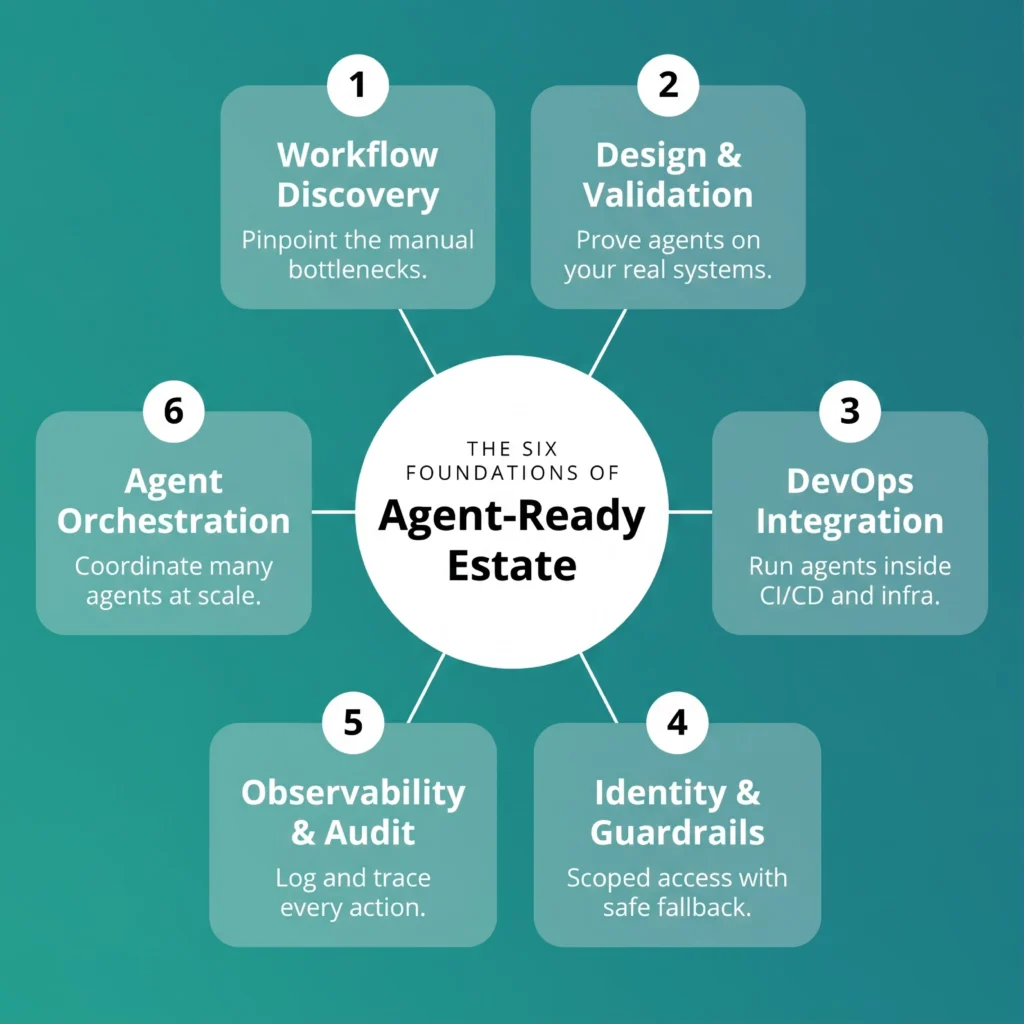
- Workflow Discovery. You need a ranked view of where manual effort accumulates across delivery and operations. Hours consumed is the ranking that counts, and the workflows that qualify are often ones nobody has flagged. Score low here and every later decision rests on guesswork.
- Design and Validation. Agents have to be proven against your real systems, real data and real failure modes before anything reaches production. A sandbox that always cooperates tells you nothing about how an agent behaves when an API times out or a state check comes back ambiguous.
- DevOps Integration. Agents belong inside the CI/CD and cloud environment your engineers already use, with the same review gates, approvals and rollback paths. An agent bolted onto the outside of your delivery process becomes a second system to govern, which is the opposite of the point.
- Identity and Guardrails. Every agent needs scoped credentials, a hard permission boundary and defined behaviour for the moment its confidence drops. Safe fallback matters more than raw capability here, because the failure that damages teams is an agent that half-completes a change and reports success.
- Observability and Audit. Every action an agent takes should be logged and traceable months later, with enough context to reconstruct why it acted. Regulated sectors make this non-negotiable, and it is what lets you answer a regulator with a log rather than a reconstruction.
- Agent Orchestration. Coverage only widens if agents can run alongside each other without contention. Orchestration governs how they share resources, hand work between each other and avoid acting on the same system at the same moment. Score low here and your second agent undoes the value of your first.
Foundations one through five close during delivery, in the four stages set out below. Foundation six stays live for as long as agents run.
Treat the framework as a readiness test. Work clockwise from discovery through to orchestration, and score yourself honestly against each foundation.
Score each foundation 0 for absent, 1 for partial, 2 for production-grade. Twelve points means agents can execute today. Anything under eight means your pilot will stall on plumbing.
How to Deploy AI Agents: The Four-Stage Delivery Path
Four stages take a scored estate to agents running in production, and each one closes a specific set of foundations.
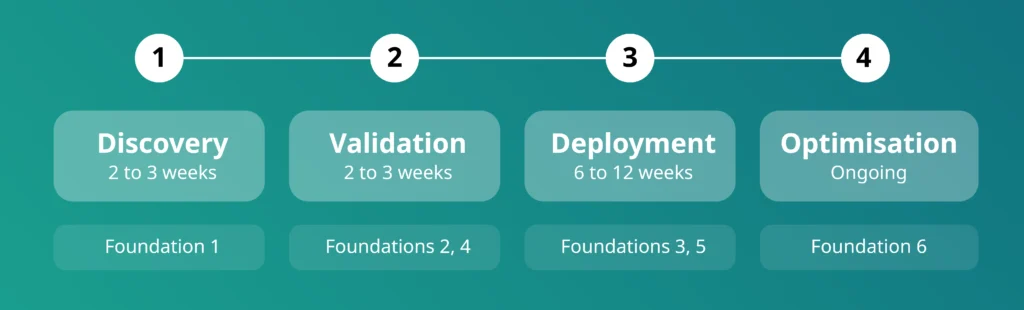
Stage One: Discovery and Workflow Analysis (Two to Three Weeks)
Discovery maps your execution-heavy workflows across pipelines, infrastructure and operations, then ranks them by the hours they consume. Visibility makes a poor proxy, and the workflows costing you most are rarely the ones anyone complains about.
Foundation one closes here. You leave with a shortlist of candidates worth handing to an agent first, and a clear view of which ones are blocked by something an agent cannot fix.
Stage Two: System Design and Agent Validation (Four to Six Weeks)
Agents get built and validated against your real workflows and environments, never a sandbox that flatters them. Scoped credentials, permission boundaries and fallback behaviour are defined at this stage, never retrofitted once agents are live, which is exactly what foundations two and four are testing for. Anything that scored low on either surfaces here, while the cost of fixing it is still a sprint rather than a programme.
Stage Three: Production Deployment (Six to 12 Weeks)
Agents go into your pipelines and infrastructure directly, using the same review and rollback paths your engineers already work through. Logging and traceability ship with them from the first deployment, so foundations three and five move from gap to capability.
Measurable impact usually lands in the first weeks of this stage, around week eight to ten from kick-off, because a validated agent starts removing hours the week it goes live.
Stage Four: Continuous Optimisation (Ongoing)
Automation coverage widens, and system performance improves as agents adapt to how your estate actually behaves. Foundation six becomes the binding constraint at this point, because coordinating several agents at once is a different engineering problem from running one well.
Score well on orchestration, and each new agent compounds the last. Score poorly, and you spend this stage rebuilding what stage three shipped.
Twelve to 21 weeks separates a first discovery workshop from agents executing in production. Where a foundation scored low, the stage that depends on it runs to the upper end of its range, which is the practical reason to score honestly before anything gets scheduled. For a sprint-level view of what fits inside each stage, see what six sprints can realistically deliver.
AI Vendor Lock-In: Who Owns What Your Systems Learn
Every agent generates knowledge, and most contracts hand it to the vendor. Each correction and workflow teaches your systems something new. Gartner calls your ability to hold on to it your Knowledge Retention Rate, or KRR, and Brocklehurst names the clause that decides your next contract: who owns what the system learns from you.
Feed it to a vendor’s shared model, and you improve a product your rivals also license. Keep it in-house, and every interaction sharpens your edge.
Architecture decides which happens. Agents that run inside your own infrastructure, with no lock-in, keep the learning yours.
The Agentic AI Decision Facing UK CTOs
The agents are coming to your systems either way. Readiness is the one variable you control.
Manage agentic arbitrage as a threat, or lead it as a shift. An agent-ready execution layer turns exposed spend into captured value, and keeps the operational learning your agents generate inside your business.
Why Deployflow for AI Agent Development
Deployflow designs, builds and runs AI agents that execute across your pipelines and infrastructure, delivered by sprint-based dedicated teams that own the work from discovery to production. The evidence sits in the work already shipped:
- Engineered a petabyte-scale, fully air-locked AI platform for a national energy client, running across H100 GPU clusters with zero manual steps in provisioning.
- Replaced manual data classification with automated pipelines for a multi-billion-dollar public-sector body, moving it to 24/7 real-time monitoring at national scale.
- ISO 27001 certified and UK Cyber Essentials certified, with AWS, Microsoft Azure and Google Cloud partnerships.
Two commitments matter most for what this article has covered: agents run inside your own stack with no platform lock-in, and ownership plus knowledge transfer stay with your team. Your operational learning stays yours.
Book a consultation to map your execution bottlenecks and score your estate against the six foundations.
Frequently Asked Questions About AI Agent Development
What is the difference between agentic AI and RPA?
RPA follows fixed rules on predictable screens. Agentic AI plans, adapts and executes across systems to reach a goal, handling variation that would break a script.
RPA repeats scripted clicks, so it breaks the moment a screen, field or step changes, and it needs constant maintenance as your tools evolve. Agents work from intent instead of instructions. They choose their own steps, call APIs directly, and handle exceptions by escalating rather than failing silently. That makes them suited to CI/CD, incident response and infrastructure work, where conditions shift constantly, and a fixed script cannot keep up. Most teams move from RPA to agents once the maintenance burden and brittleness cost more than the automation saves, and the two can coexist during that transition.
Do we need to replace our existing software to use AI agents?
No. Agents sit inside your current stack and take over execution through the APIs, pipelines and cloud environment you already run.
A rip-and-replace is rarely necessary or wise. The real prerequisite is programmatic access: the systems agents must reach an API or machine interface and not a human-only screen. Where that access exists, agents can be introduced incrementally, starting on lower-risk workflows and widening as confidence grows. Your architecture stays in place, and only the execution layer on top of it changes. The work that does come up is usually integration and access, which is why most environments are closer to ready than their teams assume.
How much does deploying AI agents cost, and when does ROI show?
Cost tracks scope rather than a fixed licence, and measurable impact usually lands within eight to ten weeks, as the first validated agents reach production and well before the full rollout completes.
Value comes from two places: removing manual operational effort, and cutting incident response from hours to minutes. Both free your engineers for higher-value work instead of adding headcount, which is where the return compounds. Fixed-scope, transparent pricing keeps the business case legible for a board, with no per-seat surprises as usage grows.
Baseline effort and response times before the first agent goes live. Hours removed and time-to-resolution are easier to defend to a board when measured against a number recorded in discovery rather than estimated afterwards. The fastest payback comes from targeting your highest-friction workflows first and expanding coverage once each stage has proven its value, so spend follows results rather than preceding them.
Is agentic AI compliant with UK regulation?
There is no single UK AI law. The UK follows a principles-based approach across existing regulators, and rules already in force, including UK GDPR, still apply to automated decisions.
Compliance depends on how you deploy, not on the technology itself. UK GDPR gives people rights around solely automated decisions that have significant effects, so meaningful human oversight matters wherever agents touch those. Regulators and sector bodies, including the FCA in financial services, expect audit trails, scoped access and clear accountability. In practice that means logging every agent action, keeping decisions traceable, and maintaining an escalation path so a human can step in. Building those controls in from the start keeps you defensible as guidance continues to evolve.
What in-house skills do we need to adopt AI agents?
Less than most teams expect. You need visibility across your pipelines, infrastructure and monitoring, not a standing AI research team.
Most environments already hold what agents need, and the gap is usually structuring and connecting it. A delivery partner can handle the specialist work of designing, building and validating agents, with knowledge transfer built into delivery so your engineers can run and extend the systems afterwards. The one capability worth developing internally is oversight: defining execution scope, setting permissions and decision boundaries, and reviewing what agents do. That governance skill is what lets you scale safely without becoming dependent on any single vendor or individual.
Explore our BLOG
Recent articles

How can a DevOps team leverage the power of AI?
Your CI/CD pipeline is automated, but it still can’t see trouble coming. Alerts land after...
read full article

Why Regulated Industries in the UK Are Getting AI Wrong
Your pilot works. It has worked for months. It still cannot go live, and every...
read full article

What Is AI Foundry, and Why Should CTOs Care?
Somewhere in your Azure tenant, an AI workload is running that nobody formally approved. It...
read full article