



Your AI pilot works in the demo, then spends months trying to reach production, and plenty never get there. The delay comes from the order of the work: governance, integration and infrastructure get left until the model is built, so it all comes back as a second pass.
Reverse that order, do the hard engineering first, and the timeline collapses to roughly 12 weeks. Same scope, six sprints, discovery to live.
Read on for where the six months go, the two patterns that compress them, and the five questions that tell you whether a partner will ship or stall.
Executive Summary
- A six-stage delivery model that hands you a live system and full IP, so you are never locked to the supplier who built it.
- Governance-first platforms have proven where it is hardest: an air-locked national energy programme and a UAE public-sector platform scaled from proof of concept to national rollout.
- What a production build costs at SME scale, £30,000 to £50,000, and how a scoped proof of concept sizes the real figure before you commit a quarter.
- Which EU AI Act tier your systems fall under, and why FinOps from day one keeps unit economics stable as usage climbs.
Why Your AI Pilot Stalls Before It Reaches Production
You move slowly because every project rebuilds the same security, networking and pipelines. Build them once, as code, and the next project inherits them. The application is rarely the slow part, but the scaffolding underneath it is.
Gartner reaches the same conclusion from the data side: it expects organisations to abandon 60% of AI projects through 2026 because the data feeding them was never made ready.
Look closely and four time sinks repeat:
- Governance and security get added after the model works, forcing a second pass to satisfy reviewers.
- Infrastructure is recreated from scratch for every project instead of being reused.
- Integration with existing systems is left late, then surfaces as a nasty surprise.
- No scoped trial kills a weak idea early, so it burns months before anyone calls time.
Each one is a planning failure. The stall gets sharper when the system acts rather than answers. That is the core challenge in moving from chatbots to AI agents. An unowned tool layer and untested decision paths sink rollouts that demos made look ready.
How Long Should AI System Delivery Take? Six Sprints, Not Six Months
Six sprints put a scoped AI system into production in about 12 weeks. Deployflow runs the work as a six-stage process on a two-week sprint cadence:
The Six-Stage AI Delivery Model
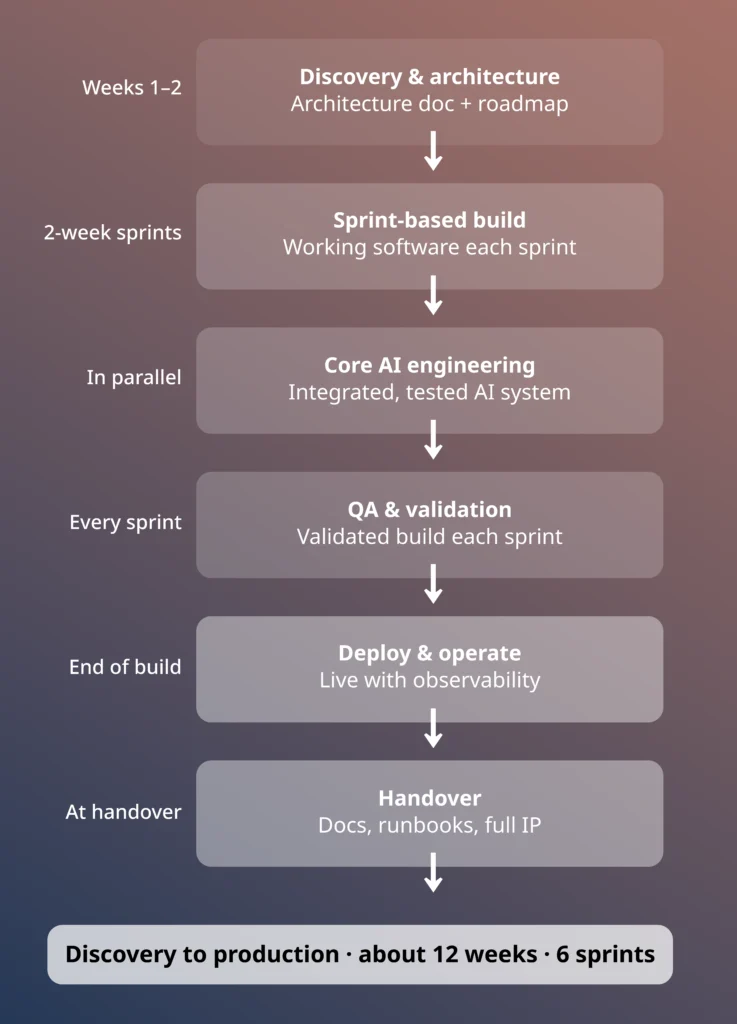
Discovery takes the first stretch, then build, core engineering, and QA run together across the rest, with deploy and handover closing it out. Six sprints are the envelope, a two-week cadence over roughly 12 weeks, rather than six fixed stages bolted end to end.
That envelope delivers a scoped first system, or a fresh use case on a platform you already run. It does not deliver a company-wide transformation across every department; that runs into quarters and ships in stages.
Scaling that first win across the organisation is a separate discipline. Scaling AI fast without losing control covers five governed-delivery moves that keep cost and compliance steady as the programme grows.
Build Your AI Platform Once, Then Ship in Sprints
An AI platform earns back what one-off projects spend twice. Build the security, networking and pipelines once as code, and every workload after the first inherits them at no extra cost.
That is now the mainstream play: Gartner expects 80% of large engineering organisations to run platform teams by 2026, up from 45% in 2022, supplying the reusable services that delivery depends on.
How Deployflow Built a Reusable, Petabyte-Scale AI Platform
Deployflow built a reusable, governance-first AI platform for a national-scale energy operator, then ran new workloads on it without rebuilding the core. The brief was to turn decades of geological research into real-time predictive intelligence for drilling, inside critical national infrastructure.
The constraints were absolute: an air-locked network reachable only from the customer’s own systems, petabytes of subsurface data, and H100 GPU clusters serving both chat-based queries and 3D visualisation from a single backend.
Kubernetes and ArgoCD ran GitOps delivery through Terraform, and a modular infrastructure-as-code framework replaced manual provisioning, so every environment came up with security, networking and governance already in place. Azure AI and machine-learning workspaces sat over the data lakes, inside the air-locked boundary.
A petabyte of data now runs in real time on the H100 clusters, and subsurface teams have moved from manual data handling to real-time AI guidance.
New workloads land on the platform without re-engineering the core; each environment inherits its policies without manual steps, and every change is tracked via GitOps for auditing. The first use case carried the build; each one after lands on the finished platform and ships in sprints.
Prove It With a POC Before You Bet a Quarter on It
A scoped proof of concept tells you whether an idea works before you spend a quarter finding out. It exposes the real risks while changing course is still cheap, which makes it the cheapest insurance against joining the half of projects that get abandoned.
Case Study: How Deployflow De-Risked a National AI Platform With a Scoped POC
A large UAE public-sector body that monitors social and economic well-being had the data but no way to use it. It sat scattered across surveys, spreadsheets and regional systems, with nowhere to see what was happening or whether policy was working.
Deployflow scoped a proof of concept first: data preparation and an early AI pipeline, before any commitment to the full national rollout. That single step proved the approach worked and gave leadership the evidence to fund the next phase.
The POC laid the foundations for the wider platform. The design feeds incoming survey and regional data through AI pipelines, turning it into comparable indicators.
An executive layer then tracks regional breakdowns, combined indices for family health, economic health and social cohesion, and policy milestones against the trends. The full national rollout runs from proof of concept to production across roughly 6 to 12 months.
The same governed approach underpins Deployflow’s DevOps and AI platform services for the public sector, where G-Cloud procurement and ISO 27001 controls are built in from the first sprint.
Ship Faster Without Failing Your Compliance Review
Moving faster doesn’t have to mean skipping compliance. It means building the controls in from the first sprint so they never reopen the work later. The two risks that matter most, regulation and runaway cost, both shrink when you handle them up front.
Take the EU AI Act. It reaches any organisation whose AI output is used in the EU, the UK included. Lawmakers have agreed to move the core high-risk obligations, conformity assessment, technical documentation, and human oversight to 2 December 2027 for standalone systems and to 2 August 2028 for AI embedded in regulated products. Formal adoption is expected before August 2026, so treat those dates as your planning baseline.
Transparency is the near-term catch. Most transparency duties apply from 2 August 2026, and the labelling of AI-generated content lands by 2 December 2026. Treat the rest as planning room, since most of the window goes on finding and classifying every AI system you run. Build the controls in as you go, and skip an expensive retrofit later.
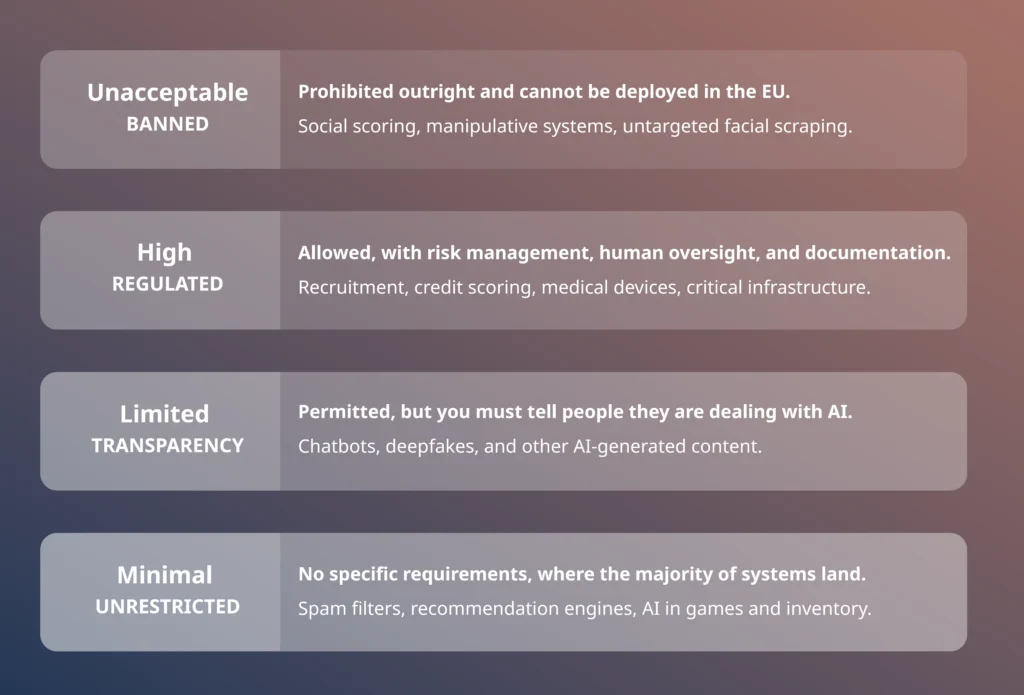
The EU AI Act’s Four Risk Tiers
Every AI system you run falls into one. The tier decides the obligations you owe.
Then there is cost. Models that look cheap in a pilot grow expensive at scale, and spend drifts when no one owns cloud efficiency. The FinOps Foundation’s State of FinOps 2026 found 98% of organisations now manage AI spend, up from 31% two years ago, and ranked AI cost management as the top skill teams need to build. Bring that discipline in early, and your unit economics hold as usage climbs.
Deployflow builds on ISO 27001 and Cyber Essentials Plus for exactly this reason, with fluency across AWS, Microsoft Azure and Google Cloud: the guardrails that keep speed from turning into audit risk.
The CTO Checklist to Cut Months Off AI System Delivery
Want to take months out of your next AI build? Six moves do most of the work:
- Start with an audit, not a blank page.
- Build governance and security into the design, not onto a finished system.
- Treat infrastructure as code and run GitOps to keep environments repeatable.
- Scope a proof of concept with a clear kill criterion before you commit.
- Buy a managed DevOps run rather than headcount, so the partner owns the outcome.
- Bring in FinOps from day one.
Then put the same five questions to every shortlisted partner:
- What is your step-by-step process for taking a pilot into production?
- Who owns the system six months after launch?
- How is post-launch support structured, and what does it cover?
- How do you build in compliance and governance from day one?
- Can you show a project that reached live production, with the result?
Vague answers tell you the pilot will stall. Concrete ones tell you it will ship.
Why Deployflow Is the Obvious Choice for Regulated AI Delivery
Six months is a choice. It is what happens when the hard engineering and the go/no-go trial are left until the end. Put both at the front, and the date you give the board is one you actually hit.
Most AI partners stop at the handover or bill you by the head. Deployflow works the other way: it takes AI into production in regulated, data-intensive environments, then owns the run. Delivery goes from discovery to production in about 12 weeks across the UK, the EU, the GCC, and beyond. Three things set it apart:
- Proven where it is hardest: production AI inside an air-locked national energy programme, and a real-time decision platform for a UAE public-sector body.
- Audit-ready by default: ISO 42001 ISO 27001 and Cyber Essentials Plus, with CI/CD built for FCA, PCI DSS and GDPR environments.
- Built to own the outcome: a managed run with cloud cost optimisation in every build.
The case studies behind each claim, the audit-first entry points, and the full managed-run scope sit on Deployflow’s AI engineering and automation services.
When you are ready, the first step is free: book a strategy session and leave with a clear, honest view of your fastest safe route from pilot to production.
Frequently Asked Questions About AI System Delivery Costs, Security and ROI
How much does it cost to build a production AI system?
A focused, production-ready build at SME scale typically runs from £30,000 to £50,000 over 6 to 12 weeks.
Three things move that figure: how ready your data is, how many systems the AI has to plug into, and how much of the running you hand to a partner afterwards. A scoped proof of concept costs a fraction of a full build and is the cheapest way to size the real number before you commit. Fixed-scope packages keep the price predictable because you are buying a defined outcome rather than an open-ended day rate.
How do you keep AI systems secure in production?
Treat an AI system like any other production system: control access, encrypt data in transit and at rest, log every action, and monitor it continuously after go-live.
AI then adds risks of its own, prompt injection, sensitive data leaking through model outputs, and context data ending up where it should not, so the data path needs as much attention as the model. Keep an auditable record of every change, which also makes regulatory questions far easier to answer later. For high-sensitivity workloads, running the model inside your own network, or fully air-gapped, removes whole categories of exposure at a stroke.
How do you measure the ROI of an AI project?
Pick one business metric, baseline it before you build, and then track the change relative to the system’s cost to run.
Goals like “improve efficiency” cannot be measured, so name the number that matters first: hours saved, error rate, conversion, or cost per transaction. Use fast lead indicators to confirm within weeks that the model behaves, and lag indicators to report value at the 90 and 180-day marks. Watch unit economics as closely as the headline, because cost per request or per outcome is where pilots that looked cheap start to slip at scale.
Which AI model should you choose for a production system?
Choose the model that meets your accuracy, latency, cost, and data control needs for the specific task, and ignore the benchmark leaderboard.
A general assistant, a domain-tuned model and an open-weight model you host yourself each suit different problems, and how sensitive your data is often decides which is even allowed. Build a model-agnostic layer so you can swap providers as prices and capabilities shift, which they do regularly. For regulated or air-gapped work, the deciding question is whether a model can run inside your own environment at all.
How do you avoid vendor lock-in when building AI?
Keep your data, code and infrastructure portable by building on open standards and owning the architecture. Infrastructure as code, containers and a model-agnostic integration layer let you move between AWS, Microsoft Azure and Google Cloud, or between model providers, without a rebuild.
Make sure any engagement leaves you owning the code, models, and architecture, with full documentation, so you never depend on a single supplier to keep the system running. Lock-in rarely comes from a single decision; it builds up through small proprietary choices, so design for portability at the start.
Explore our BLOG
Recent articles

Is Claude Down? Anthropic Outage: Protect Your Cloud Infrastructure
Claude went down across every surface on 29 September 2026. From 14:00 to 14:59 UTC,...
read full article
Top 10 Healthtech Companies in 2026: What Their Growth Means for AI and DevOps
Every software change that reaches a hospital has to clear regulatory, legacy system, and clinical...
read full article
How to Build an AI Engineering Capability Without Hiring 20 People
You don’t need 20 hires to run AI in production. Three to five people can...
read full article