



In 2021, Zillow, the leading U.S. real estate and rental marketplace, shut down its home-buying division and wrote off more than $500 million. (CNN) The cause was an AI pricing model running in production with no adequate monitoring, no output validation, and no rollback process. The model got prices wrong. Nobody caught it in time. By the time the problem was visible, the damage was already structural.
Zillow is an extreme case. But the underlying failure (an AI system making consequential decisions in a production environment with no governance layer watching it) is not extreme at all. It is the default state of most engineering organisations deploying AI today. The scale differs, but the structure of the problem does not.
What You Need to Know Before You Read Further
- Ungoverned AI drains delivery capacity and inflates cloud spend slowly, quarter after quarter
- The breakdown lives inside your build, deploy, and operate pipeline stages
- Six cost categories are likely active in your environment right now, none of them visible on a standard P&L
- Governed AI infrastructure applies the DevOps discipline you already have to a component type you have been under-managing
- A 60-minute audit with your platform leads will tell you whether the damage is already compounding
Three AI tools in Q1. Two more by Q2. By Q3: no clear ownership, no usage visibility, and a cloud bill nobody could fully attribute. Three senior engineers were spending a third of their time on what looked like code defects. It was not code. It was ungoverned AI behaving exactly as ungoverned AI behaves.
Read this to understand exactly where the cost is coming from, where your delivery pipeline is most exposed, and what a governed AI infrastructure looks like in operational terms, including a 60-minute audit you can run this week.
AI Governance Is a Boardroom Word for an Engineering Problem
Most CTOs already sense the gap. McKinsey‘s numbers make it concrete: only 18% of organisations have an enterprise-wide body with actual authority over AI governance decisions. In the remaining 82%, those decisions are being made informally, inconsistently, or not at all.
Board-level governance conversations cover risk frameworks, ethics policies, and regulatory exposure. None of that explains why delivery velocity has been slipping since Q2 or why AI-related cloud spend continues to rise without a corresponding line item.
The governance failure most CTOs are managing is operational. It lives in your deployment pipeline, your observability stack, and your team’s daily workflow. It does not announce itself, but it accumulates.
The root cause is a category error. AI has been treated as a product decision: new capability, new feature, ship it. Models and APIs get adopted without ownership structures. Prompts get written once and forgotten. Monitoring covers the application layer, but nothing watches what the model is doing in production.
82% of organisations are making AI governance decisions informally, inconsistently, or not at all. The result: running AI at scale while remaining operationally blind to it.
Six Cost Categories That Will Not Appear on Your P&L
Ask your finance team to pull the cost of ungoverned AI this quarter. They cannot do it because it has no name. It hides within existing budgets, draining them while the root cause goes unrecorded.
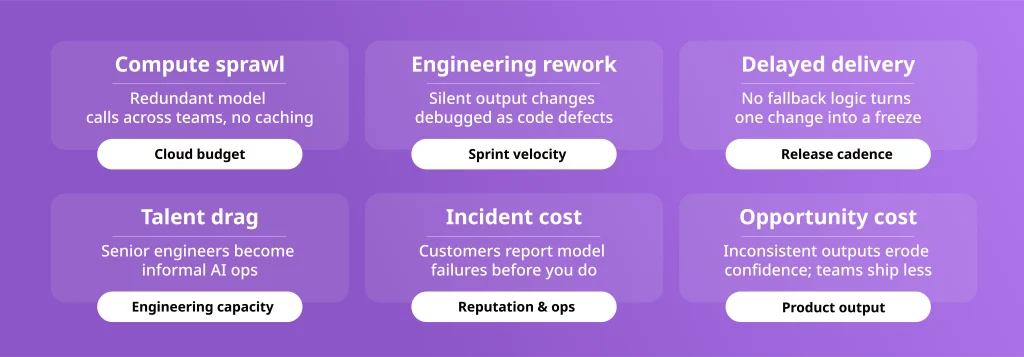
The pattern is consistent across all six categories. AI gets adopted as a product decision, but the fallout lands in engineering budgets. Debugging time gets logged against a sprint. Unplanned ops work gets absorbed by whoever is available. Cloud waste sits inside a bill that grows without explanation. Nothing points back to governance. Nothing triggers a review.
That is the real problem. Each category moves slowly enough to look like ordinary friction. A sprint that underdelivers. A cloud bill that creeps up. A senior engineer who never quite has capacity. Individually, none of it raises a flag. Collectively, over two or three quarters, it becomes the reason your delivery numbers are not where they should be.
By the time ungoverned AI shows up in a board review, it is already structural, and the engineering org is the one left explaining why delivery slowed, costs rose, and nobody saw it coming.
The Three Pipeline Stages Where Governance Breaks Down
Your CI/CD discipline is solid. Code gets reviewed, tested, versioned, and monitored. That rigour took years to build. The problem is that none of it applies to your AI components. They move through the same pipeline under entirely different rules, or no rules at all.
Where the governance gap opens:
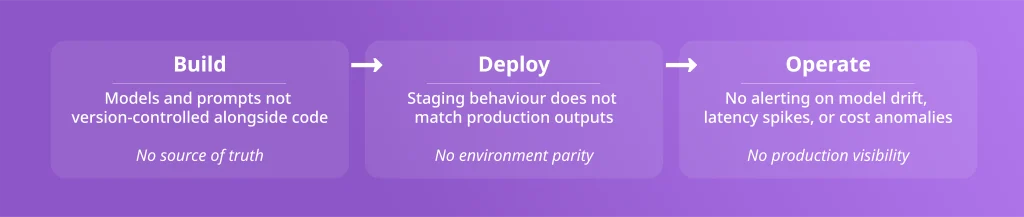
The failures are not random. They cluster at the same three stages every time. In each case, the root cause is identical: AI components were never held to the same delivery standards as the rest of your stack. That is not a technical limitation. It is a decision that has not yet been made.
Most engineering organisations have earned genuine CI/CD maturity over the past decade. That maturity does not automatically extend to AI. The discipline already exists inside your organisation. Applying it to this new infrastructure category is a specific, scoped problem.
Governed AI Infrastructure Is Just an Engineering Discipline Applied Somewhere New
Think about how your team ships a new microservice. It gets a repository, an owner, a pipeline, environment parity, and alerting before it touches production. Nobody debates whether that overhead is worth it.
Now think about the last AI model your team adopted. Chances are, it got a ticket, an API key, and a prompt in a text file nobody has looked at since.
Governed AI infrastructure closes that gap with practices already running in your engineering organisation.
- Model registry: Every model in production has an entry: version, owner, use case, and last reviewed. When something breaks, you have a list to work from rather than a conversation to reconstruct.
- Usage attribution: When you can see that one team is calling GPT-4 for a task another handles with a smaller model, the consolidation decision makes itself.
- Prompt versioning: Prompts reviewed in a pull request, tagged to a release, rolled back when a deployment degrades output. The engineer who cannot push untested code cannot push an untested prompt.
- Model observability: Output degradation surfaces in a dashboard. Latency, cost per call, and quality are scored against a baseline and watched continuously.
- Deprecation path: When a vendor sunsets a model, your teams follow a documented process rather than run an emergency sprint. The process exists before the announcement lands.
- Adoption criteria: A lightweight review for each new AI dependency: use case, owner, cost estimate, and rollback plan. Shadow AI usage drops not because governance has got stricter, but because the approved path is no longer harder than the unofficial one.
Every item maps directly to something your organisation already does for software. The only question is when you decide AI components deserve the same standard.
If the six practices above raised questions about what governed AI engineering actually looks like inside a running delivery organisation, read the complete guide to governed AI engineering, covering what mature AI delivery looks like at every pipeline stage, with the operational detail that CTOs and platform leads need to act on.
The 60-Minute Audit Most CTOs Have Never Run
You do not need a consultant to tell you whether your AI infrastructure is ungoverned. Six questions will do it. Block an hour, bring your platform leads, and answer each one honestly.
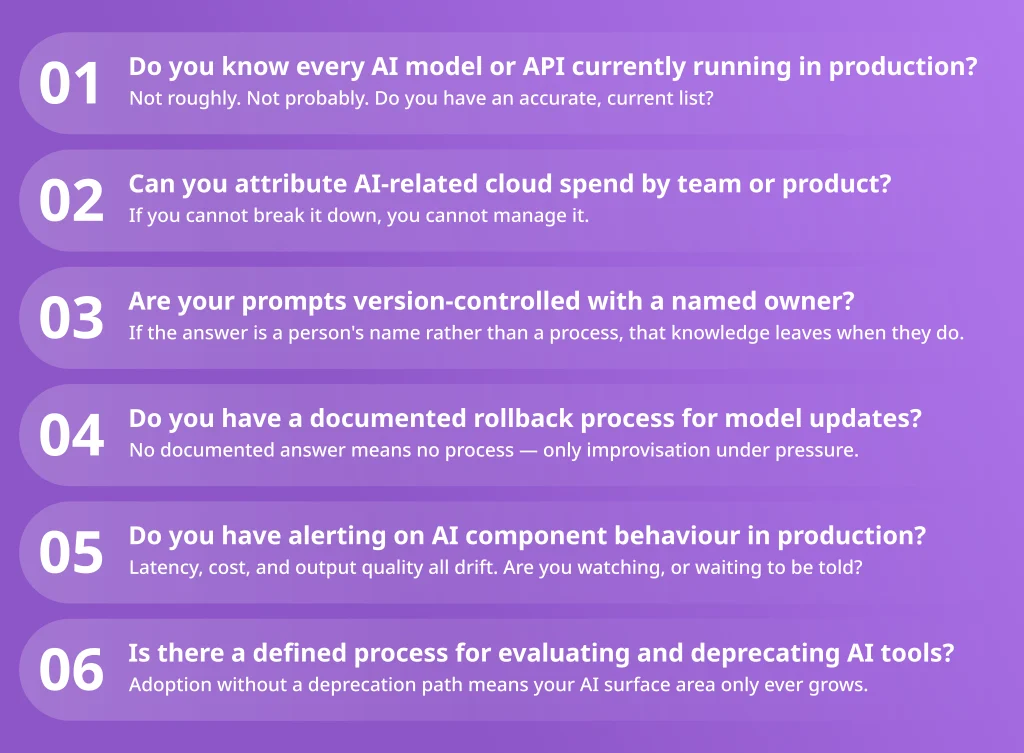
If three or more answers are “no” or “not sure,” the hidden cost is already running. The audit makes visible what has been accumulating for months inside budgets that have no line item for it.
The questions are deliberately operational. A CTO who cannot answer question one (a simple inventory of what is running in production) has an immediate problem, regardless of how mature the rest of the engineering organisation is. A CTO who cannot answer question four has no process for one of the most disruptive routine events in an AI-dependent stack: a vendor model update.
Each unanswered question is a gap. Each gap is a cost. The six together describe an infrastructure category that has been running without the oversight applied to everything else in your environment.
The Longer You Wait, the More It Costs to Fix
Every quarter without governance adds another layer to the problem. More models in production without owners. More teams are building workflows around ungoverned components. More architectural decisions that will need unpicking later.
McKinsey surveyed executives across developed markets and found that only 1% describe their AI rollouts as mature. That number reflects governance.
The fix is straightforward now. It gets progressively less straightforward with each passing sprint. AI tooling is load-bearing. Treat it accordingly.
How to Find and Fix AI Infrastructure Gaps Before They Become a Board-Level Problem
If the audit above exposed gaps, the answer is a clear-eyed look at what is already running in your environment, where the governance failures lie, and what each one is costing in terms of delivery capacity and budget.
What Does an AI Infrastructure Assessment Deliver?
An AI infrastructure assessment from Deployflow is not a discovery workshop or a slide deck. It is a structured review of your current AI estate, your delivery pipeline, and the specific distance between where your governance stands and where it needs to be. The output is a prioritised action list with realistic effort estimates built around what is already in production, because that is where the cost is running.
Choosing the wrong AI engineering partner at this stage is an expensive mistake. Before committing to an assessment or an engagement, read how to evaluate an AI engineering company, what to look for, what to ask, and what separates a delivery partner from a vendor who will hand you a report and leave.
How Deployflow Built Governed AI Infrastructure at National Scale
A large UAE public sector organisation was collecting significant volumes of data across departments and regions. The information existed in disconnected systems (surveys, spreadsheets, regional platforms) with no unified view and no way to track the impact of policy decisions in real time. Valuable data, zero governance, no visibility.
Deployflow designed and delivered a governed AI intelligence platform from the ground up: centralised data pipelines, AI classification layers, and an executive dashboard giving leadership continuous visibility across key indicators.
Fragmented reporting was replaced with a single, governed intelligence layer built in phases, with each stage auditable and extensible without re-engineering the core.
The result: automated AI pipelines replaced manual data classification entirely, real-time signal monitoring ran at a national scale, and new AI use cases could be added to the platform without rebuilding the foundation.
Most organisations discover their AI governance problem through an incident, a board question nobody can answer, or a cloud bill that no longer makes sense.
By that point, the fix is harder, and the cost is higher.
Deployflow’s AI engineering and automation services cover everything from governed pipeline architecture and AI observability to classification layers and executive reporting, built around your existing infrastructure rather than on top of a new one.
The best time to run an AI infrastructure assessment was last quarter. The second-best time is now.
Frequently Asked Questions: AI Governance for Engineering Organisations
What is the difference between AI governance and AI compliance?
AI compliance is about meeting external requirements; AI governance is about maintaining operational control of your AI systems from the inside.
Compliance answers the question of whether your use of AI satisfies a regulator or auditor. Governance answers whether your engineering organisation can see, manage, and correct what its AI components are doing in production. Compliance is a point-in-time assessment. Governance is a continuous operational practice. Most organisations that focus on compliance alone find they still have ungoverned AI infrastructure; they just have paperwork to accompany it.
How much does ungoverned AI cost the average engineering organisation?
There is no single figure because the cost is distributed across existing budgets rather than appearing as a named line item.
Cloud spend absorbs API waste. Sprint velocity absorbs debugging time. Senior engineering capacity absorbs informal AI ops work. Incident budgets absorb production failures that earlier monitoring would have caught. Organisations that have quantified it consistently find the number to be larger than expected, precisely because it was invisible for so long.
What is shadow AI, and why is it a problem for CTOs?
Shadow AI refers to AI tools and models adopted by employees or teams without formal approval, ownership, or oversight from the engineering organisation. It is a problem because it expands your AI surface area without expanding your visibility into it.
A team using an unapproved model in a customer-facing workflow creates the same production risk as a governed model, but without the monitoring, versioning, or rollback process. Shadow AI usage grows fastest in organisations where the governed adoption path is slow or bureaucratic. The fix is making the approved path faster and easier than the unofficial one.
How long does it take to implement AI governance in an existing engineering organisation?
The timeline depends on how many AI components are already running in production and how mature the existing DevOps practice is, but initial governance controls can typically be in place within four to eight weeks.
A model registry, basic usage attribution, and prompt versioning integrated into existing pipelines do not require new platforms or new teams. They require applying existing delivery discipline to a component type that has been exempt from it. The longer timeline (three to six months) covers full observability, defined deprecation processes, and adoption criteria embedded into team workflows. Starting with what is already in production and working outward is the fastest path to meaningful coverage.
What is the ROI of AI governance for engineering teams?
The return on AI governance is measured in the delivery capacity recovered, cloud spend attributed and reduced, and incident costs avoided, rather than in direct revenue.
Teams with governed AI infrastructure ship AI-dependent features faster because they have fewer silent failures, clearer ownership, and a working rollback process. Cloud spend becomes legible, meaning consolidation decisions are based on data rather than assumptions. Senior engineers spend less time on informal AI ops and more time on work that compounds. The organisations that have implemented governance consistently report that the overhead of maintaining it is significantly lower than the cost of operating without it.
Explore our BLOG
Recent articles
ISO 42001 Explained: Requirements, Certification and What Your Engineering Team Must Build
ISO 42001 is the international standard that demonstrates your organisation governs AI properly, and enterprise...
read full article

Is Claude Down? Anthropic Outage: Protect Your Cloud Infrastructure
Claude went down across every surface on 29 September 2026. From 14:00 to 14:59 UTC,...
read full article

Top 10 Healthtech Companies in 2026: What Their Growth Means for AI and DevOps
Every software change that reaches a hospital has to clear regulatory, legacy system, and clinical...
read full article