



Enterprise agentic AI deployments fail in a specific place, at a specific moment, for a specific reason.
Before You Scroll:
- Your pilot succeeded because the conditions were controlled. Production removes those conditions.
- The incident that sets your programme back will come from a fallback nobody designed.
- There are four controls that separate enterprise-grade deployments from expensive pilots. Most teams have two.
- If your deployment carries board-level consequences, the staging structure in this article is worth your time.
Most agentic AI deployments reach production carrying assumptions nobody tested. Some of those assumptions are harmless, but others write off a batch of valid claims, file a regulatory report with corrupted data, or trigger a deployment in a live environment on a Tuesday afternoon.
When Deployflow designed a national-scale AI intelligence platform for a UAE public-sector organisation, the first question was: what does the system do when something goes wrong?
This article answers that question for CTOs moving agentic AI from pilot to production, covering the failure modes, the four controls that prevent them, and the rollout structure that regulated industries require.
What Agentic AI Means for Enterprise Engineering Teams
Most definitions of agentic AI are written for a general audience. Here is what it means operationally.
An agentic system does not return a single response and stop. It plans a sequence of steps, selects and calls tools, retrieves external data, and takes action (often across multiple systems) without a human approving each move.
Document processing pipelines, automated compliance checks, multi-source financial reporting, and customer resolution workflows: these are where agentic AI is already operating.
Read more: Customer service is one of the furthest along in real-world deployment, and one of the most frequently stalled before it reaches production. The guide on UK enterprises building AI customer service agents covers the specific reasons why, including the compliance and integration challenges that international vendors consistently underestimate.
Orchestration Design Determines What Survives Production
Task sequencing, memory management, tool routing, retry logic, fallback behaviour. These components determine whether an agentic system performs reliably in production. They are also where the most important architectural decisions are made and where the majority of enterprise agentic failures originate.
If your team is investing heavily in model selection and lightly in orchestration design, the deployment is at risk.
The infrastructure decisions that actually determine whether an agent survives production, specifically memory design, tool scoping, and orchestration architecture, are covered in detail in a recent guide on how to build autonomous AI agents that work in production.
Why Agentic AI Incidents Catch Engineering Teams by Surprise
Agentic failures are operationally dangerous for a specific reason: they are often silent at the point of origin. By the time the failure surfaces, it is several steps downstream, compounded, and significantly harder to remediate.
How a Single Bad Decision Cascades Through a Pipeline
Sequential pipelines are far more sensitive to early-stage errors than single-turn inference systems. A low-confidence output at step two shapes every downstream step. The final output may look plausible. The reasoning chain that produced it is flawed from the second step onward.
This is the failure mode that catches engineering teams by surprise in the first weeks of live operation.
Unrestricted Tool Access: The Risk CTOs Underestimate
Agentic systems do not just retrieve information. They write to databases, call external APIs, trigger downstream workflows, and in some configurations, send communications on behalf of business processes.
Without explicit permission scoping per tool, a single misrouted agent task can produce consequences that are difficult or impossible to reverse. For teams in insurance, financial services, or energy, that is not a theoretical concern. It is a direct operational liability.
You Cannot Diagnose What You Cannot See
Most engineering teams instrument the model endpoint, but almost none instrument the full agent loop: task queues, memory reads, tool invocations, branching logic, and retry events.
The result is a production system that produces outputs without leaving the audit trail needed to understand how those outputs were reached. In a regulated environment, that is as much a compliance gap as an operational one.
What Happens When the Agent Cannot Complete a Step?
Retry indefinitely? Escalate to human review? Halt the pipeline? Skip the step and continue?
Undefined fallback logic is one of the most common gaps in enterprise AI readiness assessments. Teams without clear answers before go-live find those answers under pressure, after an incident, with far less control over the outcome.
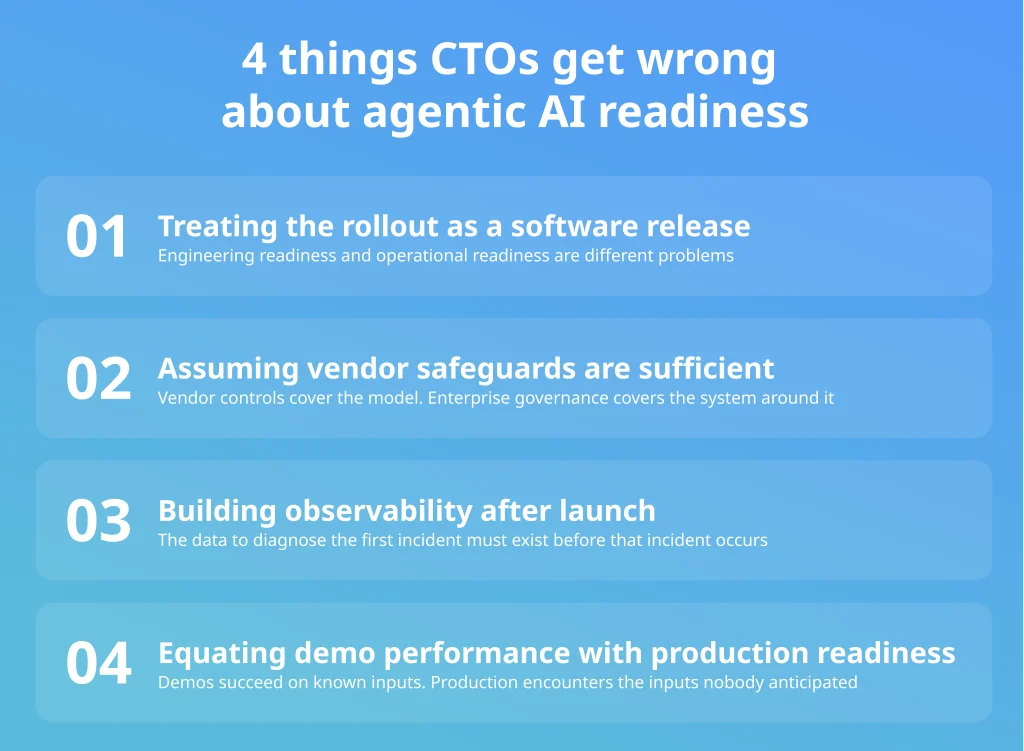
The Four AI Governance Controls Every CTO Needs Before Go-Live
- Permission Architecture: Give Each Agent Exactly What It Needs and Nothing More
An agent that can read, write, and trigger actions across your entire system can produce damage at the same scale.
The fix: Every agent gets an explicit list of what it can access, scoped to its specific task. Read permissions stay separate from write permissions. Trigger permissions are treated as the most sensitive.
Scoped permissions define the outer boundary of what any failure can actually cost you.
- Observability: Log Everything the Agent Touches
The final output of an agentic pipeline tells you what the system produced. It rarely tells you how it got there. Log every step: task inputs, tool calls, intermediate outputs, decision branches, retry events. All of it.
Teams that build observability after launch are doing forensics without evidence. Build it before the first incident, because it will come.
- Human Checkpoints: Stay in the Loop Where It Matters
Full autonomy is not the goal, but useful autonomy is. There are decision points inside every agentic pipeline where an autonomous action, if wrong, is either irreversible or carries serious downstream consequences. Find those points before go-live and put a human there.
The checkpoint does not have to be heavy. An asynchronous review that surfaces the right context to the right person takes seconds. The important thing is that it exists at the moments that warrant it.
- Circuit Breakers: Know What Undo Looks Like Before You Press Go
Walk through every tool the agent can access and answer one question: if this call produces the wrong outcome, what happens next?
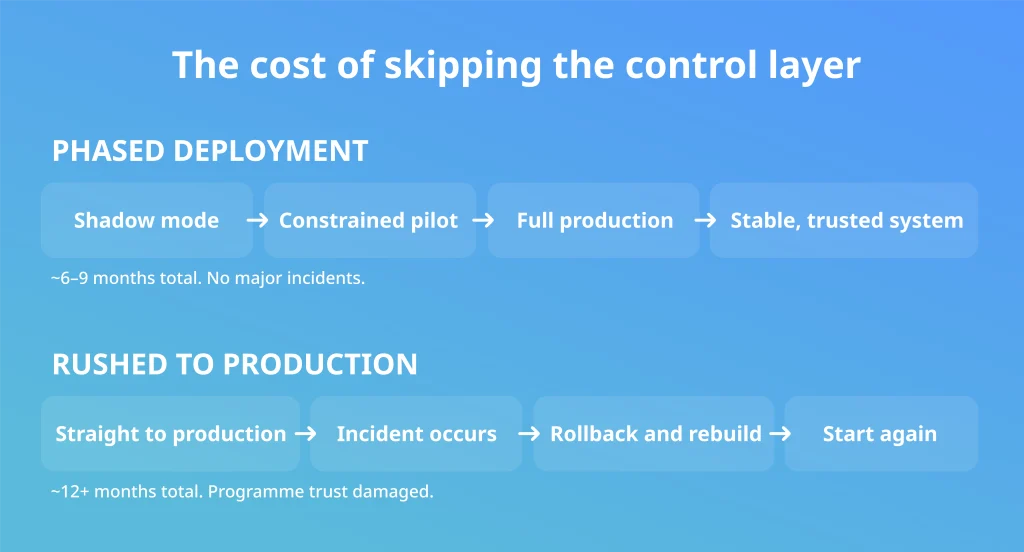
The phased approach feels slower, but it’s not. It’s a faster path to a system you can trust.
How a National AI Platform Was Built to Be Trusted From Day One
The UAE platform illustrates what this looks like when it is done in sequence rather than in parallel.
Start in Shadow Mode
Before an agentic system takes any live action, it needs a stable foundation to act on. Garbage in, cascading errors out.
When Deployflow designed a national-scale AI intelligence platform for a large UAE public-sector organisation (one responsible for monitoring social and economic wellbeing across an entire country), the first phase had nothing to do with AI. It focused entirely on bringing scattered data sources into a central, reliable structure: surveys, spreadsheets, and regional platforms that had never spoken to each other.
Only once that data layer was clean and trustworthy did AI pipelines enter the picture. An AI system processing unreliable inputs produces confidently wrong outputs, which are significantly harder to catch and correct.
That sequencing is what shadow mode looks like in practice. Validate what the system will act on before you let it act.
Constrain the First Live Pilot
The UAE platform was designed across three distinct phases: data foundations, AI pipelines, and an executive intelligence layer. Each phase was treated as a separate delivery gate rather than a continuous build. Nothing moved to Phase 2 until Phase 1 was verified. Nothing moved to Phase 3 until the AI pipelines were producing correctly classified, correctly bucketed outputs.
That structure is what a constrained pilot looks like at enterprise scale. One layer at a time. Defined success criteria at each gate. No scope expansion until the current scope is proven.
The full rollout ran across six to twelve months. For a system that would eventually give national leadership real-time visibility into policy outcomes across an entire country, that timeline was the only way to build something that could be trusted at that level.
Expand Autonomy Based on Evidence
The UAE platform’s final layer (a master dashboard with regional breakdowns, aggregated indices, and policy milestones mapped against trends) was only possible because the earlier phases had already proven the data and the classification logic beneath it.
Leadership did not have to take the system’s outputs on faith. They could see exactly what signals were feeding each index, how they had been processed, and how conditions had shifted over time. The platform made correlations visible rather than asserting conclusions. That distinction matters enormously in a regulated or politically sensitive environment, where a system that overstates certainty creates more risk than one that surfaces patterns and lets decision-makers interpret them.
Expanding autonomy incrementally and building an audit trail that shows the reasoning behind each output makes an agentic deployment defensible to a board, a regulator, or, in this case, a government.
Six to Twelve Months to Full Autonomy

Nobody Defined What “Continue” Meant
The UAE platform worked because every phase was treated as a gate and never as a formality. Data foundations before AI pipelines. AI pipelines before the executive layer. Nothing moved forward until the current phase was proven.
Every CTO needs to answer the same question before an agentic system goes live: What does this system do when it encounters something it was not designed for?
The answer to that question (defined before go-live, tested in staging, visible in the audit trail) is what separates a deployment that holds up from one that produces an incident nobody saw coming.
Find the Gaps in Your Agentic AI Deployment Before Production Does
Deployflow’s engineering teams have taken agentic and AI-driven systems from pilot to production across financial services, regulated industries, and public sector organisations at a national scale.
The work is delivery-focused: orchestration architecture, observability design, governance controls, and staged rollout planning. These are the areas where deployments most consistently stall or fail to recover.
The starting point is a free AI readiness assessment. It identifies the gaps before production does. Start with a free consultation to find out what your deployment is carrying into production.
Frequently Asked Questions About Agentic AI Deployment
How long does an enterprise agentic AI deployment typically take?
Most enterprise agentic deployments take between three and nine months from readiness assessment to full production. The timeline depends on the complexity of the orchestration layer, the number of tools the agent needs to access, and how much of the data infrastructure is already in place.
Organisations in regulated industries tend to sit toward the longer end because governance sign-off, compliance validation, and staged rollout requirements add time that cannot be compressed without adding risk.
What is the difference between agentic AI and robotic process automation?
RPA follows a fixed script. Agentic AI makes decisions. RPA executes a predefined sequence of actions reliably and repeatedly; it breaks when the environment changes. Agentic AI reasons about what to do next based on context, which makes it far more flexible but also far less predictable.
That unpredictability is why governance controls, observability, and fallback logic matter more in agentic deployments than they ever did in RPA implementations.
What skills does an engineering team need to deploy agentic AI in production?
The critical skills are orchestration design, observability engineering, and prompt reliability.
Most teams that struggle in production are strong in data science and weak in the systems engineering required to run an agent loop reliably at scale. Experience with distributed systems, API design, and failure-mode analysis translates well. Teams without that background typically need either upskilling or an external delivery partner for the production phase.
How do you measure the success of an agentic AI deployment?
Start with task completion rate, error rate per pipeline step, and escalation frequency.
Output volume tells you how much the system is doing; the other three tell you whether it is doing it correctly and where it is reaching its limits. Over time, the mean time to detect a failure and the mean time to resolve it become the most useful indicators of whether the observability and governance layer is functioning as designed.
How do you get board-level approval for an agentic AI programme in a regulated industry?
Lead with risk containment. Boards in regulated industries are not opposed to AI. They are opposed to liability that they can’t quantify. A proposal that shows a phased rollout structure, defined governance controls, a clear audit trail, and an explicit answer to what the system does when something goes wrong is significantly more likely to pass than one built around productivity projections. The readiness assessment is often the most useful tool at this stage: it gives the board something concrete to evaluate rather than a vision to approve.
Explore our BLOG
Recent articles

ISO 42001 Explained: Requirements, Certification and What Your Engineering Team Must Build
ISO 42001 is the international standard that demonstrates your organisation governs AI properly, and enterprise...
read full article

Is Claude Down? Anthropic Outage: Protect Your Cloud Infrastructure
Claude went down across every surface on 29 September 2026. From 14:00 to 14:59 UTC,...
read full article

Top 10 Healthtech Companies in 2026: What Their Growth Means for AI and DevOps
Every software change that reaches a hospital has to clear regulatory, legacy system, and clinical...
read full article