



The National Audit Office surveyed 89 government bodies and found that only 37% had actually deployed AI. The other 63% were piloting, planning, or yet to start.
That gap between intent and production is the defining challenge for every public-sector CTO in 2026, and this article is written to close it.
TL;DR
- Which AI use cases are generating verified returns at the NHS, HMRC, DWP, and local councils, and the structural decisions that moved each one from pilot to production
- Three procurement routes that cut deployment timelines inside UK government, and how to choose the right one before you write your requirement
- Why your data architecture sets your go-live date, and how to close the gaps before they surface mid-sprint
- Which compliance standards now appear in tender evaluations, and how to use them to shorten procurement rather than just survive it
- A four-decision 90-day plan to move your delivery from pilot to production this year
DSIT’s AI Opportunities Action Plan, published in January 2025, moved departmental AI targets from aspiration to accountability. Ministers, permanent secretaries, and the Public Accounts Committee are now asking for outcome data, cost visibility, and documented governance. Departments without clear answers to those three questions are exposed in the ways that matter most.
Your initiative has a path to production this year. Here is what the departments already there did differently, which use cases are generating returns across the NHS, HMRC, DWP, and local authorities, and the procurement and compliance decisions that move you from pilot to live.
The Two Tiers of UK Public Sector AI Delivery in 2026
What the NAO, the PAC and the Spending Review Now Expect From You
The Public Accounts Committee’s 2024-25 session on AI in government found that 50% of roles advertised in civil service digital and data campaigns went unfilled in 2024. Skills gaps are not a future risk. They are the operating condition your programme has to account for in its delivery model today.
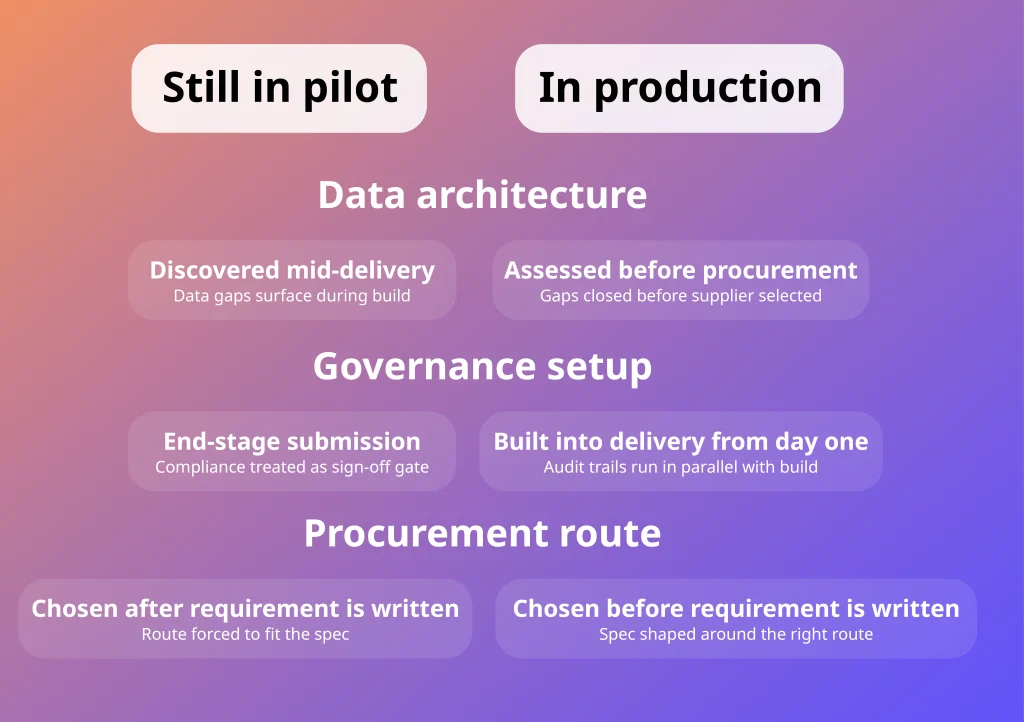
Departments with strong answers to NAO and PAC scrutiny share three characteristics: AI running in production, governance documented with audit trails, and a named owner accountable for outcomes. Building those three before scaling is the decision that separates the two tiers of public sector AI delivery in 2026.
Clinical AI in Production: What NHS Trusts Are Actually Running
NHS England’s AI Lab has moved clinical AI from research to operational use, and the production deployments provide a replicable template. AI-assisted cancer detection in chest X-rays and mammography leads trust-level production, supported by prospective evidence that satisfies NICE’s evaluation standard for clinical AI tools.
NICE’s framework is the gate your NHS AI programme passes through before clinical use. Trusts that built toward that standard from the outset cleared it faster. Running evidence requirements in parallel with delivery, rather than as an end-stage submission, is the practical difference between programmes that reach production and those that extend into another pilot cycle.
Why Data Readiness Sets Your Go-Live Date
EPR systems vary by trust. Data formats are inconsistent across clinical settings. A model validated at one trust requires retraining before it performs reliably at another. Trusts with unified, well-governed EPR environments are consistently closer to production.
The solution is a data readiness assessment before model selection. It maps data quality, access controls, and pipeline integrity against your specific use case requirements. Each gap closed at that stage costs weeks. The same gap found during delivery costs months. Running it as your delivery’s first milestone is what gives you a realistic go-live date before you commit budget to scaling.
How Central Government Got AI Into Operational Use
Central government’s stronger production track record is built on data maturity, and that is the part you can replicate. HMRC, DWP, and the Home Office hold high volumes of structured data with governance frameworks that predate AI as a delivery requirement. Two use cases account for most of what is running at operational scale.
Document Processing and Case Automation: Where Central Government Has the Clearest ROI Story
HMRC and DWP process tens of millions of structured documents annually. AI applied to classification, extraction, and routing delivers reliable throughput gains. The data is structured, the output metrics are clear, and the compliance surface is well-defined.
Your team can replicate this wherever structured document volumes are high, and data pipelines are clean. The combination of contained compliance requirements and measurable efficiency gains is why this use case reached production before any other. For departments facing PAC scrutiny, it is also the use case with the most straightforward outcome to present.
Fraud Detection and Anomaly Flagging: The AI Application With the Strongest ROI Case in UK Government
The Cabinet Office’s annual fraud and error estimates put the cost to the public sector at billions of pounds annually. AI pattern recognition applied to payment and claims anomaly detection is generating returns at scale across central government.
The ROI case is direct and defensible. The audit trail that governed delivery aligns naturally with what fraud detection requires operationally. For departments under pressure to show measurable AI returns on a defined timeline, this is the use case with the most robust justification at PAC level.
How UK Councils Are Generating Real AI Returns in 2026 on Constrained Budgets
Local authority AI is constrained by resource, and the use cases generating early returns reflect what is achievable under genuine budget pressure. The Local Government Association (LGA) has published adoption guidance, and the returns appearing at council level cluster around three application areas.
Planning Automation, Social Care Forecasting and Housing Allocation: Where Councils Are Seeing It Pay Off
Planning application processing is the most documented return. AI applied to document classification, site constraint checking, and application routing reduces officer time per case with a manageable compliance surface. Adult social care demand forecasting carries higher strategic value. Councils applying historical assessment data to forecast demand and allocate resources earlier are reducing reactive spend.
Care assessment records are more structured than most councils expect. The data foundation for social care forecasting is often stronger than it first appears, which means the investment required to reach a workable pilot is lower than budget-constrained teams assume.
Housing allocation is a third area generating early returns, particularly where councils are using AI to match applicants to available stock against multiple need and eligibility criteria simultaneously, reducing manual case review time and improving allocation consistency across boroughs.
How to Scale Council AI Affordably Using Government Commercial Agency Frameworks
A single district or borough council cannot justify standalone AI infrastructure investment at central government scale.
Government Commercial Agency frameworks (the UK’s Government Commercial Agency was previously known as the Crown Commercial Service, or CCS), regional combined authority digital programmes, and Shared Outcomes Fund grants are the three routes generating the most momentum at local authority level.
GCA frameworks remove the need to build a bespoke procurement process. Several combined authorities are already running shared AI infrastructure that member councils access through existing shared service agreements. The procurement route is available to you today.
3 Procurement Routes That Speed Up UK Public Sector AI Production in 2026
Procurement is where programmes lose weeks they never planned to lose. Choose your route before you write your requirement, because the route decides what you can specify, who can bid, and how long sign-off takes.
G-Cloud 14 lists AI and machine learning services across its cloud lots. Suppliers have passed GCA due diligence. Direct award is available within value thresholds. For programmes with defined requirements and a clear go-live pressure, G-Cloud 14 is your fastest route to a compliant contract with a vetted supplier.
GCA digital and technology frameworks cover AI delivery and advisory services within defined value and scope limits. Understanding those limits before structuring your requirement protects you from a mid-programme procurement problem. Know the ceiling before you commit to the route.
Full competitive tender through the Digital Marketplace applies where value or scope exceeds framework limits. The timeline is longer, but it gives you precise specification control: public sector delivery track record, security clearance, compliance alignment, and embedded delivery model built into your evaluation criteria from the start.
How to Make Data Architecture Your Biggest AI Deployment Advantage
Your go-live date is set by your data architecture. The departments that reached production resolved data quality, access, and audit structure issues before choosing a supplier. The ones still in pilot are discovering those gaps mid-build, where every fix costs months instead of weeks.
UK GDPR and the Data Protection Act 2018 govern every AI use case involving personal data, which covers most of what you will deploy in NHS, HMRC, DWP, and local authority contexts.
The ICO’s AI guidance sets out four operational requirements: data minimisation, purpose limitation, access controls, and audit trails, all of which are designed before model selection begins. Meeting them early turns compliance from a launch blocker into a foundation you build once.
The solution is a data readiness assessment run as your first programme milestone, before procurement opens. It closes four risks at the point where each costs the least to fix: data quality against your specific use case, access controls for human and non-human actors, audit trail completeness, and pipeline integrity. Every gap you close here is one that would otherwise surface mid-sprint at several times the cost, which is why this is the highest-return decision in your entire programme.
The data-first sequence that makes this work, and the three-layer architecture built on top of it, is set out in our technical guide to public sector AI delivery.
ISO 42001 and Cyber Essentials Plus: How to Use Compliance Standards as Procurement Accelerators
Both standards are moving from best practice to explicit requirements in UK public sector tender evaluations, and both work in your favour when you apply them early.
ISO 42001, the international standard for AI management systems, is appearing in tender evaluation criteria across central government and regulated arm’s-length bodies. Suppliers with documented, operational AI management systems aligned to the standard are clearing procurement faster. Verifying alignment in supplier documentation, rather than accepting a self-declared claim, is the due diligence step that matters at evaluation stage.
Cyber Essentials Plus is the NCSC’s independent verification standard for suppliers handling government data. A significant proportion of commercial AI suppliers hold the self-assessed Cyber Essentials certification only. Confirming Plus status before preferred bidder selection closes a risk that is considerably more expensive to manage after contract award.
Both standards expose specific gaps in AI deployments that a traditional IT audit never tests for, which our breakdown of ISO 27001 and Cyber Essentials Plus for AI delivery covers in full, including the five most common reasons a first assessment fails.
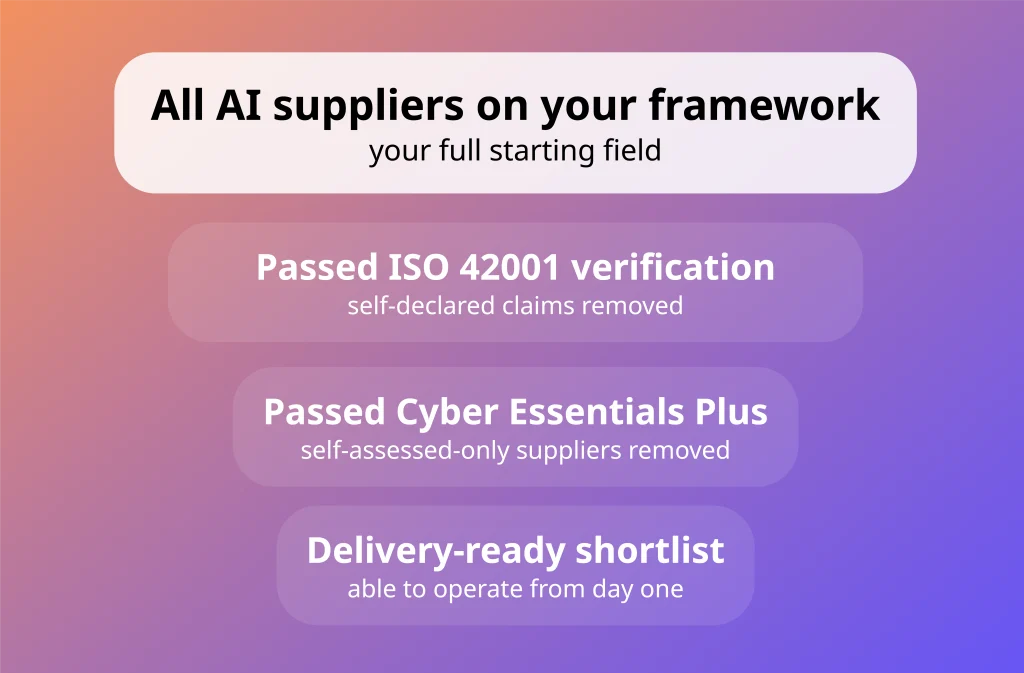
Together, these two checks narrow your supplier shortlist to those capable of operating in a public-sector delivery environment from day one.
What Governed AI Delivery Produces When the Stakes Are National
UAE Public Sector Decision Intelligence Platform
A UAE government organisation held data fragmented across surveys, spreadsheets, and disconnected regional platforms. Deployflow built a phased platform: data foundations first, AI classification pipelines second, executive intelligence layer third. Governance and architecture were settled before a single use case went live.
Results:
- Full national deployment within 6 to 12 months
- Manual reporting replaced by 24/7 real-time data ingestion
- All regional data consolidated into a single unified layer
National Energy Sector AI Platform, Petabyte Scale
For a national energy-sector AI platform running on H100 GPU clusters, Deployflow built a governance-first architecture in which every environment automatically inherits its security and networking policies.
Results:
- Zero manual steps to apply governance to a new environment
- Every change tracked via GitOps by default
- New AI workloads land without re-engineering the core
In both programmes, delivery architecture was the controlling variable.
Your Four-Decision 90-Day Plan to Move From AI Pilot to Production
Run a data readiness assessment before procurement opens. Each gap closed at this stage costs weeks to fix. The same gap found during delivery costs months. Your go-live date is set here, before a supplier is selected.
Select your procurement route before writing your requirement. G-Cloud 14, a CCS framework, or a full Digital Marketplace tender each shape what you can specify, which suppliers can respond, and how long the process takes. Choosing last forces your requirement to fit the route.
Resolve your data legal basis before procurement opens. UK GDPR requires a documented lawful basis for AI processing personal data. NHS and DWP use cases almost always involve special category data, which narrows your lawful basis options to specific statutory gateways. Discovering mid-procurement that your chosen use case requires a legislative gateway you do not yet have closes your go-live window. Resolve it with your DPO before the requirement is written.
Verify ISO 42001 and Cyber Essentials Plus at evaluation stage. Discovering either gap after preferred bidder selection is a governance problem that runs alongside your delivery problem; at the moment, your team needs full focus elsewhere.
Work With a Partner Who Delivers AI Inside Public Sector Constraints
Deployflow delivers AI and cloud programmes in regulated, high-stakes environments where governance, security, and compliance are built into the architecture from the start. For government, local authorities, and critical national organisations, that work runs through dedicated public sector DevOps, cloud, and AI platform services, ISO 27001 certified and listed on G-Cloud 14 for direct award.
Engineers work inside your platform team and contribute directly to delivery from sprint one. The full scope of AI engineering and automation is built around that model. The track record covers programmes at the scale of Vodafone and Lloyds Banking Group.
Start with a free consultation. In one session, the delivery receives a clear assessment of where it is exposed, which data and compliance gaps need closing before procurement, and the fastest credible path to production. The findings are yours to keep, with no commitment beyond the conversation.
Frequently Asked Questions: UK Public Sector AI in 2026
What AI services are available on G-Cloud 14 for public sector organisations?
G-Cloud 14 lists AI and machine learning services, data and analytics platforms, and related advisory services across its Cloud Software and Cloud Support lots. Coverage includes managed AI platforms, MLOps tooling, natural language processing, computer vision, and AI-augmented analytics, alongside the cloud infrastructure and professional support needed to operationalise them.
Suppliers have passed Crown Commercial Service due diligence checks before listing. Direct award is available within value thresholds, giving you access to vetted suppliers without a full competitive tender. G-Cloud awards typically complete in weeks rather than the months a full Find a Tender Service procedure requires.
Does ISO 42001 alignment speed up public sector AI procurement?
Yes, in a growing number of cases. ISO 42001 is the international standard for AI management systems, covering governance structure, risk assessment, impact evaluation, and accountability across the AI lifecycle. It is appearing in tender evaluation criteria across central government and regulated arm’s-length bodies, particularly where AI systems will process personal data or inform consequential decisions.
Suppliers with verifiable alignment are clearing procurement faster than those without, as they reduce the due diligence burden at evaluation stage. Verify it through documentation rather than accepting a self-declared claim.
How does UK GDPR apply to NHS AI deployments specifically?
More strictly than in most sectors, with NHS-specific obligations layered on top of the baseline. Every use case involving patient data must comply with the UK GDPR and the Data Protection Act 2018, and a Data Protection Impact Assessment is required before any AI system that touches patient data goes into use.
The ICO’s AI guidance requires a documented lawful basis, purpose limitation from the point of data collection, and transparency obligations for automated decision-making affecting patients. The National Data Guardian’s standards and the Data Security and Protection Toolkit add further NHS-specific requirements around access controls, audit trails, and incident reporting. In practice, data architecture and consent mechanisms need to be designed before model selection begins.
What AI tools is the NHS actually using in clinical settings?
The most widely deployed clinical AI in the NHS is in diagnostic imaging, funded through the NHS AI Diagnostic Fund rather than built in-house. Annalise.ai’s chest X-ray tool is live across more than 60 trusts, flagging findings suggestive of lung cancer and other acute conditions for radiologist review.
Comparable tools from Qure.ai and Kheiron Medical support lung cancer pathways and breast screening at trust level. Each tool is regulated as a medical device by the MHRA and assessed against NICE’s evidence standards before adoption. These systems support clinicians rather than replacing the diagnostic decision, which is what has allowed them to scale within existing clinical governance.
How are local councils funding AI in 2026?
The most active routes are Crown Commercial Service frameworks, regional combined authority digital programmes, and Shared Outcomes Fund grants where still available. Regional bodies such as the London Office of Technology and Innovation coordinate AI procurement across boroughs, publishing shared guidance and procurement tooling that lower the cost of getting each authority to a compliant contract.
Standalone AI investment at individual district or borough level remains uncommon under current budget conditions. Shared service models accessed through combined authorities are generating the most momentum for smaller councils.
What is the difference between Cyber Essentials and Cyber Essentials Plus for AI suppliers?
Both certifications cover the same five control areas: boundary firewalls, secure configuration, user access control, malware protection, and security update management.
Cyber Essentials is self-assessed via questionnaire. Cyber Essentials Plus involves independent technical verification by an accredited assessor, including vulnerability scanning and hands-on review of declared controls. For suppliers handling government data, Cyber Essentials Plus is the applicable requirement. A supplier holding only the self-assessed certification does not meet the baseline for most contracts in this category.
Explore our BLOG
Recent articles

ISO 42001 Explained: Requirements, Certification and What Your Engineering Team Must Build
ISO 42001 is the international standard that demonstrates your organisation governs AI properly, and enterprise...
read full article

Is Claude Down? Anthropic Outage: Protect Your Cloud Infrastructure
Claude went down across every surface on 29 September 2026. From 14:00 to 14:59 UTC,...
read full article

Top 10 Healthtech Companies in 2026: What Their Growth Means for AI and DevOps
Every software change that reaches a hospital has to clear regulatory, legacy system, and clinical...
read full article