


Public sector AI programmes fail for one reason more than any other: organisations try to build intelligence before they fix the data underneath it.
TL;DR
This article covers the architecture that gets around that problem: a three-layer sequence of data foundations, AI classification pipelines, and executive intelligence, and what applying it at national scale actually looks like.
If your programme has stalled, or has not started because the scope feels unmanageable, the sequencing is almost certainly the issue.
What Is Manual Data Processing Costing Your Public Sector Team?
These delays have a direct cost. Before reading further, you can calculate what manual data work is costing your organisation each month. The figure tends to sharpen the business case considerably.
Calculate your monthly cost of delayed AI delivery. Based on 5 analysts spending 12 hours per week on manual classification and reporting at £75 per hour, your organisation is carrying:

The Reason Public Sector AI Rarely Gets Past the Pilot Stage
The MIT research, based on analysis of 300 enterprise AI deployments and interviews with 150 senior leaders, found that 95% of AI pilots delivered no measurable business impact.
RAND Corporation puts overall AI project failure at over 80%, twice the failure rate of non-AI technology programmes. These are enterprise figures. In the public sector, the structural conditions are considerably harder.
Government organisations collect more data than almost any private sector counterpart. Surveys, regional performance metrics, economic indicators, social well-being data, departmental reporting, and the volume is substantial. The problem is that most of it is in systems that were never designed to communicate with one another.
Departments were built to operate independently, and their data systems followed the same logic. Surveys live in one place. Spreadsheets in another. Regional platforms in a third. Placing an AI layer on top of that structure does not resolve the fragmentation. It inherits it.
The UK government has acknowledged this directly. The DSIT and Government Digital Service review of digital government (the largest survey of its kind, engaging more than 100 public organisations) identified poor data foundations as a primary barrier to AI adoption, explicitly stating that public sector data is fragmented and underutilised.
The review also found that central govtech initiatives have had limited public sector-wide impact. A February 2026 analysis of UK government AI spending reached the same conclusion: without improvements to data infrastructure and governance, public sector AI initiatives risk remaining limited in their impact regardless of the budget committed.
The result is AI outputs that are technically impressive but operationally useless, because the inputs feeding them are inconsistent, unreconciled, and unauditable.
The Sequencing Decision That Determines Whether a Programme Ships
Programmes that reach production start at the data foundation layer and build upward. Programmes that stall begin at the interface and attempt to retrofit the architecture underneath it.
In the UAE public sector engagement, Deployflow deferred all executive dashboard design until data reliability across ingestion sources was confirmed. That decision created friction early in the programme. It also ensured that every subsequent phase was buildable on stable ground.
Why Public Sector AI Carries Higher Stakes Than Enterprise AI
In a commercial organisation, an AI system that produces incorrect output costs the business money and must be fixed. In a public-sector environment, an AI system that produces indefensible output can compromise policy decisions, trigger scrutiny from oversight bodies, and create political liability for senior leaders.
The stakes reshape what AI design must prioritise. Explainability is an operational requirement. Every classification, every index, every trend line shown to a minister or permanent secretary needs a traceable data trail. This becomes even more critical as organisations graduate toward autonomous AI agents in production, where decisions are made without human review at each step. Vendors who treat this as secondary tend to produce systems that look functional in demos and fail in governance reviews.
Three Reasons AI Programmes Stall Before Development Begins
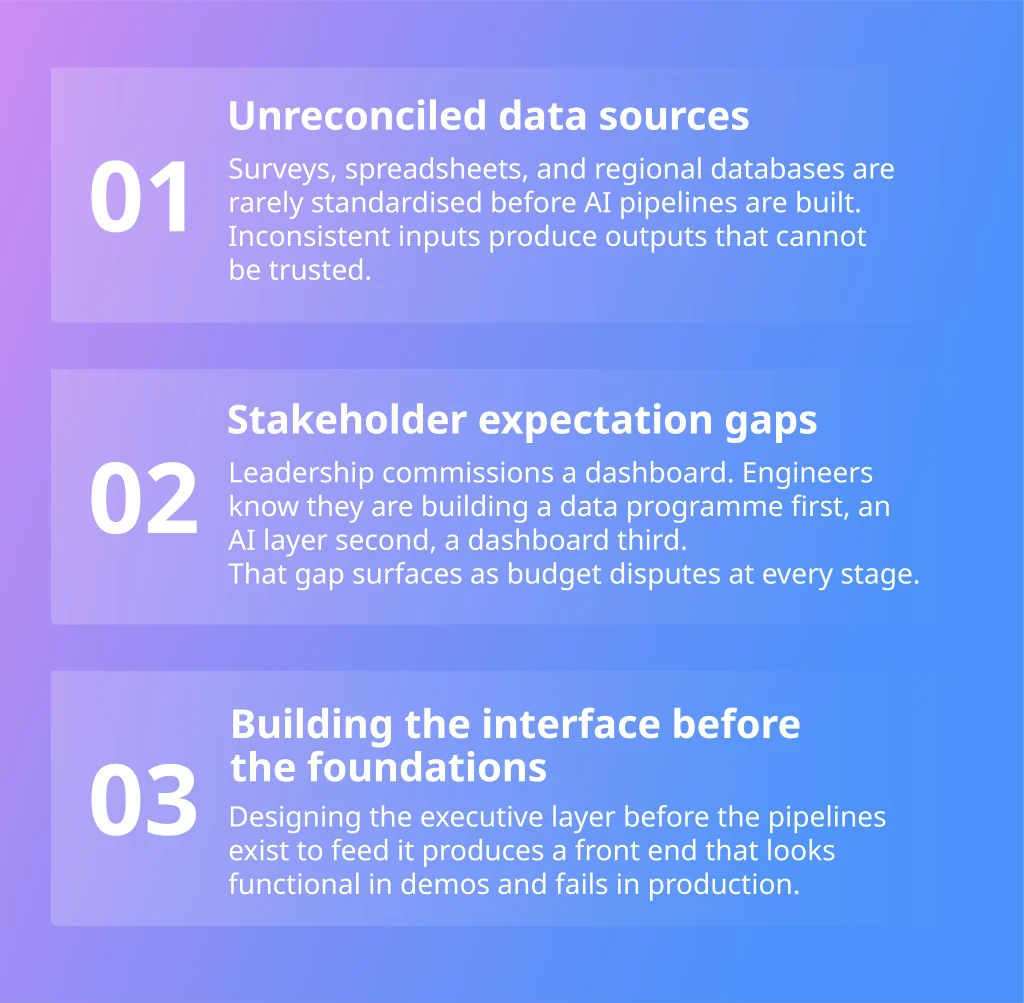
The Three-Layer Architecture That Gets Public Sector AI to Production
This is the model Deployflow applied in the UAE engagement. It is not client-specific. Any large organisation with fragmented data and a requirement for decision intelligence can follow the same sequence.
Layer 1: Data Foundations
Before any model is trained or any pipeline is built, data from across departments and regions needs to be centralised into a single ingestion layer. The objective at this stage is reliability. Consistent, correctly formatted, reconciled data is the precondition for everything that follows.
This phase consistently takes longer than procurement timelines allow for. Managing that expectation at the outset is what separates delivery partners from consulting firms.
Layer 2: AI Classification Pipelines
With clean, centralised data in place, AI pipelines can classify incoming signals into structured, comparable indicators. This transformed raw survey inputs and regional data into measurable indices covering family health, economic well-being, and social cohesion.
For the public sector specifically, every classification decision needs to be auditable end-to-end. Oversight bodies and internal governance teams require a traceable path from raw input to the reported figure. Systems that cannot provide this will not survive formal review, regardless of output accuracy.
Layer 3: Executive Intelligence Layer
The final layer translates pipeline outputs into a format that leadership can work with directly: regional breakdowns, aggregated indices, and trend lines with policy milestones overlaid.
The design reference was financial market indices, a model that collapses complex, multi-variable inputs into a small number of high-level signals that can be tracked over time. The platform was built to surface correlations and make them visible to decision-makers, without asserting causal relationships that the underlying data could not substantiate. That boundary is what makes AI outputs politically defensible in a government context.
Inside a National-Scale Public Sector AI Deployment
The UAE client was a government organisation carrying responsibility for monitoring national social and economic conditions. Data collection was already substantial across departments and regions. What was missing was any architecture to bring it together.
At the point of engagement, the organisation faced four specific problems:
- Community and economic conditions were changing, with no real-time visibility into the signals
- Survey data, spreadsheets, and regional platform outputs existed separately, with no unified view
- Policy initiatives were being assessed without measurable outcome data to reference
- Leadership required a cross-departmental intelligence layer that did not yet exist
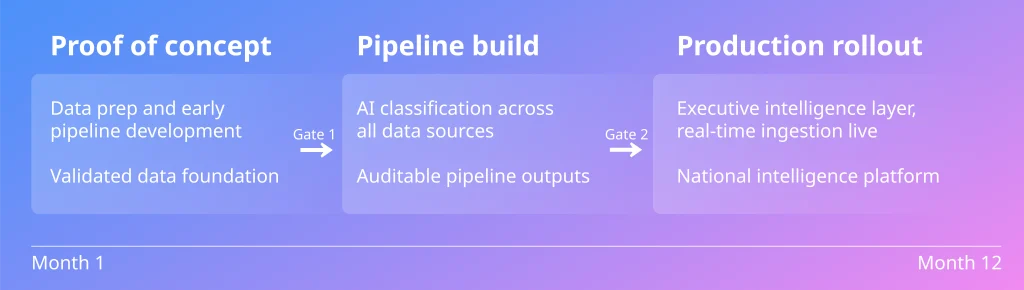
Deployflow designed a phased programme across all three architecture layers. The initial proof of concept covered data preparation and early pipeline development, producing a defined, reviewable deliverable that supported the case for subsequent funding phases.
At full deployment, the programme delivered:
- AI pipelines are replacing manual data classification across every incoming source
- Continuous real-time data ingestion at a national scale
- A single unified architecture consolidating previously disconnected systems
- Executive dashboards with regional breakdowns, aggregated indices, and policy milestone tracking
- A delivery timeline of six to twelve months from proof of concept to full production rollout
Read the UAE public sector case study for the full breakdown of the architecture, phasing, and outcomes.
Why a Proof of Concept Entry Point Is the Correct Structure
Large capital commitments face significant resistance in public sector budget cycles. A proof of concept covering data foundations and early pipeline work produces a tangible output that justifies the next approval stage and creates the documented delivery milestones that public sector governance frameworks require.
Stage-gated delivery is also a better engineering practice. Validating data readiness before building AI pipelines on top of it reduces the risk of discovering foundational problems after significant spend has already occurred. The mechanics of how that sequencing works in practice are covered in Deployflow’s guide to sprint-based AI delivery.
Phased Delivery for Public Sector AI
Each gate produces a reviewable output that justifies the next funding approval.
How to Choose a Public Sector AI Delivery Partner That Will Actually Ship
Deployflow’s solution engineers on the UAE engagement came directly from Vodafone and Lloyds Banking Group, two organisations that operate at scale, under regulatory scrutiny, with complex data environments.
That regulated-sector background is reflected in their AI engineering capabilities, where the emphasis is on delivery accountability instead of headcount.
Delivery Partner vs Staff Augmentation
| Staff augmentation | Delivery partner | |
| Accountability | Reports to your programme lead | Owns outcomes at each delivery gate |
| Architecture | Your team decides | Partner owns architecture decisions |
| Sequencing | Your team manages phasing | Partner drives stage gates |
| Knowledge transfer | Leaves with the contract | Transfer built into programme |
| Governance | Your team carries the risk | Regulated-sector experience included |
Public sector AI platforms operate under constraints that standard enterprise delivery rarely encounters: multi-source data architectures, auditability requirements across every processing layer, and political accountability for outputs. Engineers without experience in regulated environments consistently underestimate these requirements.
On credentials, Deployflow holds ISO 27001 certification, AWS Advanced Partner status, and Microsoft Solution Partner recognition. These are the procurement baseline any serious delivery partner should clear without prompting.
The broader distinction worth drawing is between a delivery partner and a staff augmentation provider. A staff augmentation model adds engineers to your existing programme. A delivery partner (as Deployflow operates) takes responsibility for architecture decisions, programme sequencing, and defined outcomes at each stage.
Deployflow’s public sector DevOps and AI platform services span the full delivery stack, from secure cloud infrastructure and CI/CD pipelines through to AI engineering and automation, data ingestion, and the executive intelligence layer that leadership actually uses.
Where to Start if Your AI Programme Has Not Shipped Yet
If your organisation has substantial data but limited visibility into what it means in real time, the starting point is an honest assessment of current data foundations before any AI scope is agreed.
Deployflow’s AI readiness assessment maps your existing data architecture against what a unified intelligence layer would require. It identifies sequencing gaps and produces a phased delivery roadmap structured for public-sector procurement and staged budget approval.
Senior engineers lead every assessment, and the output is a concrete programme design.
The cost of discovering a data foundation gap after programme spend has already been committed is significantly higher than the cost of finding it before. Contact Deployflow to see what a readiness assessment covers and whether your programme is ready to move beyond the pilot stage.
Frequently Asked Questions About Public Sector AI Development
How long does a public sector AI programme take from initiation to production?
For a well-sequenced programme, six to twelve months from proof of concept to full production rollout is a realistic target. That timeline assumes data foundations work begins immediately and is not deferred.
Programmes that skip the POC stage and attempt a direct jump to full production typically take longer, not shorter, because foundational problems surface mid-build rather than before it. The six-to-twelve-month figure also assumes staged budget approvals are managed in parallel with technical delivery rather than sequentially, a planning decision that sits with the programme lead.
How do you build an internal business case for a public sector AI investment?
Frame the investment around the cost of the current state. Decision-makers respond to quantified inefficiency: how many analyst hours go into manual data classification, how long it takes to produce a ministerial briefing, how many decisions are being made without real-time visibility into outcomes.
A phased delivery model with a proof of concept as the first gate makes the business case structurally easier: the initial ask is smaller, the first deliverable is reviewable, and subsequent funding phases are justified by demonstrated progress.
Can public sector AI systems meet GDPR and data protection requirements?
Yes, but only if auditability is designed in from the start. Every classification decision, every data transformation, and every output displayed to leadership needs a traceable data trail back to its source. Systems built without this cannot demonstrate compliance under formal review. For the UK public sector specifically, the Information Commissioner’s Office expects organisations to be able to explain automated decision-making in plain terms, which means the AI pipeline architecture itself needs to support explainability.
What happens after the proof of concept? How does a programme scale to full production?
The POC validates data foundations and early pipeline logic across a defined subset of inputs. Scaling to production means extending that architecture across all data sources, hardening the pipelines for continuous ingestion, and building out the executive intelligence layer on top of a foundation that has already been proven stable. Each phase should produce a reviewable deliverable that justifies the next funding gate. Programmes that treat the POC as a demo tend to rebuild significant work when moving to production, which is both expensive and avoidable.
Should public sector organisations build AI capability in-house or use an external delivery partner?
For the foundational architecture (data ingestion, AI pipelines, executive intelligence layer), an external delivery partner with regulated-sector experience will move faster and carry fewer technical risks than an in-house team building these capabilities from scratch. In-house capability becomes the right answer for ongoing iteration, day-to-day data management, and incremental feature development once the platform is in production. The most effective model is a delivery partner that builds the architecture and transfers knowledge to the internal team as the programme progresses.
Explore our BLOG
Recent articles

ISO 42001 Explained: Requirements, Certification and What Your Engineering Team Must Build
ISO 42001 is the international standard that demonstrates your organisation governs AI properly, and enterprise...
read full article

Is Claude Down? Anthropic Outage: Protect Your Cloud Infrastructure
Claude went down across every surface on 29 September 2026. From 14:00 to 14:59 UTC,...
read full article

Top 10 Healthtech Companies in 2026: What Their Growth Means for AI and DevOps
Every software change that reaches a hospital has to clear regulatory, legacy system, and clinical...
read full article