



If your last AI initiative took more than six months to reach production, your organisation has already spent more than it budgeted. It just does not show up as a line item.
The real cost is the revenue your competitor captured while your governance committee was scheduling its next review. It is the senior ML engineer who quietly moved on because the project was going nowhere. It is the third pilot running on the same problem as the first two.
This is where UK enterprises are bleeding, and most leadership teams are not measuring it.
The Executive Summary
Most UK enterprise AI programmes share a problem that nobody budgets for: they stall because the delivery model was never built to move fast enough.
This article breaks down exactly where the time goes, what it costs in real numbers, and what high-performing teams do differently.
80% of AI Projects Never Reach Production, and the Technology Is Not the Problem
RAND Corporation research, based on interviews with 65 experienced data scientists and engineers, found that over 80% of AI projects fail to reach production. That is twice the failure rate of traditional IT projects.
Most UK enterprise AI initiatives fail in the planning phase: buried under approval cycles, vendor evaluations with no clear owner, and internal debates about whether the organisation is ready.
By the time a pilot goes live, the world has moved on. The business case has shifted. Competitors have shipped. The team that built the momentum has quietly moved to other priorities.
The problem is a delivery failure. And in UK enterprises, it is endemic.
The real damage never appears on a project budget. It lives in what the delay itself costs. Revenue not captured. Efficiency not realised. Competitive ground was ceded while the governance committee scheduled its next review.
That gap between intention and execution is where UK enterprises are losing, and most leadership teams are not measuring it.
4 Signs Your AI Programme Is Already a Year Behind Schedule
Your AI programme probably does not look like it’s failing. It looks like it’s waiting. That waiting has a cost you are not tracking.
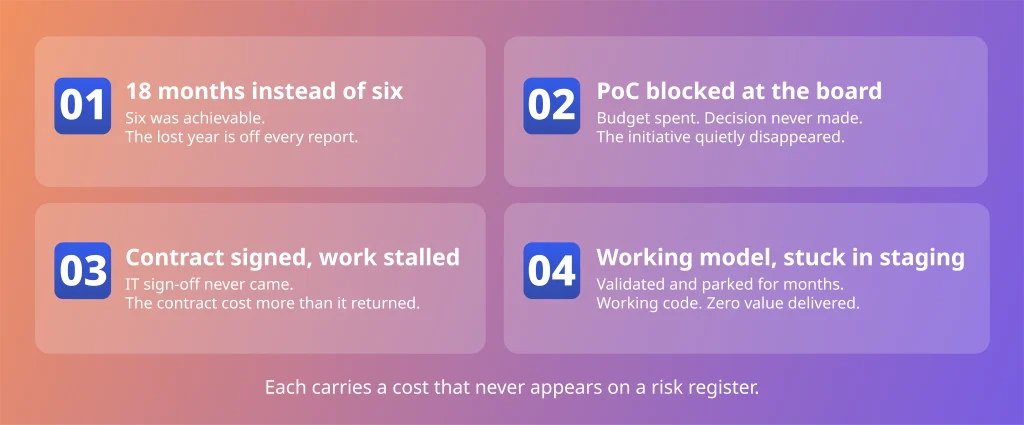
Across three or four stalled initiatives in a single year, that cost becomes a competitive disadvantage, compounding slowly, well below the line of any budget review.
Four Budget Lines That Never Appear But Are Costing You Millions
1. Your Competitors Are Compounding Their Advantage
Early adopters are accelerating. Their models are trained on real production data. Their teams are building operational intuition that takes months to develop. Their workflows are being rebuilt around AI-native processes that your organisation has not started yet.
Every quarter, a competitor operates with a capability your organisation lacks, and the gap compounds. It does not close when you eventually ship. You will be 12 months behind a system that has had 12 more months to improve.
2. Slow Projects Haemorrhage the People Running Them
Senior data scientists, ML engineers, and AI product managers are scarce across the UK market. They are also selective about where they spend their time.
When projects stall in governance review or drift without clear delivery accountability, the people driving them leave. Turnover in AI roles costs more than recruitment fees. It costs institutional knowledge, rebuilt context, and three to four months of lost momentum per departure. In a 12-person AI function, two exits can effectively restart a programme.
3. Delay Creates Technical Debt That Is Hard to Unwind
When organisations finally move after a long delay, they move under pressure. Vendor selections get rushed. Workarounds get bolted onto legacy systems. Data pipelines get scoped for one use case instead of for scale.
Technical debt created by delayed adoption is harder to unpick than debt created by moving fast and iterating. Fast iteration produces learning. Delayed deployment produces scar tissue.
4. Repeated Pilots Kill Organisational Appetite
Many UK enterprises are running their third or fourth AI pilot on the same business problem. Each one costs budget, time, and internal credibility.
When pilots are not reaching production, the delivery process, ownership structure, and governance model are almost always the culprits.
Left unchecked, pilot fatigue kills the organisational appetite for the initiatives that would actually deliver value.
S&P Global surveyed over 1,000 enterprises in 2025 and found that 42% had abandoned most of their AI initiatives that year. In 2024, that figure was 17%. The average organisation scrapped 46% of its proofs of concept before they reached production. Pilot fatigue is an industry-wide pattern accelerating year on year. (source: Fortune)
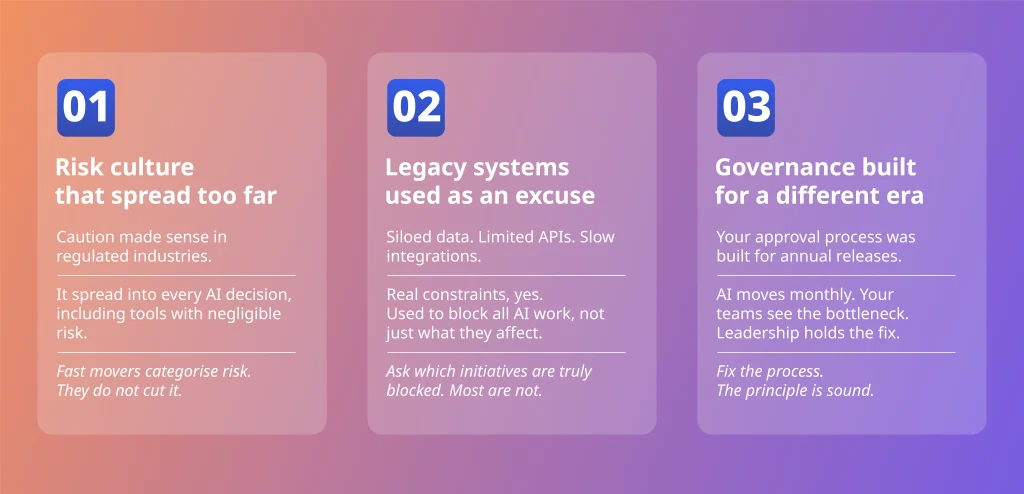
If your governance framework is creating more friction than protection, this guide to governed AI engineering explains what responsible AI oversight looks like in a production environment.
The £500,000 Question Nobody in Your Leadership Team Is Asking
Run this calculation. An AI initiative delivers £500,000 in operational efficiency gains per year once live. Your project takes 18 months to deploy instead of six.
You have not just paid for an extra 12 months of project costs. You have forgone £500,000 in delivered value, plus the compounding benefit of a more mature, better-trained system by the time your next initiative begins.
Scale that across three or four delayed initiatives in a single year. The numbers become hard to ignore and harder to explain to a board that approved the original business case.
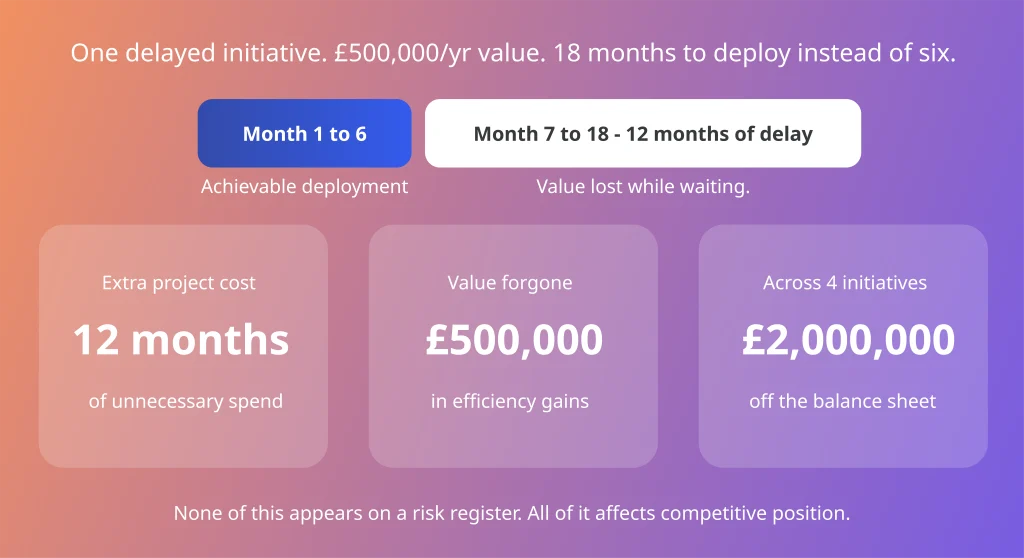
This is a strategic disadvantage that erodes margin, capability, and competitive position, quarter by quarter, initiative by initiative.
What Fast-Moving Organisations Do Differently (None of It Is Technical)
The organisations that deploy AI successfully and quickly share a set of structural characteristics. None of them is technical, and all of them are decisions.
Clear ownership. One named executive is accountable for delivery outcomes. Committees can consult, but someone has to decide. Decisions stop stalling when a person, not a group, is responsible for making them.
Modular architecture. Fast-moving organisations build in components that deploy, test, and iterate independently. No waiting for the whole system to be ready before any of it can move. Parallel workstreams become possible. Integration risk drops.
Tiered governance. The most efficient AI programmes have governance frameworks in place before a project begins. Low-risk applications move through a lightweight process. High-risk ones go through a full review. The framework does the sorting; the project does not have to wait for it to be invented.
The Hannah Fry OpenClaw AI experiment showed what the absence of that framework looks like in practice: an AI agent with real access, behaving rationally within its own logic, right up to the point where it leaked credentials.
Off-the-shelf where it fits. Building from scratch is rarely the fastest path. Where a vendor solution covers 80% of the requirement, deploying and configuring the remainder is almost always quicker and cheaper than a full build. The question worth asking is not “can we build this?” It is “should we?”
In-sprint compliance. Legal, data protection, and compliance input sits inside the delivery cycle. When it gets bolted on at the end, it becomes the single most reliable source of late-stage delay. Embedding it early removes that entirely.
Speed and compliance are not in conflict. This breakdown of how to accelerate AI delivery without sacrificing governance covers the practical steps for moving faster while keeping risk teams satisfied.
Five Things Your Leadership Team Can Do This Quarter
If your organisation is experiencing slow AI delivery, the answer is a delivery model that fits the pace at which AI needs to move.
- Run a delivery audit. You already know what AI can do. What you likely do not know is exactly where your own delivery keeps breaking down. Map your last three initiatives and identify the specific point at which each one stalled. A pattern will emerge. It almost always does, and it is almost never the technology.
- Categorise your AI initiatives by actual risk level. Not every application carries the same compliance or reputational exposure. An internal document summarisation tool is not the same governance challenge as a customer-facing credit decisioning model. Fast-track the former. Apply rigour to the latter. Treating them the same wastes time on one and underserves the other.
- Redesign your governance process. Your compliance requirements are probably sound. Your approval process was probably built for a software release cycle that no longer reflects how your organisation needs to move. A process designed for annual releases will choke monthly AI delivery. The standard does not need to change. The workflow around it does.
- Hire for delivery, and not only for AI. ML engineers alone will not close the gap. You need product managers who can run AI sprints, engineers who understand enterprise integration, and at least one senior leader whose job is to hold delivery to account. Without that structure, capability accumulates in isolation and never reaches production.
- Put a clock on every initiative. Six months is a reasonable production benchmark for most internal AI tools. If an initiative cannot reach that threshold, it should be reassessed, rescoped, or stopped. Pilots that run indefinitely are not cautious. They are expensive, demoralising, and a reliable way to kill organisational appetite for the next programme.
The uncomfortable truth: The organisations that are most cautious about AI deployment are often the ones most at risk from it, because their competitors are deploying it faster.
Why UK Enterprises With the Fastest AI Delivery All Have One Thing in Common
Most enterprises consistently lack the engineering infrastructure, production experience, and delivery rigour to move use cases from prototype to operational system at scale. The ambition is not missing, but the gap between a working pilot and a production-grade system requires a specific kind of engineering capability that most organisations have not built internally.
Deployflow works with UK engineering and operations teams on that specific transition, from stalled pilot to production-grade system.
That means shortening the gap between a working prototype and something that runs reliably at scale, integrates with existing infrastructure, and has governance and monitoring in place from day one.
Clients report up to 70% less manual work once AI is properly embedded in their workflows, and faster delivery cycles across subsequent initiatives as the foundations are already built.
For UK enterprises dealing with governance overhead, legacy infrastructure, and delivery bottlenecks, the missing piece is a partner with production experience to execute.
If your last AI initiative is still sitting in staging, or your third pilot is circling the same problem as the first two, Deployflow offers a free consultation to identify exactly what is blocking production. One conversation. A specific answer.
Questions UK Tech Leaders Are Asking About AI Delivery
Can we speed up AI delivery without increasing our compliance risk?
Yes, if you separate risk by category rather than applying the same process to every initiative.
Most compliance delays come from treating a low-risk internal automation tool the same way you would treat a customer-facing AI model in a regulated environment. Tiered governance frameworks let low-risk projects move through a lightweight process while high-risk ones receive full scrutiny. Speed and compliance are not in conflict. The process design is usually what makes them feel that way.
How long should an enterprise AI project realistically take to reach production?
For most internal tools, six months is a reasonable benchmark. More complex, customer-facing, or regulated applications may require longer. Anything beyond 12 months for a well-scoped initiative warrants close examination.
The organisations consistently hitting shorter timelines are not cutting corners. They have clear ownership, a modular architecture, and governance frameworks that are in place before the project starts rather than during it.
What is the difference between an AI pilot and a production AI system?
A pilot proves that a concept works in a controlled environment.
A production system works reliably at scale, integrates with existing infrastructure, handles real data, and has monitoring and governance controls in place.
The gap between the two is where most UK enterprise AI initiatives stall. Getting from pilot to production requires delivery capability, not just a working prototype. That means engineering rigour, integration experience, and clear organisational ownership.
How do we build a business case for AI when ROI is hard to measure upfront?
Start with operational metrics rather than financial projections. Identify the specific process you are targeting, the number of manual hours involved, the error rate, and the decision latency, and use those as your baseline.
AI initiatives with the clearest ROI are almost always scoped around a single, measurable pain point rather than a broad transformation programme. A tightly scoped pilot with defined success criteria is easier to fund, deliver, and scale once it proves its value.
What should I look for when choosing an AI delivery partner?
Production experience matters more than demo quality. Look for a partner who has taken AI from prototype to live enterprise system before, across your cloud infrastructure, within regulated environments if relevant, and with governance and monitoring built in from the start.
Ask for examples of what they have delivered, instead of just what they have built. The ability to compress the pilot-to-production timeline while maintaining compliance and security is what separates genuine delivery partners from consultancies that stop at the proof of concept.
Explore our BLOG
Recent articles
ISO 42001 Explained: Requirements, Certification and What Your Engineering Team Must Build
ISO 42001 is the international standard that demonstrates your organisation governs AI properly, and enterprise...
read full article

Is Claude Down? Anthropic Outage: Protect Your Cloud Infrastructure
Claude went down across every surface on 29 September 2026. From 14:00 to 14:59 UTC,...
read full article

Top 10 Healthtech Companies in 2026: What Their Growth Means for AI and DevOps
Every software change that reaches a hospital has to clear regulatory, legacy system, and clinical...
read full article