


AI can speed up engineering work, but it can also amplify weak processes.
CTOs want to know whether AI is being used within a delivery model that maintains quality, ownership, security, and operational control.
Without clear review standards, data boundaries, approval rules, and accountability, AI can introduce rework, inconsistency, and avoidable risk into engineering workflows.
What You’ll Take From This Article
- Governed AI engineering means using AI within clear review, security, and delivery controls
- The goal is to improve speed and output quality without losing control of risk
- Tool access is not enough. CTOs need a reliable operating model for AI-assisted work
- Review, ownership, and auditability matter more than experimentation alone
This article explains what governed AI engineering looks like in practice, which controls matter most, where AI adoption tends to break down, and how to introduce structure without slowing delivery. If you’re trying to balance speed, reliability, and oversight, that is the part that matters.
What Governed AI Engineering Actually Means in Practice
Governed AI engineering means using AI inside clear delivery, security, and review controls. It turns AI from an informal tool into a controlled part of the engineering workflow.
It does more than just speed up tasks. It starts shaping decisions, changes, and delivery outcomes across the engineering workflow. That is why the real challenge is whether teams can use AI inside a model that keeps ownership, review quality, security, and operational control intact.
Without that, faster output can simply push weak decisions through the system more quickly.
AI can support code generation, troubleshooting, documentation, infrastructure work, and faster execution. But without structure, it can also increase rework, weaken accountability, and introduce avoidable risk.
In practice, governance cannot stay static. AI-assisted work needs control before use, during delivery, and after deployment, because risk does not sit in one moment. It can appear in prompts, generated output, reviews, approvals, production changes, and post-release behaviour.
Strong governance is continuous, not a one-time sign-off.
Why CTOs Need More Than AI Adoption to Get Real Value
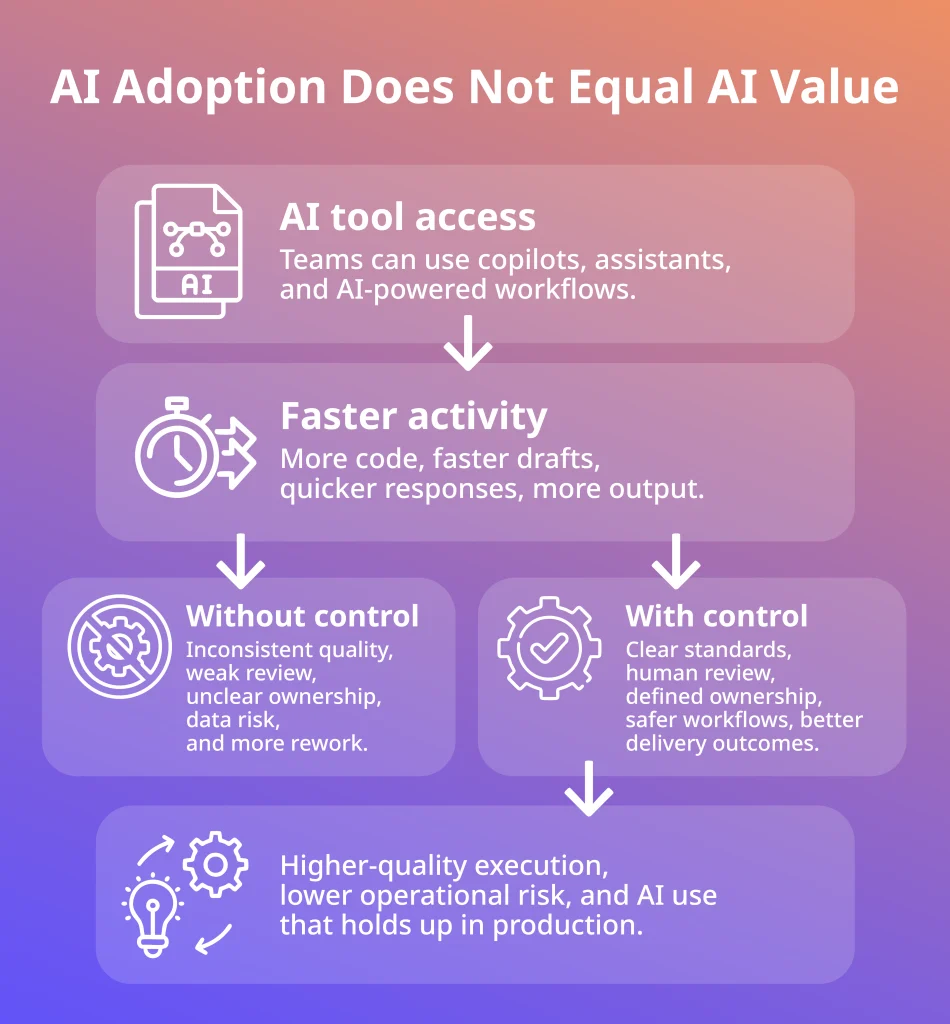
That is the real dividing line. The question is whether the organisation can control how AI output is used, reviewed, approved, and owned once it begins to affect delivery. AI value depends less on raw capability than on the operating model around it.
The Real Test of AI in Engineering Is Delivery Quality
Faster output is useful only when it still meets the standards the business depends on. Without that, speed can turn into rework, uneven quality, security gaps, and more pressure on senior engineers to correct avoidable mistakes.
The real value of AI comes from controlled use. That’s why governance matters.
Governance gives teams a way to use AI inside clear workflows, review standards, and accountability rules. That makes adoption more consistent and makes the output easier to trust.
The goal is to make AI useful in ways that improve delivery quality, reduce avoidable risk, and support reliable execution across teams. That is the difference between AI experimentation and AI that creates operational value.
AI Governance for Engineering Teams: The Controls That Matter Most
AI becomes safer when the workflow has the right controls in the right places.
The priority is to focus on the controls that protect delivery quality, reduce avoidable risk, and keep responsibility clear when AI starts influencing engineering work.
The controls that matter most are the ones that protect sensitive data, keep review standards intact, and stop risky changes from moving too easily.
- Start with data boundaries. Teams need clear limits on what can be shared with AI tools and what must stay out. That includes customer information, credentials, internal systems details, and commercially sensitive material. If that line is blurred, the rest of the governance model is already weaker than it looks.
- Then comes review quality. AI can speed up code, documentation, scripting, and analysis, but speed is not the same as trustworthiness. Output that affects production systems, infrastructure, security logic, or customer-facing functionality still needs proper human review.
- Approval should match risk. Low-impact internal tasks can move quickly. Changes tied to infrastructure, permissions, deployment logic, or sensitive workflows need a higher bar. That is how CTOs avoid treating every AI use case the same when the consequences clearly are not.
- Decision rights should also be explicit. Teams need clarity on who can use AI for what, who can approve AI-assisted changes, who can override or reject output, and who remains accountable if something goes wrong. Governance gets weaker very quickly when responsibility is assumed rather than defined.
- Just as important is traceability. If AI helped shape a change, teams should be able to see what happened, who reviewed it, and where accountability sits. That matters during audits, incident reviews, and everyday engineering management.
- Two controls deserve extra discipline: prompt handling and secret protection. Poor prompt habits can expose information or create inconsistent outputs. Secrets, tokens, keys, and sensitive environment details should never drift into AI workflows casually.
- Finally, infrastructure changes need stronger caution than AI enthusiasm usually admits. AI-assisted updates to cloud configuration, Terraform, networking, access controls, or CI/CD logic can create serious operational issues if they move forward too easily. Faster generation does not reduce the need for engineering judgement.
Make AI-assisted work easier to trust without turning governance into drag. When these controls are clear, teams can move faster with fewer surprises, and CTOs get a model that supports real delivery rather than loose experimentation.
What a Safe AI-Assisted Development Workflow Looks Like
A safe AI-assisted workflow is a clear path from prompt to review to release, with stronger checks where the risk is higher.
A simple model looks like this:

That flow matters because AI output is not equally risky. Some tasks can move quickly with a lightweight review. Others need much more control.
Low-risk work usually includes internal drafting, documentation, test scaffolding, code suggestions for non-critical components, and early research support. In these cases, AI can save time without creating much exposure, as long as someone still checks the output before it is used.
Higher-risk work needs a different path. That includes architecture decisions, infrastructure changes, security logic, access controls, CI/CD updates, production-impacting code, and anything involving customer or sensitive internal data. In those cases, AI should support engineering judgement.
Safe adoption depends more on workflow design than on tool choice.
That is consistent with the current UK government’s AI adoption research published in February 2026: businesses already using AI repeatedly stressed that safe AI use requires human oversight, with many specifically raising concerns about AI being used without human checks. 84% of businesses reported at least some human input or checking, while 67% said that input or checking was significant.
A strong workflow usually includes:
- Clear rules on what can be shared in prompts
- Defined ownership for AI-assisted output
- Human review before anything important moves forward
- Stronger approval for higher-risk changes
- Testing and traceability before deployment
Your goal should be to let low-risk work move faster while making sure higher-risk output faces the level of scrutiny it deserves.
Why AI Agents Need Stronger Governance Than AI Assistants
AI agent development services can raise the governance bar because they can do much more than generate suggestions. They can take actions across systems, follow multi-step workflows, and influence outcomes with less direct human input.
That changes the control model. Governance must cover not only what the system produces, but also what it can access, what it can change, where approval is required, and how actions are logged for review.
That means agentic workflows need tighter access boundaries, clearer approval checkpoints, and much stronger traceability than lower-risk AI assistance. The more independently the system can act, the less room there is for vague ownership or lightweight oversight.
The Risks of AI Engineering Without Proper Governance
Without proper governance, AI can weaken delivery quality, resilience, and accountability across the engineering function.
Recent OECD analysis adds weight to that concern. In a 2026 paper tracking media-reported AI incidents and hazards, the OECD found that the average number of reported AI incidents and hazards rose from 92 per month in 2022 to 324 per month in 2025. This supports the case for stronger monitoring, review, and response as AI use expands.
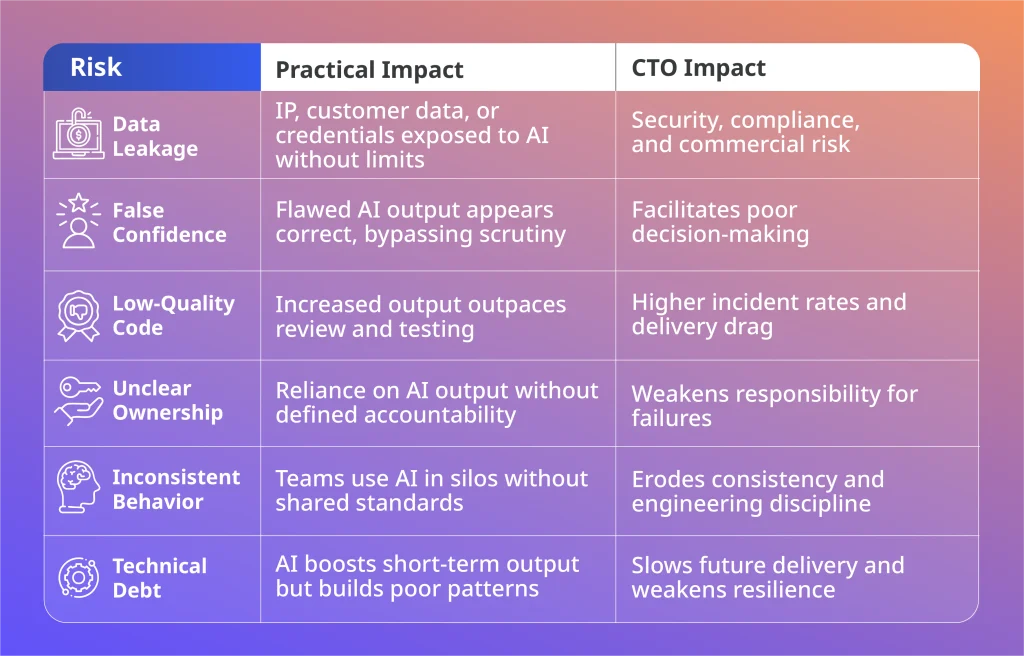
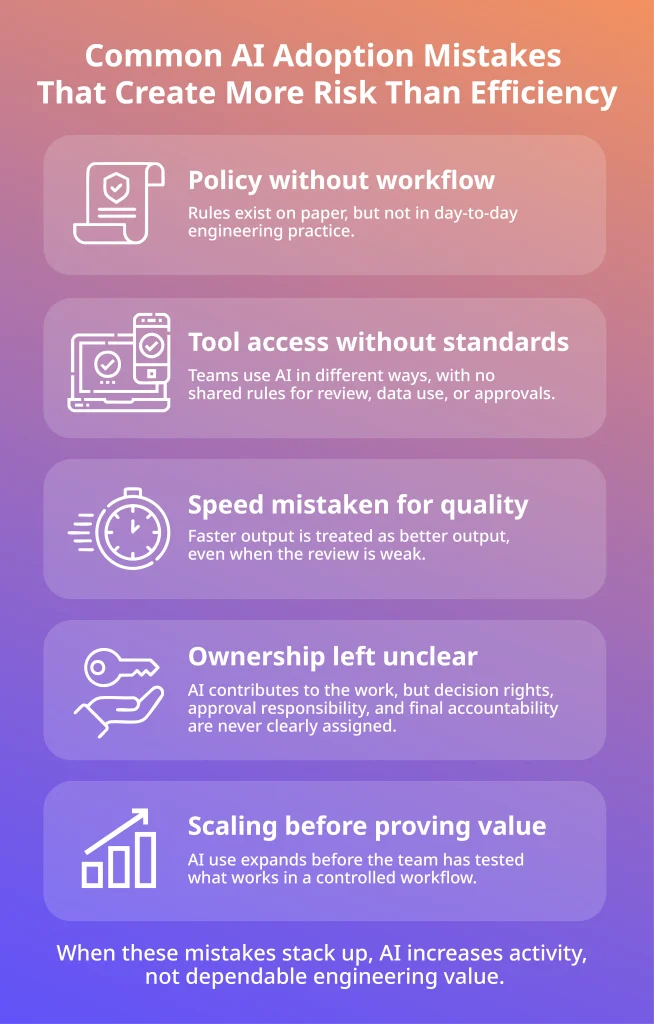
The wider problem is operational drift. If governance cannot be checked in practice through reviews, approvals, traceability, and incident response, it is not really governance. It is just policy language without operational proof.
How to Build Governed AI Workflows Without Slowing Delivery
The best governance models apply more control where the risk is higher.
Good governance depends on clarity. Teams need to know where AI fits, what still needs human judgment, and where responsibility stays when output moves toward production.
That also means governance cannot sit with engineering alone. Security, legal, leadership, and product all influence how AI can be used safely in real delivery. The practical goal is to make decision-making, escalation, and accountability clear before problems appear.
You should make the safe path the easiest path.
Why the Right Delivery Model Matters for AI Governance
Controls work better when the delivery model supports them. For a clearer view of how that delivery model works in practice, see what clients say in Deployflow’s Clutch reviews.
Full-stack dedicated teams make it easier to review AI-assisted work in context because platform, cloud, application, and operational decisions stay connected.
Sprint-based delivery helps teams test what works and tighten standards quickly.
Experienced engineers bring judgment to challenge weak output, while knowledge transfer helps good practices spread across the team.
For teams trying to turn AI into a dependable part of delivery, Deployflow’s AI engineering and automation brings the winning model: full-stack teams, sprint-based execution, experienced engineers, and knowledge transfer that supports lasting control instead of one-off implementation.
Key Takeaways on Governed AI Engineering
- AI adoption alone does not create engineering value
- Governed workflows help teams use AI without weakening control
- Review quality, ownership, and data boundaries matter most
- Safe AI use depends on workflow design, not just tool choice
- The right delivery model makes AI adoption easier to manage
- CTOs need AI use that holds up in real production environments
Get a free AI workflow review to see where AI can safely reduce friction, which controls need to be stronger, and whether the use case is ready for rollout.
Frequently Asked Questions About AI Governance in Engineering
What is the difference between AI governance and AI compliance?
AI governance is the broader operating model, while AI compliance is only one part of it.
Governance covers how AI is reviewed, approved, monitored, and controlled across delivery, whereas compliance focuses on meeting legal, regulatory, or policy requirements. A team can satisfy a policy checklist and still have weak review standards, unclear ownership, or poor control over AI-assisted changes.
Who should own AI governance in an engineering organisation?
AI governance should be owned jointly, with the CTO leading how it works in practice.
Engineering cannot manage governance alone because AI risk touches security, legal, leadership, product, operations, and delivery. The CTO usually plays the central role by making sure decision rights, review standards, and escalation paths are clear across the organisation.
How often should AI governance policies and controls be reviewed?
AI governance controls should be reviewed regularly and updated whenever workflows, risks, or tooling change.
A static policy quickly becomes outdated when teams adopt new AI tools, expand use cases, or introduce AI into more sensitive parts of the delivery process. In practice, governance works better when it is treated as a living operating model and not a fixed document.
Does every AI-assisted task need the same level of review?
No, the review should match the level of risk.
Low-risk work, such as internal drafting or early research, can move with lighter checks, while production-impacting code, infrastructure changes, security logic, and sensitive workflows need stronger review and approval. Treating every task the same either slows delivery unnecessarily or creates exposure where more control is needed.
How can CTOs measure whether AI governance is working?
CTOs can measure AI governance by assessing whether controls hold up in real-world delivery, not just whether policies exist.
Useful signals include review quality, traceability, approval discipline, incident response, clear ownership, and the consistency with which teams follow defined standards. If governance cannot be seen in daily engineering behaviour, it is probably weaker than it looks. That’s why many teams use structured AI engineering and automation services to turn governance into a real delivery model rather than a policy document.
Explore our BLOG
Recent articles
ISO 42001 Explained: Requirements, Certification and What Your Engineering Team Must Build
ISO 42001 is the international standard that demonstrates your organisation governs AI properly, and enterprise...
read full article

Is Claude Down? Anthropic Outage: Protect Your Cloud Infrastructure
Claude went down across every surface on 29 September 2026. From 14:00 to 14:59 UTC,...
read full article

Top 10 Healthtech Companies in 2026: What Their Growth Means for AI and DevOps
Every software change that reaches a hospital has to clear regulatory, legacy system, and clinical...
read full article