



You start using AI to move faster. Output goes up, but confidence drops. Reviews become less consistent, ownership gets blurry, and production changes become harder to trust.
AI can increase delivery speed, but without clear control, it can also increase friction, rework, and risk.
See how to stop the AI drag.
Executive Summary:
- AI delivery fails when it sits outside your core engineering workflow.
- To maintain speed without losing control, UK IT leaders must move from AI as a project to AI as an integrated pipeline.
- Read and find out how to achieve a 75% reduction in manual effort by focusing on high-value, governed use cases.
For CTOs and IT leaders, the challenge is whether the organisation can keep pace without sacrificing governance and losing control.
This article breaks down where that tension shows up in practice and how to build an AI delivery model that is faster, safer, and easier to trust.
Why Most AI Prototypes Stall Before Production
AI delivery breaks when a working prototype needs to be trusted in production.
What starts happening:
- Prototypes prove value, but production slows down. The model works, but there is no clear path to integrate, test, and release it safely.
- Output scales faster than control. AI increases the volume of changes, decisions, and actions, but review, validation, and approval do not scale with it.
- Ownership becomes fragmented. AI sits across engineering, product, and security, but no one clearly owns delivery, risk, and outcomes.
- Confidence drops before performance does. The issue is not whether the AI works, but whether teams trust what it produces enough to ship it.
So the bottleneck is the delivery structure.
AI is already capable of accelerating work. The constraint is whether the organisation can absorb that speed without losing control.
Stop Treating AI as a Side Project. Build It Into Core Workflows
The latest DORA research makes one thing clear: AI does not fix delivery problems. It amplifies whatever is already there.
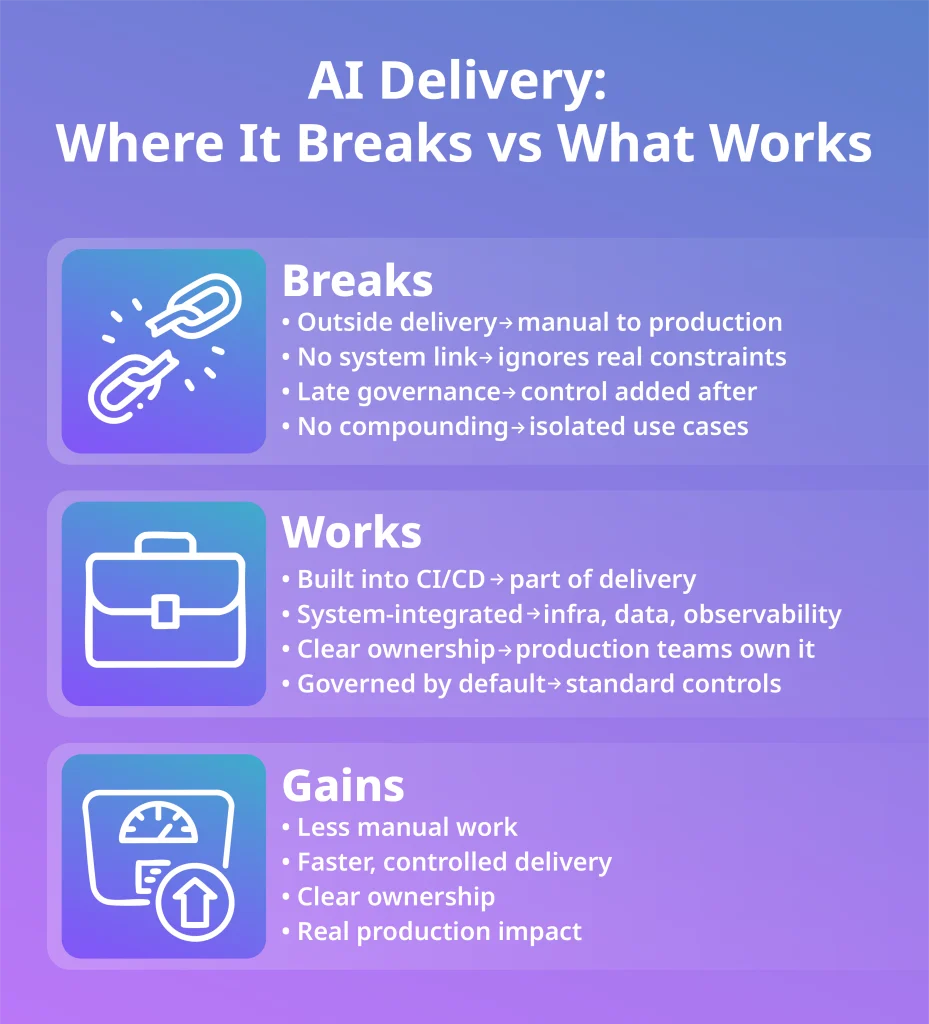
That means teams with strong delivery systems get faster. Teams with weak structure get more noise, more rework, and more risk. This happens when AI is treated as a side project.
AI adoption often begins in the margins of delivery. A team tests a tool, proves a concept, or automates one isolated task. But the workflow still sits outside CI/CD, outside infrastructure controls, and outside the accountability of the teams that run production. Momentum stalls when the organisation tries to scale it.
That is why more teams are looking at practical ways generative AI can remove CI/CD bottlenecks without pushing governance outside the delivery process.
Stop the Experiment: Focus Only on High-Value Use Cases
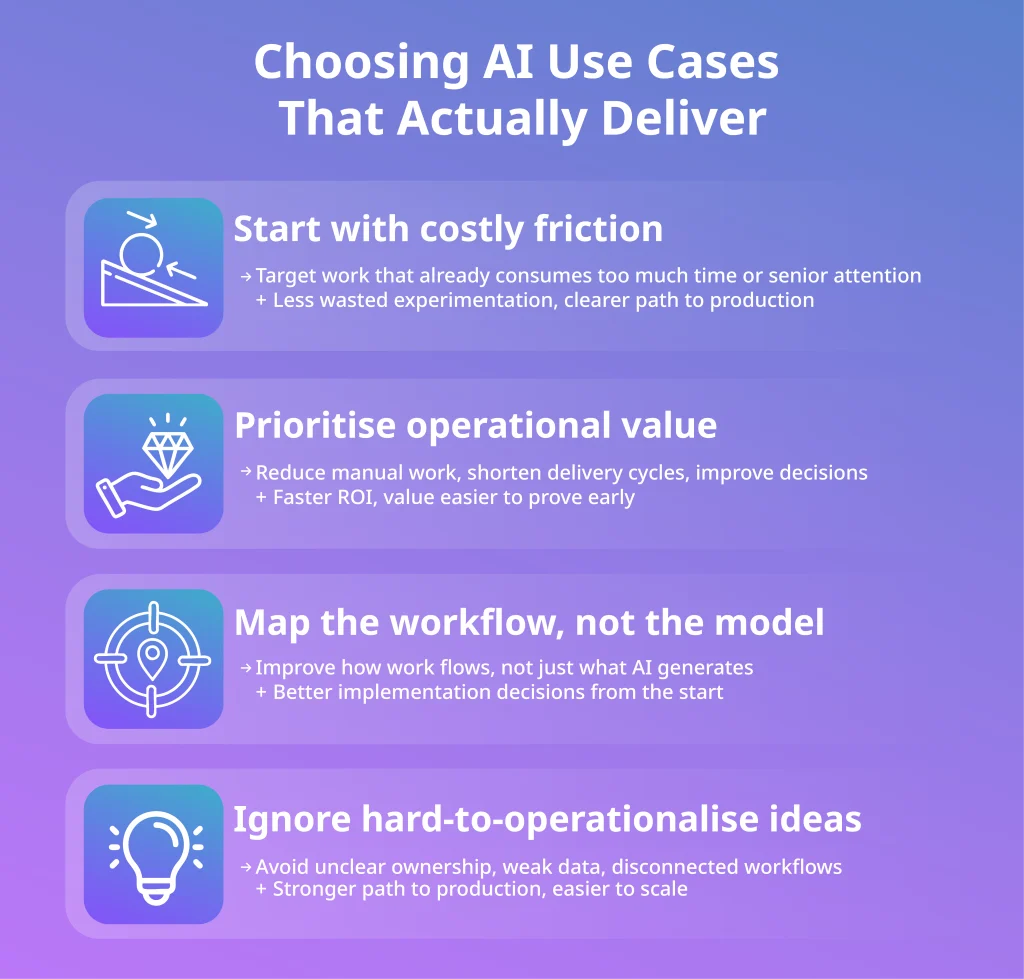
The real challenge is choosing the small number of use cases that can justify investment, reduce friction, and reach production without turning into another slow-moving side initiative. That means resisting ideas that look impressive in a demo but do very little for delivery speed, operating cost, or decision quality.
A use case can sound innovative, demo well, and still do very little for delivery speed, operating cost, or decision quality. If the business case is weak, the workflow is unclear, or the path to implementation is too messy, it will absorb time without creating much return.
The better starting point is much closer to the core of how work gets done.
Look for workflows where manual effort is already high, delays are already visible, or decisions are already slowed down by too much repetitive effort. That is where AI has a better chance of creating measurable value quickly.
The PoC Trap: Why Demos Build False Confidence
A PoC can build confidence too early. It shows the model can do something useful, but it does not prove the use case is ready for production.
That is where delivery starts to slow down. The demo works, but the harder questions remain:
Is the business value clear enough? Who owns the workflow? How will outputs be reviewed? What happens when the system gets something wrong?
The practical way to avoid rework, delays, and loss of confidence after the PoC stage is to build the prototype around production from the start.
Define success in business terms. Test it against real workflows. Set ownership early. Decide how approval, fallback, and limited rollout will work before the use case picks up momentum.
That changes the value of the prototype. It stops being just a technical signal and starts becoming a real delivery decision. Instead of revisiting the workflow later under more pressure, you shape it early enough to move forward with more confidence.
The gains are less rework, faster decisions, and a shorter path from a promising idea to something the business can actually trust.
What Production-Ready AI Requires and Why Most Teams Miss It
Production-ready AI should be delivered through the same system that already runs engineering, operations, and change, and that is where things often break. The use case looks promising, but it still sits outside core workflows, outside clear ownership, and outside the controls needed for production. At that point, AI is still an add-on.
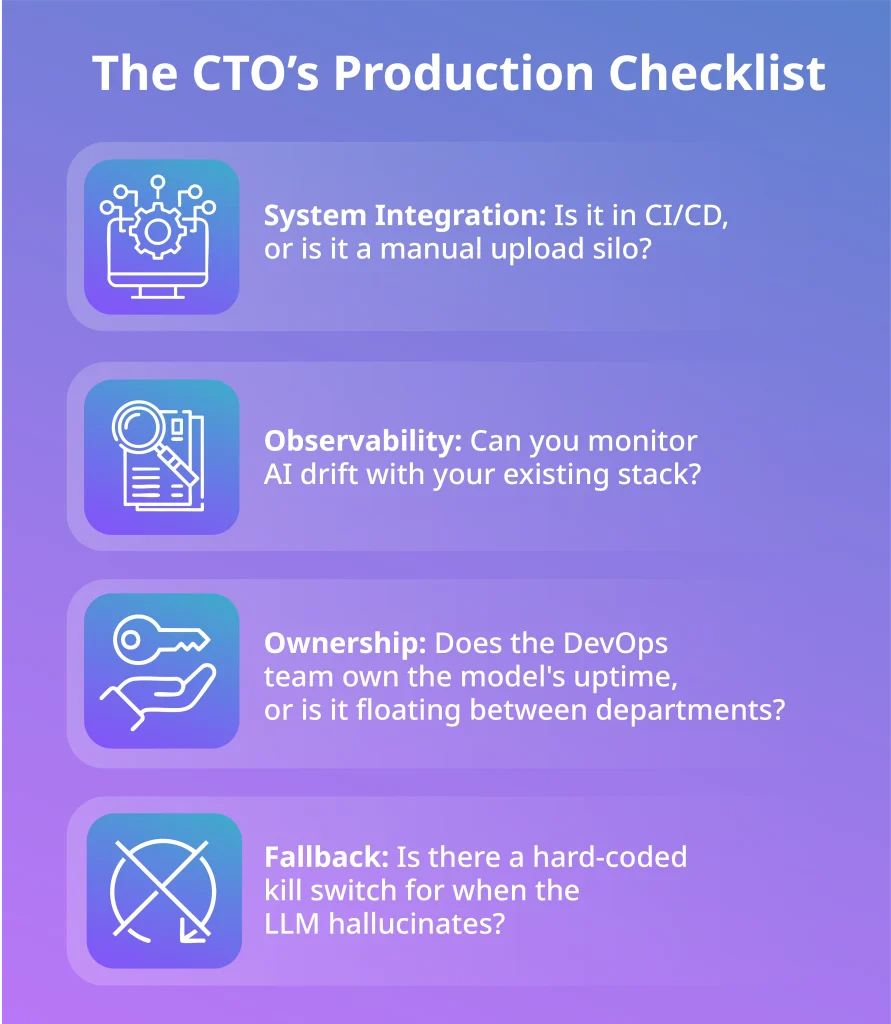
To make AI production-ready, it needs to be integrated into existing systems, governed through clear data and access boundaries, monitored like any other operational capability, and supported by rollback or fallback paths when things go wrong. Just as important, one team needs to own how it performs in production and how it improves over time.
Secure AI-assisted cloud engineering models are getting more attention, especially where infrastructure automation, observability, and controlled rollout all need to work together in production.
That is what allows AI to support live workflows without creating more manual checks, more hesitation, or more operational risk.
The Governance Fallacy: Why Removing Controls Slows You Down
Cutting controls can make AI delivery feel faster at first. The problem usually appears later, when unclear ownership, weak review paths, and last-minute governance start slowing decisions down.
When delivery is organised around clear ownership, short execution cycles, and governance built into the workflow, AI moves forward with less friction and fewer surprises.
Recent NBER research states that, when workplaces combined encouraged AI use, enterprise chatbots, and training, 93% of workers reported using AI at work, and 28% used it daily. The largest reported benefits appeared under that fuller delivery setup and not from isolated measures.
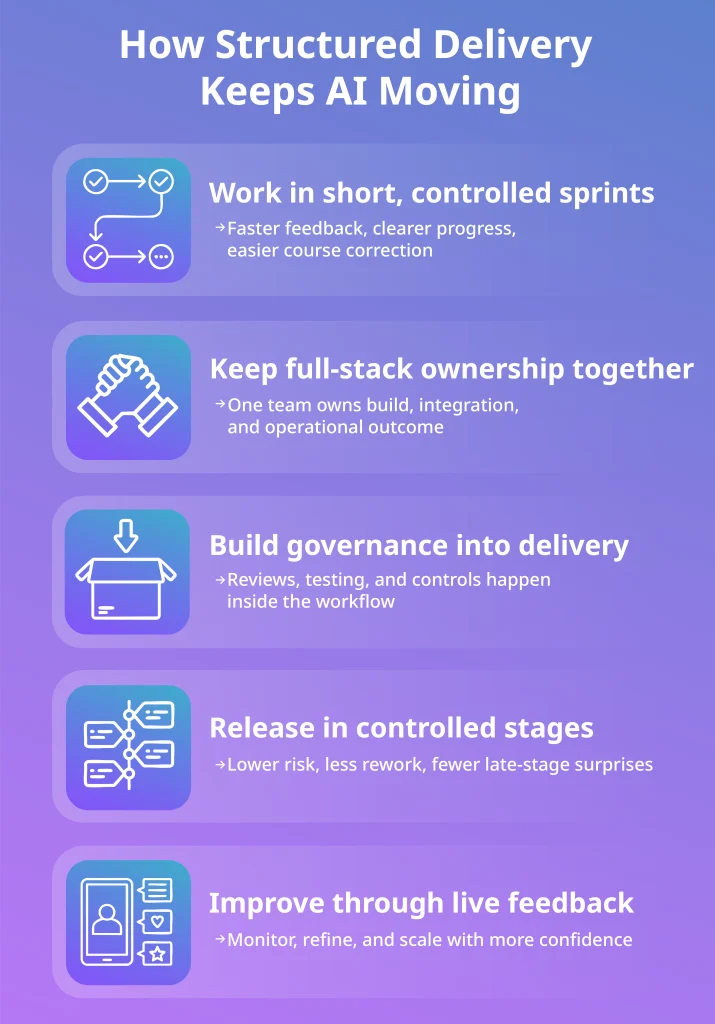
With Deployflow, AI engineering and automation are built around full-stack delivery, short sprints, and production-first implementation. AI can be integrated into real workflows, properly governed, and turned into operational capability without adding another disconnected layer to the business.
Continuous Optimisation Is Where AI Actually Pays Off
Go-live is not the payoff. It is the starting point.
AI becomes more valuable once it is used in real workflows, measured under real conditions, and improved based on what happens after release. Manual checks can be reduced further, weak points can be tightened, and automation can take on more work with more confidence.
Continuous optimisation is where AI starts compounding its value. Monitoring shows what needs attention. Iteration improves fit and reliability. Agents and automation reduce operational load over time. AI stops being a one-off project and starts becoming an operational advantage.
Build AI Delivery That Holds Up Under Real Business Pressure
AI success is measured by whether delivery can keep moving once the use case meets real workflows, real scrutiny, and real operational demands. That’s how weaker AI initiatives usually start to lose ground.
Sustaining progress without additional friction, manual control, or delivery risk is the hard part.
Deployflow offers more than model delivery. Its AI engineering and automation service is built to embed AI into real systems, workflows, and delivery processes so the result is usable in production.
Case Study: From Discovery to a 75% Manual Effort Reduction in 10 Weeks
Deployflow’s work with the Positive Impact Concept shows how this holds up under real delivery pressure. The team moved from discovery to a fully functional MVP in just 10 weeks, turning a complex, manual sustainability assessment process into a structured digital platform that reduced manual data processing by 75%.
Instead of treating the solution as a standalone build, the focus stayed on usability, workflow integration, and long-term scalability, which is exactly what allows more advanced capabilities, including AI-driven analysis, to operate reliably once they meet real users and real operational demands.
Secure Your AI Roadmap: Book Your Readiness Assessment
The next step is to book an AI opportunity and readiness assessment with Deployflow, so you can pinpoint where AI can remove friction fastest, what needs to be in place for a safe rollout, and how to move forward without creating governance debt.
“We were lucky to find Deployflow because they understand the algorithm and were able to create a digital product suitable for the purpose. They are part of our business family. They seamlessly embed into your team, giving you the feeling that your business matters to them.”
— Lilla O’Connor, Co-Founder, PI Concept
Frequently Asked Questions About AI Delivery and Governance
How do you measure ROI from AI in delivery?
AI ROI is measured through delivery metrics like cycle time, change failure rate, and manual effort reduction.
Most teams default to technical metrics, but those rarely reflect business impact. A stronger approach is to track how AI affects delivery speed, operational cost, and decision quality. If AI reduces time spent on repetitive tasks, shortens release cycles, or improves reliability, the value becomes visible quickly. Without tying AI to these outcomes, it risks staying an expensive experiment.
When should AI be removed from a workflow?
AI should be rolled back when it introduces more friction, errors, or review overhead than it removes.
Early success can hide long-term issues. If teams start adding manual checks, slowing releases, or questioning outputs more often, the AI use case is not holding up under real conditions. Having rollback paths and fallback processes defined early allows teams to step back without disrupting delivery, which is critical for maintaining trust.
What is the biggest risk when scaling AI across multiple teams?
The biggest risk is inconsistent standards, where different teams adopt AI in ways that create fragmentation and governance gaps.
Without shared rules for usage, validation, and ownership, AI becomes uneven across the organisation. Some teams move fast, others slow down, and overall delivery becomes harder to manage. Standardising how AI is introduced, reviewed, and monitored ensures that scaling does not increase risk or complexity.
Do smaller teams need the same level of AI governance as enterprises?
Yes, but it should be proportionate and built into delivery rather than added as a heavy layer.
Smaller teams often think governance is only for large organisations, but the risks are the same, just on a different scale. The difference is in implementation. Lightweight controls, clear ownership, and simple review processes can provide strong governance without slowing progress. The goal is not more process, but better structure.
How do you avoid over-automation with AI in engineering workflows?
Over-automation is avoided by keeping human oversight on high-impact decisions and limiting AI to clearly defined tasks.
Not everything should be automated. AI works best when applied to repetitive, well-understood parts of a workflow, while critical decisions still require human judgment. Defining boundaries early helps prevent teams from relying on AI in areas where mistakes carry a higher risk, keeping delivery both fast and reliable.
Explore our BLOG
Recent articles
ISO 42001 Explained: Requirements, Certification and What Your Engineering Team Must Build
ISO 42001 is the international standard that demonstrates your organisation governs AI properly, and enterprise...
read full article

Is Claude Down? Anthropic Outage: Protect Your Cloud Infrastructure
Claude went down across every surface on 29 September 2026. From 14:00 to 14:59 UTC,...
read full article

Top 10 Healthtech Companies in 2026: What Their Growth Means for AI and DevOps
Every software change that reaches a hospital has to clear regulatory, legacy system, and clinical...
read full article