



Your AI delivery is slower than it should be, riskier than your board knows, and running on a sprint model built for deterministic software.
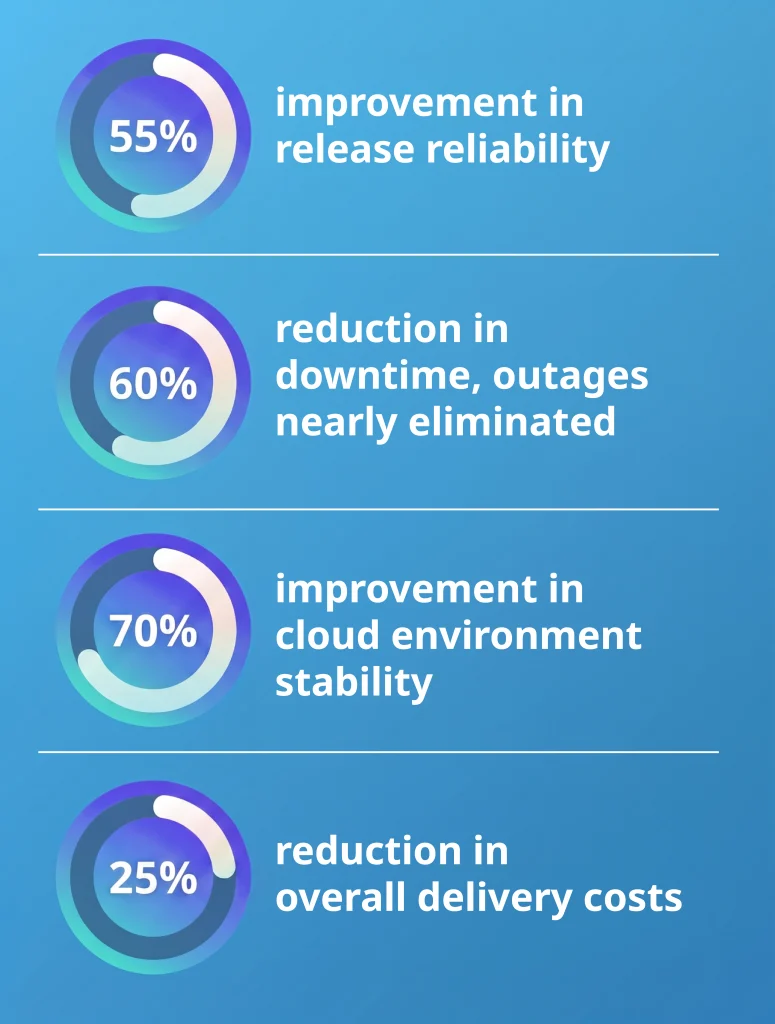
Strike is one example of what restructuring delivery looks like in practice: 55% improvements in release reliability, deployment timelines cut from days to under two hours, and complex integrations shipped in under a month.
The gap between those results and where most AI programmes are today comes down to one structural decision made at the sprint architecture level.
This article shows you what that decision looks like, why it changes everything downstream, and how to apply it without stalling your current delivery.
TL;DR for Engineering Leaders
- Standard sprint models hide AI governance gaps until audit time finds them.
- A two-loop delivery architecture keeps development and governance moving in parallel.
- Governance built into engineering costs one conversation. Found during the audit, it costs a sprint.
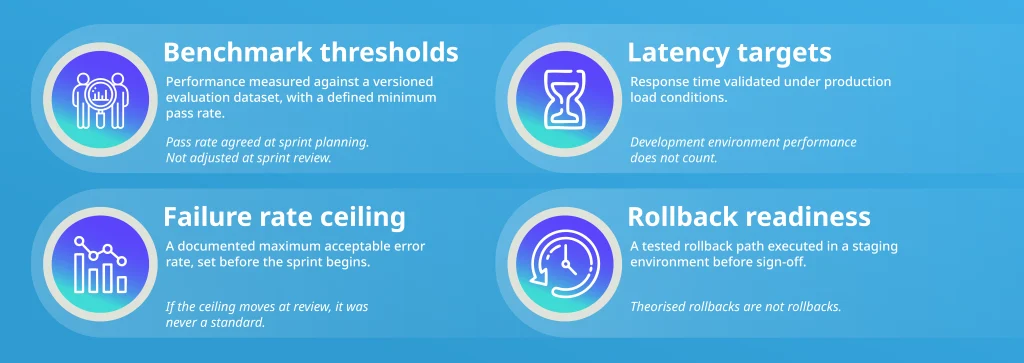
- The definition of done includes benchmark thresholds, tested rollback paths, and versioned datasets.
Teams that restructured delivery this way saw 55% better release reliability and 60% less downtime. This article shows how.
S&P Global’s 2025 survey of over 1,000 enterprises across North America and Europe found that 42% of companies abandoned the majority of their AI initiatives that year, up from 17% in 2024. The delivery blockers behind that figure are well-documented and specific to the UK enterprise context. Read why AI project delivery keeps stalling in the UK if your programme is already showing early signs.
How Strike Restored Delivery Confidence Through Sprint-Based Engineering
Strike, the UK property platform now known as Purplebricks, approached Deployflow after its internal DevOps team departed overnight. What Deployflow inherited on arrival was a delivery process held together by undocumented workarounds, with no sprint structure capable of sustaining the pace the business required.
Deployflow joined Strike’s delivery cycle from day one, working within it.
- Sprint boundaries were defined.
- Governance checkpoints were built into the engineering process.
- CI/CD pipelines were restructured so that release validation happened inside the sprint.
- Every cycle had a clear definition of done, a tested rollback path, and accountability that did not depend on any single person staying in the room.
A delivery cycle that governs itself as it moves does not collapse when people leave, priorities shift, or timelines compress. That is the point of structured sprint execution, and that is what Strike needed.
“Working with Deployflow has been a game-changer for our organisation. From the outset, their team demonstrated a deep understanding of our needs and challenges. Their expertise in streamlining our development and operations processes has significantly improved our efficiency and productivity.”
Dan Rafferty, CTO at Strike
The pipeline restructuring that gave Strike’s delivery cycle its stability sits within Deployflow’s DevOps CI/CD Services, built specifically for engineering teams running at pace.
The numbers show what that looks like in practice. The rest of this article shows you how to build the same architecture inside your own delivery process.
Why Your Current Sprint Model Is Creating Hidden Risk in AI Delivery
Every sprint model starts from the same premise: scope the work, build the thing, ship it. Done means done.
AI delivery does not work that way. The output is probabilistic; the completion state is rarely binary, and if your framework does not account for that, your metrics tell your board a more comfortable story than your pipeline deserves.
According to RAND Corporation’s research into AI project outcomes, more than 80% of AI initiatives fail to reach meaningful production deployment, which is roughly twice the failure rate of traditional IT projects run without AI components.
Probabilistic outputs mean your engineers cannot define “done” the way they do for deterministic software. Evaluation cycles consume sprint time that never appears on a burndown chart. Data readiness sits outside your team’s direct control but lands inside their sprint commitments. Model drift means a feature that passes benchmarks today can behave differently in six weeks under production conditions, without any code change required to cause it.
When the Framework Lies to the Board
The result is a specific and compounding set of problems. Velocity metrics look reasonable while evaluation debt builds invisibly. Your board reads roadmap progress while governance gaps widen. Sprint reviews describe delivery that looks coherent on a slide and feels uncertain to the engineers who built it.
The risk is that your framework is generating blind spots that your current reporting cannot surface.
The Two-Loop AI Sprint Architecture: Faster Delivery With Governance Built In
The most effective structural fix for AI delivery is a two-loop sprint model running within a single cycle. It keeps the development pace and governance integrity operating simultaneously rather than sequentially.
The Inner Loop: Days 1 to 8
What it covers: Feature engineering, model and prompt iteration, unit-level evaluation.
The core discipline: Experimentation is timeboxed formally as spike work. Without a hard boundary, model iteration expands to fill available time with no accountability signal until the sprint review.
What changes in your standups: Blockers in this phase are AI-specific. Data availability, evaluation infrastructure readiness, model access, and agreement on evaluation criteria all need to be surfaced daily.
The benefit: Your team experiments at pace inside a structure that prevents open-ended research from consuming delivery capacity.
The Outer Loop: Days 9 to 14
What it covers: Integration testing, model evaluation against versioned benchmarks, and governance review gate.
The core discipline: This is not a compliance checkpoint appended to the sprint. It is an engineering activity that produces delivery artefacts: evaluation results, risk classification, rollback documentation, and a signed-off definition of done.
What changes in your retrospectives: Add one question that standard retros omit entirely. Did your evaluation criteria reflect actual production conditions? If the answer is no, that is a sprint-zero item for the following cycle, addressed at source rather than discovered at audit.
The benefit: Governance findings surface inside the sprint where they cost one conversation. Outside, they cost a future sprint of rework.
Agile AI Governance: How to Embed Compliance Without Slowing Your Team Down
Governance that lives outside your sprint will always feel like drag. When compliance review happens after delivery, every finding requires rework in a future sprint. The cost compounds with every cycle it goes unaddressed.
The correct frame is governance as an engineering concern, sitting inside the delivery process with the same priority as testing and logging.
The Three Governance Layers Every AI Sprint Needs
Data governance: Covers provenance, versioning, and access control for the datasets driving model behaviour. This layer needs a named owner per sprint, not a shared responsibility that belongs to everyone and therefore no one.
Model governance: Covers evaluation benchmarks, performance thresholds, and the documented criteria for accepting or rejecting a model output at the sprint boundary. Acceptance criteria defined here become part of your definition of done.
Output governance: Covers what your AI feature produces in production. Monitoring thresholds, degradation triggers, and escalation paths all belong here. This layer answers the question your board will ask when something goes wrong: who knew, when did they know, and what did the process require them to do.
Risk Tiering: Govern by Impact, Not by Category
Applying identical governance overhead to every AI feature is the fastest way to make governance feel bureaucratic and incentivise your team to work around it.
A content summarisation tool and a credit decision model do not carry the same compliance weight. Classify features by risk at sprint planning. High-risk features receive full three-layer governance review. Low-risk features receive a lighter process with fewer approval steps. Both are governed. Neither is over-governed.
The benefit: Your team applies governance effort proportional to actual risk, so governance is faster on low-risk work and more rigorous where it matters.
The Governance RACI That Works at Sprint Speed
Three sign-offs. Nothing more.
- Your engineering lead signs off on technical benchmarks.
- A domain expert or product owner signs off on output quality against user expectations.
- Your designated governance owner signs off on risk classification.
One sprint boundary, three approvals, no drag.
Instrumentation Over Documentation
Audit trails built through your observability stack serve both engineering debugging and legal accountability simultaneously. They require no separate effort and exist as a delivery asset rather than a sprint task. Documentation written after the fact is a liability. The instrumentation built into the feature is a self-running governance mechanism.
AI Feature Completion Criteria: The Quantitative Standard Your Delivery Process Needs
Subjective delivery thresholds are a manageable problem in traditional software. In AI delivery, they produce governance gaps, rollback failures, and sprint reviews where nobody can agree on what was actually shipped.
“The model performs well” is not an exit criterion. “Stakeholders are satisfied” is not a release standard.
These assessments mean different things at different stages of the product lifecycle and will be interpreted differently every time they are applied.
What a Quantitative AI Definition of Done Covers
Evaluation Datasets as Delivery Artefacts
Your evaluation datasets need version control, a named owner, and a defined update cadence. When the distribution of production data shifts, your evaluation dataset needs to shift with it.
Teams running static evaluation datasets will consistently pass benchmarks that no longer reflect what users experience in production. That gap is invisible until it becomes a support incident or a board-level conversation about why the AI programme is underperforming against its original projections.
The benefit: A quantitative delivery standard removes the subjective interpretation that causes sprint review disagreements and post-release governance investigations.
CTO AI Delivery Metrics: What to Report to the Board
Board confidence in your AI programme is a reporting architecture problem, and the wrong metrics are actively making it worse.
Burndown charts structurally misrepresent AI sprint progress. A team running evaluation iterations across the final six days of a sprint will show stalled velocity on a burndown chart even when that evaluation work is the highest-value activity in the cycle. Boards read stalled velocity as a delivery problem. The metric is reflecting a measurement mismatch.
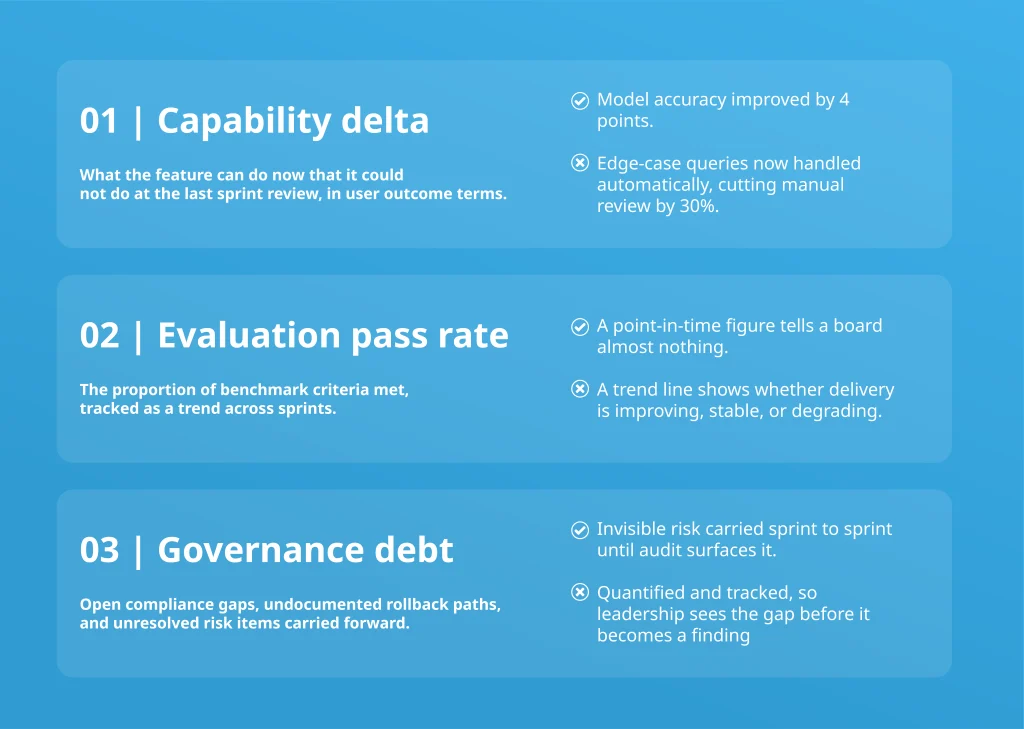
The Three Metrics That Translate AI Delivery Into Board Language
Framing Model Iteration as Progress
Iteration is not failure. A team that runs five prompt cycles and lands on the right configuration at cycle three has not wasted two attempts. It has followed a structured process with a documented outcome.
Sprint reviews that separate what was shipped from what was learned give leadership both the progress signal and the confidence that your team knows exactly what it is building.
MLOps Sprint Structure: When Sprints Work and When They Do Not
Sprints work for AI feature development, RAG pipeline iteration, prompt engineering at scale, and MLOps tooling. The two-loop architecture in this article is built for exactly that scope.
For foundational model training, large-scale data infrastructure, or major architecture shifts, two-week boundaries produce distorted metrics and misaligned expectations. These are long-cycle activities that need different planning horizons, different success criteria, and different governance mechanisms entirely.
The hybrid model that scales most reliably runs a sprint-based feature team alongside a longer-cycle model development track. Shared governance infrastructure, separate cadences, separate review mechanisms.
If any of the following are true, your sprint model needs redesign before it needs optimisation:
- Evaluation debt accumulates across sprints and never gets resolved.
- Rollback events arrive as surprises at sprint planning.
- Your technical narrative and executive narrative of the same sprint cannot be reconciled at review.
- Governance findings consistently arrive after delivery rather than during it.
Build a Governed AI Delivery Architecture Before the Gaps Find You
The two-loop sprint model, risk-tiered governance, quantitative completion criteria, and accurate executive metrics are not additions to your delivery process. They are the delivery process. Without them, your sprint model produces results that look coherent in reporting and feel uncertain to everyone who built them. That gap does not stay invisible indefinitely.
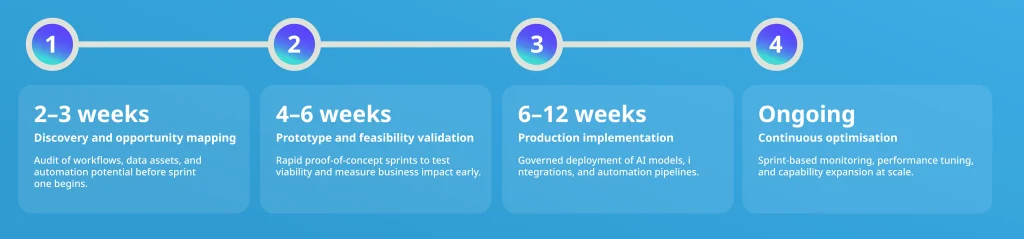
Deployflow Delivery Process From First Sprint to Production Scale
Deployflow works with CTOs and engineering leaders who need AI delivery that holds up under scrutiny.
For teams earlier in the AI journey, AI engineering and automation cover the full build, from model integration to production-ready automation pipelines.
If your current sprint model is generating risk that your reporting cannot see, request a delivery process review, and experts will show you where the gaps are.
If you are weighing whether you need someone to advise on the architecture or own delivery outcomes inside the sprint, the difference between an AI engineering partner and a consultant is worth understanding before that decision is made.
Frequently Asked Questions: Sprint-Based AI Delivery
How many sprints does it take to deliver a production-ready AI feature?
Three to five sprints are a realistic baseline.
The first covers scoping, data audit, and initial iteration. The second and third move through integration, evaluation, and governance review. By sprint four or five, a well-governed team should have a tested rollback path, signed-off completion criteria, and a feature validated under production load conditions.
Teams that target production in a single sprint almost always do so by skipping evaluation steps rather than genuinely compressing the work. That debt surfaces in the next sprint as incidents, rollback events, or governance findings that take longer to resolve than the original shortcut saved.
What is the difference between AI sprint governance and traditional agile governance?
Traditional agile governance confirms that code meets acceptance criteria and behaves predictably under expected conditions. When those boxes are checked, the feature is done.
AI sprint governance operates differently because the output is probabilistic. A model that passes every test in development can degrade under production data distribution, shift behaviour as input patterns change, or meet technical benchmarks while failing against real user expectations. Traditional governance has no mechanism for any of those failure modes. AI sprint governance adds data provenance, model evaluation benchmarks, and post-release output monitoring, treating delivery as ongoing.
How do you handle model drift inside a sprint cycle?
By treating it as a tracked delivery event rather than a background concern.
The mechanism is versioned evaluation datasets with defined performance thresholds checked at every sprint boundary. When a model’s pass rate drops below the threshold, it triggers a formal sprint item in the following cycle with a named owner and resolution criteria.
The harder governance question is who owns the decision to act on drift. Defining that ownership at sprint planning, before drift occurs, is the difference between a process that handles drift systematically and one that handles it reactively every time.
What governance documentation does an AI sprint need?
Four artefacts at the sprint boundary: a risk classification for the feature, evaluation results against a versioned dataset, a tested rollback procedure with an execution record, and a completion criteria record agreed at sprint planning.
Beyond those four, requirements scale with risk tier. High-risk features in regulated environments need data lineage records, model card documentation, and observability-based audit trails. The principle that matters is that all governance documentation is produced inside the sprint, not assembled retrospectively for compliance purposes.
Can small engineering teams run a two-loop AI sprint without a dedicated MLOps resource?
Yes, with explicit structural decisions that larger teams can avoid making. The inner and outer loop responsibilities sit with the same engineers, which is workable provided the boundary between them is formally timeboxed and treated as a hard constraint.
The failure mode is prioritisation. Evaluation gets deprioritised under delivery pressure when the same person building the feature is also responsible for evaluating it. Evaluation tasks carry the same sprint priority as feature work; one person is designated the governance owner per sprint, and the completion criteria explicitly include evaluation sign-off so a feature cannot ship without it.
Explore our BLOG
Recent articles

ISO 42001 Explained: Requirements, Certification and What Your Engineering Team Must Build
ISO 42001 is the international standard that demonstrates your organisation governs AI properly, and enterprise...
read full article

Is Claude Down? Anthropic Outage: Protect Your Cloud Infrastructure
Claude went down across every surface on 29 September 2026. From 14:00 to 14:59 UTC,...
read full article

Top 10 Healthtech Companies in 2026: What Their Growth Means for AI and DevOps
Every software change that reaches a hospital has to clear regulatory, legacy system, and clinical...
read full article