


This SOC 2 remediation roadmap takes you from a red compliance dashboard to a clean audit in seven engineering steps, starting with the controls auditors test hardest.
Your compliance platform shows what is failing. Your engineers still have to fix it. Get the order wrong, and controls patched by hand fail mid-audit, in a report your customers will read.
SOC 2 Remediation in 60 Seconds
- Run it as a project: failing tests become an engineering backlog with owners and a deadline.
- Keep scope tight: every extra system adds evidence and audit hours.
- Fix by audit risk: access first, then change management, logging and backups.
- Automate evidence: pipelines, code history and tickets replace screenshots.
- Finish before Type II starts: any lapse during the window stays in the report.
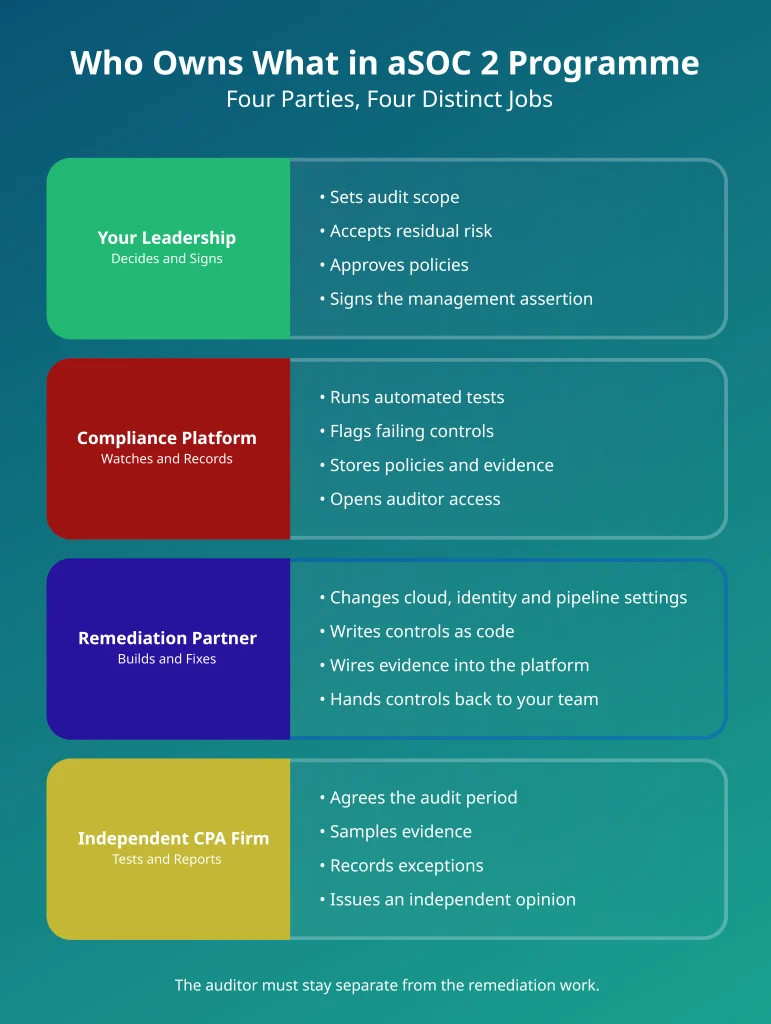
- Know the roles: a partner gets you ready; an independent CPA firm issues the report.
Why Your SOC 2 Dashboard Stays Red After the Platform Goes Live
Vanta, Drata and similar platforms connect to your cloud accounts, HR system and code repositories. They test controls around the clock and track policy sign-offs. Changing your infrastructure is outside their reach.
Each failing test, such as “MFA not enforced”, becomes a ticket for engineers already busy with product work. From there, SOC 2 projects tend to stall in one of three ways:
Paper controls. Policies get approved for controls nobody has built.
Console fixes. Engineers patch settings by hand, the change drifts, and the test fails again weeks later.
Orphaned controls. Security, platform and IT each assume another team owns the fix.
The way out is to manage SOC 2 like any other engineering delivery: one backlog, a named owner per control and a deadline set by the audit date.
Step 1: Run a SOC 2 Gap Assessment Before Fixing Anything
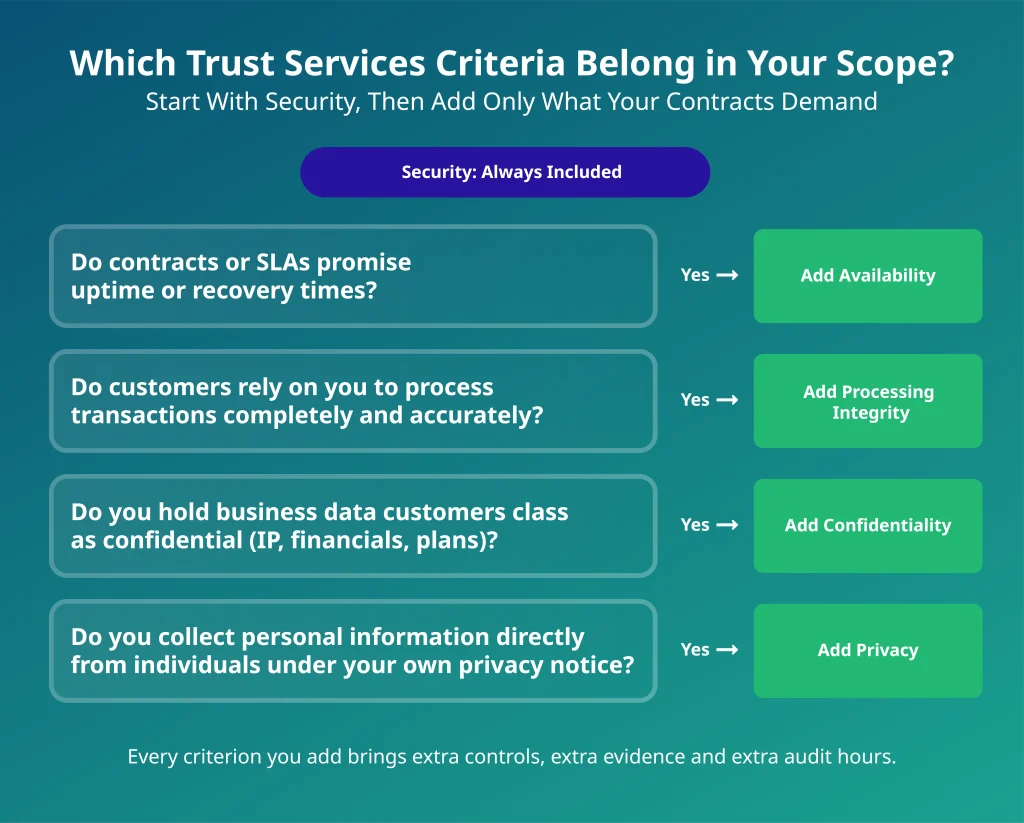
Every SOC 2 report is measured against the AICPA Trust Services Criteria. Security is mandatory. Availability, Processing Integrity, Confidentiality and Privacy are optional.
Scope the Audit Around What Customers Ask For
Your scope sets your workload, so draw the boundary before touching a single control.
Inside the boundary: production cloud accounts, databases, CI/CD tooling, code repositories, your identity provider and support tools holding customer records.
Outside it, if fully separated: sandbox accounts with no customer data or route to production, and internal tools used only by marketing or finance.
Add optional criteria only when customer contracts require them.
Rank Failing Controls by Audit Risk and Engineering Effort
Export the failing tests from your compliance platform and group them by control area. Then score each fix on two questions: how likely is an auditor to flag it, and how much engineering work does it need?
| Low Effort | High Effort | |
| High Audit Risk | Fix this sprint | Start now; it sets your timeline |
| Low Audit Risk | Batch into one clean-up sprint | Challenge the scope or document a compensating control |
The board gets a credible plan with a visible critical path. Engineers get a backlog they can pull straight into sprints.
Step 2: Lock Down Identity and Access First
Access controls touch every system in scope, which makes them the most heavily sampled area of any SOC 2 audit.
Put Every Production Tool Behind SSO and MFA
Route cloud consoles, Git hosting, CI/CD, monitoring and databases through one identity provider, with MFA enforced there. Then remove local accounts and shared credentials. Where a tool cannot support SSO, document a compensating control. NIST SP 800-63B sets a sound baseline for authentication strength.
Auditors will ask for: an identity provider export showing MFA status for every user.
Grant Least Privilege and Keep Proof of Every Review
Swap broad admin roles for role-based groups defined in code. Give production access just in time, with approval and automatic expiry. Review access quarterly, the cadence most teams adopt, and store each sign-off.
Auditors will ask for: completed review records, including the removals you actioned.
Make Offboarding Revoke Access Everywhere at Once
Auditors pick leavers at random and compare their last working day with the moment access ended. Connect your HR system to the identity provider, and one offboarding action revokes access across every tool and logs the timestamp. Give contractors and agency staff an end date in the identity provider too, since they rarely appear in the HR system.
Auditors will ask for: leaver dates matched against deprovisioning logs.
Step 3: Turn Your CI/CD Pipeline Into a Change Management Control
SOC 2 expects every production change to be authorised, tested and approved before release. Most engineering teams already work this way by habit. Auditors need to see it enforced by the system and recorded every time. Deployflow’s CI/CD services build these gates into pipelines you already run.
Enforce Four Gates on Every Production Change
- Protected main branch: no direct pushes, admins included.
- Independent review: at least one approver other than the author.
- Passing tests: merge blocked until the build is green.
- Restricted deploys: only named roles can release to production.
Urgent fixes still need a route. Allow a documented break-glass path, then require approval within an agreed time afterwards.
Let Infrastructure as Code Become Your Change Log
Terraform, OpenTofu and similar tools put infrastructure changes through the same review flow as application code. Each edit to a security group or IAM policy then carries an author, a reviewer and a timestamp. Drift detection flags anything changed by hand in the console before an auditor spots it. To add automated scanning to the same flow, see this guide to adding security checks to your pipeline.
Step 4: Prove You Can Detect and Respond to Incidents
Detection and response controls need proof of two things: incidents get spotted quickly, and every one is handled the same way.
Centralise Audit Logs and Match Retention to Policy
Send cloud audit trails, identity provider logs and application logs to one store with restricted write access. Set retention in configuration so it matches your written policy exactly. Then alert on the events that signal trouble:
| Event | Why It Matters |
| Root or break-glass account use | Bypasses normal access controls |
| Logging disabled or altered | Often the first move in hiding activity |
| Privilege escalation | Grants access beyond an approved role |
| MFA removed from a user | Weakens a control auditors test directly |
Rehearse Incident Response Before the Auditor Asks
A runbook nobody has used is hard to defend. Keep yours short: roles, severity levels, communication steps and escalation paths. Run a tabletop exercise at least once a year, and record the scenario, attendees, gaps found and fixes agreed. That record becomes your evidence. The NCSC incident management guidance offers UK teams a practical structure.
Step 5: Show Auditors Your Backups Actually Restore
A backup policy carries little weight without a successful restore on record. Work through it in three moves:
Protect. Encrypt backups and keep copies in a separate account or region, out of reach of the production credentials an attacker would target first.
Define. Document recovery point and recovery time objectives for each in-scope system.
Prove. Schedule restore tests, time each one against those objectives and keep the results.
If Availability is in scope, add capacity monitoring and a tested continuity plan. NIST SP 800-34 is a useful reference for both.
Step 6: Stop Taking Screenshots and Automate SOC 2 Evidence
Screenshots go stale, miss timestamps and eat engineering hours in the weeks before an audit. The systems you already run hold stronger evidence:
- Change approval → pull request history
- Tested releases → pipeline run logs
- Infrastructure changes → IaC commit history
- Access requests and incidents → ticketing records
Connect these sources to your compliance platform where integrations exist, and schedule exports where they do not. Compliance as Code goes a step further: each control becomes a policy that runs on every deployment and logs its own result. The measure of success is simple. Any sample an auditor requests takes minutes to produce.
Step 7: Time Your Type I Report and Type II Window Correctly
SOC 2 Type I vs Type II: Which Report Will Your Customers Accept?
A Type I report checks that controls are suitably designed on a single date. A Type II report tests that they operated effectively over a period, typically three to twelve months.
Choose Type I if a deal needs evidence within weeks and your controls are newly built.
Choose Type II if enterprise buyers are asking, since it shows controls working over time. A shorter first window gets the report into their hands sooner.
What Auditors Sample During the Observation Window
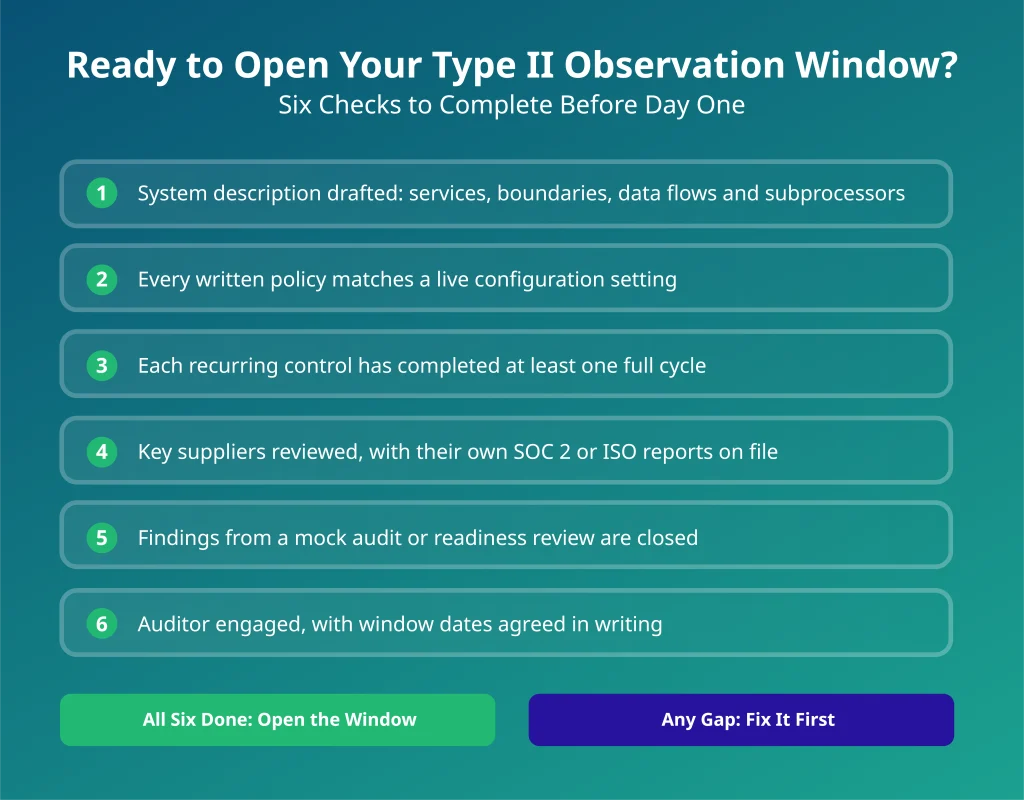
Auditors draw samples from across the whole period: joiners, leavers, production changes, access reviews, incidents and restore tests. One missed review or unapproved change becomes an exception, printed in the report your customers read. Finish remediation before day one.
Your SOC 2 Remediation Plan at a Glance
Use this as a tracker: each phase has one accountable owner and a clear finish line.
| Phase | Owner | Done When |
| Gap Assessment and Scoping | CTO, Security Lead | Scope is signed off and every failing control has an owner and priority |
| Identity and Access | Platform, IT | Every production tool uses SSO and MFA or has a documented compensating control |
| Change Management | Engineering Leads | No path to production skips review and tests |
| Logging and Incident Response | Platform, Security | High-risk alerts reach on-call and a tabletop exercise is on record |
| Backup and Recovery | Platform | A timed restore meets your stated recovery objectives |
| Evidence Automation | Platform, Compliance Owner | Recurring controls produce evidence with no manual screenshots |
| Audit Readiness | CTO, Compliance Owner | The readiness review closes with no open findings |
Get SOC 2 Audit-Ready in Three to Four Months
Deployflow engineers work alongside your compliance platform and your auditor, turning failing tests into working controls across cloud accounts, pipelines and identity systems. The fixed rate means cost and finish date are agreed before work begins.
A readiness assessment gives you:
- A scoped control backlog, ranked by audit risk and effort
- A realistic date to open your observation window
- A fixed quote for the remediation work
Book a SOC 2 Readiness Assessment to turn a red dashboard into a dated, fixed-price plan you can share with your board and your buyers.
SOC 2 Remediation Frequently Asked Questions
Is SOC 2 a certification?
SOC 2 is an attestation report. An independent CPA firm examines your controls and issues a formal opinion in accordance with AICPA standards. There is no certificate, no central register and no pass mark.
The report describes your system, lists the controls tested and records any exceptions found. This distinction matters in sales conversations. When a prospect asks whether you are “SOC 2 certified”, the accurate answer is that you hold a SOC 2 Type I or Type II report. Most companies share it under a non-disclosure agreement. Avoid the word “certified” on your website, because auditors and experienced buyers will notice.
Do UK companies need SOC 2 or ISO 27001?
It depends on where your customers are. ISO 27001 is the international standard most UK and European buyers recognise, and it leads to a formal certificate. SOC 2 is a US framework that North American customers and many global SaaS buyers request.
UK firms selling into both markets often need both. Fortunately, the two overlap heavily. Access control, change management, logging, incident response and supplier management appear in each. Engineering work done for one therefore supports the other. Plan them together and map each control once. This guide explains why ISO 27001 matters for DevOps teams.
How much does a SOC 2 audit cost?
Total cost comes from three areas: auditor fees, compliance tooling and the engineering time needed to reach readiness. Auditor fees rise with scope, the number of criteria and the length of the observation window.
Type II costs more than Type I, because the auditor tests controls across a period. Engineering time is the easiest cost to underestimate. Remediation pulls senior engineers away from product work for weeks or months. Ask auditors to quote against a defined scope. Get a remediation estimate before you commit to an audit date. A fixed-rate engagement removes the open-ended risk from that third cost.
How long is a SOC 2 report valid?
A SOC 2 report has no formal expiry date. In practice, customers treat a report as current for about twelve months after its period ends.
Many organisations therefore run a Type II audit every year. Each new observation window usually starts where the last one finished, so controls never pause. Customers may ask for assurance in the gap before your next report arrives. Your management can then issue a bridge letter. This letter confirms that no material changes to your controls have occurred since the last period ended. It carries less weight than the report itself, so keep the gap short.
What is the difference between SOC 1, SOC 2 and SOC 3?
SOC 1 covers controls relevant to your customers’ financial reporting. It suits payroll, billing and payment processors.
SOC 2 covers security, plus optional availability, processing integrity, confidentiality and privacy. It is the standard choice for SaaS, cloud and technology providers.
SOC 3 draws on the same examination as SOC 2. It is a short, general-use summary without the detailed control testing. You can publish a SOC 3 on your website, whereas you typically share a SOC 2 under an NDA.
Most technology companies’ buyers request SOC 2 Type II, and SOC 3 serves as a useful public addition.
Explore our BLOG
Recent articles

Is Claude Down? Anthropic Outage: Protect Your Cloud Infrastructure
Claude went down across every surface on 29 September 2026. From 14:00 to 14:59 UTC,...
read full article
The SOC 2 Remediation Roadmap: From Compliance Dashboard to Passed Audit
This SOC 2 remediation roadmap takes you from a red compliance dashboard to a clean...
read full article
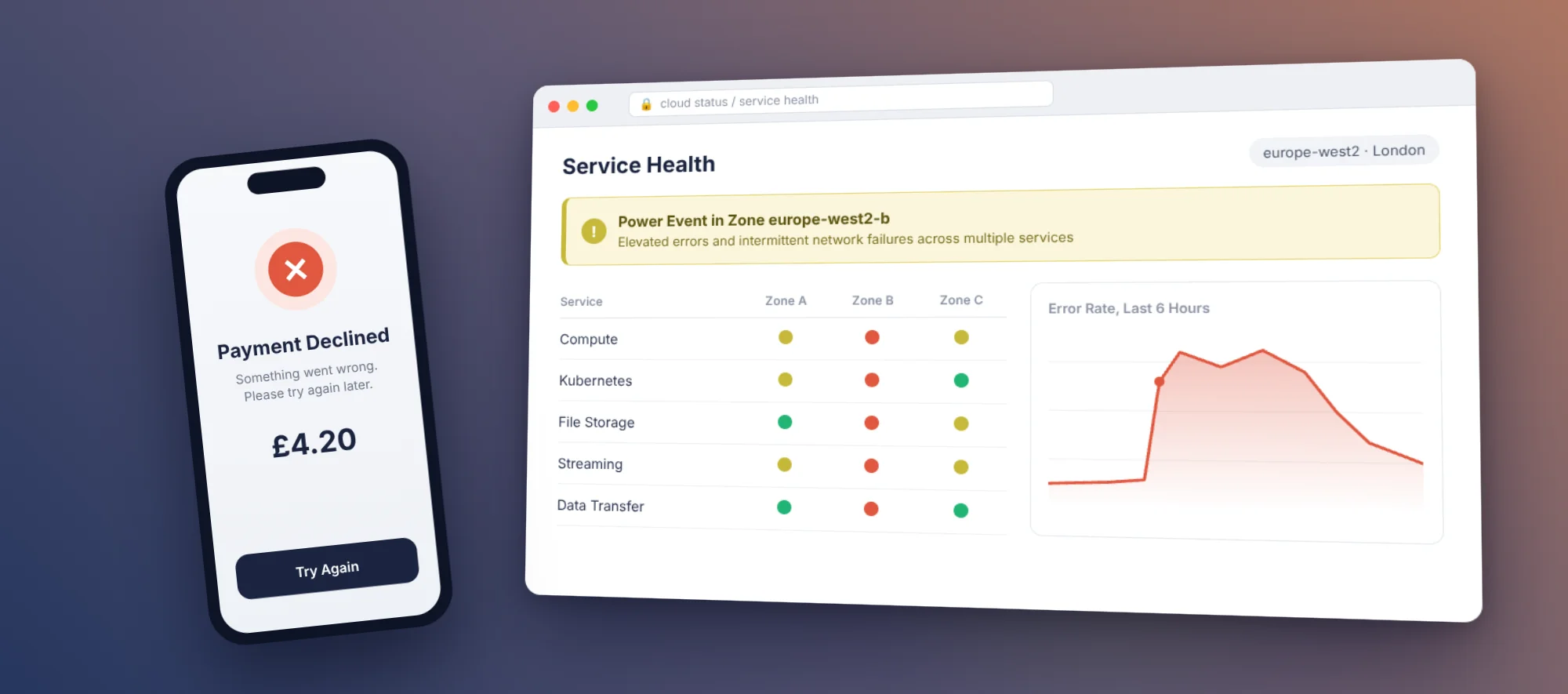
Is Google Cloud Down? The GCP Outage That Froze Revolut Cards and What CTOs Should Fix Now
Yes, Google Cloud went down in London. A major Google Cloud outage hit the europe-west2...
read full article