


Executive summary:
ISO 27001 is a crucial international standard for information security management that enhances data protection and helps organisations gain a competitive edge. In this blog, we highlight the key reasons why DevOps teams need to be ISO 27001 certified. Deployflow, a UK-based cloud consultancy, has successfully achieved this certification, reinforcing its commitment to top security standards and positioning itself to attract clients seeking certified solutions while delivering innovative services globally.
ISO 27001 is an international standard for information security management which includes the best practices and controls for ensuring CIA Triad (Confidentiality, Integrity and Availability) of sensitive information. Earning ISO 27001 certification is critical in enhancing information security and protecting sensitive data.
To achieve ISO 27001, organisations should partner with a dedicated consultant, ISO 27001-certified auditor, who can help them set up tools and processes and make sure that the company is prepared for any potential security assessments.
In this blog, we will dive deeper into the benefits of earning ISO 27001 certification and the reasons why DevOps teams must obtain this certification.
What is ISO 27001?
ISO 27001 is a globally recognised security framework that evaluates how a certain organisation information security management system (ISMS) secures and protects its data. It is the world’s most used standard for ISMS requirements providing guidance on how companies can develop, implement, maintain, and improve their ISMS.
It involves technology, regulating processes, and workflows teams use across the globe. The biggest benefit of ISO 27001 certified companies is that they can gain a competitive advantage much more quickly and easily.
What does it mean to be ISO 27001 certified?
In February 2024, 47% of publicly reported incidents in Europe were linked to the supply chain, while January saw a slightly lower figure of 26%. These statistics highlight a serious risk from third-party threats. Achieving ISO 27001 certification provides robust assurance that your organisation is less likely to be part of these concerning trends.
With cybersecurity always evolving, it is imperative for both companies that are in a regulated industry and the ones that are not, to obtain ISO 27001 certification to be able to protect their sensitive proprietary and customer data. This certification provides companies with a piece of mind by protecting them from any potential data theft and even lawsuits.
How to get ISO 27001 certification?
While obtaining ISO 27001 may seem like a complex process, this can be achieved in a few steps:
- Do your research and prepare thoroughly – Become familiar with all of the requirements for obtaining ISO 27001 certification by reading through their guidelines. This will help you identify the potential gaps.
- Set your objectives – Take into account your company’s ISMS and then set your objectives.
- Create a management framework – To meet your previously defined objectives, you need to build a management framework, a set of processes that will allow you to meet those objectives.
- Conduct a risk assessment – ISO 27001 does not include any specific risk assessment methodology but requires you to define and implement the right processes.
- Implement controls to mitigate risks – After defining your risks, you must define ways how you will address them.
- Organise training sessions – If the people who maintain your ISMS lack the proper skills to do the job in the right way, you must help them acquire those skills.
- Review and update the documentation – You must produce all the documents required by ISO 27001.
- Continuously enhance your ISMS – Always keep your objectives in mind and measure your performance against them.
- Conduct an internal audit – Conduct regular internal audits to make sure everything is running smoothly.
- Certification audits – Certification audits are conducted by an independent registrar who validates whether you have implemented ISMS in the right way and if it is aligned with the Standard.
How long does it take to get ISO 27001 certified?
The duration of the ISO 27001 implementation process depends on a few factors: the size and complexity of ISMS and the number of resources that organisations provide during this process.
The process is usually completed in the period between 6 and 12 months. However, if organisations decide to hire a professional agency that will help them conduct the entire process and provide them with the right tools and technologies, the process can be brought down to three months.
Who needs ISO 27001?
ISO 27001 certification aims to demonstrate to your customers and prospects that security is a key priority for your business.
Although certification isn’t legally mandated, many customers may require it before engaging in business with you. This standard is particularly relevant for organisations that handle or manage customer data, making it especially common among SaaS providers, data storage solutions, data processing, analytics tools, and other data service platforms.
Another thing you need to keep when deciding whether you need ISO 27001 or not is your customers’ location. For instance, SOC2 is a standard used primarily for North America, while ISO 27001 is used globally.
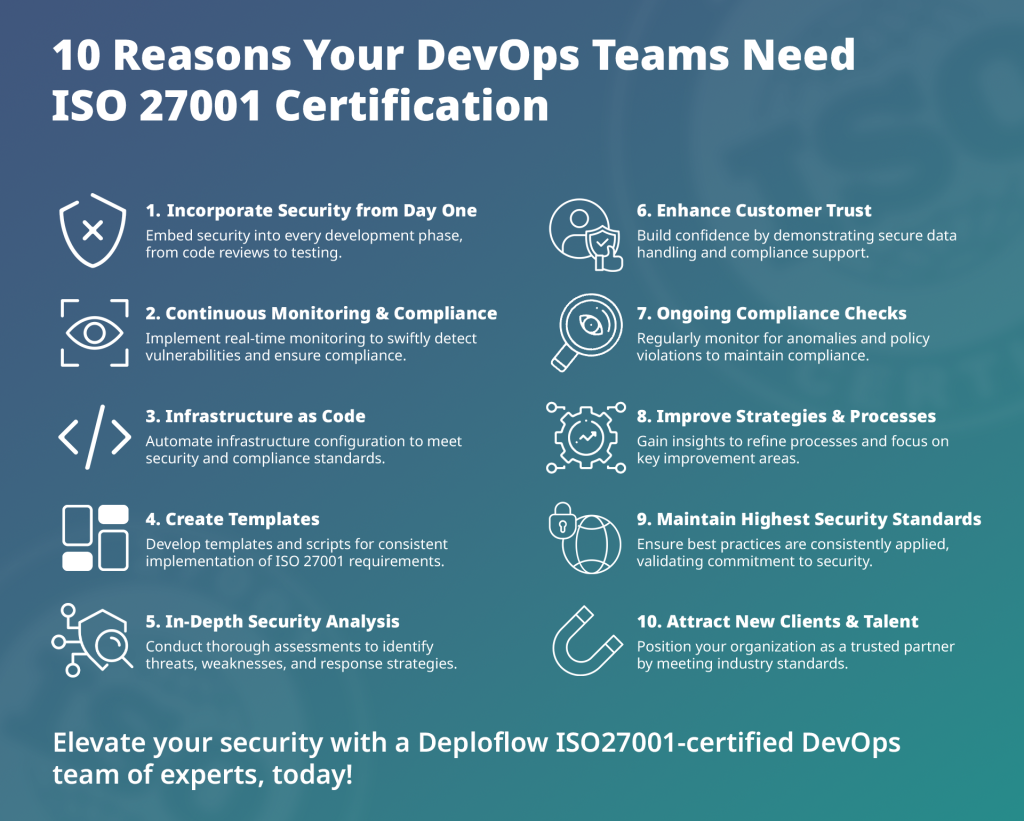
10 Reasons Why Your DevOps Teams Need to Be ISO 27001 Certified
An ISO 27001-certified DevOps services company plays a key role in helping companies, from startups to enterprises, meet security standards and avoid breaches. Here are 10 reasons why DevOps teams need ISO 27001 Certificate:
- Incorporate security from day one: ISO 27001-certified DevOps teams can integrate security considerations in the development and deployment from the start, including stages like code reviews security testing at different stages and static and dynamic code analysis.
- Conduct continuous monitoring and compliance checks: Constant monitoring and alert systems can be incorporated to detect vulnerabilities in real time and then act quickly to ensure that companies meet ISO 27001 requirements.
- Implement Infrastructure as Code: Use Infrastructure as Code to automate configuration and provisioning of infrastructure which plays a major role in building systems that comply with compliance and security requirements.
- Create templates: ISO 27001 certification allows DevOps teams to create templates and scripts that meet and enforce ISO 27001 requirements such as data encryption and access controls.
- Conduct a deep analysis of the company’s security status: ISO 27001 certification allows DevOps teams to do an un-depth analysis of companies’ security status and provide an unbiased assessment of their security. This includes a deep analysis of a few critical elements including companies’ threats and weaknesses, how they plan to react to emergencies, and what kind of training they provide to their employees to ensure that everyone is well-equipped with the right knowledge and skills to stop cyberattacks.
- Provide customers with higher levels of trust: ISO 27001 is the foundation that allows companies to securely handle data stored in their systems. By providing companies with continuous support in achieving and maintaining ISO 27001 compliance, DevOps teams help enhance trust with customers, providing them with peace of mind that they give up their personal information without fear that they will be attacked by malicious attackers.
- Perform ongoing compliance checks: the certification helps DevOps teams conduct compliance checks continuously, allowing them to detect any anomalies, discrepancies, and policy violations on time.
- Improve strategies and processes: ISO 27001 makes it easier for DevOps teams to evaluate companies’ processes and strategies allowing them to gain insight into the key areas companies should focus on in future.
- Help companies maintain the highest security standards: Achieving ISO 27001 certification enables DevOps teams to ensure that the best practices and robust policies are always implemented. This serves as a validation to partners and clients that the team’s main focus is maintaining the excellence and highest security standards.
- Attract new customers and employees: The ISO 27001 certification process helps attract new clients and employees by ensuring IT systems meet industry standards. It demonstrates the team’s commitment to confidentiality, integrity, and availability for clients.
Deployflow achieves ISO 27001 certification, reinforcing commitment to top security standards
Deployflow, a UK-based cloud consultancy specialising in cloud, DevOps, managed support, and Gen AI services, has achieved ISO/IEC 27001 certification, validating its commitment to the highest security standards.
Announced on September 24, 2024, this certification, recognised globally for information security management systems, highlights Deployflow’s dedication to continuous improvement and excellence in client service.
The rigorous evaluation ensured adherence to best practices for managing risks to information assets, emphasising data protection in today’s complex threat landscape. The team from PCG has helped Deployflow tremendously in achieving this milestone by contributing to auditing efforts.
As Deployflow looks to the future, it aims to leverage this achievement to further innovate and provide high-quality solutions worldwide.
Keep the highest levels of security with Deployflow
This milestone not only positions Deployflow to attract clients seeking ISO-certified solutions but also enhances trust in its services, assuring clients of robust data security and operational excellence. As
Deployflow looks to the future, it aims to leverage this achievement to further innovate and provide high-quality solutions worldwide. Contact our team of DevOps and security experts and explore our DevOps services to learn how we can help you infuse cybersecurity into your ecosystem to protect value, help prevent threats, and build trust as you grow.
Explore our BLOG
Recent articles
ISO 42001 Explained: Requirements, Certification and What Your Engineering Team Must Build
ISO 42001 is the international standard that demonstrates your organisation governs AI properly, and enterprise...
read full article

Is Claude Down? Anthropic Outage: Protect Your Cloud Infrastructure
Claude went down across every surface on 29 September 2026. From 14:00 to 14:59 UTC,...
read full article

Top 10 Healthtech Companies in 2026: What Their Growth Means for AI and DevOps
Every software change that reaches a hospital has to clear regulatory, legacy system, and clinical...
read full article