


A single bad API call can cost a bank its license.
That’s the brutal reality of PSD2 and UK Open Banking, where compliance is survival. Every endpoint must authenticate perfectly, every transaction must be traceable, and every audit trail must exist before regulators even ask for it.
In this environment, developers build trust. And that’s why Go has become the quiet powerhouse of modern financial infrastructure.
Golang’s simplicity removes ambiguity. Its concurrency makes high-volume requests predictable. Its security libraries make strong authentication almost effortless.
This isn’t another language trend but an engineering strategy.
In the following sections, you’ll learn:
- How Go structures Open Banking APIs for airtight compliance and transparency.
- How its built-in libraries replace layers of fragile middleware.
- Why teams using Go cut onboarding time and compliance overhead by focusing on clarity, not complexity.
- And how real-world fintechs use Go to balance speed, security, and auditability in one architecture.
When financial regulation meets developer velocity, Go is the middle ground where both finally get what they want.
From PSD2 to UK Open Banking: The API-First Mandate
Regulators replaced the rulebook with code.
When the Revised Payment Services Directive (PSD2) came into force, it forced banks to open their data vaults to third-party providers through secure, standardised APIs.
The UK’s Open Banking framework pushed this further, turning what was once proprietary banking logic into publicly consumable endpoints.
The intent was noble: create a transparent, competitive financial ecosystem. The execution was brutal for developers.
To comply, teams must build APIs that can:
- Authenticate users and third parties with strong customer authentication (SCA).
- Encrypt data in transit and at rest.
- Log every transaction in a way auditors can trace months later.
It’s not enough for APIs to “work.” They must prove they’re working consistently, securely, and in line with shifting regulatory updates.
And this is where many teams hit their wall:
- Fragmented standards between the EU and UK leave developers guessing which schema to follow.
- Frequent API version updates break integrations faster than they can be patched.
- Security layers often pile up so high that they suffocate performance.
In Open Banking, agility is as important as encryption. And that balance between compliance and velocity is precisely where Go earns its place.
Go emerged as the language that turns these compliance headaches into clear, testable architecture.
Why Golang Became the Go-To Language for Financial APIs
Speed used to be optional in banking software until Open Banking made it a survival skill.
When hundreds of third-party apps hit your endpoints daily, languages that rely on heavy frameworks simply can’t keep up. Go was built for exactly this kind of pressure: fast-moving data, strict security, and zero margin for error.
At its core, Go is engineered for concurrency. Its goroutines and channels let developers handle thousands of API calls in parallel without the memory bloat that kills performance in traditional runtimes.
Go consistently ranks among the fastest backend languages in independent performance benchmarks, making it ideal for latency-sensitive financial systems.
A Go-based payment gateway can authenticate users, log requests, and forward data to multiple partners (all within milliseconds) because it treats every transaction like a lightweight task, not a bottleneck.
Security isn’t an afterthought either.
Go’s standard library ships with production-ready cryptography, including TLS 1.3, secure hashing, and strong typing that stops unsafe operations before they ever reach deployment.
Unlike interpreted languages, where validation depends on developer diligence, Go enforces integrity at compile time; mistakes simply don’t compile.
That discipline extends beyond code execution.
Go’s clean syntax and explicit error handling make codebases readable across teams, reducing onboarding time for multi-vendor projects that dominate modern fintech ecosystems.
A new developer can scan a Go repository and understand business logic in hours, no nested abstractions or framework spaghetti.
And because Go compiles to a single binary, deploying secure microservices or API gateways is frictionless. You build once, ship anywhere, and know exactly what’s running in production, no hidden dependencies or surprise version mismatches.
For financial APIs that live and die by reliability, Go is the architectural foundation for performance, compliance, and peace of mind.
For a deeper look at how specialised Go squads speed up regulated development cycles, see Deployflow’s take on sprint-based Golang teams built for compliance and delivery speed.

Developers new to Go can explore how these concepts work in practice through Go’s official web service tutorial using Gin, which demonstrates how to build and secure REST APIs from the ground up.
Secure by Design: How Go Simplifies Compliance
In Open Banking, compliance isn’t a form you fill out. Compliance is something your code has to prove with every request.
Every handshake, token, and transaction is a live test of security. A single misconfigured endpoint or expired certificate can expose personal data and trigger PSD2 violations before anyone even notices.
That’s why Go doesn’t just support secure development. Go enforces it. Its standard library includes battle-tested encryption, authentication, and auditing features that map directly to regulatory requirements under PSD2 and UK Open Banking.
The following examples show how Go turns legal obligations like “Strong Customer Authentication” or “Data Encryption in Transit” into working, auditable code, without extra dependencies or fragile middleware.
TLS 1.3 and Mutual TLS (mTLS): Security from the First Handshake
When two financial systems talk, trust starts at the socket. Go’s built-in crypto/tls package makes it simple to configure TLS 1.3 with mutual authentication, meaning both the API provider (ASPSP) and the third-party provider (TPP) validate each other before any data moves.
If you’re not a developer, think of this as a real-time security handshake. Go validates every connection before it even starts the conversation.
srv := &http.Server{
Addr: “:8443”,
TLSConfig: &tls.Config{
MinVersion: tls.VersionTLS13,
ClientAuth: tls.RequireAndVerifyClientCert,
CurvePreferences: []tls.CurveID{tls.X25519, tls.CurveP256},
VerifyPeerCertificate: func(rawCerts [][]byte, chains [][]*x509.Certificate) error {
cert, _ := x509.ParseCertificate(rawCerts[0])
// Example: validate QWAC or PSD2 role identifiers
return verifyPSD2Cert(cert)
},
},
ReadHeaderTimeout: 3 * time.Second,
}
log.Fatal(srv.ListenAndServeTLS(“bank.crt”, “bank.key”))
Go’s native crypto/tls package enables production-grade TLS 1.3 encryption straight out of the box, while OAuth2 token validation, defined in the IETF’s official standard, integrates seamlessly with Go’s security flow.
PSD2 mandates Strong Customer Authentication (SCA) and secure client identification. With mTLS, your Go API can verify that every third-party app holds a valid, regulator-approved certificate before it even reads a request.
OAuth2 Introspection: Verifying Access, Not Assuming It
Once the connection is secure, the next challenge is access control. Go’s “golang.org/x/oauth2” package makes token validation and introspection reliable and fast. Instead of trusting an access token blindly, your API can confirm its validity in real time.
ctx, cancel := context.WithTimeout(context.Background(), 800*time.Millisecond)
defer cancel()
req, _ := http.NewRequestWithContext(ctx, “POST”, introspectURL,
strings.NewReader(url.Values{“token”: {accessToken}}.Encode()))
req.SetBasicAuth(clientID, clientSecret)
req.Header.Set(“Content-Type”, “application/x-www-form-urlencoded”)
resp, err := http.DefaultClient.Do(req)
if err != nil { http.Error(w, “Auth server unavailable”, 503); return }
defer resp.Body.Close()
var result struct {
Active bool `json:”active”`
Scope string `json:”scope”`
Exp int64 `json:”exp”`
}
json.NewDecoder(resp.Body).Decode(&result)
if !result.Active || time.Now().Unix() > result.Exp {
http.Error(w, “Unauthorized”, 401); return
}
PSD2 requires banks to ensure that tokens are current and limited to approved scopes. This snippet prevents expired or tampered tokens from sneaking through, even under heavy traffic.
JWT Validation: Making Strong Authentication Effortless
Many Open Banking APIs rely on JWT (JSON Web Token) for representing claims securely. Go’s “github.com/golang-jwt/jwt” package offers everything you need to verify signatures, validate claims, and reject forged tokens before they reach your business logic.
token, err := jwt.Parse(tokenString, func(t *jwt.Token) (interface{}, error) {
return []byte(os.Getenv(“JWT_SECRET”)), nil
})
if err != nil || !token.Valid {
http.Error(w, “Unauthorised”, http.StatusUnauthorized)
return
}
claims := token.Claims.(jwt.MapClaims)
if !claims.VerifyExpiresAt(time.Now(), true) {
http.Error(w, “Token expired”, http.StatusUnauthorized)
return
}
With Go’s JWT library, you can enforce issuer validation, algorithm pinning, and expiry checks natively. That directly aligns with SCA requirements, ensuring every API request is both authenticated and time-bound.
Strong Customer Authentication (SCA) Flows in Go
Under PSD2, payment initiation requires multi-factor authentication. Go’s concurrency model makes it easy to manage these workflows, from issuing a challenge to confirming authorisation asynchronously.
// Step 1: Create an SCA challenge
challengeID := newChallenge(consentID, psuID, amount, “SCA_REQUIRED”)
storeChallenge(challengeID, time.Now().Add(2*time.Minute))
// Step 2: Verify the challenge result
func scaCallback(w http.ResponseWriter, r *http.Request) {
id := r.URL.Query().Get(“challenge_id”)
if ok := verifyChallenge(id, r.FormValue(“auth_result”)); !ok {
http.Error(w, “SCA failed”, 401)
return
}
markConsentAuthorised(consentID)
w.WriteHeader(http.StatusNoContent)
}
These asynchronous flows keep transactions responsive while fulfilling PSD2’s requirement for dynamic linking, binding each payment to the customer, the amount, and the recipient in a verifiable way.
Audit Logging Without Exposing Data
Auditors want evidence, not exposure. Go’s structured logging libraries like “zerolog” allow detailed, non-PII event trails that satisfy audit requirements without leaking sensitive information.
logger := zerolog.New(os.Stdout).With().Timestamp().Logger()
logger.Info().
Str(“txn_id”, txnID).
Str(“scope”, scope).
Str(“endpoint”, r.URL.Path).
Msg(“API call logged securely”)
Each of these features turns legal obligations like SCA and encryption into executable, auditable logic.
Open Banking demands traceability for every API call, but personal data must never appear in logs. Go’s type safety ensures you log what you mean to, and nothing you shouldn’t.
Compliance by Default
Go doesn’t need extra security layers or proprietary SDKs to pass an audit. Encryption, authentication, concurrency, and traceability are baked into the language itself.
That means fewer moving parts, fewer attack surfaces, and fewer late-night compliance failures. Developers can focus on business logic while regulators get exactly what they want: transparent, provable, secure-by-design architecture.
For developers looking to strengthen their setup, the Go security overview covers best practices for secure coding, vulnerability management, and dependency hygiene.
Streamlined Integration: Fast Onboarding and Version Control
In Open Banking, new partners don’t wait months; they expect your API to work.
But when every integration depends on its own custom version, even a small update can trigger a domino of failed requests. Developers spend more time fixing backward compatibility than building new features, and innovation slows to a crawl.
Go simplifies this chaos through modular design and explicit versioning.
Each version of your API can live as an isolated package, cleanly separated from others. No hidden dependencies or half-updated routes, just predictable behaviour across every release.
Here’s what clean version control looks like in Go:
mux := http.NewServeMux()
mux.Handle(“/v1/accounts”, v1.AccountHandler())
mux.Handle(“/v2/payments”, v2.PaymentHandler())
This modular approach follows Microsoft’s REST API versioning guidelines, helping teams evolve endpoints without breaking integrations.
Each version runs independently, yet shares the same core logic where needed. When regulations evolve (say, a PSD2 update adds new fields or changes consent flows), you don’t have to rewrite everything. You just introduce “/v3/” and move forward while “/v2/” continues to serve existing partners without disruption.
Banks and fintechs using Go report faster partner onboarding, simpler regression testing, and shorter iteration cycles when standards change.
Instead of chasing errors from outdated endpoints, teams can roll out updates in days, knowing exactly what will break (and what won’t).
Go’s clarity makes documentation easier, too.
Each API version becomes self-explanatory, which means fewer onboarding tickets and less developer confusion, something every Open Banking platform struggles with.
In short, Go’s modular structure makes APIs run better and easier to maintain, evolve, and trust. It replaces brittle integrations with architecture that scales as fast as your partnerships grow.
In contrast, legacy stacks often require full redeployment just to roll out a minor schema update.
Real-World Patterns: Building Compliant Open Banking Gateways
Financial systems fail at their weakest link, and in Open Banking, that’s often the point where one service hands data to another.
A solid gateway architecture keeps those connections secure, traceable, and easy to maintain.
Go’s design philosophy (simplicity, concurrency, and security by default) makes it ideal for building this kind of compliant, high-trust architecture.
Here’s what a typical Open Banking setup looks like in Go and how each layer plays its part.
API Gateway: The High-Trust Entry Point
The gateway is the first layer of defence and the central point of control. It decides who’s allowed in, how often they can call your API, and which version of your services they can reach.
In practice, the gateway performs five essential jobs:
- Encrypt and verify every connection: Using TLS 1.3 for secure data transfer and mutual TLS (mTLS) to ensure both sides (your system and the third-party provider) present valid, regulator-approved certificates (QWAC or QSeal).
- Authenticate and authorise calls: It validates tokens using OAuth2 or JWT, confirming both identity and scope.
- Rate-limit traffic: It prevents overloads and malicious spikes by limiting the number of requests per client.
- Ensure idempotency: It stops accidental duplicates, which is vital when processing payments.
- Validate payloads early: The gateway checks request structures before passing them to any internal service, keeping downstream systems clean and consistent.
Here’s a simple illustration in Go:
mux := http.NewServeMux()
mux.Handle(“/v1/accounts”, chain(v1.Accounts, mTLS, oauth, rateLimit, idempotency))
mux.Handle(“/v2/payments”, chain(v2.Payments, mTLS, oauth, rateLimit, idempotency))
http.ListenAndServeTLS(“:8443”, “server.crt”, “server.key”, mux)
Each endpoint has its own chain of security middleware. That modular setup allows you to patch or upgrade authentication, throttling, or logging without touching the rest of the system — a huge benefit for compliance-driven environments where stability matters as much as speed.
Domain Microservices: Focused, Independent, Replaceable
Behind the gateway sit small, focused Go services. Each one handles a single domain (payments, accounts, or consents) and communicates securely through lightweight APIs.
This structure makes scaling and testing straightforward. When one piece needs updating (say, a new PSD2 field in payment initiation), you can change that service alone without affecting the rest.
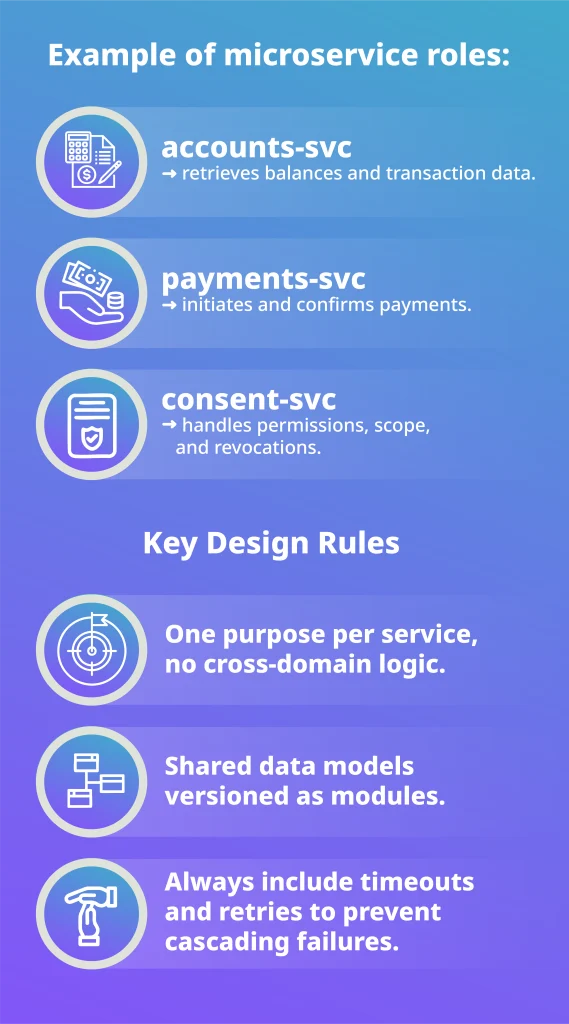
Here’s a simplified Go example with safe network calls:
func callBank(ctx context.Context, req *PaymentReq) (*PaymentResp, error) {
ctx, cancel := context.WithTimeout(ctx, 800*time.Millisecond)
defer cancel()
resp, err := bankClient.Do(ctx, req)
if err != nil { return nil, err }
if resp.StatusCode >= 500 { return nil, fmt.Errorf(“retryable error”) }
return resp, nil
}
Even in this minimal form, you can see Go’s reliability: strict typing, predictable concurrency, and graceful error handling that prevents small network hiccups from escalating into outages.
Secure Data Access: Protect What Moves and What Stays
APIs in Open Banking handle sensitive financial data every second. Go’s libraries make it easy to secure both data in motion and data at rest without external tools.
- Use IP geolocation for security, fraud prevention, regulatory compliance, and for providing localized user experiences.
- Separate reading and writing operations (for example, one service reads statements, another handles payments).
- Use scoped service accounts and temporary credentials, never static secrets.
- Rely on Key Management Systems (KMS) or Hardware Security Modules (HSM) for key rotation and encryption.
- Encrypt payloads and database entries using Go’s “crypto” and x/crypto libraries.
A small setup change (like rotating API secrets automatically) turns a potential compliance risk into a non-issue.
Audit Logging and Monitoring: Evidence Without Exposure
Regulators want to see how your systems work.
Go’s structured logging and observability libraries make it simple to create traceable, non-PII logs that prove compliance without leaking sensitive information.
logger := zerolog.New(os.Stdout).With().Timestamp().Logger()
logger.Info().
Str(“txn_id”, txnID).
Str(“endpoint”, r.URL.Path).
Int(“status”, rw.Status()).
Dur(“latency_ms”, time.Since(start)).
Msg(“API request processed”)
This gives you:
- Complete visibility of what happened and when.
- Logs you can share with auditors or use for incident reconstruction.
- Peace of mind that no private user data ever slips through.
You can also integrate OpenTelemetry to track requests across microservices and visualise performance or compliance metrics in Grafana or Jaeger, a small step that saves hours during audits.
Secure Interaction with Bank APIs
Not all banks follow the same standards, but your platform has to.
Go makes it easy to maintain consistency across different institutions by embedding validation into the communication layer itself.
- Always use mTLS for secure connections to banks’ endpoints.
- Prefer token introspection for opaque tokens and strict JWT checks for signed tokens.
- Enforce dynamic linking, tying each payment to the amount, account, and consent.
A basic check in Go might look like this:
if !linkOK(req.Amount, req.CreditorIBAN, claims[“consent”], claims[“psu”]) {
http.Error(w, “dynamic_linking_failed”, http.StatusBadRequest)
return
}
This prevents tampering or mismatched transactions, a simple line of defence with huge compliance impact.
Faster Partner Onboarding
When your APIs are predictable and well-documented, onboarding new fintech partners becomes quick and repeatable.
Using Go’s modular setup, you can spin up isolated sandbox environments, distribute sample credentials, and automate contract tests for each API version.
Partners can test integrations safely while you maintain full oversight and security, reducing setup times from weeks to days.
Operational Resilience: Expect Failure, Recover Fast
Even perfect code meets imperfect networks.
Go’s lightweight concurrency makes it easy to build safeguards that keep incidents small and contained:
- Rate limits per client stop one partner from overwhelming the system.
- Idempotent writes prevent duplicate payments.
- Circuit breakers and retry logic isolate downstream failures.
- Dead-letter queues capture failed requests for later review.
Instead of firefighting, your team gets predictable degradation and fast recovery.
The Bigger Picture: Compliance by Engineering
Go turns Open Banking compliance into a set of repeatable engineering patterns.
Each layer (gateway, services, data, and logging) contributes to a transparent system that regulators can trust.
Security becomes a built-in property of the platform, not a bolt-on project at the end.
For teams that want this architecture without managing every operational detail, Deployflow’s DevOps managed services provide ready-made pipelines, monitoring, and compliance guardrails, so developers can focus on innovation while the infrastructure stays fast, secure, and audit-ready.
Observability and Error Handling: Meeting Audit and Traceability Demands
Transparency is as important as security.
Every transaction, token check, and consent update must leave a trail that regulators can verify at any time. Every API call, token check, and consent update must leave a verifiable trace that proves the system behaved exactly as intended. Regulators don’t just want security; they want evidence.
Go makes this easy to achieve through transparent logging and clear error handling.
Its built-in tools (log, zap, or zerolog) allow developers to record key events like transaction IDs, endpoints, response times, and statuses in a consistent, machine-readable format.
Here’s an example:
log.Printf(“TransactionID: %s, Status: %s”, txn.ID, txn.Status)
That one line shows what happened, when it happened, and how it ended, exactly what auditors look for.
For teams handling larger traffic volumes, structured loggers like “zerolog” or “zap” make it easy to output clean, machine-readable logs for dashboards and monitoring tools. This means faster troubleshooting, real-time visibility, and effortless traceability across every API call.
Go’s clear error-handling philosophy also helps maintain integrity. Instead of hiding problems, Go requires developers to handle errors explicitly, ensuring failures are logged, visible, and easy to diagnose later.
This level of transparency is what keeps Open Banking systems both compliant and trustworthy. When every transaction can be traced from request to response, audits stop being stressful and become just another part of good engineering.
Future-Proofing Open Banking Integrations with Go
Building Open Banking systems is a bit like constructing a bridge over a river that never stops changing.
Regulations shift, technology evolves, and new fintech startups keep adding waves of complexity. The structure holding it all together needs to be strong, flexible, and built to last, and that’s what Golang provides.
Go’s stability is one of its biggest advantages.
It doesn’t break with every update, and its syntax has barely changed in over a decade, a rare thing in modern programming. That means the APIs you write today won’t suddenly become obsolete tomorrow.
Add a growing, active developer community and regular security patches, and you get a language designed for long-term reliability in highly regulated sectors.
As the Open Banking landscape evolves, a few trends are shaping the next generation of integrations:

Chief among them is fraud detection: as payment APIs open up to more third parties, strong payment fraud prevention becomes essential to catch account takeover, synthetic identities, and suspicious transactions in real time before they clear.
For organisations racing to keep up with changing standards, architecture defines survival.
As initiatives like the EU Data Act push for greater data transparency, Go’s clean concurrency model and predictability make it ideal for scalable, future-proof architectures.
That’s why Deployflow’s sprint-based squads don’t just write Go code; they design ecosystems that evolve on their own.
Each full-stack squad blends developers, DevOps engineers, and compliance specialists who treat every integration as a living system: monitored, secured, and improved with every sprint.
So when regulations shift or a new API protocol appears, there’s no panic or rebuild, just another sprint.
To see how AI is already transforming this process, explore how AI-powered engineering squads accelerate FinTech delivery without breaking compliance.
That’s the power of future-proof engineering: systems that adapt faster than the rules can change.
Go in Open Banking: The Silent Engine Behind Secure APIs
If compliance and innovation were a couple, Go would be the quiet therapist keeping them together.
It takes the tension out of Open Banking, turning endless checklists, security layers, and audit stress into clean, predictable code that just works.
Go bridges the gap between regulators and developers by making security a feature, not a chore.
Its stability gives banks the confidence to build for the long haul, and its simplicity lets teams move fast without breaking rules or production.
Under PSD2 and UK Open Banking, that balance isn’t just helpful; it’s survival.
And while the next wave of regulations is already on the horizon, Go doesn’t panic, overcomplicate, or reinvent itself every six months. It keeps running (fast, safe, and unbothered) while the financial world spins around it.
Because in the end, the most future-proof systems aren’t the loudest or the flashiest.
They’re the ones written in Go, doing their job so well you almost forget how hard it used to be.
How Go and Deployflow Power Compliance-Ready Open Banking Platforms
That quiet precision extends to the teams behind it, like those at Deployflow, where engineering isn’t just coding but collaboration built for regulated speed.
Deployflow works with fintechs and regulated businesses that need more than code. They need engineering partners who can align with their goals, deliver securely, and scale confidently.
As one of Deployflow’s clients put it:
“They were able to give us another vision, another way of doing things. It took only a couple of days for them to understand the whole methodology. And it was amazing, because not many people are able to do that. I can see Deployflow as a long-term technological partner that will bring a lot of innovation.”
Her words capture what most Open Banking teams look for: not just developers, but partners who can understand complexity fast and deliver innovation that lasts.
If you’re ready to build that kind of quiet reliability into your next Open Banking project, explore how Deployflow’s Golang delivery squads embed directly into fintech teams to deliver secure, sprint-based results.
Frequently Asked Questions About Go in Open Banking
Is Go secure enough for Open Banking APIs?
Absolutely. Go was designed with security and simplicity at its core.
Its memory-safe architecture, strong typing, and built-in cryptographic libraries make it ideal for handling sensitive financial data.
Unlike dynamically typed languages that can allow unsafe operations at runtime, Go stops many security issues at compile time. Its native support for TLS 1.3, mutual authentication (mTLS), and token validation with OAuth2 and JWT aligns directly with PSD2 and UK Open Banking standards — ensuring data integrity and trust by design.
How does Go improve performance compared to other backend languages?
Go’s advantage comes from its lightweight concurrency model.
Using goroutines and channels, Go can handle thousands of parallel API calls with minimal resource overhead, perfect for the high-volume transaction loads of Open Banking.
Benchmarks consistently show Go outperforming traditional runtimes in latency, throughput, and memory efficiency, making it a better fit than heavy frameworks when milliseconds matter.
How does Go simplify compliance with PSD2 and Strong Customer Authentication (SCA)?
Go reduces compliance complexity by turning legal requirements into auditable, executable code.
For example, SCA mandates strong encryption and multi-factor authentication — both of which can be implemented natively using Go’s standard libraries.
Developers can combine Go’s crypto/tls for secure communication, oauth2 for token exchange, and structured logging for traceability, meeting regulator demands without excessive middleware or plugins.
This built-in transparency is why Go is gaining traction across regulated sectors like fintech, healthtech, and insurance.
Can Go integrate with existing banking systems and APIs?
Yes, easily.
Go’s simplicity and small deployment footprint make it interoperable across modern and legacy systems.
It integrates seamlessly with RESTful and event-driven architectures, supports JSON, XML, and gRPC, and works well with containerised environments like Docker and Kubernetes.
That flexibility lets banks modernise incrementally: they can rebuild one API gateway or microservice in Go without disrupting the entire infrastructure.
What skills or tools are essential for Go developers in regulated industries?
In regulated industries like fintech or healthcare, Go developers need more than coding skills. They need discipline and compliance awareness.
Key proficiencies include:
- Secure coding practices (encryption, token validation, TLS setup)
- API observability (logging, monitoring, audit trails)
- CI/CD and IaC tools (Terraform, GitLab, or Azure DevOps)
- Familiarity with PSD2, GDPR, and Open Banking frameworks
Teams that blend Go expertise with DevOps and compliance knowledge (like Deployflow’s sprint-based squads) can deliver faster, safer, and fully auditable systems with every sprint.
Explore our BLOG
Recent articles

ISO 42001 Explained: Requirements, Certification and What Your Engineering Team Must Build
ISO 42001 is the international standard that demonstrates your organisation governs AI properly, and enterprise...
read full article

Is Claude Down? Anthropic Outage: Protect Your Cloud Infrastructure
Claude went down across every surface on 29 September 2026. From 14:00 to 14:59 UTC,...
read full article

Top 10 Healthtech Companies in 2026: What Their Growth Means for AI and DevOps
Every software change that reaches a hospital has to clear regulatory, legacy system, and clinical...
read full article