


Making an informed decision between the IT services, from cloud migration to DevOps and fully managed IT support services, you can feel like trying to find your way through a fog. It’s easy to get lost in the maze of technical jargon, pricing models, and service promises, and that’s before you even start thinking about the future!
Take, for instance, a recent meeting we had with a prospective client. We sat down, ready to chat about their needs, but when we asked them what criteria they were using to evaluate their IT managed service provider (MSPs), we were met with a blank stare. “Erm, we haven’t really thought about that,” they admitted.
And it wasn’t just them, many businesses, particularly those new to outsourcing, aren’t sure where to start when selecting an MSP. Many of us in the tech industry have seen this problem repeatedly.
The truth is that choosing an MSP without a structured framework can feel overwhelming. One minute, you think you’ve made a solid decision, and the next, you’re scrambling to fix a service issue that could have been avoided.
In this article, we will guide you through the decision-making process and help you navigate the MSP selection journey—without the headache and the confusion.
The Problem: Uncertainty and Lack of Structure
Selecting the right partner can be a difficult challenge for many SMBs, especially those that haven’t worked with an MSP before. Do you want a sports car with speed (high-end tech solutions), or are you looking for something more reliable and budget-friendly (basic cloud support)?
The problem is that without clear decision-making criteria, many businesses wind up picking something that doesn’t quite fit simply because it seemed like a good idea at the time.
In many cases, businesses know they need an MSP to solve a problem. Perhaps they’re struggling with cloud management or need a reliable IT support system, but they have no idea what exactly to look for.
They may get bogged down in endless meetings with providers, with each one offering a slightly different combination of services and prices.
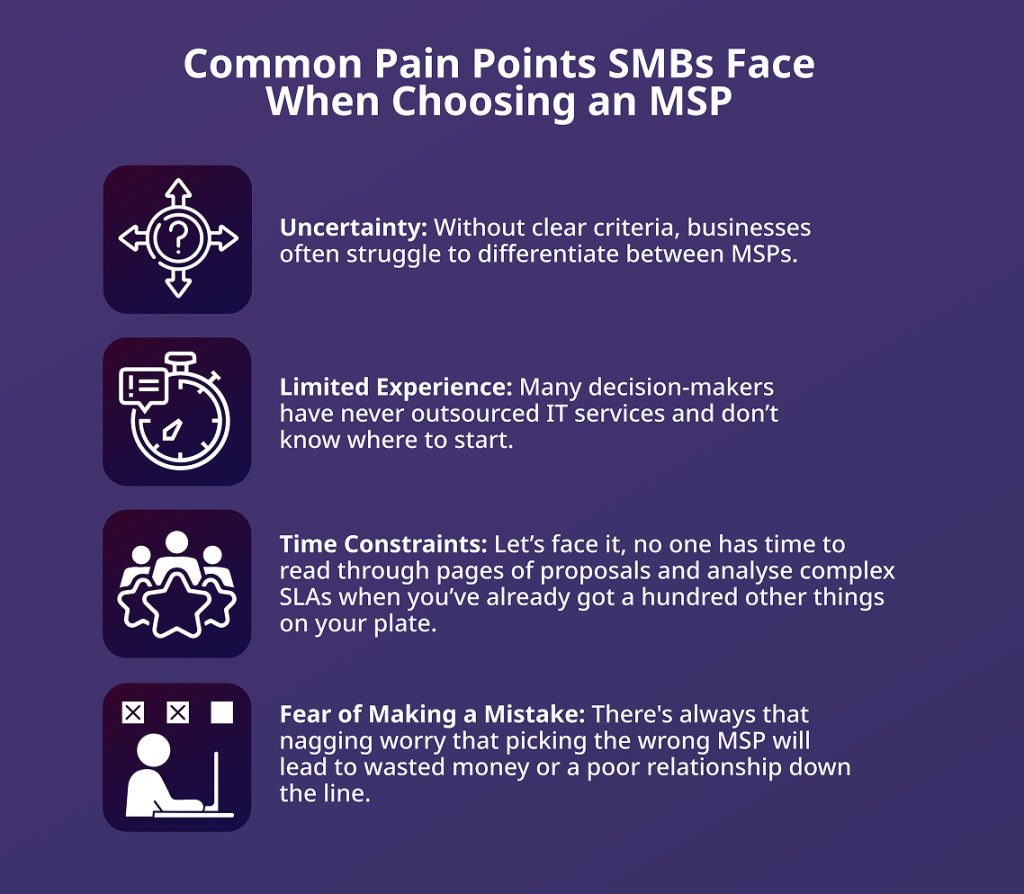
As you’d expect, this often leads to poor decisions, increased costs, and sometimes even more headaches when the chosen MSP doesn’t meet expectations.
The Deployflow Approach: Guiding CTOs and Decision-Makers Through the Buying Process
At Deployflow, we’ve been around long enough to know that picking the right MSP doesn’t need to be a stressful guessing game. In fact, it can be quite a straightforward process if you have a structured framework in place to guide your decision.
We’re not here to push you into signing a contract with us, we’re here to help you clarify your needs so you can make a well-informed decision that works best for your business.
Instead of bombarding you with endless sales pitches, we focus on helping you clarify your own decision-making criteria. This simplifies the process, less stressful, and ultimately far more effective.
Here’s how we guide CTOs and IT decision-makers through the MSP evaluation process:
Step 1: Identify Your Top 3 Criteria
The first step in any successful MSP search is determining your top three criteria. It sounds simple, but this is often where many businesses get stuck.
What’s most important to you? Is it cost efficiency? Technical expertise? Support and responsiveness? Scalability?
We always recommend our clients start by asking themselves these questions. It’s a crucial exercise to get clarity on what matters most. Once you know your top priorities, evaluating potential providers and making decisions accordingly becomes much easier.
Step 2: Create a Comparison Framework
Once you’ve figured out what’s most important to you, the next step is to create a solid framework for comparing different MSPs. When you evaluate providers, make sure you look at the following key factors:
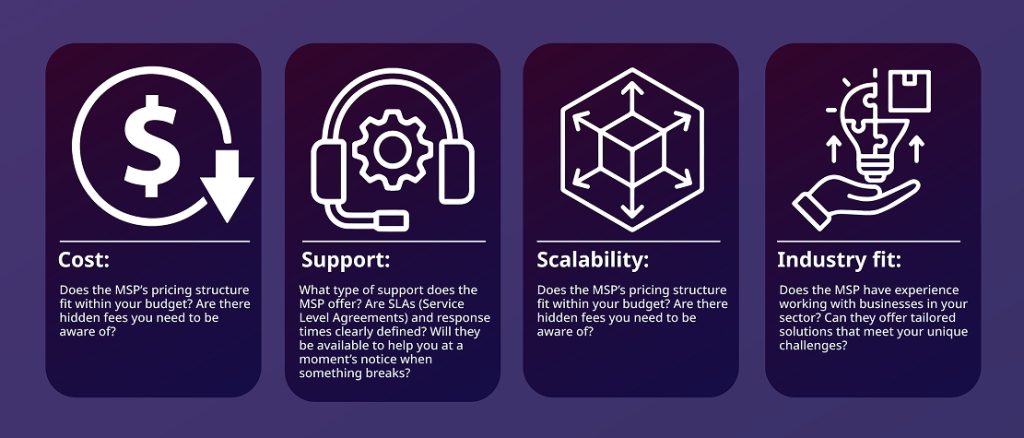
The beauty of this framework is that it helps you compare apples to apples instead of apples to oranges. It removes the ambiguity and ensures that you’re evaluating each MSP against a consistent set of criteria.
Step 3: Understand the Trade-offs
Here’s the thing: no MSP is perfect. One provider may excel in cost efficiency but lack the scalability you need for future growth. Or perhaps another provider offers outstanding support but comes at a premium price. It’s important to understand that there will be trade-offs along the way.
The key is to be realistic about what your business needs right now and what you can afford. It’s all about finding a balance that works for your business so you don’t end up overpaying for services you don’t need or undercutting yourself in the areas that matter most.
Step 4: Ask the Right Questions Before Signing
Before signing any contracts, asking the right questions is essential to ensure you get the expected service. Some of the key questions we recommend asking include:
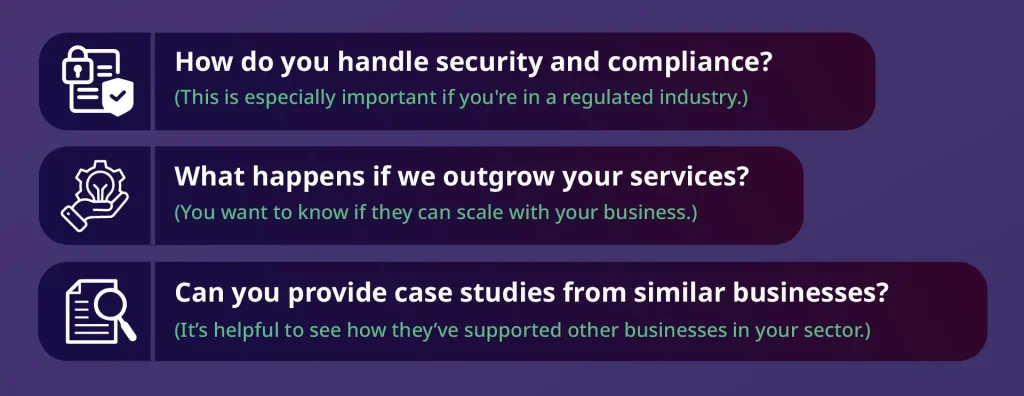
Asking these questions gives you peace of mind and helps establish a strong, transparent relationship with your MSP from the get-go.
How Deployflow Helps SMBs Make Better Decisions
To illustrate this process, let’s consider a few real-world examples of how we’ve helped businesses make better, more informed decisions.
Case Study 1: Positive Impact Concept
Deployflow tea, helped Positive Impact Concept (PI Concept) build a digital platform for assessing winery sustainability. By providing tailored IT support and infrastructure management, Deployflow enabled PI Concept to scale and improve circularity in winery operations.
The structured approach ensured long-term scalability, leading to a strong, ongoing partnership that supported PI Concept’s growth and sustainability product goals.
Case Study 2: HHP
HHP, a sustainable berry farm, had a specific requirement: an MSP with deep sector-specific expertise. Using our framework, they could zero in on providers with experience in their industry, ensuring they got the tailored support they needed. This decision led to improved operational efficiency and a more seamless IT experience.
Case Study 3: Berrymakers
We helped Berrymakers, a family business that sells premium berries, develop a webshop on Shopify, ensuring all technical and marketing aspects were covered. The project evolved from a simple WordPress site into a full-fledged Shopify e-commerce platform.
After following our evaluation framework, they chose an MSP aligned with their needs and budget, resulting in better uptime, enhanced productivity, and a more scalable solution as their business grew.
Why Is This Approach Critical for Your Business’s Success?
Choosing an MSP isn’t just about the technology; it’s about building a long-term partnership that supports your business’s goals. By following a structured evaluation process, you’ll make a more informed decision and ensure that your chosen MSP can deliver the right solutions at the right time.
The goal is not to rush into a decision based on price alone or pick the first MSP you come across. A thoughtful, well-structured process ensures that the MSP you select will meet your current needs and grow with your business in the future.
Making Informed Decisions, Not Sales Pitches
By following a simple, structured approach, you can confidently evaluate your options and make decisions that will benefit your business in the long run.
At Deployflow, we’re here to help guide you through that process, not by pushing our services, but by helping you gain the clarity you need to make an informed, confident decision.
If you’re ready to make your MSP selection journey a little less confusing and a lot more manageable, contact us. We’ll help you identify your priorities, assess your options, and make the decision that works best for you, no strings attached.
Ready to gain some clarity? Explore our IT managed support services to learn how we can simplify your journey to success.
Explore our BLOG
Recent articles

ISO 42001 Explained: Requirements, Certification and What Your Engineering Team Must Build
ISO 42001 is the international standard that demonstrates your organisation governs AI properly, and enterprise...
read full article

Is Claude Down? Anthropic Outage: Protect Your Cloud Infrastructure
Claude went down across every surface on 29 September 2026. From 14:00 to 14:59 UTC,...
read full article

Top 10 Healthtech Companies in 2026: What Their Growth Means for AI and DevOps
Every software change that reaches a hospital has to clear regulatory, legacy system, and clinical...
read full article