



Your Azure bill went up again, your engineers say the infrastructure is fine, and your finance team wants answers by Friday.
When Hall Hunter migrated their legacy on-premises infrastructure to Azure, they faced the same challenges most organisations encounter mid-migration: limited internal DevOps capacity, undocumented infrastructure, and a cost model that was hard to read. Deployflow completed the migration on time, within budget, and delivered a 30% reduction in IT costs.
The internal team now owns and governs the infrastructure independently. Here is how that outcome is achievable and why most organisations are further from it than they should be.
TL;DR for CTOs:
- Azure cost overruns are an ownership problem.
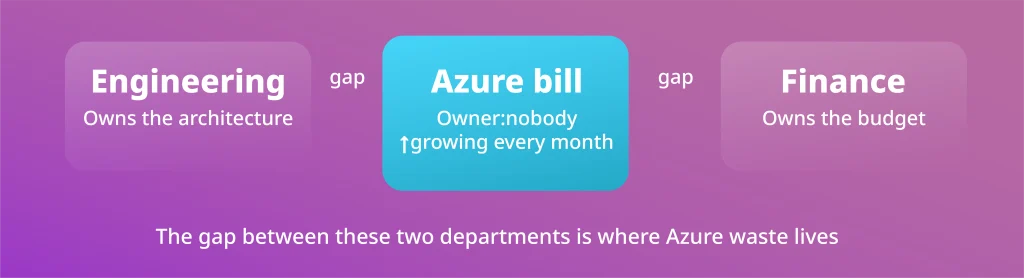
- The org structure that built your infrastructure was never designed to govern what it costs, and no dashboard closes that gap.
- The solution exists, but it starts somewhere most teams are not looking.
Most writeups on Azure overspending hand you a checklist: right-size your VMs, set up alerts, use Reserved Instances. Useful advice. But it sidesteps the harder question: why has none of that happened already?
Engineers know what idle resources cost. Someone chose the wrong storage tier on purpose, because performance felt safer than savings.
Somebody else never reviewed instance sizing after go-live because that was the vendor’s job, and the vendor left.
The spending compounds because the operating model was never built to catch it.
Azure Cost Management Shows You the Problem. It Cannot Fix It.
The first call most CTOs make when the Azure bill becomes uncomfortable is to the Azure Cost Management dashboard. Alerts get configured, budget thresholds get set, and a report gets scheduled to go out every Monday morning.
A month later, the bill is higher.
Azure Cost Management is a visibility tool. It tells you what happened. It does not tell you who is responsible, who has the authority to change it, or who has the time to act before next month’s cycle runs. Alerts land in inboxes that belong to engineers deep in sprint work. Reports get opened, skimmed, and filed away for a conversation that gets pushed to the next quarterly review.
Gartner predicts 25% of organisations will have experienced significant dissatisfaction with their cloud adoption by 2028, due to unrealistic expectations, suboptimal implementation, and uncontrolled costs. For a quarter of enterprises, the problem is already baked in.
The data sits there, accurate and entirely inert.
The organisation already has the numbers. What it is missing is an operating model built around those numbers, someone whose job, on an ongoing basis, is to connect a line item on the Azure invoice to a decision that can change it.
Most companies cannot answer a straightforward question:
Who is responsible for the Azure bill by name, with the authority and the time to act on it?
If that answer is not immediate, the cost problem will continue to compound regardless of which monitoring tools are running.
Deployflow’s Cloud Management is built around named ownership, sprint-based cost reviews, and ongoing governance of your Azure environment, so the bill reflects decisions rather than drift.
6 Budget Leaks Draining Your Azure Spend Right Now
Azure bills grow from six patterns that compound over months, each one enabled by an organisational gap, not a technical one.
1. Idle and Forgotten Resources
Dev and test environments run around the clock because spinning them down requires a decision, and decisions require an owner. The VM provisioned for a project that shipped in October is still running in April. Not because anyone wants it or needs it, but because decommissioning it is nobody’s job. In most engineering organisations, provisioning has a clear process, and deprovisioning does not.
The leadership blind spot: Your team is measured on delivery. There is no metric for what they leave running after they ship.
2. Sized for a Crisis That Never Came
Compute tiers get chosen at the most stressful moment in the project: before launch, under pressure, with every stakeholder watching. Nobody downgrades after go-live. The traffic spike never came, the storage upgrade was never needed, and the instance size that felt responsible six months ago is now just expensive. Right-sizing after the fact requires someone to own the outcome of that decision and revisit it when circumstances change.
The leadership blind spot: Your engineers optimise for reliability and not cost efficiency. Those are different incentives, and you designed them that way.
3. Lift-and-Shift Workloads That Were Never Refactored
Cloud migration projects get declared complete at the moment everything is running in Azure. The optimisation work, the part that actually makes cloud economics work, was always planned for phase two. Phase two never has a deadline. On-premises pricing assumptions stay baked into the architecture indefinitely: databases sized for hardware constraints that no longer exist, workloads running on dedicated compute that could run serverless, storage tiers chosen for a threat model that expired years ago.
75% of cloud migrations go over budget, with more than a quarter of enterprises experiencing cost overruns greater than 20%. (McKinsey & Company) The migration gets declared complete. The overspend does not stop there.
The leadership blind spot: Migration success was measured by uptime, not total cost of ownership. Nobody was accountable for what came next.
4. Egress and Data Transfer Charges Nobody Planned For
These do not appear in architecture diagrams. They do not show up in budget estimates. They surface in the invoice, every month, in a line item that takes real investigation to attribute. Moving data between Azure regions, out of Azure entirely, or between services inside the same environment: each transfer carries a charge. The engineers who designed the data flows were optimising for latency and reliability. Cost was someone else’s column.
The leadership blind spot: Your architecture reviews have acceptance criteria for performance and security. How many include a data transfer cost estimate?
5. No Tagging, No Attribution, No Accountability
If a resource has no tag, it has no owner. If it has no owner, the cost lands in a catch-all bucket that nobody is responsible for. Tagging policies exist in most organisations, but are enforced in none. When finance asks which business unit generated a spike in Azure spend last month, the answer is a week-long investigation rather than a thirty-second query. Cost accountability requires cost visibility at the resource level, which requires tagging discipline from day one, enforced automatically, with consequences when it slips.
The same governance breakdown that drives tagging failures tends to affect IAM, policy enforcement, and billing transparency in equal measure. A comparison of AWS, Azure, and GCP shows exactly where configuration drift turns into measurable financial leakage and how Infrastructure as Code changes the economics.
The leadership blind spot: Tagging feels like an operational detail. It is actually the foundation of every cost conversation you will ever have with your board.
6. Commitments and Reservations Left on the Table
Pay-as-you-go pricing is designed for unpredictable workloads. Most production infrastructure is not unpredictable. Reserved Instances and Savings Plans exist precisely for workloads that run continuously and can reduce compute costs by 30 to 60% on committed spend. The analysis required to purchase them takes a few hours. The reason it has not happened is that nobody has been given the time, the data, and the mandate to sit down and do it.
The leadership blind spot: Every month you stay on pay-as-you-go for stable workloads, you are leaving a meaningful amount of money on the table. Not as a rounding error. As a deliberate organisational choice, even if it was never made deliberately.
3 Structural Reasons Your Azure Costs Keep Compounding
Cost Reviews Run on a Calendar, Azure Charges Run in Real Time
Quarterly reviews cannot catch problems that compound over 12 weeks. By the time numbers surface in a meeting, the damage is done, and the fix is a project. Cloud infrastructure changes daily, and governance cadence needs to match it.
The Engineers Who Built It Have Moved On.
The team that inherited the infrastructure keeps it running. They do not question what it costs because nobody asked them to, and because raising a concern without the authority to act on it generates work with no reward. Decisions cannot be explained. The cost baseline has no owner willing to challenge it.
In Regulated Industries, Caution Hardens Into Permanent Inaction
Engineers who inherit infrastructure they did not build face a straightforward choice: optimise something they do not fully understand and risk a compliance incident, or leave it running and absorb the cost. Most choose the latter. Azure spend accumulates not through recklessness but through rational risk aversion, in an org structure that never transferred knowledge properly.
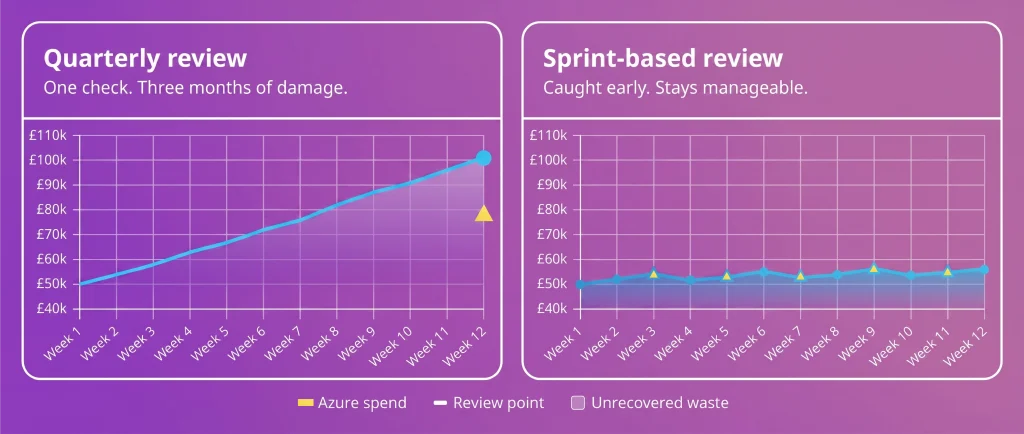
Quarterly cloud cost reviews let Azure spend drift unchecked for three months. Sprint-based reviews catch overruns as they happen, keeping waste from compounding.
What a Cost-Governed Azure Environment Looks Like in Practice
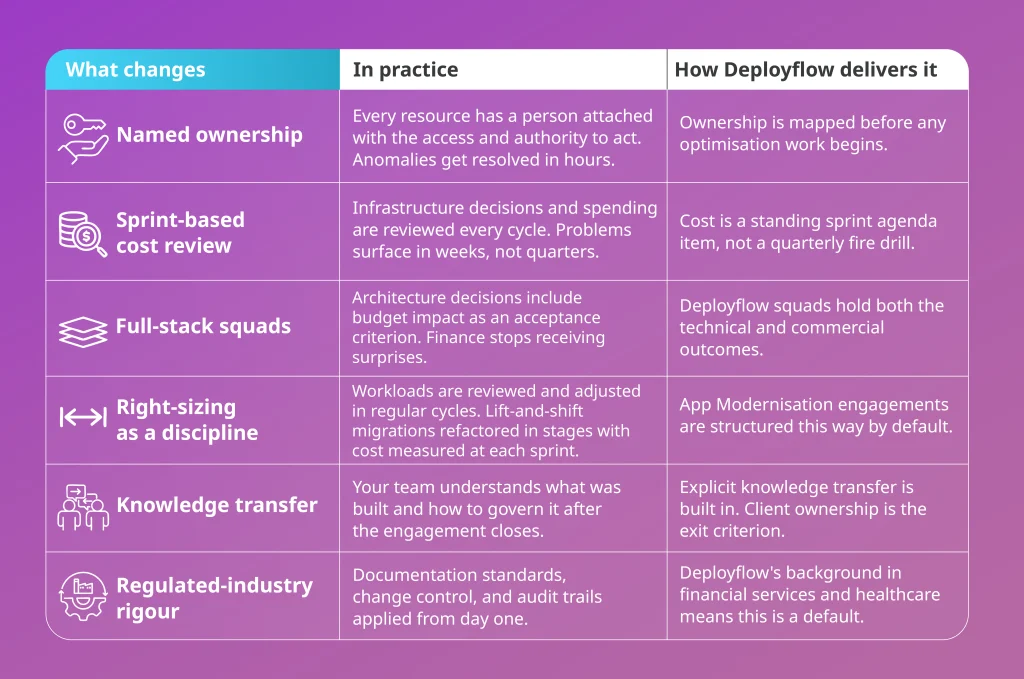
Organisations that get Azure spend under control do not find a better monitoring tool. They change how engineering decisions get made and who is accountable for the consequences.
The CTO’s Azure Governance Audit: 13 Questions to Answer This Week
Ownership:
Who is responsible for the Azure bill by name?
Who has both the authority and the time to act on a cost anomaly this week?
When a resource has no tag, whose job is it to find the owner?
Cadence:
When did your team last review instance sizing across the production environment?
How frequently does cloud spend appear as a standing agenda item in engineering?
If a cost problem started compounding today, how many weeks before someone notices?
Architecture:
Do your dev and test environments shut down automatically outside working hours?
Which workloads are still running on pay-as-you-go that could be on Reserved Instances?
When did you last review data egress and transfer costs across regions and services?
Knowledge:
Can your current engineering team explain every significant infrastructure decision made in the last two years?
If the team that built the architecture left tomorrow, who owns what they built?
Regulated environments:
Are your Azure governance practices sufficient to pass an audit today without preparation?
Does your team have a documented process for reviewing and retiring unused resources each quarter?
If more than a few of those questions exposed a gap, Deployflow’s cloud consulting covers the kind of structured assessment that turns those answers into a clear action plan.
The Organisations That Win on Cloud Are Spending Deliberately
There is a version of your Azure environment where every pound spent is traceable, every decision is revisitable, and cost efficiency is a byproduct of how engineering runs rather than a remediation project that lands on someone’s plate twice a year.
That version does not require a smaller infrastructure footprint or a freeze on new development. It requires the right operating model underneath both. Most organisations are closer to that than they think. The infrastructure is not the obstacle. The gap between the team that builds it and the team that governs it is.
Deployflow works in sprint-based cycles with full-stack teams embedded directly in your workflows. Not as an external vendor you brief once a quarter, but as part of the engineering cadence itself.
For CTOs already managing Azure AI workloads alongside core infrastructure, this problem compounds further. The same governance gaps that inflate cloud costs tend to slow AI delivery. A guide to moving Azure AI Foundry projects from experimentation into production covers the structural reasons why, and what a governed delivery path looks like in practice.
Deployflow’s CloudChecker assessment maps exactly where your Azure spend is going and why, before any engagement begins and before any commitment is made. If the numbers on your invoice stopped making sense, that is the right starting point.
Frequently Asked Questions About Azure Cost Management
Why is my Azure bill increasing for no reason?
Because passive spend compounds without intervention.
Most Azure cost growth comes from existing resources (idle environments, oversized instances, unoptimised storage) accumulating charges nobody is reviewing. The bill rises because the operating model was never built to catch it, not because anything in the architecture changed. Most organisations discover this when they finally do a line-by-line audit and find resources running from projects that closed quarters ago.
Azure Reserved Instances vs Savings Plans: which saves more?
Reserved Instances deliver higher discounts (up to 72%), but commit you to a specific VM size and region.
Savings Plans offer around 65% discount with more flexibility across VM families and regions.
Reserved Instances are best suited for stable, predictable workloads where the instance type is unlikely to change. Savings Plans suit environments with more variation. Both require an upfront analysis of actual usage patterns to purchase correctly, which is why most organisations leave them unused.
How do I forecast Azure cloud costs accurately?
Start by separating predictable workloads from variable ones. Production infrastructure (databases, application servers, scheduled jobs) can be modelled against historical billing data with reasonable confidence. Variable workloads, particularly AI and data processing, are harder because consumption shifts with the business.
The most common forecasting failure is treating the entire estate as a single line item. Without resource-level tagging and cost attribution in place, accurate forecasting is structurally impossible; you are estimating a total without knowing what is driving it.
Can you reduce Azure costs without affecting performance?
In most environments, yes. The majority of waste comes from overprovisioned resources running well below allocated capacity. Right-sizing instances against 30-day utilisation data, shutting down non-production environments outside working hours, removing unattached storage volumes, and moving stable workloads onto Reserved Instances all reduce cost without touching production architecture.
Cases where cost reduction genuinely creates performance risk are rarer than most engineering teams assume, but they exist, which is why changes should be made in sprint cycles with rollback plans rather than all at once.
What is Azure FinOps, and do I need it?
FinOps is a framework that brings financial accountability into cloud operations by connecting the teams that build infrastructure with the teams that pay for it.
In practice, it means a regular cadence for reviewing spend, clear ownership of cost by workload or business unit, and cost efficiency built into engineering decisions rather than treated as a finance problem. If your team cannot attribute the majority of your Azure bill to specific projects or owners, and cost review only happens when finance flags something, the answer is yes. The framework does not require a dedicated team to start. It requires a named person with a mandate, a meeting cadence, and access to the right data.
This is the operational core of cloud management in practice.
Explore our BLOG
Recent articles

ISO 42001 Explained: Requirements, Certification and What Your Engineering Team Must Build
ISO 42001 is the international standard that demonstrates your organisation governs AI properly, and enterprise...
read full article

Is Claude Down? Anthropic Outage: Protect Your Cloud Infrastructure
Claude went down across every surface on 29 September 2026. From 14:00 to 14:59 UTC,...
read full article

Top 10 Healthtech Companies in 2026: What Their Growth Means for AI and DevOps
Every software change that reaches a hospital has to clear regulatory, legacy system, and clinical...
read full article