


Cloud costs don’t spiral because AWS is expensive or Azure is complex. They spiral because governance breaks down. Configuration drift, unmanaged IAM, and inconsistent policy enforcement quietly inflate both risk and spend.
This AWS vs Azure vs Google Cloud security comparison skips branding and feature lists. It measures IAM complexity, policy enforcement consistency, native security tooling depth, audit readiness under UK compliance pressure, cost transparency, and infrastructure drift risk. It also answers the two questions that decide most UK migrations: AWS Config vs Azure Policy, and whether single sign-on survives contact with three platforms.
AWS vs GCP security gets its own section, since that pairing decides more UK small business migrations than the full three-way choice.
TL;DR
- All three providers are secure when configured correctly.
- All three become expensive when governance is weak.
- IAM complexity drives operational risk more than provider choice.
- Nearly every AWS, Azure, and GCP cloud security vulnerability starts with customer misconfiguration and not provider weakness.
- Terraform reduces drift, privilege sprawl, and cost volatility across all platforms.
- Governance maturity determines financial predictability.
This piece shows exactly where AWS, Azure, and Google Cloud Platform (GCP) differ for security-conscious UK teams.
It exposes where hidden cost inflation begins and how Terraform shifts the economics from reactive spending to controlled, predictable infrastructure.
How We Compared AWS, Azure, and GCP
The comparison draws from real-world advisory engagements across UK SMB estates and focuses on the governance factors that most consistently influence security exposure and cost predictability.
Evaluation criteria:
- IAM complexity and its impact on privilege sprawl and breach exposure
- Native security tooling depth and the operational overhead required to manage it
- Policy enforcement consistency across staging, production, and hybrid environments
- Audit evidence readiness for GDPR- and FCA-aligned organisations
- Cost visibility, billing transparency, and hidden security-related OPEX
- Infrastructure drift risk and financial leakage without Infrastructure as Code
The environments assessed reflect real UK-scale-up estates operating at £10k-£50k per month in cloud spend. At that scale, small inefficiencies compound quickly. Governance gaps turn into measurable financial leakage and compliance exposure.
AWS vs Azure vs GCP: Security Architecture Comparison
The Identity Tax: Why Manual IAM is Killing Your Agility
IAM complexity is the single biggest hidden operational cost in cloud security. Manual identity management is the silent killer of UK IT budgets. Whether it’s AWS role sprawl or Azure’s licensing tiers, your team is spending time untangling access permissions instead of delivering new features.
AWS
IAM is extremely granular. Policies can be scoped down to individual actions on specific resources. That flexibility is powerful because it enables precise least-privilege design. It is also risky because complexity increases exponentially as environments grow.
In scale-up environments, role sprawl becomes common. Teams create temporary roles for speed, then fail to rationalise them. Over time, visibility decreases, and privilege creep sets in.
Azure
Azure’s identity model integrates tightly with Entra ID. This reduces friction if your organisation already relies on Microsoft identity across endpoints, SaaS, and collaboration tools. Centralised identity simplifies enforcement because policies extend across the wider ecosystem.
However, advanced conditional access and identity governance features often depend on higher licensing tiers. Security posture and cost are therefore directly linked to the subscription level.
That means security maturity is directly tied to licensing spend. Cost control and identity control become inseparable.
GCP
GCP’s IAM model is structurally cleaner. Fewer nested policy constructs reduce configuration surface area. For lean teams without dedicated cloud security engineers. For lean teams without a dedicated cloud security engineer, that simplicity lowers operational error risk and shrinks the number of decisions that have to be right on the first attempt.
The trade-off is less granularity compared to AWS in certain advanced scenarios.
Identity complexity expands your attack surface.
When IAM is manually layered, permissions accumulate and rarely get removed.
If you cannot instantly explain who has production access and why, your risk is governance failure, not cloud insecurity.
How Deep Is Native Security Across the Big Three Clouds?
Tooling depth matters less than operational clarity. Security tooling depth affects how early you detect risk and how much operational effort detection requires.
AWS
Services such as GuardDuty, Security Hub, and Config provide layered detection, monitoring, and compliance visibility. This depth is valuable because it supports granular insight across services.
The challenge is integration overhead. Multiple tools generate overlapping findings. Without centralised governance, you pay for signals your team does not operationalise.
Azure
Defender for Cloud integrates tightly with Azure workloads and Microsoft security products. That cohesion reduces configuration time because services are designed to operate together.
However, a recent Microsoft Defender cloud security incident highlights that detection capability alone does not eliminate risk without a disciplined governance and response architecture.
GCP
GCP provides strong default encryption and a streamlined Security Command Center. Fewer layers make the platform easier to manage operationally.
The trade-off is that detection depth is not as extensive as AWS in complex enterprise-grade architectures.
Security tooling does not reduce risk by default. Configuration quality and operational discipline determine whether alerts prevent incidents or simply increase noise.
A governance-first security model is what turns tooling into protection, as explored in our guide on using cybersecurity as a strategic compass in cloud decision-making.
Cloud Governance for FCA-Aligned and GDPR-Regulated Teams
For UK scale-ups navigating FCA scrutiny and GDPR obligations, manual click-ops IAM is a liability during your next funding round, security review, or data protection audit.
GDPR enforcement focuses on access control, logging integrity, and breach traceability, areas where unmanaged cloud environments consistently fail.
All three providers meet baseline regulatory standards. The difference lies in the control of implementation and the generation of audit evidence.
AWS
Holds the broadest global compliance certifications. This makes it attractive in fintech and FCA-aligned sectors because procurement and risk teams recognise its certification breadth.
Azure
Has strong positioning in UK enterprise environments. Integration with Microsoft compliance reporting simplifies documentation for organisations already using M365 compliance tooling.
GCP
Meets regulatory requirements but appears less frequently in UK-heavy regulated reference cases. This can influence risk perception during procurement discussions.
Regulators do not audit the cloud provider’s brochure. They audit your implementation.
Audit readiness comes down to consistent policies, reliable logging retention, and controlled identity governance.
The provider gives you the capability. Your operational maturity determines whether you pass scrutiny cleanly or pay for remediation later.
AWS vs Azure Security and AWS vs GCP Security: Head-to-Head
Most UK teams compare two providers, not three. The pairwise view exposes what the three-way table hides.
AWS vs GCP Security: Precision or Error Rate
AWS IAM scopes a policy to one action, on one resource, under one condition. Google Cloud’s predefined roles and cleaner hierarchy cut the number of decisions a small team has to get right.
Without a dedicated cloud security engineer, the smaller surface on GCP produces fewer exploitable mistakes. For a fintech proving exactly who can reach which record, AWS has the vocabulary. AWS fails through complexity. GCP fails through a coarse permission granted because a narrower one did not exist.
AWS vs Azure Security: Policy Document or Directory
An AWS vs Azure security comparison comes down to where control lives. AWS puts it in the policy document. Azure puts it in the directory.
AWS security vs Azure security, in three lines:
- Blast radius. A bad AWS policy over-grants on one resource. A bad Entra ID conditional access rule hits every workload in the tenant.
- Cost of maturity. AWS security services are mostly consumption-priced. Azure gates identity governance, conditional access, and Privileged Identity Management behind Entra ID P1 and P2 tiers.
- Fit. Azure security vs AWS security flips the advantage when the estate is already Microsoft-centred. One identity plane across endpoints, M365, and cloud workloads removes a whole category of drift.
AWS Config vs Azure Policy: Detection or Prevention
AWS Config records configuration state and evaluates it after the resource exists. Azure Policy evaluates at the control plane and can deny the deployment outright.
AWS Config gives you an audit trail and a remediation backlog. Azure Policy gives you a gate. AWS teams close the gap with Service Control Policies and OPA or Sentinel checks in the pipeline. Google Cloud’s equivalent is the Organization Policy Service, with fewer options than either.
Why Cloud Costs Spiral Without Infrastructure as Code
94% of IT decision-makers say managing cloud costs is difficult, and 44% admit they lack full visibility into where spend is going. (source: Tech Radar)
That visibility gap is not a pricing but a governance problem. Across AWS, Azure, and GCP, security inefficiency quickly becomes cost inefficiency when infrastructure is unmanaged.
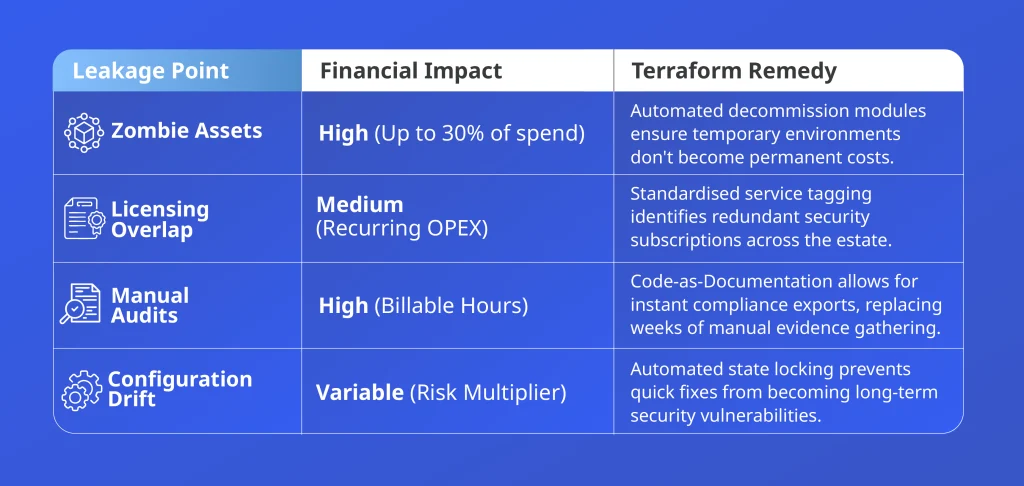
When infrastructure is manually configured, drift is inevitable. Drift leads to inconsistency. Inconsistency leads to overprovisioning and duplicated controls. The result is higher spending without stronger security.
How Terraform Improves Cloud Security and Cost Predictability
Terraform did not change the cloud provider. It changed the operating model.
Environment Without Terraform
- IAM inconsistencies across environments
- Policy drift between staging and production
- 15–30% resource waste from overprovisioning and duplication
- Slow, manual audit preparation
- Reactive patching after configuration errors
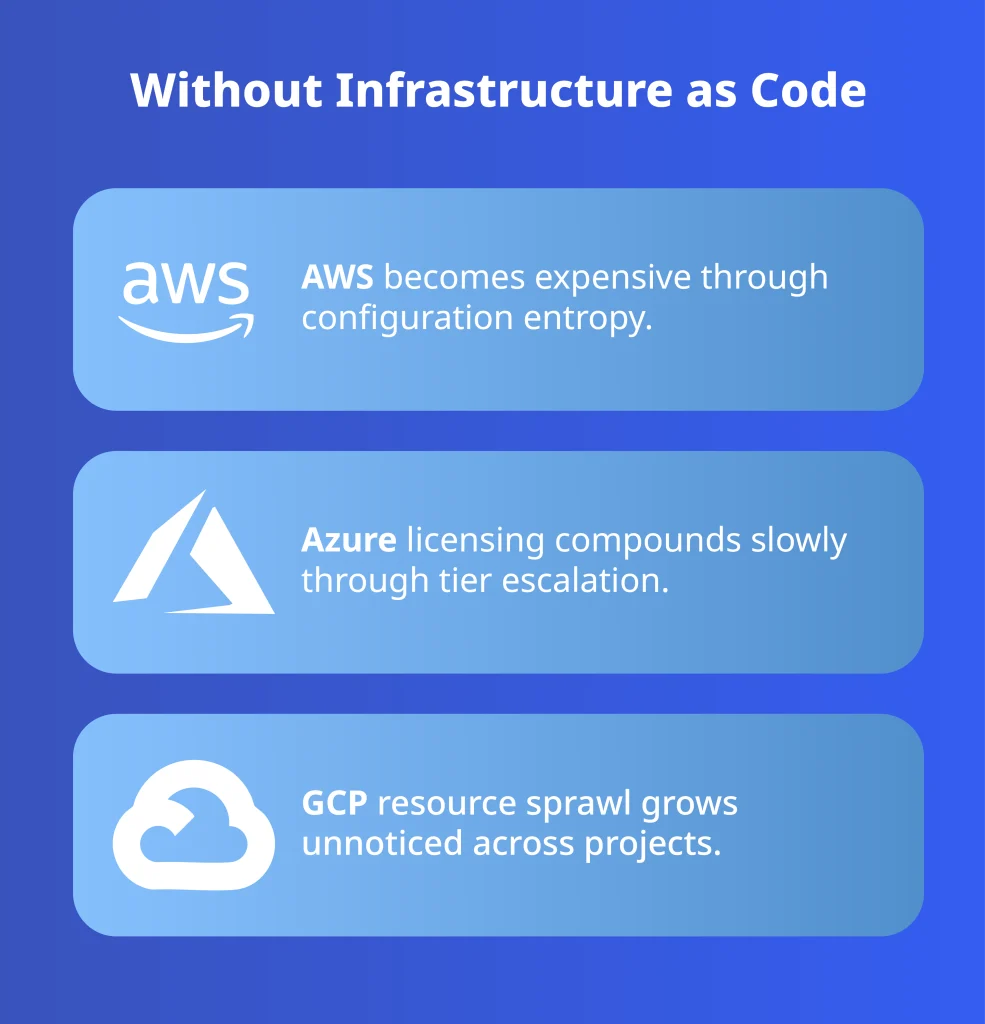
Without Infrastructure as Code, environments evolve organically. Changes are made under pressure. Permissions accumulate. Resources remain active longer than necessary. Cost and risk move in the same direction.
Environment With Terraform
- Version-controlled IAM policies
- Enforced tagging and cost allocation at the module level
- Standardised security baselines across environments
- Immutable infrastructure patterns
- Faster change recovery through predictable deployments
Infrastructure becomes declarative. Changes are reviewed before deployment. Drift is detectable. Security configuration becomes repeatable rather than improvised.
Measured Impact
- 20–35% infrastructure cost reduction in fragmented SMB estates (Observed across fragmented UK SMB estates post-governance standardisation)
- Lower change failure rate due to controlled releases
- Faster audit cycles because the configuration state is documented in code
Terraform did not make AWS cheaper than GCP. It made all three predictable. That predictability is what reduces both cost volatility and security exposure.
Side-by-Side: Cloud Cost and Security With and Without IaC
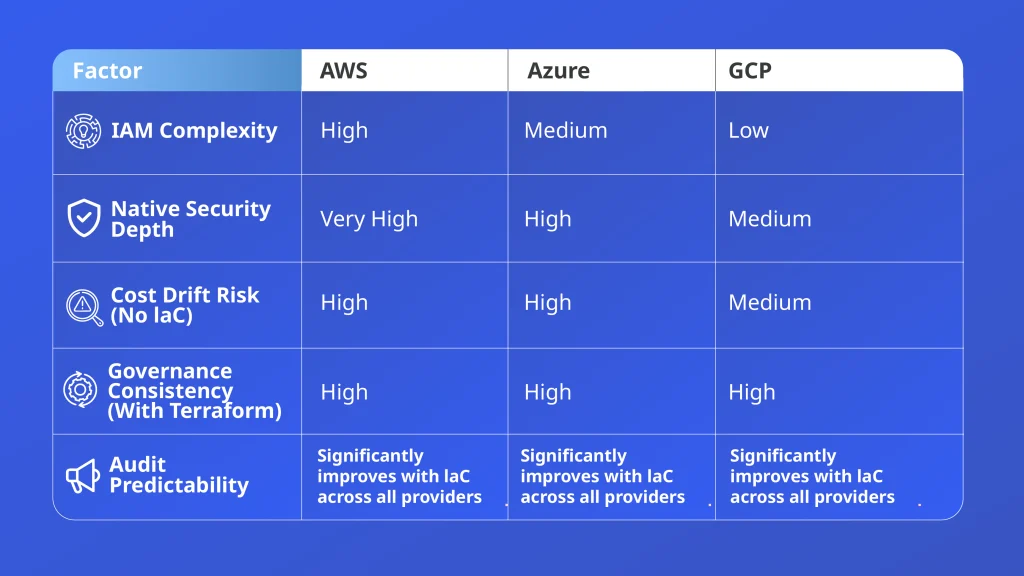
Choosing a provider shapes how you work day to day: the tools you use, the integrations you rely on, and the complexity your team manages.
Introducing Terraform changes something more fundamental: how predictable your costs, governance, and risk exposure become across any platform.
From Provider Comparison to Governance Strategy
Structured cloud advisory prevents governance entropy. A well-designed governance framework, enforced through Infrastructure as Code and aligned with your compliance requirements, prevents entropy before it compounds into cost leakage or audit friction.
If you want to formalise that structure before scaling, explore Deployflow’s cloud consulting services to see how governance-first cloud architecture reduces risk exposure while stabilising financial performance.
Which Cloud Is Most Cost-Efficient for UK SMB Security?
Cost efficiency across AWS vs Azure vs Google Cloud security depends on how the infrastructure is governed, not on list pricing.
If unmanaged:
- GCP typically shows the lowest early-stage cost volatility. Its simpler IAM structure and cleaner billing model reduce early operational friction.
- Azure’s licensing model can obscure the true total cost of ownership. Security features often scale with subscription tiers, and that can quietly increase monthly spend.
- AWS becomes expensive when configuration entropy sets in. Granular flexibility without strict control leads to role sprawl, duplicated services, and overprovisioned resources.
If governed with Terraform:
The cost efficiency gap narrows significantly. Standardised modules, enforced tagging, and version-controlled IAM reduce drift across all three platforms. At that point, operational maturity becomes the dominant factor.
In practical terms, governance outweighs provider selection when cost predictability and security efficiency matter.
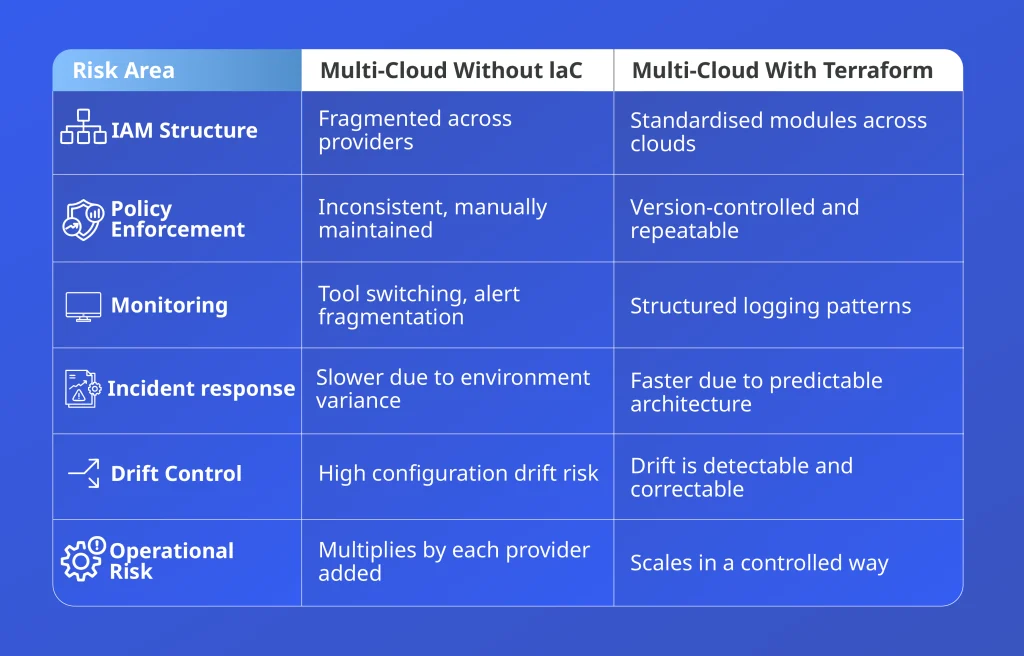
Multi-Cloud Security Risks for UK SMBs
Multi-cloud multiplies identity and monitoring complexity before it improves resilience.
AWS, Azure, and GCP Cloud Security Vulnerability: Where It Starts
Provider breaches are rare. Almost every AWS, Azure, and GCP cloud security vulnerability on record sits on the customer side of the shared responsibility model: public storage, over-scoped service accounts, unrotated keys, logging switched off to save money. Multi-cloud triples the count. Same mistake, three consoles, one overstretched engineer.
Compare SSO for Multi-Cloud AWS, GCP, and Azure
Compare SSO for multi-cloud AWS, GCP, and Azure, and the answer is always one identity provider, federated outwards.
- Entra ID. Federates into AWS IAM Identity Center and Google Cloud over SAML or OIDC. The default for Microsoft-heavy estates.
- AWS IAM Identity Center. Fine when AWS carries most workloads.
- Google Cloud Identity. Cleanest if Google Workspace is already the directory.
Local accounts per platform fail predictably: joiners are provisioned three times; leavers are removed once.
Best Identity Governance for AWS, Azure, and GCP Together
The best identity governance for AWS, Azure, and GCP together is one directory and four rules.
- Roles map to groups, never to individuals.
- Access reviews on a fixed cadence. Entra ID Governance, AWS IAM Access Analyzer, and Google Cloud IAM Recommender all surface unused permissions.
- Just-in-time elevation, not standing admin.
- Group-to-role mappings in Terraform, so every change leaves a diff.
Three consoles mean three governance processes. In code, it is one.
Practical Recommendation for UK CTOs
Make decisions based on operational fit. Choose your cloud provider according to ecosystem alignment and internal capability. Cloud strategy decisions become expensive when delayed. Governance decisions become expensive when avoided.
- If your estate is Microsoft-heavy, Azure reduces integration friction.
- If engineering velocity is dominant, GCP may simplify operations.
- If flexibility and service breadth matter, AWS is strong.
The key is alignment with your existing stack and team skill set.
Standardise infrastructure with Terraform before you scale. Retrofitting governance into a live, fragmented estate is significantly more expensive than embedding control early. Enforce tagging at the module level so cost allocation is automatic and not dependent on human discipline. Version-control IAM so every permission change is traceable and reversible.
Measure cost per environment monthly. Break down spend across production, staging, and test. If that visibility is difficult to obtain, financial control is already compromised. Audit infrastructure drift quarterly by comparing the declared configuration against the live state. Early deviation detection prevents minor inconsistencies from compounding into operational risk.
Security maturity should reduce cost volatility. If strengthening controls makes your monthly spend less predictable, governance is reactive rather than structured.
Stop guessing your cloud spend. Request a cloud governance audit from Deployflow and see exactly where your infrastructure is drifting before your next FCA review.
Frequently Asked Questions About AWS, Azure, GCP and Cloud Security Costs
Which cloud provider is cheapest for small businesses?
There is no universally cheapest provider; cost depends on how well your environment is governed.
AWS, Azure, and GCP all offer competitive pricing models, but poor tagging, overprovisioned compute, and unused environments quickly inflate spend on any platform.
For UK SMBs, the biggest cost driver is usually operational discipline, not list pricing. When governance is structured and Infrastructure as Code is in place, cost volatility reduces across all three providers.
Is AWS more secure than Azure or GCP?
No, all three providers offer strong baseline security capabilities.
Each platform provides encryption, identity management, monitoring tools, and compliance certifications. Security differences usually come down to IAM complexity, tooling integration, and how well policies are implemented. Most cloud security incidents stem from misconfiguration rather than weaknesses in the provider itself.
Do small businesses really need Terraform or Infrastructure as Code?
Yes, once cloud environments move beyond basic workloads, manual management becomes risky.
Without Infrastructure as Code, environments drift over time. Permissions expand, staging environments are forgotten, and security controls become inconsistent. Terraform helps standardise deployments, enforce tagging, and make configuration changes traceable, which improves both cost control and audit readiness.
Is multi-cloud a good strategy for improving resilience?
Multi-cloud can improve resilience, but only if governance is consistent across providers.
Running workloads in multiple clouds increases operational complexity. Identity structures, monitoring tools, and logging systems often differ. Without standardised policies and Infrastructure as Code, multi-cloud can introduce more risk instead of reducing it.
How can I reduce cloud security risks without increasing costs?
The most effective way is to focus on governance before adding new security tools.
Overlapping security subscriptions, unused monitoring services, and reactive configuration changes increase spend without improving protection. Standardising IAM, enforcing tagging, automating deployments, and regularly reviewing drift typically reduce both security exposure and cost unpredictability.
Is AWS or GCP more secure for a small business?
Neither platform is more secure by default. An AWS vs GCP security decision usually turns on team size. AWS IAM offers finer control and more ways to misconfigure it. Google Cloud’s simpler role model reduces the number of decisions a lean team has to get right, at the cost of granularity in advanced scenarios. Misconfiguration causes far more incidents than provider weakness on either platform.
What is the difference between AWS Config and Azure Policy?
AWS Config records and evaluates resource configuration after deployment, then flags drift for remediation. Azure Policy evaluates at the control plane and can block a non-compliant resource before it is created. Detection versus prevention is the practical difference. AWS teams usually close the gap with Service Control Policies and policy-as-code checks in the deployment pipeline.
Explore our BLOG
Recent articles

ISO 42001 Explained: Requirements, Certification and What Your Engineering Team Must Build
ISO 42001 is the international standard that demonstrates your organisation governs AI properly, and enterprise...
read full article

Is Claude Down? Anthropic Outage: Protect Your Cloud Infrastructure
Claude went down across every surface on 29 September 2026. From 14:00 to 14:59 UTC,...
read full article

Top 10 Healthtech Companies in 2026: What Their Growth Means for AI and DevOps
Every software change that reaches a hospital has to clear regulatory, legacy system, and clinical...
read full article