



Organisations discover their AI governance problem through their cloud bill, their incident log, or a CFO meeting they were not prepared for. This article shows you how to find it first, and exactly what to do about it.
What Is Already Happening in Your Stack
- Unapproved AI is already running on your infrastructure and generating costs nobody owns.
- Four silent cost traps: cloud sprawl, delivery drag, incidents, and legacy debt.
- AI debt compounds faster than technical debt. Fast teams today become slow teams tomorrow.
- Every ungoverned AI component is a future sprint blocker.
- Inside: a governance manual, self-assessment, and three ways to find your risk early.
Know where ungoverned AI hides in your stack, what it is costing you, and the five things engineering teams that scale AI without crisis do differently.
Why Your CFO Is Already Asking Questions You Cannot Answer
Check your last cloud bill. Somewhere in it is a line item you cannot fully explain. Probably more than one.
This is the most consistent finding from AI cost reviews: actual spend is higher than the CTO believed, ownership is murkier than anyone reported, and at least some of it traces back to decisions nobody made deliberately.
A data scientist connects directly to an LLM API to skip a procurement process that was not built for AI timelines. A product team spins up a vector database in a personal cloud account to hit a sprint deadline. A third team redeploys the same model in a different region because the first instance was too slow. None of it gets flagged, and all of it lands on your infrastructure.
AI experimentation becomes AI debt the moment it touches production without a governance layer.
Every successful experiment that ships without cost attribution or rollback capability is a liability dressed as a win.
The question your CFO is beginning to form is whether anyone in engineering can account for what AI actually costs. If producing that answer takes more than a few minutes, the gap is already larger than it should be.
Your AI Bill Is Larger Than Your Finance Team Thinks
Ungoverned AI accumulates across four distinct cost categories, each tied to a recognisable failure pattern that engineering leadership has almost certainly already encountered.
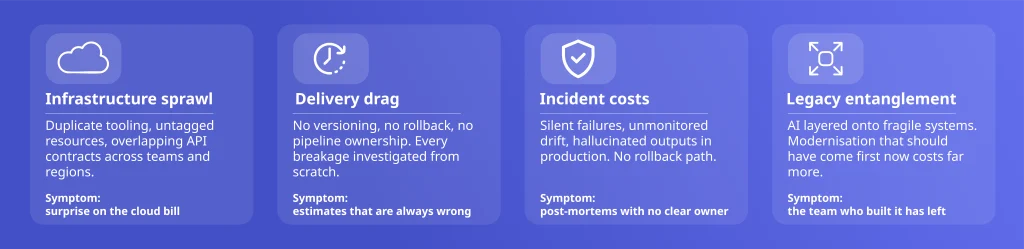
The more capable your engineers, the worse this gets. Senior engineers provision, ship, and move on. That is the behaviour you hired for, and exactly how ungoverned AI spending accumulates fastest.
And when something eventually breaks, the compliance question arrives shortly after the incident: why did a model that touched user data have no formal review on record? That conversation is significantly harder than the technical remediation.
Stable-looking systems rarely are. They just have not been stressed yet. It is just stable enough that nobody has been forced to look closely yet. An AI dependency is what finally forces that look, at the worst possible time.
Why AI Debt Is More Dangerous Than Technical Debt
Technical debt accumulates slowly and predictably, but AI debt doesn’t.
A Gartner survey of 782 infrastructure and operations leaders, conducted in late 2025, found that only 28% of AI use cases fully succeed and meet ROI expectations, while 20% fail outright. The remaining majority sit somewhere in between: running, accruing cost, and delivering less than anticipated. Most of that shortfall stems from what surrounds the model. Or rather, what does not.
Consider what that looks like in practice. A logistics company integrates an AI model to optimise delivery routing. It performs well for six months.
Then, the primary data input changes structure after a supplier API update. Nobody catches it. The model keeps running, producing routes that look plausible but are subtly wrong. The degradation never triggers an alert. It surfaces three quarters later in a margin review, traced back to an input change with no monitoring and no owner. The fix takes longer than the original build because the engineer who worked on it has moved on.
That is a governance failure that expressed itself as a financial one.
Gartner has warned that failure to adopt AI observability tools “exposes organisations to significant governance risks”, yet the same research projects that dedicated monitoring will reach only 40% of AI-deploying organisations by 2028. The other 60% are running production models with no systematic way to detect when those models stop behaving as intended.
🚩 Every ungoverned AI component is a future delivery blocker that does not announce itself until it has already cost you sprints, margins, or both. The teams moving fastest today by skipping governance structures are typically the same teams operating in crisis mode twelve months later.
Govern now or remediate later. Remediation costs more than governance. Incident recovery costs more than observability. Architectural rework costs more than sequenced modernisation.
AI scaling without delivery governance is speed without steering. It covers ground quickly and ends expensively.
What Engineering Teams That Scale AI Without Crisis Do Differently
Governed AI scaling is a delivery architecture. Compliance thinking produces documents, and delivery thinking produces systems that hold under pressure.
Here is what that looks like in practice, across the five areas where ungoverned AI organisations consistently break down.
1. AI Workloads Are Treated as First-Class Delivery Assets
Every model in production sits within a pipeline with versioning, rollback capability, and defined SLOs. Deploying a new model version goes through the same process as any other software release. No exceptions.
What to check in your organisation right now:
- Can you list every model currently running in production, who owns it, and when it was last reviewed?
- Do any of those models exist outside your CI/CD pipeline?
- Is there a defined rollback path for each one, and has it been tested in the last 90 days?
If the answer to any of these is no or unclear, you have ungoverned AI in production. The practical fix is to apply the same pipeline discipline you already have for software to every AI workload, without exception. If it touches production, it lives in the pipeline.
2. Infrastructure Is Provisioned Through Code, Governed Through Policy, Monitored Through Observability
Cloud resources for AI workloads should be defined in version-controlled configuration, access governed by policy, and usage monitored by tooling that surfaces anomalies before they generate incidents.
The three-layer check:
Provisioning: Are all AI resources defined in IaC? If not, manual console provisioning is already a red flag.
Governance: Is access to AI infrastructure policy-controlled? Personal accounts with cloud access are where ungoverned spending starts.
Observability: Is there an alert for model performance degradation? No drift monitoring means the first sign of a problem is the problem itself.
Most organisations have the provisioning layer partly in place. The observability layer is where the gaps appear. A model running without drift monitoring is a liability with no alarm. Set performance baselines at deployment and alert on deviation instead of on failure.
3. Ownership Is Explicit at Every Layer
When something fails, the accountability chain should be clear within minutes. In ungoverned AI environments, it is typically discovered over days.
Four ownership assignments every production AI component needs:
- Model owner: responsible for performance, retraining triggers, and version decisions
- Data owner: responsible for input pipeline integrity and schema change communication
- Infrastructure owner: responsible for compute, cost, and availability
- Integration owner: responsible for the boundary between the AI component and the systems it feeds
These do not need to be four different people. They do need to be four documented roles, each with a named individual. When an incident occurs at 2 am, the on-call engineer should be able to find the right person in under five minutes without reading through Slack history.
A simple ownership registry, even a maintained spreadsheet, is operationally more valuable than a sophisticated platform nobody keeps current.
4. DevOps Is the Connective Tissue Between Experimentation and Production
Without DevOps, AI prototypes and production systems exist in parallel worlds. The prototype works in a notebook. The production feature breaks in ways no one anticipated because the two environments were never reconciled.
The practical gap CTOs should close:
Most engineering organisations have strong DevOps practices for software but weak or absent DevOps practices for AI.
The typical failure pattern: a data science team builds a model, hands it to engineering for deployment, and neither team fully owns what happens next. The model ships, but the structure that should support it does not.
Close this by requiring every AI initiative to name a DevOps lead at the prototype stage. That person’s job is to define the deployment architecture before the model is built. Retrofitting DevOps onto a working model is significantly harder than designing for it from the start.
The practical gap between AI experimentation and production-ready delivery is explored in detail in the guide about accelerating AI delivery without sacrificing governance, including where CI/CD bottlenecks appear and how governed use cases reduce manual effort by up to 75%.
5. Cost Visibility Is Built In From the Point of Provisioning
AI infrastructure costs should be tagged, tracked, and attributed from the moment a resource is provisioned. FinOps is part of the delivery design, not a retrospective exercise conducted after the bill surprises someone.
The minimum viable cost governance setup:
- Every AI resource is tagged at provisioning with team, project, model name, and environment (dev/staging/prod)
- A cost dashboard for AI workloads separated from general compute, reviewed weekly by engineering leadership
- A defined threshold for new AI infrastructure spend that requires approval before provisioning, not after
Any threshold beats no threshold. The organisations with the worst AI cost surprises are almost never the ones that spent too much on a single approved project. They are the ones with dozens of small, untagged, unapproved resources that nobody thought to flag because each one seemed too minor to escalate.
The common thread across all five is that none of this requires new tooling. It requires applying existing engineering rigour to AI workloads with the same consistency as it is applied to everything else. The organisations scaling AI without crisis are doing the basics.
Rate Your AI Governance in 90 Seconds
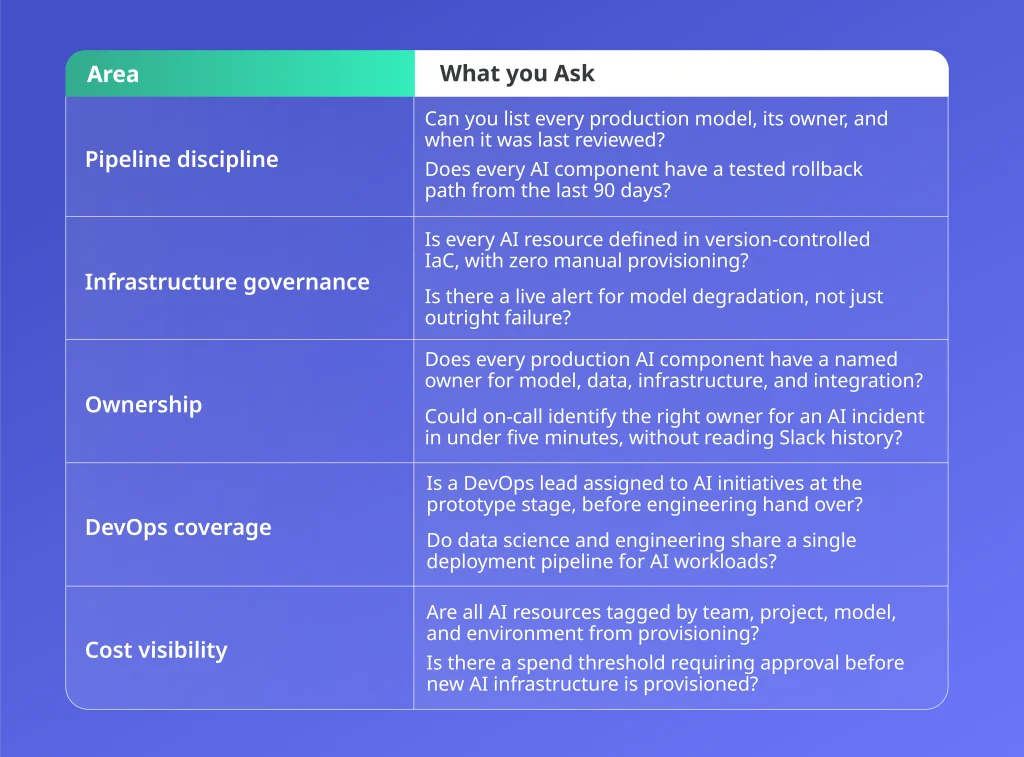
Any no is a gap. More than three is a pattern.
How to Find Your AI Risk Before Your Cloud Bill Does
Organisations that govern AI effectively started with an honest assessment of their current state.
A policy describes where an organisation wants to be. An assessment reveals what is already running, what it is costing, and where the exposure lies right now. There are three entry points worth knowing.
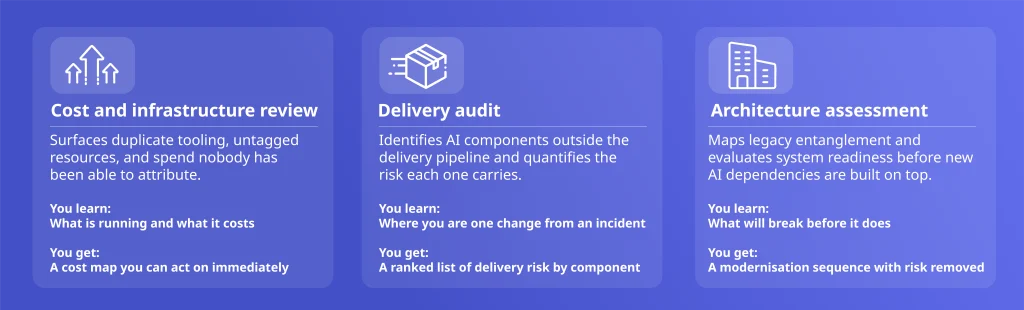
All three do the same thing: surface what is already true before it becomes expensive.
The One Question CTOs Who Avoid AI Crises Ask First
The outcome of sustained AI scaling without governance means cost overruns, delivery slowdowns, and preventable incidents. The only variables are timing and magnitude.
Which means the question is never whether the cost arrives.
Does your next AI incident find you prepared or surprised?
CTOs who avoid AI crises are not more technically sophisticated than those who don’t. They ask that question earlier, before the cloud bill, before the incident, before the sprint velocity report nobody wants to present. They run an assessment while the answer is still manageable.
The starting point is a straightforward inventory of what is already running in your infrastructure, what it costs, and who owns it. Everything else follows from that.
If you cannot answer those three things confidently right now, that is your answer.
Your Next Move Before AI Costs Become Unrecoverable
The organisations that scale AI without crisis start with a clear picture of where they stand.
How a National Energy Organisation Made Petabyte-Scale AI Governable
Deployflow has done this. For a national energy organisation running H100 GPU clusters on petabyte-scale geological data, the challenge was to make AI governable.
The engagement delivered a modular infrastructure-as-code framework that eliminated configuration drift entirely: every environment spun up automatically, inheriting the required security, networking, and governance policies with zero manual steps.
New AI workloads now land on the platform without re-engineering the core. Every change is tracked via GitOps, satisfying regulatory requirements without slowing delivery.
From Disconnected Data to AI Intelligence Platform: UAE Public Sector Case Study
For a multi-billion-dollar UAE public sector organisation, the problem was the opposite of a technical failure. The data existed, but the insights did not. Surveys, spreadsheets, and regional platforms held valuable signals that leadership could not see together.
Deployflow designed an AI intelligence platform that replaced manual data classification with automated pipelines, consolidated disconnected systems into a single architecture, and delivered 24/7 real-time signal monitoring at a national scale. The full deployment ran from proof of concept to production in six to twelve months.
Both engagements started the same way: with an assessment of what was already running, what it cost, and where the exposure was.
The Team That Knows What Ungoverned AI Looks Like at Scale
Deployflow’s team includes engineers who have built and governed AI infrastructure at Vodafone and Lloyds Banking Group. They have worked in environments where ungoverned AI creates the kinds of problems this article describes, which means they recognise the signs quickly and know what good looks like on the other side.
A free discovery call takes thirty minutes. What it surfaces, whether that is a cost anomaly, a delivery gap, or a legacy dependency nobody has formally mapped, typically takes months to find on your own and costs significantly more to fix once it does.
Frequently Asked Questions About AI Governance in Engineering
Does AI governance matter if we are still a small engineering team?
The cost of ungoverned AI is proportional to speed, and not size.
A ten-person engineering team shipping AI features without pipeline discipline accumulates debt at the same rate as a hundred-person team. The difference is that a smaller organisation typically has less capacity to absorb the remediation when it arrives. A startup that ships three ungoverned AI features in a quarter can find itself six months later with a delivery problem it cannot explain and a cloud bill it cannot fully attribute. Governance is cheaper at the start than at any later stage, regardless of headcount or funding round.
We have cloud governance in place. Does that cover AI workloads too?
Rarely, and the gaps tend to appear in the places that matter most. Standard cloud governance frameworks were designed for infrastructure and application workloads. AI introduces variables they were not built to handle: model drift, training data dependency, inference cost unpredictability, and non-deterministic outputs that behave differently under load than they did in testing.
Most existing frameworks cover provisioning and access control adequately. What they leave unaddressed is observability for model behaviour, ownership assignment at the model and data layer, and FinOps attribution specific to AI workloads. Those are precisely the gaps where ungoverned AI cost and risk accumulate fastest.
How do you govern AI models provided by a third-party vendor?
Third-party models do not transfer governance responsibility to the vendor. The integration points, the data flowing through them, the cost of the API calls, and the behaviour of outputs in your production environment remain entirely your problem to govern.
Vendor-provided models often create a false sense of security because the model itself is maintained externally, leading engineering teams to treat the surrounding architecture as someone else’s concern. The vendor is responsible for the model. You are responsible for everything it touches inside your organisation, including how it is called, what data it receives, how outputs are validated, and what happens when it behaves unexpectedly.
If your organisation is moving toward AI that takes autonomous action across systems and does not generate outputs for human review, the governance challenge shifts significantly. The guide about agentic AI in the Enterprise covers where that boundary is and what changes when AI starts acting instead of advising.
Where do we start with an AI governance framework?
A cost review combined with a delivery audit typically surfaces the most critical gaps within two to three weeks, without requiring a lengthy engagement or a formal programme.
- Start by pulling every cloud resource tagged or suspected to relate to AI workloads and mapping it to an owner.
- Then identify which of those resources exist outside your CI/CD pipeline.
- Finally, check which have drift monitoring configured and which do not.
Those three things together will give you a clearer picture of your actual exposure than most organisations produce through months of internal review, because they force specificity rather than self-reported status.
How do you implement AI governance without slowing down engineering velocity?
Separate the environments.
Experimentation should have its own designated space with relaxed provisioning rules, no production traffic, and no customer data. Governance standards apply the moment anything crosses into production. The teams that sustain both pace and stability treat that boundary as a formal gate with defined criteria: pipeline membership, ownership assignment, observability in place, and cost attribution confirmed. What they avoid is the gradual, unmanaged transition in which an experiment slowly becomes a production dependency without anyone deliberately deciding to treat it as one. That transition, left unmanaged, is where most AI debt originates.
Explore our BLOG
Recent articles
ISO 42001 Explained: Requirements, Certification and What Your Engineering Team Must Build
ISO 42001 is the international standard that demonstrates your organisation governs AI properly, and enterprise...
read full article

Is Claude Down? Anthropic Outage: Protect Your Cloud Infrastructure
Claude went down across every surface on 29 September 2026. From 14:00 to 14:59 UTC,...
read full article

Top 10 Healthtech Companies in 2026: What Their Growth Means for AI and DevOps
Every software change that reaches a hospital has to clear regulatory, legacy system, and clinical...
read full article