



Match the right discipline to the right problem, and your AI work finally ships. Confuse AI engineering with data science, and it stalls, however large the budget.
The two look almost identical on an org chart, yet they reward opposite skills: one proves what works, the other makes it run in production. Treat them as a single role, and capable people solve the wrong problem at speed.
Get the distinction right, and you stop pouring budget into roles your roadmap does not need. The call is simpler than the debate suggests, and this guide hands you the framework to make it with confidence. Here is the short version, then the details.
Executive Summary
- Data science answers what works. AI engineering makes it run reliably at scale. The skills barely overlap.
- Stalled AI usually breaks down to engineering and integration, rarely to the model itself.
- A production AI system is mostly infrastructure. The model is a small slice of the overall code and cost.
- Foundation models raised the bar on evaluation and data quality. LLM features still need data science rigour to prove they work.
- Hire against your bottleneck: Insight problems need data science first; delivery problems need AI engineering first.
AI Engineering vs Data Science: What Each Discipline Does
Here is the distinction that saves you a costly hire: data science turns data into reliable answers, and AI engineering turns a working model into a dependable system.
Data science is experimental work. You frame a question, test a hypothesis, model a relationship, and measure how far you can trust the result. Success shows up as a defensible insight, a validated model, or a measurable lift. Judge a data scientist on rigour and on whether the conclusion survives contact with reality.
AI engineering is operational work. You handle latency, cost, reliability, monitoring, and the route from a promising result to something that serves users and stays healthy under load. Success shows up as uptime, predictable spend, and a feature that behaves in production the way it did in the demo. Judge an AI engineer on whether the system ships and keeps working.
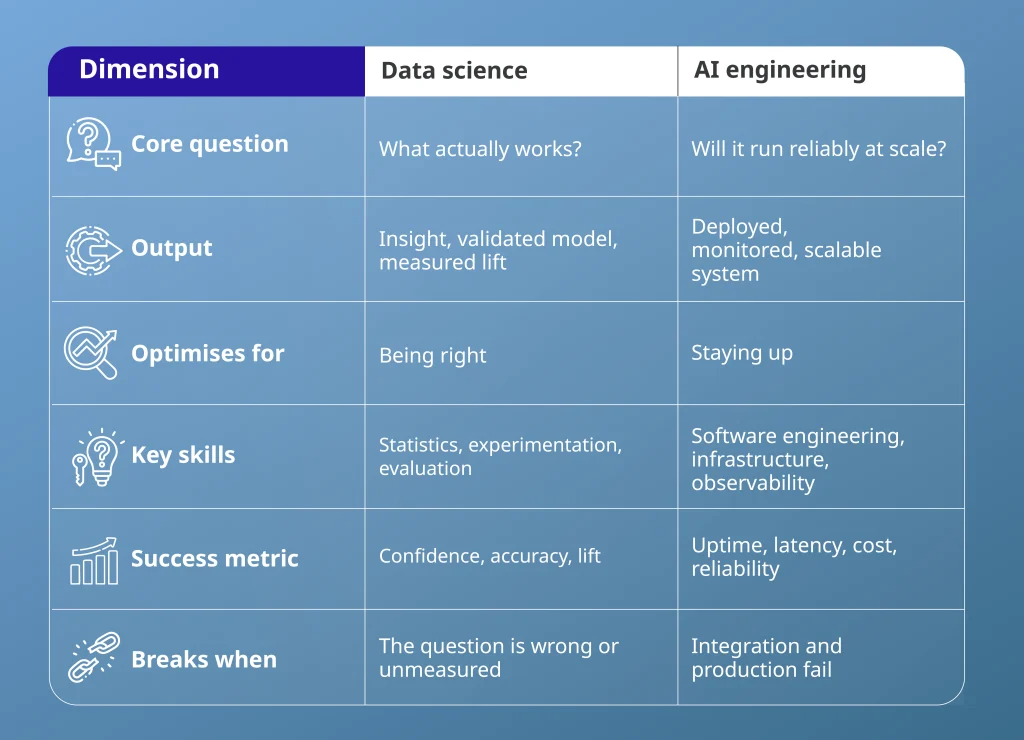
Both disciplines touch on machine learning, which is why the org chart blurs the lines between them. The work underneath pulls in different directions.
The 5 Mistakes Draining Your AI Budget
Five repeatable errors account for most wasted AI spend, and the model is rarely the culprit. The pattern shows up across sectors, so treat it as an industry problem worth fixing rather than a personal failing.
Mistake 1: Asking Data Scientists to Ship Production Software
You staff delivery with discovery-stage talent, then pay senior salaries to build models that never reach a user. A data scientist is hired to find what works. Production reliability is a separate trade, built on monitoring, version control, latency, and incident response.
Compare how many models passed evaluation last year against how many serve users today. A wide gap is a structural mismatch, and hiring more of the same profile will not close it.
Separate the two remits. Resource discovery with data science, and delivery with engineering.
Mistake 2: Funding the Model and Forgetting the System
Cost a business case around the model, and the budget runs out where production starts. The model is a small slice of the spend. Research from Google found that only a small fraction of a real-world machine learning system is the model code itself. The rest is configuration, data pipelines, feature work, serving infrastructure, resource management, and monitoring.
Where does the AI budget go?
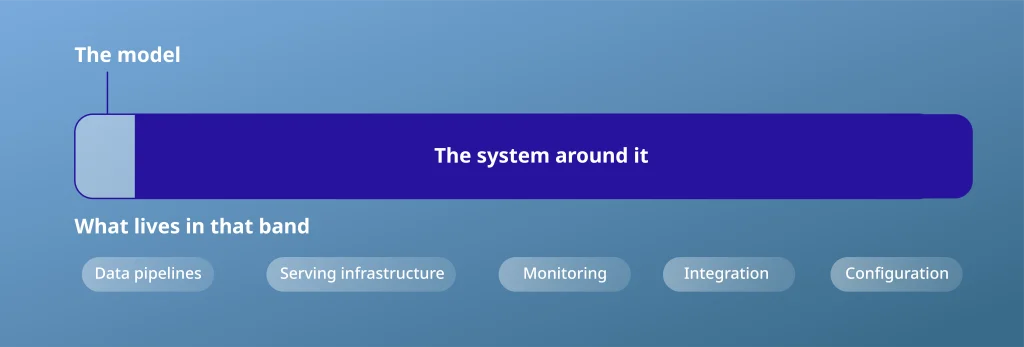
You see it in the business case, which prices the model and treats the platform as a footnote. The unbudgeted infrastructure is where timelines slip and overruns land, and it stays invisible until the model is built and has nowhere to run.
Price the whole system in the original proposal, including platform and monitoring.
Mistake 3: Believing Foundation Models Killed Data Science
Assume a hosted model lets you cut the data team and silent quality failures ship straight to customers. An API call leaves the hard questions open: what counts as a good answer, how you measure it, how you catch drift, and whether the input data holds up.
Without an evaluation harness, a model can deliver incorrect information to customers for weeks before anyone notices, because nothing is compared against real cases. The exposure is reputational, and in regulated sectors, it is compliance-grade.
Keep data science for evaluation, data quality, and measurement. Those prove the feature works and flag it the moment it stops.
Mistake 4: Calling a Prototype a Product
Treat the pilot that wowed the board as finished, and you join the majority whose AI never reaches the P&L. A prototype that works once is a hypothesis about production. Research reported by Fortune found that around 95% of enterprise generative AI pilots produced no measurable profit-and-loss impact, while roughly 5% reached real value at scale.
The demo succeeds on a handful of clean inputs and a controlled path. Production demands the full range of messy real queries and live links to the systems staff use daily, and that distance is where the spend converts or evaporates.
Budget the prototype-to-production distance up front, while the pilot is still a pilot.
When you are ready to cross that gap, how sprint-based AI delivery gets features into production sets out the two-loop cadence and the quantitative definition of done that a one-off pilot never has.
Mistake 5: Running Models With No Owner
Leave a production model unowned, and the first sign of trouble is a customer complaint or a finance review. A live model drifts as data shifts and costs climb, and neither corrects itself.
Look for a model in production with no named owner, no retraining schedule, and no line in the budget. Accuracy erodes quietly, cloud spend creeps, and both run unchecked until something downstream breaks.
Assign one accountable owner per production model, covering retraining, monitoring, and cost. It is the cheapest form of governance you can put in place.
One owner fixes one model, and an AI governance guide for engineering leaders scales that discipline across a growing fleet, mapping the ownership roles, drift monitoring, and cost attribution that stop ungoverned AI from draining the budget.
How the LLM and AI Agent Era Changed Who You Need to Hire
The hard part of AI has shifted from building models to running them reliably in production, and that shift created a distinct senior role: the AI engineer. Training a model was the old challenge. Integration is the new one, wiring a capable model into a live workflow so it holds up every day.
The cause of failure moved with it. Fortune’s report on MIT’s research found that stalled generative AI pilots rarely failed on model quality. Executives blamed regulation or model performance, but MIT traced the real barrier to weak enterprise integration: tools that never learned or adapted to how the work actually runs. The model was seldom the problem. The engineering around it was.
That changes the hire. AI engineering owns the integration, reliability, and production path that decides whether anything ships. Data science keeps a vital, narrower seat, focused on where judgment is scarce: designing evaluations, deciding when fine-tuning earns its cost, protecting data quality, and proving that a feature moves a number that matters.
Agentic systems raise the bar again. Chaining several model calls into an autonomous workflow adds moving parts, and every extra part is another way for the system to be confidently wrong.
How to Know Which Discipline Your Problem Needs
Drop the job titles, ask four questions about the problem, and the right discipline becomes obvious.
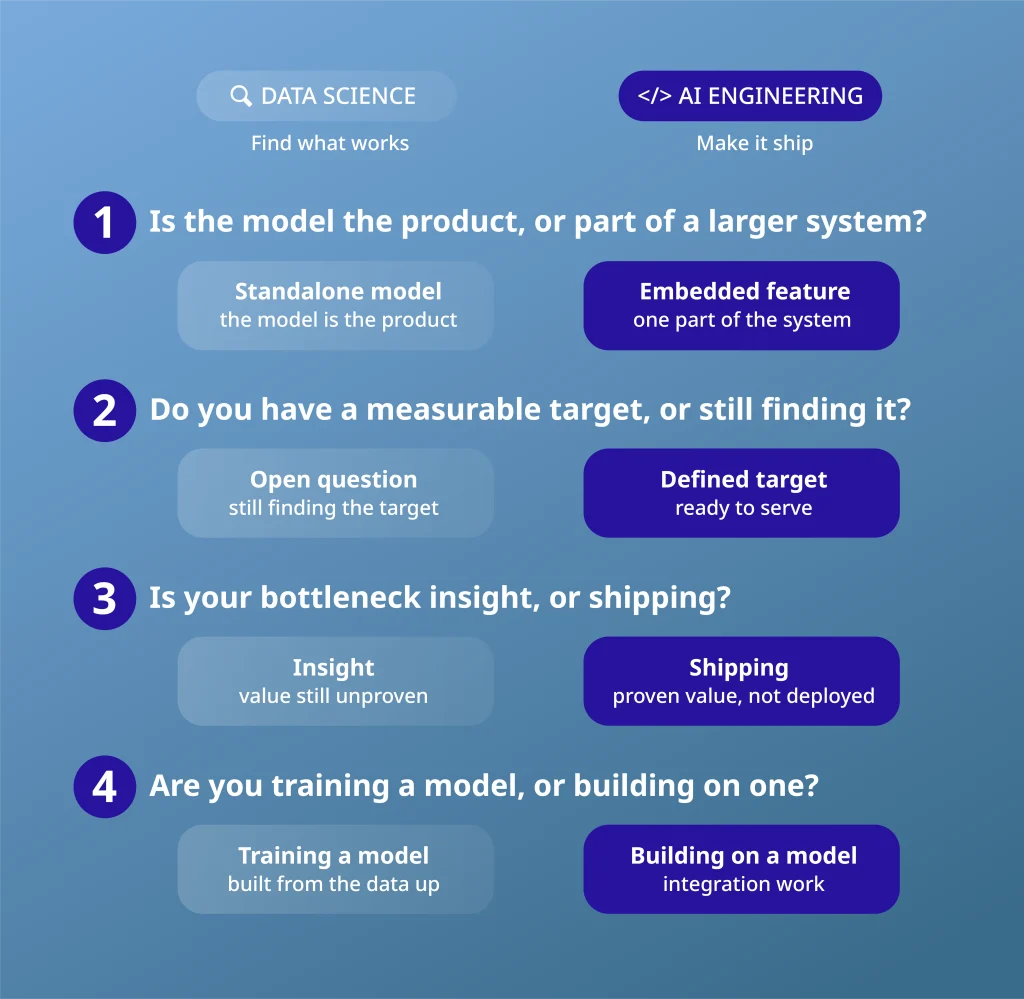
Real initiatives usually need both, in sequence. Pay for one and expect the other to appear on its own, and the roadmap stalls.
How to Structure an AI Team That Ships to Production
An AI team ships on the strength of its structure. The shape that works splits into three layers, and the middle one is where most budgets fail.
Data science owns discovery: framing the problem, evaluation, and measurement, held to insight that survives contact with production. AI engineering owns delivery: the production path, reliability, and cost. Between them sits a platform layer, the MLOps and operational practice that turns a notebook into a monitored, version-controlled, observable service.
The platform layer is the highest-leverage hire, and the one teams defer longest. One strong platform engineer lets several data scientists ship instead of stalling, because pipelines, serving, and monitoring stop being rebuilt by hand for every project. A first team that can actually ship is often smaller than expected: one platform engineer, one or two AI engineers, and a data scientist, sequenced to wherever you stall rather than hired all at once.
Reporting lines decide more than the org chart admits. Put production reliability under a research function, and it loses every prioritisation fight to the next experiment. Hold delivery accountable for uptime and cost instead, and give every model in production a single named owner. Drift and runaway spending are usually ownership failures before they are technical ones.
Treat build-versus-buy as a structural choice, then buy the commodity and build the edge. Serving infrastructure, observability, and evaluation tooling are largely solved problems, so buying them frees your scarce engineers for the parts that differentiate you.
The data backs the instinct. Stanford’s 2025 AI Index found that the cost of running a model at GPT-3.5’s level fell from $20 per million tokens in November 2022 to $0.07 per million tokens by October 2024, a drop of more than 280-fold. When the base layer commoditises that fast, every engineering month spent rebuilding it is written off against a price that keeps falling.
One signal tells you whether the structure works. Compare the number of models you have built against the number running in production. A wide gap points at structure and platform, seldom at talent.
Where to Start When Your AI Keeps Stalling
Start by diagnosing whether your AI gap is skills, structure, or process, because fixing the wrong one wastes another quarter. The instinct to hire more specialists rarely unblocks delivery on its own.
A focused delivery assessment maps where momentum dies: discovery that never converts to shipped features, prototypes that cannot survive production, or models running without owners or cost controls. From there, the priority is clear, and the quickest wins usually sit in delivery practice.
Deployflow’s AI engineering work targets exactly these failure points.
Real-World Proof: Turning Stalled AI into Production Value
Fixing the wrong bottleneck wastes another quarter. Deployflow’s AI engineering frameworks target these exact enterprise failure points.
Unifying Scattered Data for National Scale
- The Challenge: A multi-billion-dollar UAE public-sector organisation had its critical information trapped across scattered surveys, spreadsheets, and disconnected regional systems.
- The Solution: Deployflow consolidated the infrastructure into a single unified AI platform, deploying AI to automatically sort and classify data that staff had previously been processing by hand.
- The Outcome: A fully approved proof of concept delivered, with a national rollout scheduled over the next six to twelve months.
Transitioning to Industrial-Grade Operations
- The Challenge: A national-scale energy client needed to move past isolated AI experiments and enter production with industrial-grade reliability, compliance, and security.
- The Solution: Deployflow engineered a secure, governed platform capable of processing more than a petabyte of data in real time. Security policies apply automatically, and every change is logged for audit.
- The Outcome: New AI initiatives now launch directly on top of this platform without rebuilding the core architecture.
The entry point is small. A short assessment shows which of the three is actually blocking you. Work that clears the path to production, like a DevOps uplift, usually moves fastest, because it unblocks everything after it.
Deployflow’s AI engineering and automation work follows the same path: assess the opportunity, prove it with a prototype, then turn it into a secure production system you own and can build on.
What Separates AI That Ships From AI That Stalls
AI engineering versus data science is an operating model decision dressed up as a hiring debate. The teams that capture value match the discipline to the problem, fund the engineering that turns insight into a dependable system, and give every production model a clear owner. Do that, and you stop paying for motion that never reaches a user.
If you want a clear read on where your own AI work stalls, book a free consult with Deployflow and walk away with the priorities worth acting on.
Frequently Asked Questions: AI Engineering vs Data Science
Does an AI engineer cost more to hire than a data scientist?
Usually yes, because strong AI engineers pair production software skills with ML fluency, and that combination is scarcer than either skill on its own.
The premium reflects scarcity more than seniority, since someone who can reason about model behaviour and also run a reliable service under load is harder to find than either profile alone. Exact figures swing with location, sector, and how far the role leans toward platform work, so price against your own market rather than a single benchmark. The sharper budgeting question is which skill your roadmap is short on, because paying the wrong premium wastes the budget either way.
What is the difference between an AI engineer and a machine learning engineer?
A machine learning engineer builds and trains the models, while an AI engineer integrates models, including hosted ones, into reliable production systems.
The two overlap, and plenty of job adverts use the titles interchangeably, which is where the confusion starts. A machine learning engineer sits closer to data science, owning model architecture, training pipelines, and tuning; an AI engineer sits closer to software and infrastructure, owning latency, cost, monitoring, and integration. In the foundation-model era, the AI engineer role has grown fastest, as more teams consume a capable model through an API and spend their effort on everything around it.
Can a data scientist become an AI engineer?
Yes, with the caveat that it is a substantial career change, because it means adding production software engineering on top of a research skill set. The gap is mostly in software discipline: version control, testing, monitoring, CI/CD, and designing for failure instead of for a clean dataset.
A data scientist who enjoys building tools and shipping code tends to cross over well, while one who prefers framing questions and proving results may be happier deepening the data science craft. It takes months and suits some people far better than others, which makes it a deliberate development plan rather than a fix for an immediate delivery gap.
What tools do data scientists and AI engineers use?
Data scientists live in notebooks, statistical libraries, and experiment-tracking tools, while AI engineers work in the same software and cloud stack as any production team. Discovery centres on exploration and proof: Python or R, libraries such as pandas, scikit-learn, and PyTorch, and notebooks like Jupyter. Delivery centres on version control, CI/CD pipelines, containers and orchestration, cloud services, and observability for latency, cost, and behaviour in production. The two meet at the MLOps layer, which is exactly why a platform hire earns its keep.
Should you build an in-house AI team or outsource AI engineering?
Build the capabilities that differentiate your product, and outsource the delivery and platform engineering you need to run quickly. Hiring a senior AI engineer or a full delivery team takes months, and the prototype-to-production gap is where timelines slip, so an AI engineering partner can close that distance while you recruit. Outsourcing fits the delivery layer, where practices are mature and the constraint is capacity, better than core discovery, where context about your data and domain is hard to transfer. A common pattern is to ship the first production system with a partner and set the standards, then hand operations to an internal team as it grows.
Explore our BLOG
Recent articles

ISO 42001 Explained: Requirements, Certification and What Your Engineering Team Must Build
ISO 42001 is the international standard that demonstrates your organisation governs AI properly, and enterprise...
read full article

Is Claude Down? Anthropic Outage: Protect Your Cloud Infrastructure
Claude went down across every surface on 29 September 2026. From 14:00 to 14:59 UTC,...
read full article

Top 10 Healthtech Companies in 2026: What Their Growth Means for AI and DevOps
Every software change that reaches a hospital has to clear regulatory, legacy system, and clinical...
read full article