



Gartner predicts that by 2029, agentic AI will autonomously resolve 80% of common customer service issues without human intervention, leading to a 30% reduction in operational costs. Most UK enterprises will not capture any of that. The gap between ambition and delivery is where the money goes.
This article covers exactly where UK enterprise AI customer service projects break down, what the build stage consistently gets wrong, and what the teams seeing real ROI are doing differently.
What CTOs Need to Know Before Committing Budget to AI Customer Service
- The pilot-to-production gap is where most UK enterprise AI programmes quietly die, and it has nothing to do with the model
- Ownership gaps, integration debt, and governance frameworks built for human agents are the actual blockers
- Agents that impress in demos regularly collapse at scale when connected to legacy CRM, billing, and ticketing infrastructure
- FCA, ICO, and GDPR obligations surface late in most projects because vendors do not build for UK compliance from day one
- The fastest path to ROI is a single high-volume, low-risk query type with defined success criteria, not a full contact centre overhaul
Your AI Agent Worked in the Demo, but It Won’t Survive Production
A UK financial services firm deploys an AI customer service agent. It handles 10,000 queries in the first month. It also generates 3,000 complaints nobody saw coming. The agent was not technically wrong, but it was just never built for production.
What follows covers what creates the gap, what the build stage consistently gets wrong, and what leadership teams can do differently before the next initiative goes live.
Chatbot, LLM Agent, or Agentic System: Does Your Procurement Team Know the Difference?
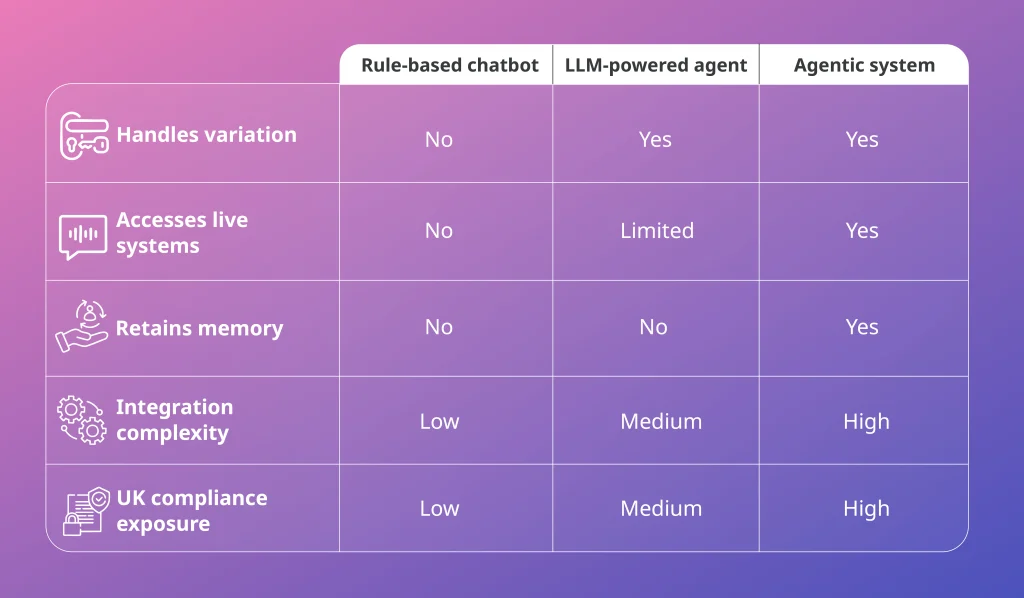
Most enterprise buying decisions are made on demo quality rather than production readiness, and each level of capability carries materially different integration requirements, compliance obligations, and delivery timelines.
A system that looks impressive in a controlled environment can behave very differently when connected to a live CRM, handling real customer data, and operating under FCA scrutiny.
The CTO’s First Decision:
Before scoping budget or vendor shortlists, answer this: which type of agent are you actually building? Rule-based, LLM-powered, or fully agentic? The compliance obligations, integration requirements, and delivery timelines differ significantly across all three. This decision is regularly skipped, and it is the single most common reason projects have to restart.
Before locking in a vendor or platform, it is worth understanding how agentic AI is already disrupting the SaaS tools your customer service stack depends on. The procurement implications for CTOs are worth reading before any vendor conversation.
The Uncomfortable Truth About Why UK Enterprise AI Projects Stall
In customer service specifically, the breakdown shows up in the same four places, almost every time.
- Data is fragmented across CRM platforms, ticketing systems, and billing infrastructure that were never designed to talk to each other.
- Nobody owns the escalation logic, so edge cases fall through.
- Governance frameworks were built around human agents and do not translate cleanly to AI systems.
- Compliance requirements surface late in the project, after the architecture has already been set.
The FCA has clear expectations around automated decision-making in financial services. The ICO’s guidance on GDPR and automated processing applies to any customer-facing AI system that influences outcomes. Neither of these is a surprise requirement. Both arrive as late-stage blockers for the same reason: they were never built into the delivery cycle from the start.
Gartner predicts over 40% of agentic AI projects will be cancelled by the end of 2027, citing escalating costs, unclear business value, and inadequate risk controls as the primary causes. In customer service, where the stakes are visible and the complaints are public, that failure rate carries a cost that leadership teams rarely measure.
The Build-Stage Mistakes That Are Costing UK CTOs Six Months of Delivery Time
Most AI customer service builds are optimised for the happy path. The system works well when the customer’s query matches the training data, the intent is clear, and the resolution is straightforward. Real enterprise customer service rarely is.
The Build-Stage Audit: 4 Failures to Eliminate Before You Write a Line of Code
1. Underestimating integration complexity. Connecting an AI agent to Salesforce, Zendesk, or SAP in a live enterprise environment takes significantly longer than vendors typically indicate. Legacy APIs, authentication layers, and data formatting inconsistencies all add time and risk.
2. Training on historical data that no longer reflects customer behaviour. Data from three years ago captures a different customer base, a different product set, and language patterns that have shifted. Models trained on it will underperform from day one.
3. No fallback logic. Agents that cannot recognise the limit of their own competence create worse customer experiences than no AI at all. This is a standard capability in mature conversational AI for customer support platforms, and one of the clearest indicators if
a solution is genuinely production-ready or still at the demo-stage.
Clear escalation triggers and human handoff paths need to be designed in from the start.
4. Skipping observability. Monitoring and alerting are routinely scoped for post-launch. When something goes wrong in production, and it will, the team has no visibility into what happened or why.
The UK Compliance Layer That International AI Vendors Keep Getting Wrong
UK-specific compliance is where international AI vendors most regularly leave enterprise clients exposed.
GDPR Article 22 restricts solely automated decisions that produce legal or similarly significant effects on individuals. For customer service agents handling complaints, account changes, or credit-related queries, that threshold is closer than most teams assume. ICO guidance requires transparency about when AI is involved and meaningful human oversight where it matters.
FCA-regulated firms face additional obligations. The Consumer Duty, introduced in 2023, requires firms to demonstrate that AI-driven customer interactions deliver good outcomes. That is a higher bar than simply logging the conversation.
The practical implication is that explainability, audit trails, and human oversight mechanisms need to be designed into the system architecture, not added after the fact. When compliance sits inside delivery sprint cycles from the start, it removes the single most reliable source of late-stage delay. Bolted on at the end, it reliably kills momentum and creates the kind of rework that derails timelines and budgets.
Pro Tip for Regulated Industries:
If your organisation operates under FCA oversight, map your Consumer Duty obligations against your agent’s decision points before architecture is finalised. Retrofitting explainability into a live system is significantly more expensive than building it in from the first sprint.
What Production-Grade AI Customer Service Architecture Looks Like
Production-grade AI customer service agents share four structural characteristics. All of them are decisions made before a line of code is written.
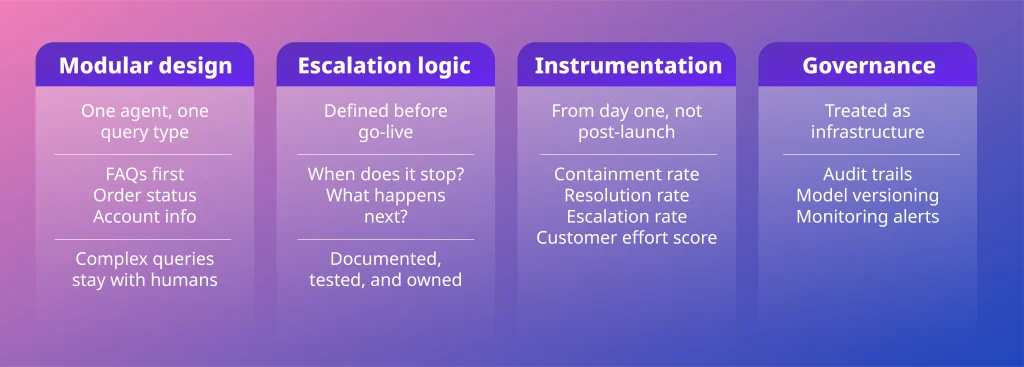
Governance in agentic systems goes beyond audit trails and monitoring; what enterprise control looks like when AI takes autonomous actions is a separate challenge most CTOs underestimate until it is too late.
Stop Measuring Cost Per Contact: The Metrics That Actually Reflect AI Agent Performance
Most businesses reach for cost per contact first. It tells you what you spent. It does not tell you whether anything was actually fixed.
Containment rate and resolution rate are different things. An agent can contain a query, meaning the customer does not escalate to a human, while still leaving the issue unresolved. High containment with low resolution is a customer satisfaction problem waiting to surface in your NPS data.
The Performance Dashboard Your Head of Customer Experience Should Be Reviewing Weekly
- Containment rate vs resolution rate: Are queries being closed, or are they just being deflected?
- Customer effort score: Is the agent reducing friction or just deflecting it?
- Escalation rate and escalation reason analysis: What is the agent consistently failing to handle?
- Sentiment drift over time: Is the experience degrading as edge cases accumulate?
- Model performance metrics: Reviewed regularly instead of waiting for a crisis point
A Realistic UK Enterprise Delivery Timeline (That Your Board Will Approve)
A well-scoped AI customer service agent for a single channel, built on clean data with clear integration paths, should reach production in three to four months.
A multi-channel deployment with legacy system integration and regulatory complexity takes six to nine months for a properly governed production system.
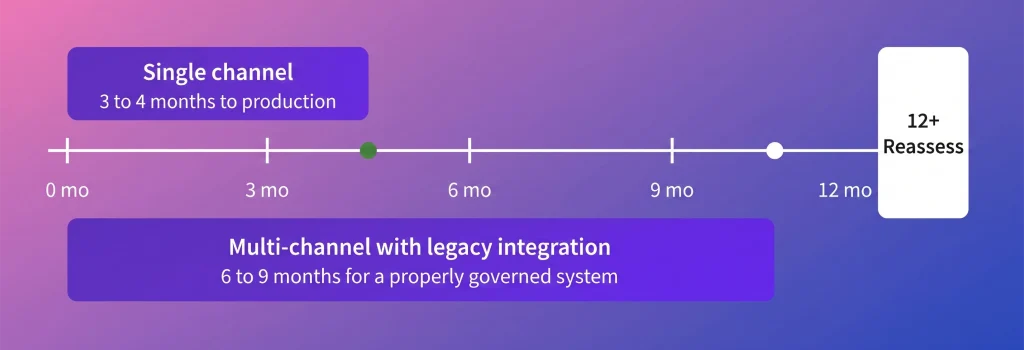
Anything beyond twelve months for a clearly scoped initiative warrants close examination. Projects running that long are almost always carrying unresolved ownership questions, integration problems that were deprioritised early, or governance requirements that were never properly mapped.
Red flags that your programme is running off course:
- No named executive is accountable for delivery outcomes
- Compliance input arriving at the end rather than embedded throughout sprints
- Scope expanding to accommodate stakeholder requests rather than staying fixed around a defined use case
The One Structural Pattern Shared By Every Successful UK AI Customer Service Deployment
The red flags are predictable precisely because the success factors are consistent: one accountable executive, compliance embedded from sprint one, and a scope that stays fixed around a defined use case.
The detail that separates the fastest deployments is where they started. One query type. High volume, low risk, clearly defined success criteria. Proved it. Then scaled.
The right delivery partner has a production track record. Specifically, the ability to take an AI system from working prototype to live enterprise deployment, across real infrastructure, under real compliance requirements.
If Your AI Customer Service Project Is Stalled, Here Is the Specific Fix
The organisations that close the pilot-to-production gap fastest are the ones that resolved the structural questions early: who owns delivery, where compliance sits in the process, and what the first use case actually is.
Deployflow works with UK enterprises on the pilot-to-production transition for AI customer service specifically. That covers agent architecture, CRM and ticketing integration, compliance-aligned delivery for FCA and ICO-regulated environments, and the monitoring infrastructure that keeps the system performing after go-live.
After losing its internal DevOps team, Strike (now Purplebricks) brought Deployflow in to stabilise a failing production environment. The result was a 70% improvement in cloud stability and a 60% reduction in downtime.
Little Journey, a regulated paediatric healthcare platform, needed to scale without compromising medical compliance and left with 100% data segregation and deployment timelines cut by 80%.
Different sectors, different problems, same outcome: systems that hold up when it matters.
Book a free consultation with Deployflow’s engineering team and leave with a clear diagnosis of exactly where your delivery is breaking down and what it takes to fix it.
Frequently Asked Questions: AI Agent Development for Customer Service in UK Enterprises
When should a business not use an AI agent for customer service?
When the query type is too variable to define clear success criteria, when the underlying data is too fragmented or outdated to train on reliably, or when the regulatory exposure of getting it wrong outweighs the efficiency gain.
AI agents work best on high-volume, predictable query types with clear resolution paths and measurable outcomes. Deploying one across a broad, undefined scope before those conditions exist is one of the most reliable ways to produce a pilot that never reaches production.
The right question to ask before building is whether the organisation has the data quality, integration readiness, and governance structure to support it. If any of those are not in place, fix the foundation first.
How do I get internal buy-in for an AI customer service project?
Start with a single use case that has a measurable baseline: a query type with known volume, known handling time, and a clear definition of what resolution looks like. Proving value on one narrow problem is significantly easier to fund, deliver, and defend to a board than a broad transformation programme.
The mistake most organisations make is presenting AI customer service as a platform initiative rather than a specific fix to a specific problem. Boards approve specific problems with specific metrics. Once the first use case is live, the numbers are real, and the internal conversation shifts from risk to scale.
What data do I need before starting an AI customer service build?
At minimum: a clean, representative sample of recent customer interactions, a clear taxonomy of query types and their resolution paths, and an honest assessment of where that data has gaps or reflects behaviour that no longer applies.
Models trained on data that is more than two to three years old will underperform from day one because the customer base, product set, and language patterns will have shifted.
Beyond volume, data quality matters more than most teams expect. Incomplete records, inconsistent labelling, and missing context from legacy CRM migrations are the most common reasons a model that performed well in testing falls short in production. The data audit should happen before architecture decisions are made.
Can AI agents handle emotionally sensitive customer interactions?
They can recognise sentiment signals and trigger escalation logic accordingly, but they should not be handling emotionally sensitive interactions autonomously. Complaints involving distress, bereavement notifications, vulnerability disclosures, and high-stakes financial decisions all require human judgment, empathy, and contextual reasoning that current agentic systems cannot reliably replicate.
Under the FCA Consumer Duty, firms are required to demonstrate that vulnerable customers receive appropriate support, which sets a high bar for any automated interaction in that territory. The architecture decision is how to ensure the agent identifies those interactions quickly, escalates without friction, and hands off with enough context that the human agent does not have to start from scratch.
How do I future-proof an AI customer service agent as the technology evolves?
Build modular from the start. An agent architecture tied to a single vendor’s model or built as a monolithic system becomes a significant liability the moment better options emerge, and in the current AI landscape, that moment arrives faster than most enterprise procurement cycles can accommodate.
The enterprises with the most flexibility are the ones that separated the agent layer from the integration layer from the governance layer at the build stage. That separation means individual components can be swapped, upgraded, or extended without re-engineering the entire system. It also means the monitoring and governance infrastructure built now remains relevant regardless of which model sits underneath it.
The infrastructure investment made at this stage is what determines how quickly and cheaply the organisation can move when the technology shifts again, and it will.
Explore our BLOG
Recent articles

ISO 42001 Explained: Requirements, Certification and What Your Engineering Team Must Build
ISO 42001 is the international standard that demonstrates your organisation governs AI properly, and enterprise...
read full article

Is Claude Down? Anthropic Outage: Protect Your Cloud Infrastructure
Claude went down across every surface on 29 September 2026. From 14:00 to 14:59 UTC,...
read full article

Top 10 Healthtech Companies in 2026: What Their Growth Means for AI and DevOps
Every software change that reaches a hospital has to clear regulatory, legacy system, and clinical...
read full article