


You can roll out AI across a regulated financial platform and keep your ISO 27001 certification intact. Most teams do not believe that, and their own certificate is the reason. That gap between paper and production is where your exposure sits.
The route through is simpler than the risk suggests. Treat AI as an in-scope asset, map it to the controls you already hold, and enforce them automatically on every release.
Compliance then becomes something your pipeline proves and not paperwork your team chases before each audit. None of it means re-certifying from scratch.
Executive Summary
- The five blind spots ISO 27001 leaves around AI: non-deterministic output, data lineage, shadow AI, model drift, and third-party model risk
- Where DORA, the EU AI Act, and FCA expectations stack on top of 27001, and how ISO 42001 closes the gap
- What auditors demand once models enter scope, from versioning to data provenance to explainability
- How to bring AI into a certified ISMS without re-certifying
- How Compliance as Code keeps audit readiness continuous, giving your board a live risk position
Does ISO 27001 Cover AI Systems in Finance?
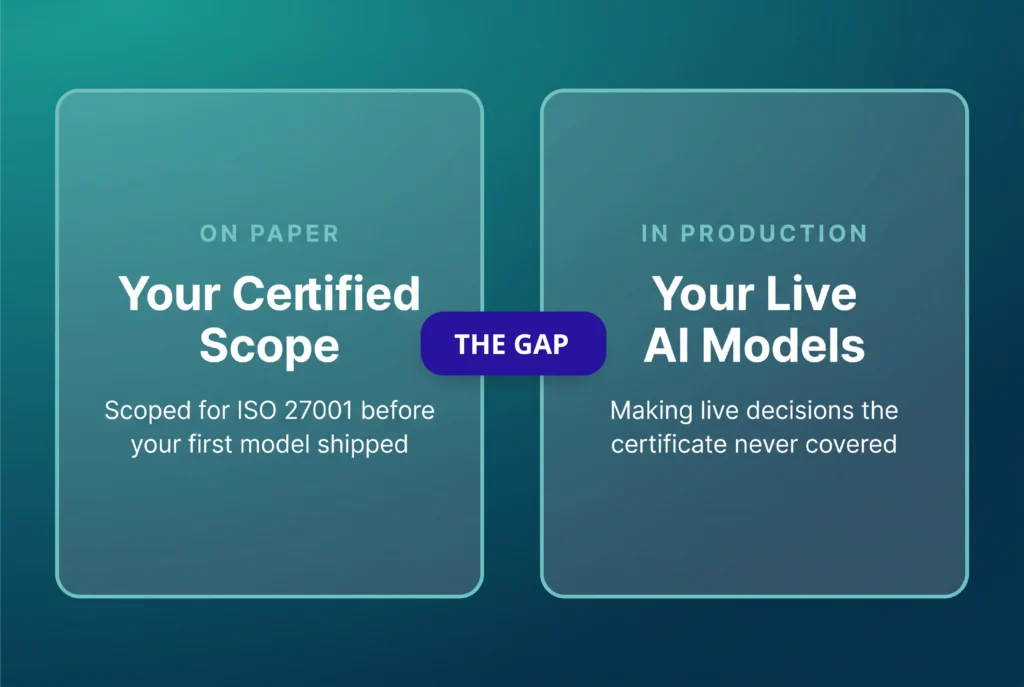
ISO 27001 covers the ground around your AI. The model itself sits in the gap.
Partly. The gap is where your risk lives. ISO 27001 is strong at what it was built for. Access control, supplier management, and secure development all sit inside its management system.
The 2022 revision modernised it further, adding controls for secure coding, threat intelligence, and data masking that map onto how software ships today.
AI introduces risks the standard never anticipated. Five gaps matter most:
- Non-deterministic output. A model’s answer can change between runs, which makes “prove what this system did and why” far harder than it is for ordinary code.
- Data lineage. Training and prompt data raise provenance questions a classic asset register ignores.
- Shadow AI. Staff reach for ungoverned tools, moving sensitive data outside your controls without a ticket.
- Model drift. As live data diverges from what a model learned on, a control that held at certification can quietly stop holding months later.
- Third-party model risk. The supplier is often an API you cannot inspect. If it retrains or changes how it handles data, your exposure shifts without a line of your own code changing.
None of this makes 27001 redundant. The certificate covers the ground around your AI. The model itself sits in a gap you have to close on purpose.
AI Regulation for Finance: DORA, the EU AI Act, and ISO 27001
Financial services sits among the most heavily regulated sectors, and AI has stacked new rules on top of the ones you already run. Two of them target AI and resilience head-on.
DORA has applied to EU financial entities since 17 January 2025, covering ICT risk across the third-party providers and services your platform depends on, including the AI models delivered through them.
The EU AI Act goes a step further. It classes creditworthiness assessment as high-risk under Annex III, which brings obligations on data governance, human oversight, and monitoring.
In the UK, the FCA and the Bank of England have set their own expectations on model risk and the safe use of AI.
Underneath sit the data rules that never went away. PCI DSS, PSD2, and GDPR still govern how payment and personal information moves through your systems, and AI touches all three.
ISO 27001 secures the management layer around them, yet stops at the edge of the models themselves. Closing that gap is a scoping exercise, extending the ISMS you already run to cover how a model behaves, where its training data came from, and the human oversight a regulator now expects. ISO 42001 formalises that layer.
Miss it, and the cost arrives twice over: the scramble to remediate, and the roadmap that slips while releases wait on an audit you cannot pass. The guide to the changing UK AI governance landscape maps where the rules head next.
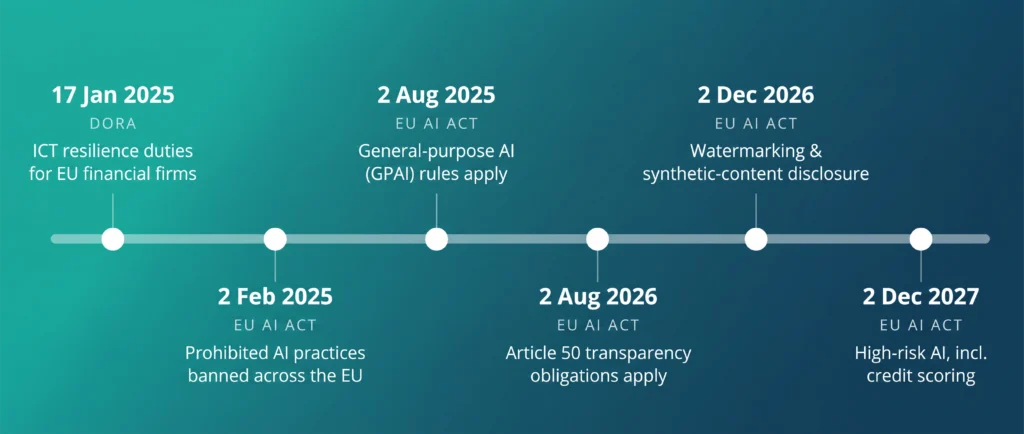
The rules do not land at once, and it helps to know which clock you are racing. Article 50 transparency obligations apply from 2 August 2026. Machine-readable marking of AI-generated content applies from 2 August 2026 on newly deployed systems, extending to systems already in production by 2 December 2026. High-risk obligations governing credit scoring now fall on 2 December 2027.
EU AI Act Deadlines for UK Financial Firms
Key deadlines, in the order they take effect:
How AI Breaks Your ISO 27001 Audit Trail
Auditors want one thing above all: to see what a system did, and why. Deterministic software answers that easily. A model whose output shifts from one run to the next does not.
Expect the questions to change. Model and prompt versions become evidence, and data provenance is now mandatory. A record of who touched which model starts to matter as much as your firewall configuration.
Explainability goes further still: a regulator reviewing a declined loan will want the reasoning behind the decision, down to the factors that drove it. Miss any of this, and a feature that cleared review in the morning can fail an audit by the afternoon.
Keeping that record intact is a pipeline problem. The fix lives in how you ship, through audit-ready CI/CD pipelines that bake PCI DSS, SOC 2, and FCA evidence into every change. The trail then writes itself with each release, rather than getting pieced together the week before an audit.
How to Add AI to Your ISO 27001 Scope Without Re-Certifying
Extending your certification does not mean starting again. A handful of deliberate updates bring AI inside the management system you already run.
- Inventory your AI as assets. Record every model, data source, and third-party API in your asset register, each in its own right rather than buried inside an application.
- Reassess risk and update the Statement of Applicability. With those assets in view, run them through your risk assessment and document which controls now apply, and why.
- Bring model providers under supplier control. Treat each provider as a supplier, so external AI faces the same due diligence as any other vendor you depend on.
Handled this way, AI adoption strengthens your posture instead of threatening the certificate. Your compliance lead gets a clear sequence to follow, and your auditors see a management system that has kept pace with what you build.
Defining the controls is half the work. The other half is deciding who owns each one, because an unassigned control is the first to fail an audit.
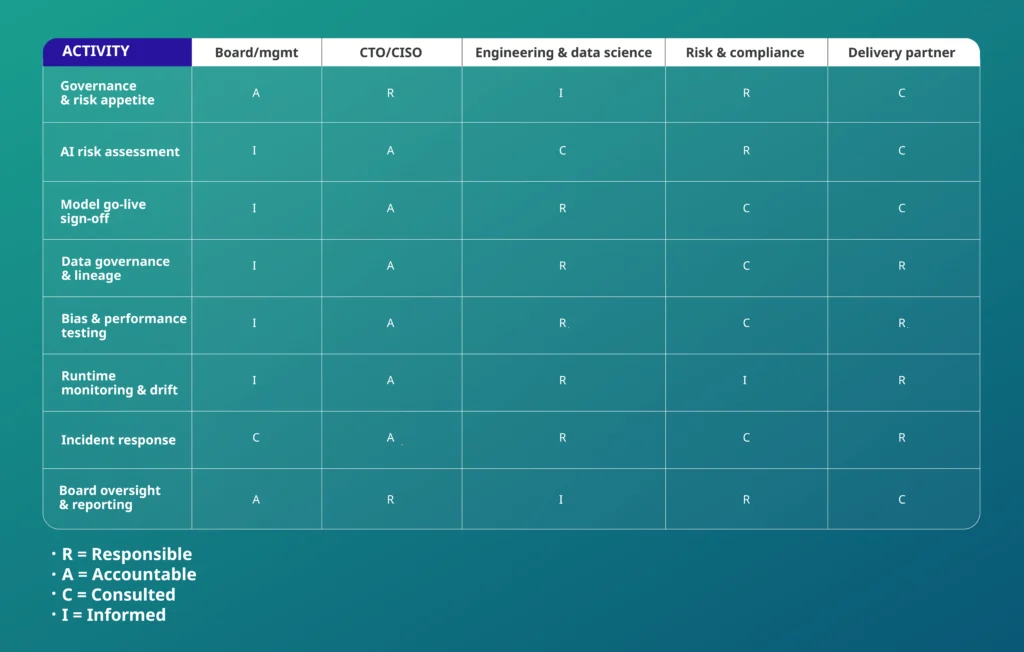
AI Governance Responsibilities Mapped in a RACI
A RACI map for assigning AI compliance responsibility:
As your use of models deepens, ISO 42001 adds the AI-specific layer that sits above 27001, the natural next step once scoping is under control.
Compliance as Code: Automate Your ISO 27001 Controls
Manual compliance cannot keep pace with AI. Models change weekly, so evidence gathered by hand is stale before the auditor arrives. Writing the controls into code is what closes the gap.
Compliance as Code turns your controls for ISO 27001, Cyber Essentials, and GDPR into versioned, reviewable policy files.
A GDPR data-residency rule, for instance, becomes a policy that blocks any release attempting to store regulated data outside its permitted region. The evidence for each control is generated as the pipeline runs, so your compliance position reflects this morning’s release rather than last quarter’s paperwork.
Building this into delivery is the job of a managed DevSecOps practice, where the pipeline enforces the policy on every release. Remediation time falls by 90%, and every pull request is scanned for misconfigurations before it merges. Audit readiness holds across ISO 27001 and Cyber Essentials, without the scramble that usually precedes a review.
Security shifts left at the same time. Static analysis, dynamic testing, and dependency scanning run inside the build, and findings are ranked by exploitability so the fixes that matter land in the same sprint. Releases stay fast, and risk stays managed inside the pipeline.
Your AI Is Only as Secure as Its Pipeline
A secure model still fails if the pipeline serving it is exposed.
The infrastructure around AI needs the same rigour as the model itself, at every layer between commit and production.
Start with the running workload. Container and Kubernetes security protect the services that host your models at scale, while secrets management and policy enforcement sit inside the CI/CD pipeline instead of being bolted on afterwards.
Ahead of each release, dependency scanning flags risk across your APIs and integrations, so nothing breaks downstream. Self-healing infrastructure catches problems early and corrects them before customers notice, and on the rare deployment that still fails, automated rollback steps in with a full log of what happened and why.
The outcome is delivery that moves at the speed of your engineers while holding the line on risk. That combination has cut deployment time by as much as 70%, with controls enforced on every change.
Ownership stays with you throughout, everything documented and version-controlled.
Give Your Board a Live View of AI Risk
Your board needs a current risk position, and AI moves the estate faster than the reporting cycle can track. A quarterly snapshot ages badly: by the time leadership reads it, the report flags exposures you have already closed and misses the ones that opened since.
Live metrics give the board a view that keeps up. Exposure by environment, remediation lead time, control coverage, and audit readiness update continuously, so leadership tracks the position as it changes rather than reconstructing it a quarter late.
Control coverage shows how much of your estate the policy actually reaches. Remediation lead time shows how fast an exposure closes once found.
If you operate inside DORA’s scope, a live view maps to how the rules already work: DORA expects continuous monitoring of ICT risk, with the risk-management framework reviewed at least annually, and your AI systems sit inside that same domain. A board seeing only the quarterly is reading a lagged slice of a system meant to run live.
Proven in Regulated, High-Growth Delivery
Deployflow is a transformation delivery partner for regulated, high-growth teams, and its core strength is removing a trade-off most of them accept: shipping fast while keeping a compliance and risk position that holds up under audit.
How the Delivery Model Works
- Embedded senior engineers who work inside your team from day one, backed by deeper platform and security specialists
- Security and compliance built into the pipeline from the first commit, so audit evidence is generated as the platform runs
- AI-assisted monitoring across the estate, giving continuous risk visibility in place of a periodic snapshot
- Full ownership of your pipelines and infrastructure, with no proprietary tooling and no lock-in
- ISO 27001 and Cyber Essentials certified, delivering across AWS, Azure, and Google Cloud
Case Studies From Regulated Sectors
Zilch scaled from MVP to a double unicorn valued above $2bn in buy now, pay later, one of the most tightly regulated corners of fintech. Deployflow ran the cloud and delivery underneath that growth, closing complex API integrations inside a month while the audit trail held.
“They assembled a dedicated workforce, enabling us to transform our vision into reality. Their seamless team-building and thorough knowledge transfer have been instrumental in bringing our product to life.”
Sean Hederman, CIO, Zilch
Little Journey applied the same discipline in healthtech, where patient data raises the bar again. Terraform-built environments cut deployment from days to roughly two hours and met medical-compliance rules with complete data segregation.
“I enjoy working with the Deployflow team and appreciate their adaptiveness and responsiveness – they offer strategic advice and do a good job at balancing the need to put security first whilst also developing and maintaining our services in a way that meets our users’ needs.”
Ian Knott, Regulatory and Governance Lead, Little Journey
Strike, now Purplebricks, brought Deployflow in after losing its internal DevOps team. CTO Dan Rafferty credits the CI/CD work with a marked lift in release reliability, alongside a 60% cut in downtime and near-total elimination of outages.
“Working with Deployflow has been a game-changer for our organisation. From the outset, their team demonstrated a deep understanding of our needs and challenges. Their expertise in streamlining our development and operations processes has significantly improved our efficiency and productivity.”
Dan Rafferty, CTO, Strike
A Live View, Designed at National Scale
For a multi-billion-dollar UAE public-sector organisation, Deployflow designed the live executive view this piece argues for, at national scale:
- Real-time pipelines behind a continuous leadership view of economic and social indicators
- Regional breakdowns, with policy milestones layered onto the trend lines
- Many inputs distilled into a handful of high-level measures, modelled on financial market indices
The engagement is approved and into its first build phase, and the discipline behind it begins where every Deployflow engagement does, with an assessment of your current position.
Find the Gaps Before an Auditor Does
You cannot fix an exposure you have not mapped. An audit shows where your models have widened your risk surface, then hands you a prioritised plan that closes the gaps while your certification holds. The work embeds in your team, so knowledge transfers as it happens and you are left running the result yourself.
Start with a free consultation and turn AI compliance from a blocker into proof your pipeline delivers on every release.
Frequently Asked Questions on AI and ISO 27001 Compliance
Does the EU AI Act Apply to UK Financial Firms?
Yes, if you place AI systems on the EU market or the output of your AI is used inside the EU, even though the firm sits in the UK.
The Act reaches providers and deployers by where the system or its output lands, so a UK lender scoring EU-based customers, or running an EU-facing product, falls in scope. Purely domestic UK use stays outside it, though FCA expectations and UK data protection law still apply. Mapping which of your models touch the EU is the practical starting point, since scope is decided model by model and not at company level.
Can AI Models Process Customer Personal Data Under GDPR?
Yes, provided you have a lawful basis, minimise the data used, and stay transparent about how the model uses it.
A credit or fraud model handling personal data carries the same GDPR footing as any other processing, with particular weight on purpose limitation and data minimisation, which sit awkwardly against training on large historical datasets. Where a model makes a decision with legal or similarly significant effect, such as declining a loan with no human involved, Article 22 gives the customer a right to meaningful information, human review, and grounds to contest the outcome.
Using special category data to test a model for bias is now permitted in narrow circumstances under recent amendments, though significant safeguards apply and it can only be relied on in limited circumstances, so document the basis before you lean on it.
Does the EU AI Act Classify Credit Scoring as High-Risk AI?
Yes. Assessing the creditworthiness or credit score of individuals is listed as high-risk, with fraud detection the main carve-out.
High-risk status brings the Act’s heaviest obligations, covering risk management, data governance, logging, human oversight, and technical documentation.
The deadline for these Annex III obligations recently moved: the Digital Omnibus (Regulation (EU) 2026/1744) was published in the Official Journal on 24 July 2026 and pushes the high-risk deadline from 2 August 2026 to 2 December 2027. Credit teams gain runway, but transparency and watermarking arrive first.
Treat that as time to build the controls properly rather than a reason to pause, since systems placed on the market before the deadline avoid the high-risk requirements only until they are substantially modified afterwards.
How Long Does ISO 42001 Certification Take?
Usually three to six months for an organisation already running a mature ISO 27001 ISMS, and longer if you are building the management system from scratch.
The timeline turns on how much groundwork exists: AI governance policies, an inventory of AI systems, risk assessments, and defined roles. Where a certified ISMS is in place, much of the structure and evidence carries across, and the effort concentrates on the AI-specific controls ISO 42001 adds. A two-stage external audit follows, and most of the calendar goes into preparation rather than the audit itself.
Who Is Accountable for AI Compliance, the Board or the CTO?
The board holds ultimate accountability, while the CTO or a named control function owns it operationally.
Under DORA, the management body carries final responsibility for the ICT risk framework, and that responsibility extends to the AI systems inside it, so accountability cannot be handed off to a vendor or a single engineer. Day-to-day, a defined owner (often the CTO, CISO, or a dedicated AI governance lead) runs the controls, evidence, and reporting. The split holds up under audit only when it is written down, with clear reporting lines from the operational owner up to the board.
Explore our BLOG
Recent articles

How can a DevOps team leverage the power of AI?
Your CI/CD pipeline is automated, but it still can’t see trouble coming. Alerts land after...
read full article

Why Regulated Industries in the UK Are Getting AI Wrong
Your pilot works. It has worked for months. It still cannot go live, and every...
read full article

What Is AI Foundry, and Why Should CTOs Care?
Somewhere in your Azure tenant, an AI workload is running that nobody formally approved. It...
read full article