



You are already behind on regulatory compliance if you are waiting for a formal UK AI Act before funding your governance architecture. The government is not passing a standalone AI bill this parliamentary session. Instead, binding enforcement has already arrived via targeted regulatory updates.
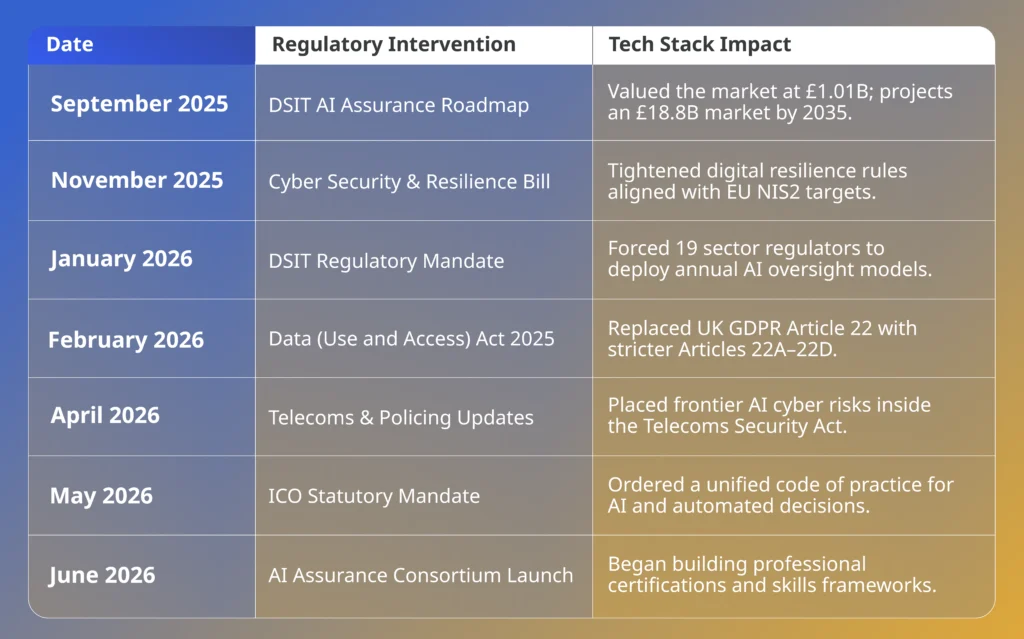
New automated decision-making duties took effect in February 2026. Sector regulators also received aggressive new mandates in January.
Enterprise buyers in regulated sectors increasingly demand documented governance proof before signing software contracts.
Fixing this does not require a complex statutory overhaul. It requires a lean, auditable framework built on a live inventory, ISO 42001 compliance, and a single accountable owner.
Executive Summary for IT Leadership
- The Regulatory Reality: The May 2026 King’s Speech confirmed no standalone UK AI bill. Regulation remains strictly regulator-led.
- The Active Deadline: New UK GDPR rules on automated decisions (Articles 22A to 22D) have been active since 5 February 2026.
- The Cross-Border Threat: The EU AI Act still impacts UK firms. Generative AI transparency duties land on 2 August 2026, with high-risk deadlines following in December 2027 and August 2028.
- The Commercial Impact: DSIT projects the AI assurance market will reach £18.8 billion by 2035. Procurement teams, insurers, and auditors will police this space.
- The Market Gap: McKinsey reports that only one-third of organisations possess a strong AI strategy and governance maturity.
The Death of the UK AI Bill: How Regulators Became Your Main Compliance Threat
The UK government deliberately chose rapid commercial growth over a centralised, rigid statute. AI compliance is now enforced directly through the existing regulators you already answer to.
Visualising the Path: Your UK AI Compliance Architecture
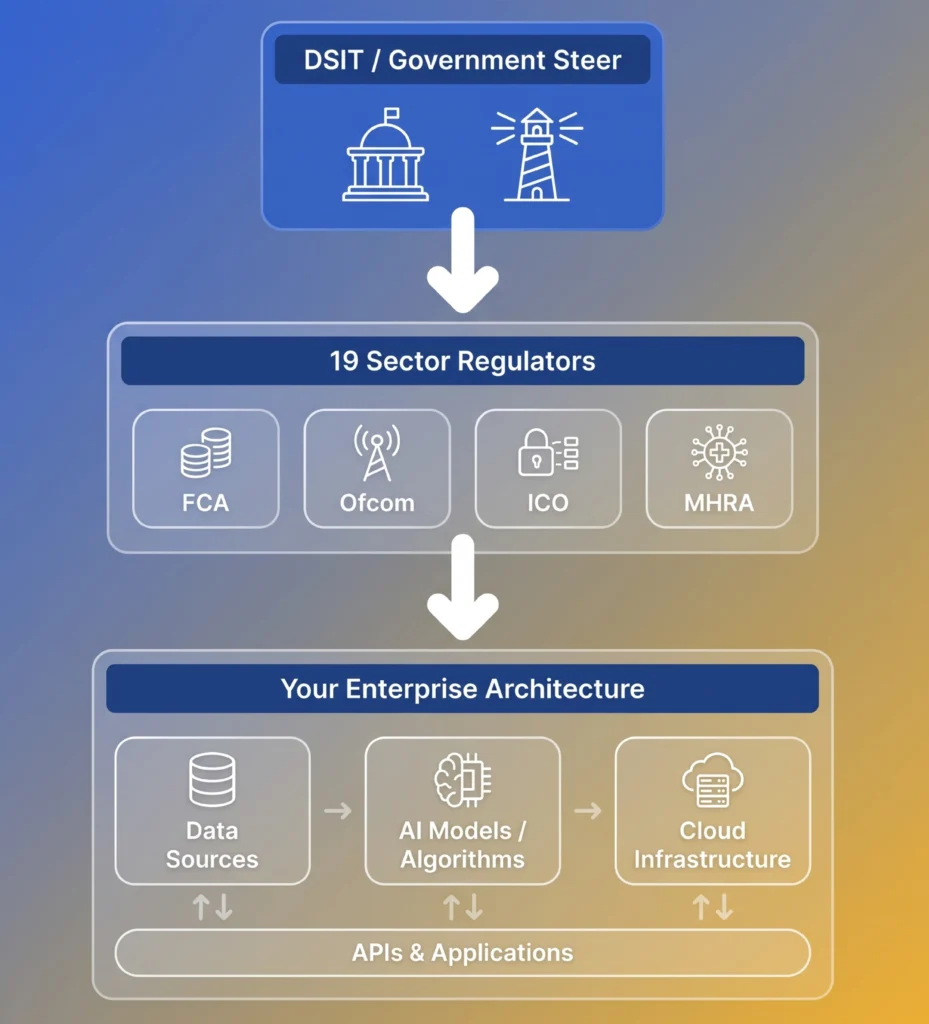
In January 2026, the Technology Secretary ordered 19 regulators to publish immediate AI safety plans. These watchdogs must now report progress annually.
The 2026 King’s Speech reinforced this decentralised model by announcing the Regulating for Growth Bill. Once passed, the bill will put regulatory sandboxes on a statutory footing and strengthen the growth duty on existing regulators.
Ministers will also gain a new statutory power to issue strategic steers directly to watchdogs. Successful trials inside regulatory sandboxes can then be embedded permanently into law through secondary legislation.
Additional enforcement arrives through secondary amendments. For example, the Crime and Policing Act 2026 created powers to bring illegal AI-generated content and chatbot services within the Online Safety Act, with the first regulations expected by the end of 2026.
The CTO Impact: There is no single future deadline to put on your roadmap. Your specific sector regulator is writing the rulebook right now.
UK AI Regulation Timeline: The 12-Month Shift
Already in Breach? The Hidden February 2026 Automated Decision Deadline
Your systems are already operating under strict new compliance standards if your software uses automated profiling to make decisions about individuals.
New UK GDPR rules under Articles 22A to 22D became active on 5 February 2026. These updates allow automated decisions in more scenarios, but they demand heavy, documented safeguards.
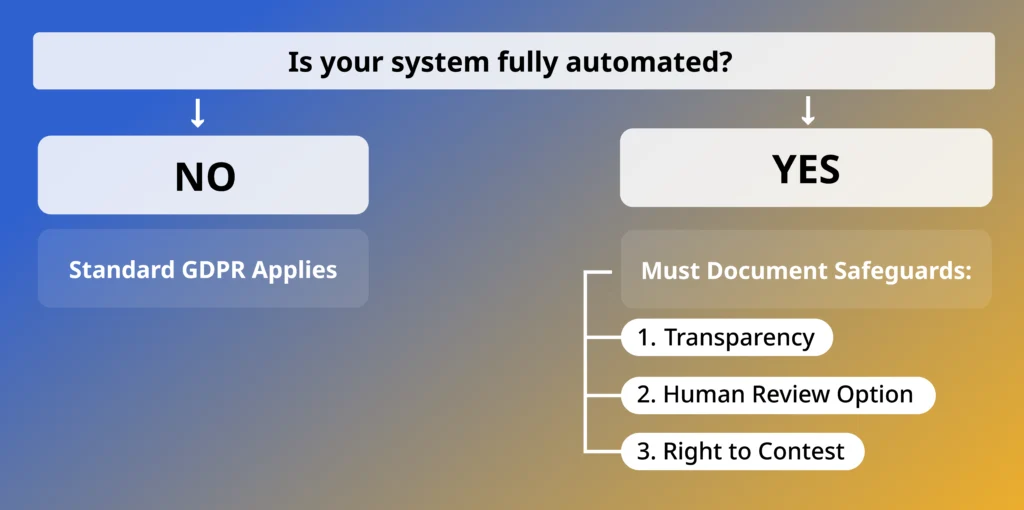
An undocumented safeguard will fail an Information Commissioner’s Office (ICO) inquiry. The ICO has a statutory duty to codify exactly what constitutes compliant automation.
Sector regulators are adding their own enforcement weight. The Financial Conduct Authority (FCA) tackles AI through the Consumer Duty framework. Meanwhile, Ofcom has opened formal investigations into AI companion services and user-facing chatbots under the Online Safety Act.
The EU AI Act Loophole Is Closed: The Critical Deadlines UK CTOs Must Watch
Brexit offers zero protection against EU AI Act enforcement if your software serves European users or processes their data. The legal test relies purely on EU market impact.
A Manchester-based SaaS platform with users in Dublin falls fully inside the regulatory scope.
The compliance timetable shifted following a provisional agreement on the Digital Omnibus. The updated compliance roadmap requires strict adherence to these specific deadlines:
- 2 August 2026: Transparency duties for generative AI take effect.
- 2 December 2027: High-risk compliance requirements apply to standalone AI systems.
- 2 August 2028: Stricter rules apply to AI embedded within pre-regulated products.
Maintaining two separate product architectures doubles your compliance surface. The cheaper long-term choice is to harmonise upwards. Building once to the highest international standard costs less than running split governance stacks.
The Procurement Bottleneck: How ISO 42001 Protects Enterprise Deals
Commercial contracts are enforcing AI safety much faster than government legislation. Enterprise procurement teams, legal counsels, and insurers now treat AI governance as a mandatory contractual obligation.
Regulated markets are moving first, because their procurement teams already run security and resilience audits and can extend them to AI with minimal friction:
- Defence and Aerospace
- Financial Services and Fintech
- Health and Social Care
- Justice and Public Sector Education
ISO 27001 Security Foundation + AI Risk Controls = ISO 42001 Readiness
ISO/IEC 42001 serves as the definitive international standard for an AI Management System (AIMS). It proves to enterprise buyers that your entire AI infrastructure is inventoried, risk-assessed, and monitored.
Teams holding ISO 27001 can accelerate this process. The existing governance forums, risk methodologies, and audit frameworks extend naturally to AI.
McKinsey’s AI Trust Maturity Survey puts average responsible AI maturity at just 2.3 out of 5.0, and the gap between leaders and laggards is widening. Two-thirds of enterprises still lack strong governance across strategy and agentic AI, while nearly two-thirds of leaders name security as the biggest barrier to scaling autonomous agents.
Boards are reading the same survey. Expect direct questions about where your systems sit on that scale.
The 6-Step Technical Roadmap for Compliant AI Architecture
This architecture roadmap generates the exact audit trail required by regulators, enterprise buyers, and corporate insurers.
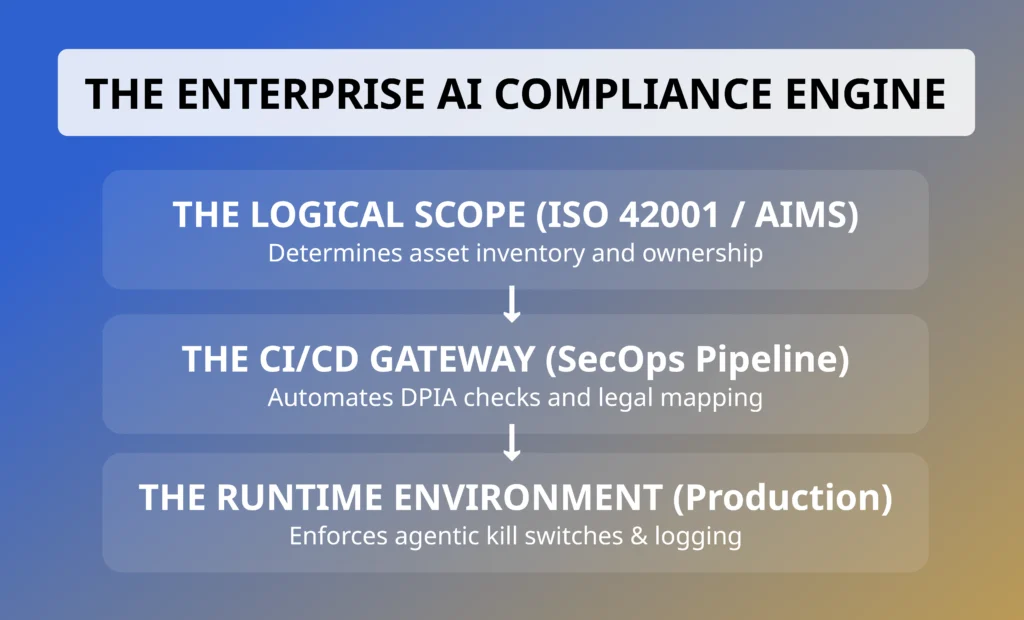
1. Automate a Live AI Asset Inventory
The Action: Continuous discovery across your ecosystem.
The Technical Execution: Do not rely on manual spreadsheets. Deploy automated discovery tools to scan your production environments, cloud clusters, and CI/CD pipelines. This process must map third-party APIs, vendor-embedded models, and unsanctioned shadow AI applications. Enterprise governance requires a dynamic, real-time registry.
2. Map Legal Foundations and Jurisdictional Blast Radius
The Action: Compliance classification by design.
The Technical Execution: Run the strict UK GDPR Articles 22A-22D test on all automated decision engines. If a system automates choices about individuals, you must flag it for immediate engineering safeguards. Concurrently, map where your data flows and where your outputs are consumed. That mapping determines whether the EU AI Act high-risk deadlines directly impact your codebase.
3. Merge ISO 42001 Controls into Existing Scaffolding
The Action: Infrastructure reuse over rebuild.
The Technical Execution: Do not build an entirely new compliance silo. Map the AI Management System (AIMS) framework of ISO/IEC 42001 directly onto your existing ISO 27001 Information Security Management System (ISMS). You can rapidly accelerate deployment by recycling your established access controls, risk management workflows, and internal audit cadences.
4. Enforce Hard Guardrails for Agentic AI
The Action: Containment protocols for autonomous models.
The Technical Execution: Autonomous agents act instead of merely answering. Because of this, you must build explicit runtime boundaries before scaling these systems. Implement deterministic validation layers, secure execution sandboxes, continuous audit logging, and automated kill switches. Retrofitting these containment frameworks onto live production models causes severe system incidents.
5. Bake Automated Assurance into CI/CD Pipelines
The Action: Shift-left compliance documentation.
The Technical Execution: Manual documentation delays deployments. To fix this, treat regulatory evidence as code. Integrate automated checks into your deployment pipelines to generate model cards, data lineage graphs, and algorithmic impact assessments during every build cycle. This automation turns stressful procurement reviews into a standard, friction-free formality.
6. Appoint a Single Technical AI Owner
The Action: Clear accountability at the board level.
The Technical Execution: Distributed responsibility fails in enterprise environments. Assign a single senior technical leader, such as your CTO or CISO, with the formal mandate for AI safety. Support this leader with a cross-functional engineering committee. Establish a direct, fixed reporting cadence to the executive board.
If You Only Have 30 Days
- Pull a manual list of every system making automated decisions about individuals. Imperfection beats absence when the ICO asks.
- Check each against the Articles 22A to 22D safeguards: transparency, human review option, and right to contest.
- Name your accountable AI owner in writing and put the first board reporting date in the diary.
Everything else in the roadmap builds on these three moves.
Stop Letting Governance Gaps Kill Your B2B Sales: Secure Your Infrastructure
Designing compliant architecture from your first sprint costs a fraction of retrofitting it later. NASA’s error-cost research shows that fixes made after deployment cost up to 10 times as much as those made at the design stage. Bolting compliance frameworks onto deployed software delays enterprise deals and introduces severe architectural risk.
Deployflow removes this architectural friction by integrating automated compliance validation directly into your CI/CD pipelines through core AI engineering and DevSecOps. Governance stops being an administrative layer. Security boundaries are hardcoded into your deployment infrastructure from day one.
Practical execution includes engineering national-scale platforms delivered inside air-gapped government infrastructure, where every model weight, training dataset, and access control path passes rigid security validation before production deployment.
Find Your Governance Gaps Before Your Buyers Do
Hidden regulatory gaps freeze enterprise sales pipelines at the procurement stage, long after your engineering work is done.
Book your free AI governance consultation and get a prioritised view of exactly where your architecture falls short of ISO 42001, UK GDPR Articles 22A to 22D, and EU AI Act requirements.
Frequently Asked Questions: Crucial UK AI Compliance Queries Answered
What are the UK AI Act penalties for non-compliance?
Because the UK bypassed a standalone AI Act in favour of a regulator-led model, there is no single schedule of fines. Instead, penalties are dictated by the specific watchdogs enforcing safety.
If your system violates data privacy or automated decision-making rules, the ICO enforces penalties under the UK GDPR up to £17.5 million or 4% of global annual turnover. Within financial services, the FCA can impose unlimited financial penalties or revoke regulatory permissions under its Senior Managers and Certification Regime (SM&CR).
Is an AI system compliance check mandatory for UK financial services?
Yes, validation is effectively mandatory under the FCA’s Consumer Duty and operational resilience rules.
The FCA and Bank of England mandate that financial institutions remain entirely responsible for any technology or third-party model they deploy. That responsibility covers availability as well as behaviour, and the 2026 Claude outages show why leaning on a single model provider is the kind of operational-resilience gap regulators now expect you to close.
If your software introduces bias or lacks transparency, senior leadership can be held personally liable under the SM&CR framework. Furthermore, passing an AI compliance check is required to clear enterprise B2B financial procurement processes.
Do I need a Data Protection Impact Assessment (DPIA) for AI tools under UK GDPR?
You must legally conduct a DPIA if your AI tools process personal data and utilise technologies that involve systematic, large-scale automated profiling.
Under current ICO regulations, deploying machine learning algorithms to analyse user behaviour, predict performance, or score individuals automatically triggers a mandatory DPIA. This assessment must be documented before any training data is ingested or code is pushed to production environments.
How does the EU AI Act apply to UK companies post-Brexit?
The Act applies based on where your outputs land, never on where your company is registered. If your UK-based enterprise develops or deploys software whose outputs are used within the EU, your infrastructure must comply fully, regardless of Brexit.
Violating high-risk obligations can result in penalties of up to €15 million or 3% of global revenue. UK CTOs must architect their infrastructure to conform to the strict European deadlines hitting in 2027 and 2028.
What are the legal risks of using open-source AI models in the UK?
Utilising open-source model weights does not shield your enterprise from copyright infringement, data privacy, and intellectual property liabilities under UK law. If the foundational open-source model was trained on copyrighted material without a license, your enterprise faces legal exposure if it reproduces protected assets. Additionally, open-source architectures lack vendor indemnification, meaning your organisation assumes 100% of the financial and legal responsibility for algorithmic drift or security vulnerabilities.
Explore our BLOG
Recent articles

How can a DevOps team leverage the power of AI?
Your CI/CD pipeline is automated, but it still can’t see trouble coming. Alerts land after...
read full article

Why Regulated Industries in the UK Are Getting AI Wrong
Your pilot works. It has worked for months. It still cannot go live, and every...
read full article

What Is AI Foundry, and Why Should CTOs Care?
Somewhere in your Azure tenant, an AI workload is running that nobody formally approved. It...
read full article