



AI engineering company evaluations are designed to satisfy procurement instead of protecting your engineering org. You do the calls, check the case studies, sign, and six months later, you’re maintaining a system you don’t own, built on decisions you weren’t part of. That outcome is a failure of evaluation criteria, and it’s entirely preventable.
S&P Global’s survey of over 1,000 enterprise IT leaders found that 42% of companies abandoned most of their AI initiatives before reaching production, up from 17% the previous year. The average organisation scrapped 46% of its proofs of concept. The organisation you choose is one of the most consequential variables in determining which side of those numbers you land.
The guide approaches company evaluation the way you’d assess a senior engineering hire: same rigour, same scepticism, same focus on what happens after the honeymoon ends.
TL;DR: Don’t Evaluate the Pitch, Evaluate the Exit
- A trustworthy AI engineering company builds for your team’s long-term ownership; the bad one builds its own continued dependency
- Audit MLOps maturity and production track record before anything else
- Lock down IP ownership (model weights, training data, inference infrastructure) in the contract
- Always run a paid PoC with defined success criteria before full engagement
- If they resist structured accountability at any stage, that’s your answer
Stop Evaluating Agencies and Start Evaluating Engineering Partners
The first mistake CTOs make is applying a standard vendor evaluation rubric to an AI engineering decision. That works for SaaS procurement, but not here.
Technical debt compounds. ML debt compounds faster. A poorly architected model creates cascading failures across your data pipelines, your inference layer, and eventually your product. The cost of a bad firm hire is measured in the engineering months required to undo what they built.
The right mental model: treat evaluation like a senior engineering hire. You wouldn’t extend an offer based on a portfolio and two reference calls alone. You’d assess how they think, how they handle ambiguity, and whether their judgment holds up under scrutiny.
The same standard applies here, with one additional variable. AI engineering means something different depending on who you ask. Some agencies build genuine ML systems with custom training pipelines, fine-tuned models, and production-grade MLOps. Others wrap GPT-4 API calls in a React frontend and invoice accordingly. Knowing who you’re dealing with is the entire evaluation.
Audit Their AI/ML Stack Fluency First
Before you review pricing, timelines, or team size, establish whether they actually build AI systems or merely use AI tools.
The distinction matters enormously. An organisation that builds systems has opinions on model versioning, experiment tracking, and data drift. A company that uses tools has a Notion page with a list of integrations.
Three questions that surface real depth immediately:
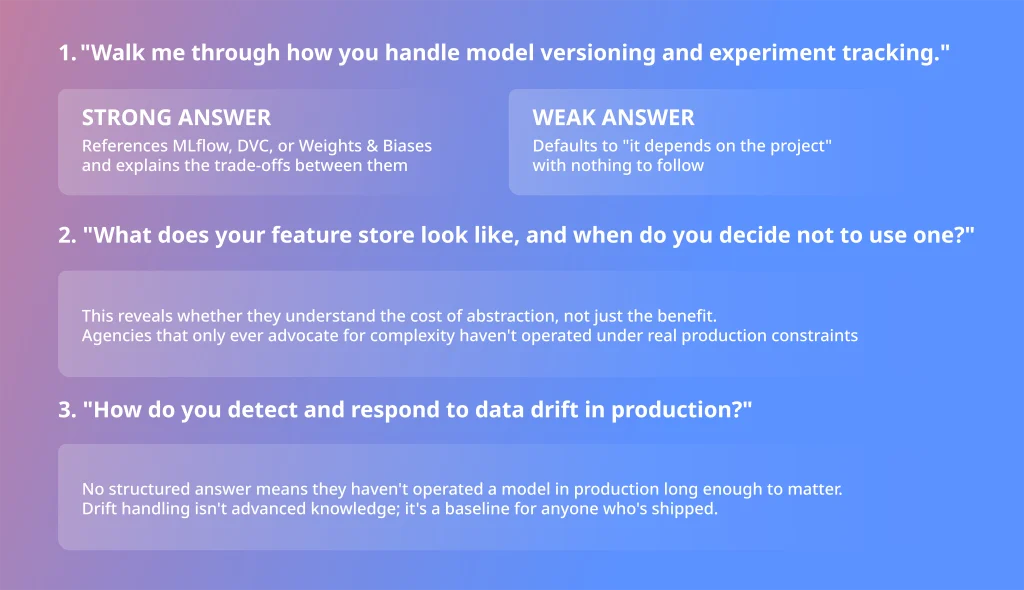
Also worth asking about: Feast for feature serving, Seldon or BentoML for model deployment, and their approach to inference optimisation. You’re establishing whether their architecture decisions are driven by engineering judgment or by whatever’s trending on Hacker News.
Green flag: They push back on your requirements with better alternatives.
Red flag: They default to “we use the best tools for the job” with no specifics to follow.
Read The Company Portfolio Like an Engineer, Not a Buyer
Organisations’ portfolios are marketing documents. They’re written to impress procurement teams. Reading them as an engineer requires asking the questions that aren’t answered on the page.
For any published case study, ask:
- What was the baseline model performance before the engagement, and what was the final result?
- How did the system perform six months post-launch?
- Who owns and maintains it today?
The third question is the most revealing. If the answer is “the client, fully independent,” that’s a strong signal. If there’s any ambiguity (ongoing retainers framed as “support,” proprietary tooling that requires company access), treat it as a dependency flag.
Watch for the wrapper company pattern: impressive-sounding use cases built entirely on GPT-4 or Claude API calls, with no custom training, fine-tuning, or meaningful architecture decisions. This isn’t inherently disqualifying. GPT wrappers are entirely appropriate for certain scopes. The problem is when agencies present them as bespoke AI engineering without the transparency to say what they actually built.
Finally, ask for a case where something went wrong. How they handled a mid-project pivot or a model that underperformed in production tells you far more about their engineering culture than any success story.
Assess MLOps and Production Engineering Maturity
The majority of AI projects fail in deployment. Evaluating a company’s production engineering maturity is therefore more predictive of project success than evaluating its modelling capability.
MIT Project NANDA’s 2025 research, covering over 300 real deployments, found that 95% of organisations deploying generative AI saw zero measurable return. The failure is in deployment maturity, data readiness, and production engineering, which is exactly what most evaluations fail to test.
Apply a simple maturity model:
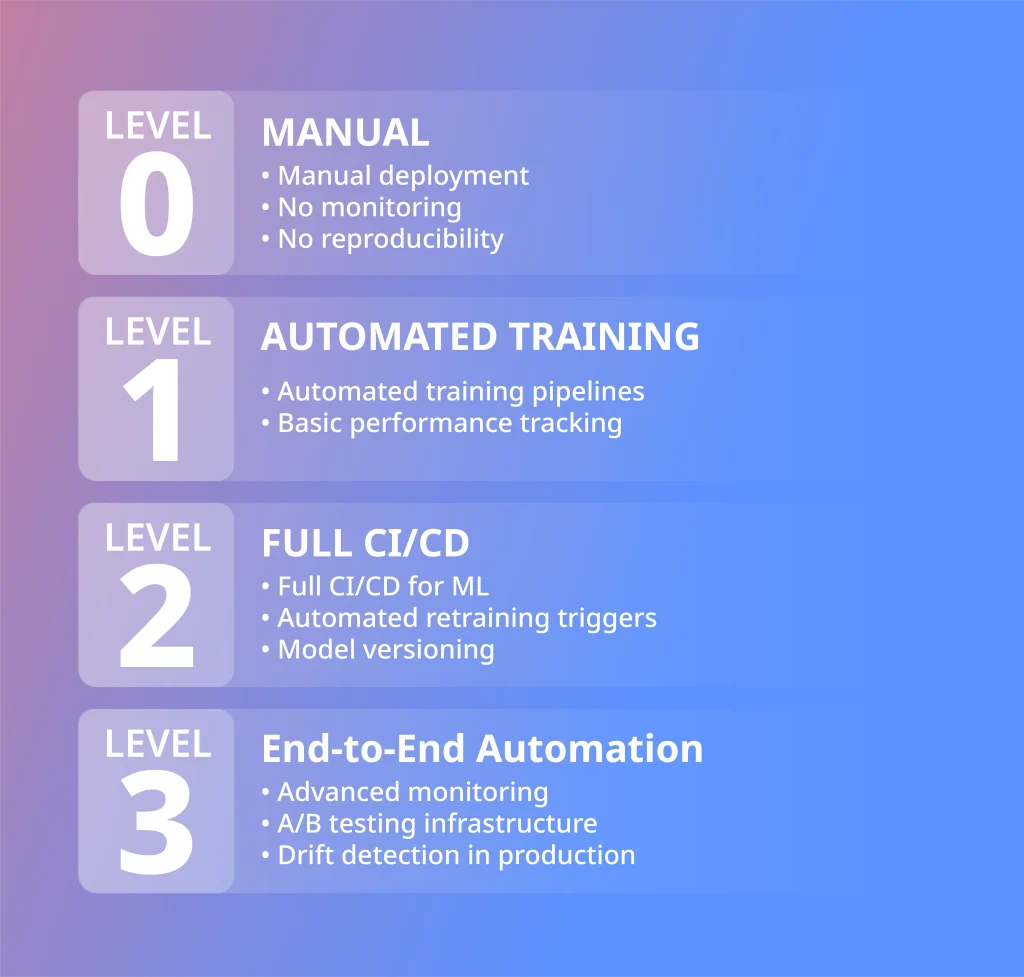
Most agencies operate between Level 0 and Level 1. The question is whether they’re honest about it, and whether the scope of your project requires more.
Infrastructure questions worth asking:
- How do they handle CI/CD for ML pipelines?
- What’s their containerisation and serving approach (Docker, Kubernetes, Triton, Ray Serve)?
- Do they build cloud-native or portable deployments, and under what circumstances do they choose each?
And the single most important handoff question: “After engagement ends, what does your client need to maintain this without you?” If they can’t answer that clearly, the system was never designed to be handed over.
Red flag: No opinion on observability for ML systems. Observability isn’t optional in production. It’s the difference between a model that degrades silently and one that tells you when something’s wrong.
Data Practices and Security Due Diligence
Data governance is where CTOs most frequently get caught out after the engagement, when a compliance issue surfaces that could have been prevented at the contract stage.
Key questions on data handling:
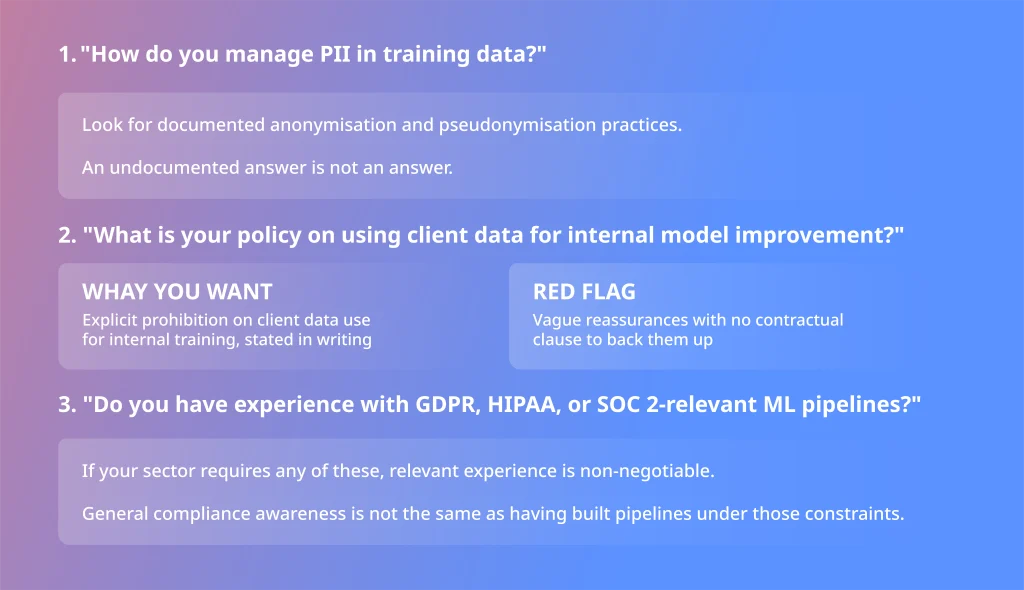
Evaluate their data architecture opinions as well. An organisation that understands ML feature engineering will have a clear view of when to use a data warehouse versus a lakehouse, and why that distinction affects model performance downstream. Vague answers here suggest they’re designing systems without fully thinking through the data layer.
Security posture is the final check: model access controls, API key management, and inference endpoint security. These are baseline hygiene. Any company that treats them as edge cases has never operated in a production environment with real security requirements.
If you want to understand what a governed AI engineering approach looks like in practice, this breakdown of governed AI engineering covers the frameworks and controls that separate production-ready systems from those that create compliance exposure.
Team Structure and Accountability
Find out who is working on your project versus who presented on the sales call. These are frequently different people, and in many agencies, different teams, different countries, and entirely different accountability structures.
The subcontractor transparency problem is widespread. Many agencies white-label offshore talent without disclosure. That arrangement can work perfectly well. The issue is that when they obscure team composition, expect the same approach across the engagement.
Ask directly: “Can we meet the engineers who’ll be on this engagement?” and “What’s your ratio of ML engineers to data scientists to MLOps engineers?” The second question reveals whether they’re staffing for development, production, or both.
Also, evaluate their QA process for AI outputs. Do they run internal red-teaming? Do they have a review cadence for model behaviour before delivery? An organisation without structured quality processes for AI outputs is relying on luck.
What good looks like: a dedicated point of contact with genuine engineering authority. Not an account manager who relays messages. Someone who can make technical decisions, explain trade-offs, and escalate correctly when something goes wrong.
The Commercial Structure Reveals Their Incentives
How a company structures the deal tells you what they’re optimising for. Time-and-materials favours the organisation. Outcome-based favours the client. Milestone-based, when designed well, creates shared accountability.
Avoid fixed-scope contracts for AI work. ML is iterative, and model performance isn’t known until you’re in the data. Any firm offering a fixed scope without substantial qualifications is either overconfident or unable to deliver.
Lock down IP ownership explicitly: model weights, training data, fine-tuned datasets, inference infrastructure. Most contracts are ambiguous by default. Define ownership and ensure full transfer at engagement end.
Watch for the dependency trap. The test is simple: if the company disappeared tomorrow, could your team maintain and extend the system? If not, the architecture was never designed for your benefit.
Minimum contract requirements: code quality standards, documentation, and structured knowledge transfer before close.
Always Run a Paid Proof-of-Concept
A scoping call is insufficient for an AI engineering decision. The only reliable filter is a structured, paid proof of concept (typically two to four weeks) with defined evaluation criteria agreed in advance.
What to assess during the PoC is not just technical output. Evaluate communication cadence, transparency in technical decision-making, and willingness to document as they go. An organisation that produces clean documentation during a PoC will do so during a full engagement. One that doesn’t, won’t.
If you’re weighing delivery speed against engineering rigour during the PoC, this guide on accelerating AI delivery without sacrificing governance is worth reading before you set your evaluation criteria.
Red flag: Any resistance to structured evaluation criteria or milestone accountability during the PoC stage. If a company is uncomfortable being evaluated, the problem will be considerably worse when the stakes are higher.
The Right Company Makes Itself Replaceable
The agencies most worth hiring are the ones that treat the end of engagement as a success condition. They document thoroughly, transfer knowledge deliberately, and build systems your team can own, extend, and maintain without them.
That’s the standard. Most agencies don’t meet it because their commercial model depends on you not meeting it either.
How Deployflow Is Structured Around Full Knowledge Transfer
Every engagement runs through a four-stage delivery model designed to move you from validated opportunity to production-grade system without the handoff problem:
- AI discovery and opportunity mapping (2 to 3 weeks)
- Prototype and validation (4 to 6 weeks)
- Production implementation (6 to 12 weeks)
- Monitoring, improvements, and AI capabilities expansion
Each stage has defined outputs. Nothing is left ambiguous at the close.
The production implementation stage is where most agencies cut corners. Deployflow deploys across AWS, Azure, and Google Cloud with governance, monitoring, and security controls built in from the start. Responsible AI frameworks are part of the delivery.
Built for Environments Where the Stakes Are Absolute
For a UAE public-sector organisation monitoring national social and economic wellbeing, Deployflow consolidated fragmented data sources into a unified AI intelligence platform. Automated classification pipelines replaced manual reporting. Real-time signal monitoring now runs at a national scale. Full deployment completed within 6 to 12 months from PoC to production.
For a national energy operator processing 1PB+ of subsurface data on H100 GPU clusters, Deployflow delivered a governance-first DevOps architecture with 100% air-locked infrastructure, zero manual provisioning steps, and a platform where new AI workloads land without re-engineering the core. Every change is tracked via GitOps. Full ownership transferred at close.
Both clients went from fragmented, manual operations to production-grade AI infrastructure. Neither needed to call back.
If you’re evaluating AI engineering partners and want to pressure-test your requirements against a team that has shipped at scale, start with a free technical consult. Bring your architecture questions, your constraints, and your scepticism.
Frequently Asked Questions About AI Engineering Agencies
What Red Flags Should You Look for in an AI Engineering Company’s Contract?
Vague IP clauses, automatic renewal terms, and proprietary tooling dependencies are the three most common contract red flags, and the ones most likely to cause problems after the engagement ends.
Vague IP language typically defaults ownership toward the organisation. If the contract does not explicitly state that model weights, training data, fine-tuned datasets, and inference infrastructure transfer to you at close, assume they don’t. Automatic renewal terms create lock-in that is difficult to exit without disrupting live systems. Proprietary tooling dependencies mean your production system requires ongoing company access to function, a structural conflict of interest that should be resolved before signing.
What Is the Difference Between an AI Engineering Company and an AI Consultancy?
A consultancy tells you what to build. An AI engineering company builds it. In practice, many firms position themselves as both, which is where the confusion starts.
The distinction that matters operationally is that a consultancy’s primary output is strategy, recommendations, and roadmaps. An engineering company’s primary output is working software, deployed models, and production infrastructure. If the engagement ends with a document rather than a system, you hired a consultancy. Neither is inherently wrong for your situation, but confusing the two leads to misaligned expectations and wasted budget. If you need someone to build and ship, evaluate accordingly.
How Long Does an AI Engineering Project Typically Take?
A structured proof of concept runs for two to six weeks. A production deployment typically takes three to nine months, depending on data readiness, infrastructure complexity, and integration requirements.
The timeline variable most organisations underestimate is data readiness. Agencies can only move as fast as your data layer allows. If pipelines are fragmented, data quality is poor, or governance is underdeveloped, expect to spend significant time before any modelling work begins. Any company that quotes a fixed timeline without first assessing your data infrastructure is either guessing or telling you what you want to hear.
Can an AI Engineering Company Work With Our Existing Infrastructure?
Yes, and how they answer this question is itself a useful evaluation signal.
A capable AI engineering company should be able to integrate with your existing cloud environment, data platforms, and internal tooling rather than requiring you to rebuild around their preferred stack. Ask specifically: what cloud providers do they have production experience with, and how have they handled environments with strict security or compliance constraints? If the answer leans heavily toward rebuilding your infrastructure rather than working within it, examine whether that recommendation is driven by your requirements or by their internal capabilities and preferences.
What Should a Handover Look Like at the End of an AI Engineering Engagement?
At minimum: documented architecture, runbooks for operation and maintenance, model versioning records, a knowledge transfer session with your engineering team, and full IP transfer confirmed in writing.
In practice, handovers are where many agencies reveal their true incentives. A dependency-free handover requires deliberate effort throughout the engagement. It means writing documentation as the project progresses, building on open standards rather than proprietary tooling, and structuring the final weeks around your team’s ability to operate independently. If knowledge transfer appears as a single line item at the end of a statement of work rather than being embedded throughout the document, treat it as a structural warning sign.
Explore our BLOG
Recent articles

Is Claude Down? Anthropic Outage: Protect Your Cloud Infrastructure
Claude went down across every surface on 29 September 2026. From 14:00 to 14:59 UTC,...
read full article

The SOC 2 Remediation Roadmap: From Compliance Dashboard to Passed Audit
This SOC 2 remediation roadmap takes you from a red compliance dashboard to a clean...
read full article
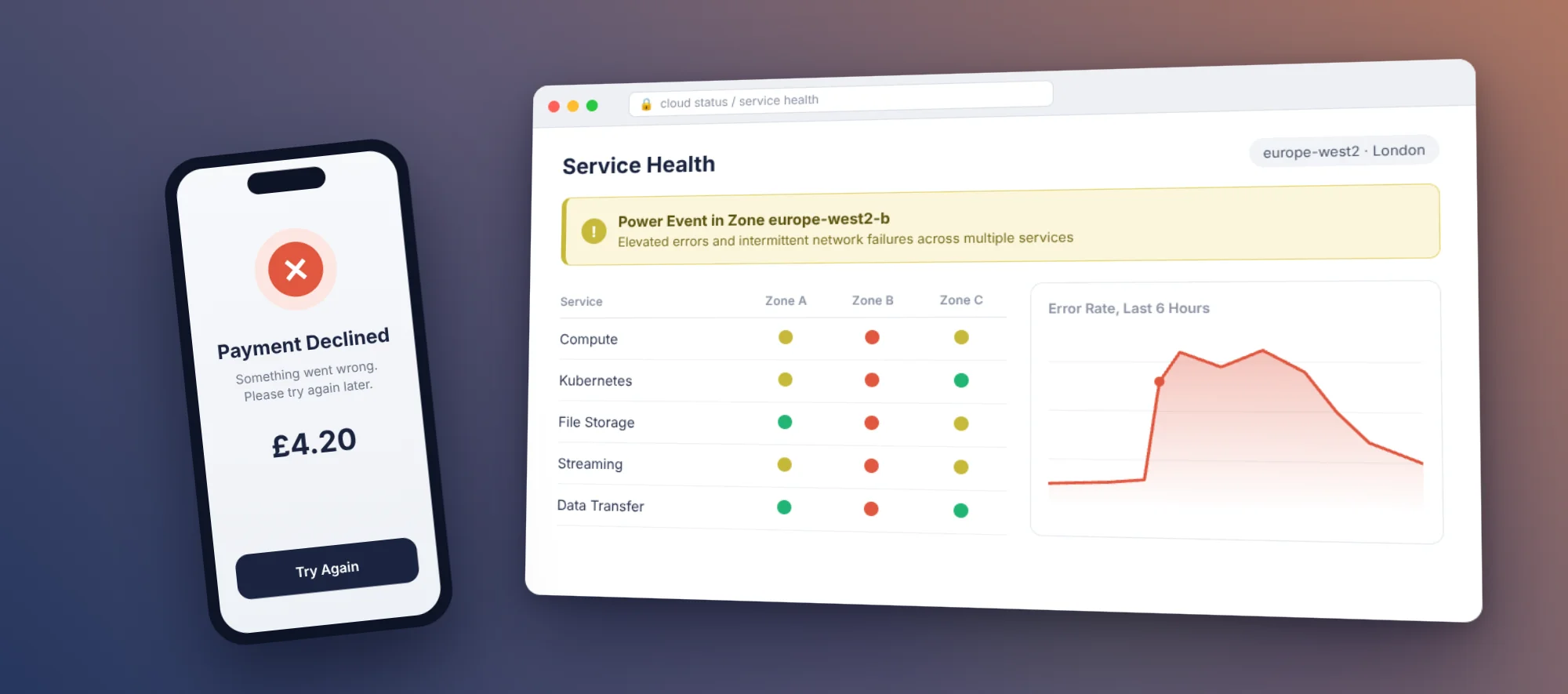
Is Google Cloud Down? The GCP Outage That Froze Revolut Cards and What CTOs Should Fix Now
Yes, Google Cloud went down in London. A major Google Cloud outage hit the europe-west2...
read full article