



By mid-February 2026, the S&P 500 Software & Services index shed $2 trillion from its October peak.
Fortune reports that this wipeout represents a “valuation chasm” in which the market is decoupling from traditional SaaS growth metrics in favour of agent-ready infrastructure.
As of April 15, BlackRock and Dividend data show the IGV remains down 21.49% year-to-date.
AI agents have begun to bypass the workflows that vendors spent a decade monetising. If an agent executes a multi-step task across a stack without a human ever logging into a dashboard, the workflow rent model collapses.
The Reality for the Modern CTO
The $2 trillion selloff is not a market overreaction but the first large-scale pricing of a structural shift that has been building for years. It lands directly on the enterprise stack you are responsible for.
This piece breaks down what is actually happening, which parts of your software estate are most exposed, and where the decisions need to be made in the next 90 days.
What Is Driving the SaaS Market Selloff in 2026
In early February 2026, the software sector experienced a nearly $1 trillion rout. Reuters tracked an $830 billion decline in software and services stocks over just six trading days, triggered specifically by Anthropic’s rollout of advanced agentic plugin capabilities.
What $830 Billion in Six Days Signals
This capital flight reflects a systemic shift. AI agents are beginning to absorb tasks that were previously distributed across a fragmented ecosystem of specialised tools.
For years, enterprise software revenue has been protected by historical workflow lock-in rather than genuine technical defensibility. Investors are now discounting the system-of-engagement layer because it relies on human interaction with a UI to justify its cost. When an agent can orchestrate the same outcome by communicating directly with a database or an API, the premium paid for that UI evaporates.
As a CTO, your focus must shift from managing these tools to identifying which ones own the underlying truth of your business.
How AI Agents Are Threatening the Traditional SaaS Business Model
The traditional SaaS value proposition relies on a bundled architecture. Vendors wrap a proprietary data model in a custom UI, adding workflow logic, permissions, and reporting into a single monthly subscription. This bundle is now being aggressively unbundled by autonomous agents.
When Agents Bypass the UI, the Dashboard Loses Its Value
The UI has long served as a moat by creating user habituation and training barriers.
AI agents bypass this entirely. When an agent executes a task via API or headless browser, the brand equity of a slick dashboard drops to zero. For a CTO, this means the aesthetic quality of a tool no longer justifies its cost. If a team never logs into the software, the enterprise is overpaying for pixels.
Why Process Mediation Is No Longer Worth Paying For
Many SaaS products monetise process mediation, or the act of moving data from point A to point B. AI agents excel at cross-application orchestration, meaning they can stitch together custom workflows that once required a specialised middleman tool.
Software that merely facilitates a process without owning the underlying data is now a legacy bottleneck. The market is shifting from renting a workflow to owning the outcome through agentic logic.
The same logic applies to pricing. The per-user model assumes value is tied to human logins. When a single agent handles what a hundred tasks require, that assumption breaks.
The opportunity for CTOs is to replace high-seat-count systems with leaner, API-first alternatives that charge for outcomes rather than access.
The New Control Layer Every Enterprise Stack Needs
Owning the data is only half the battle. As workflows shift from human clicks to autonomous execution, the enterprise risk profile changes.
You cannot manage an agent with a password and a seat licence. Software must evolve from a simple interface into a governed execution layer across five key vectors:
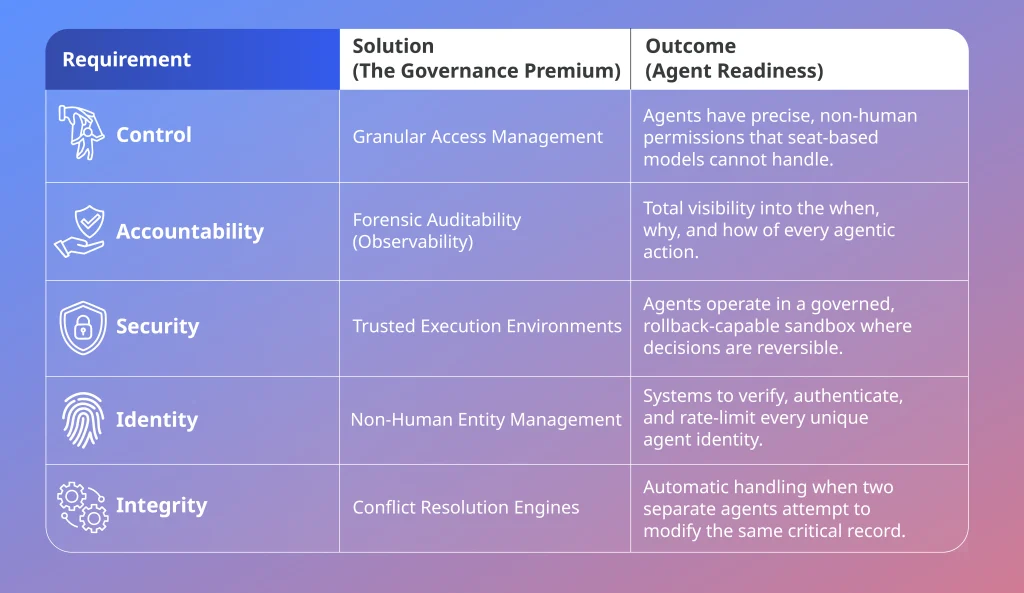
Governance determines whether agents can act safely. But data ownership determines whether they have anything worth acting on.
Systems of Record vs Systems of Engagement: Where Enterprise Value Is Moving
The software market has split into two camps. On one side is software that stores truth; on the other is software that merely rents process.
If a tool exists primarily to make a task easier for a human, it is now an endangered species. AI agents do not care about ease of use; they care about data access and execution rights.
The $2 trillion wipeout targeted the system of engagement layer. These products function as a thin skin over workflows that agents now navigate natively.
The Exposed: SaaS products that organise tasks, trigger simple flows, or sit on top of data owned elsewhere. When the main advantage is convenience rather than control, switching costs drop to zero.
The Defensible: Systems of record and platforms with proprietary operational data. These are the trusted runtimes for AI work: software embedded in critical workflows with strong governance, identity, and audit controls.
What Happens to Your Software Budget When Agents Take Over
This shift forces a radical rationalisation of the enterprise stack. Departmental preference for a specific interface no longer justifies a line item when agents become the primary users.
The question every leadership team will face soon: what happens when AI becomes the operator? Whether an entire category of tools can be replaced by a leaner stack integrated with agentic workflows.
The primary risk is no longer just cost but also the operational debt of uncontrolled automation: fragmented permissions, brittle integrations, and weak audit trails.
Three Questions Every CTO Should Ask Before Renewing a Licence
CTOs must now evaluate software through a lens of survivability. Feature depth is secondary to:
How easily can a non-human entity execute the core function?
Does the tool provide the guardrails necessary for autonomous action?
Does the vendor own a unique truth, or are they just renting you a process you could automate elsewhere?
The Six Pillars of Safe AI Agent Deployment in Enterprise Environments
For an agent to function as a reliable operator within your organisation, it must operate within a controlled execution layer built on six pillars:
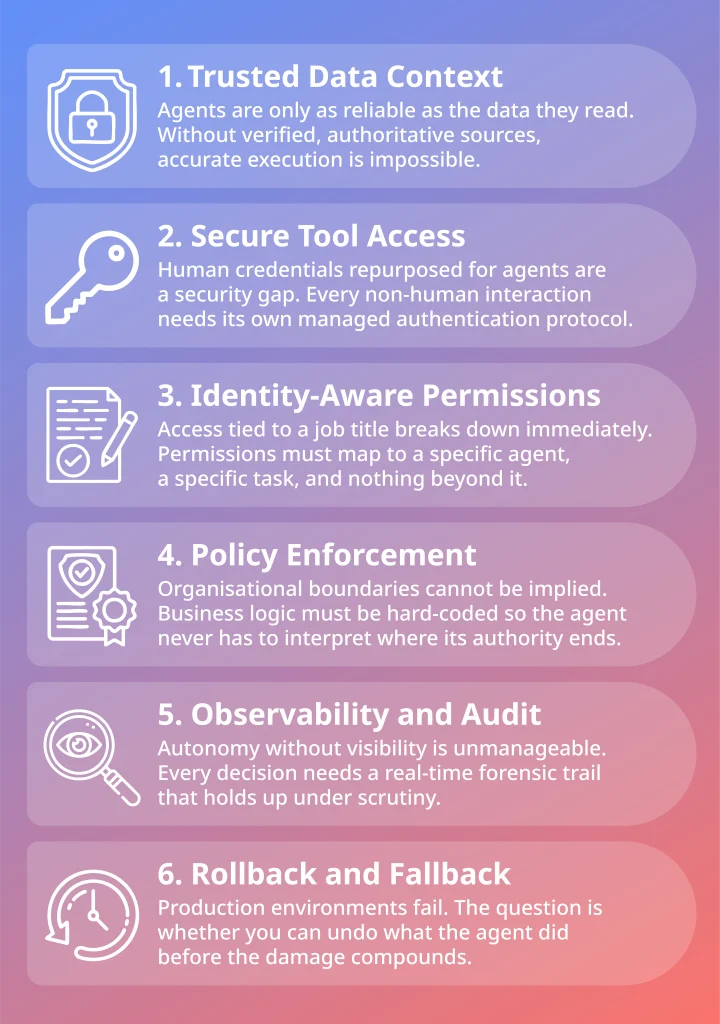
Software that masters these pillars is evolving from a mere application into a trusted runtime environment for autonomous enterprise work.
If you want to go deeper on what losing control of an agentic workflow actually looks like in practice, our guide to the five control failures CTOs need to solve first covers where most enterprise deployments break down.
Where Does Enterprise Software Value Go After the SaaS Repricing?
The $2 trillion correction is only the signal. The more important question for anyone running enterprise infrastructure is where the value is actually going. The answer is a redistribution across four areas.
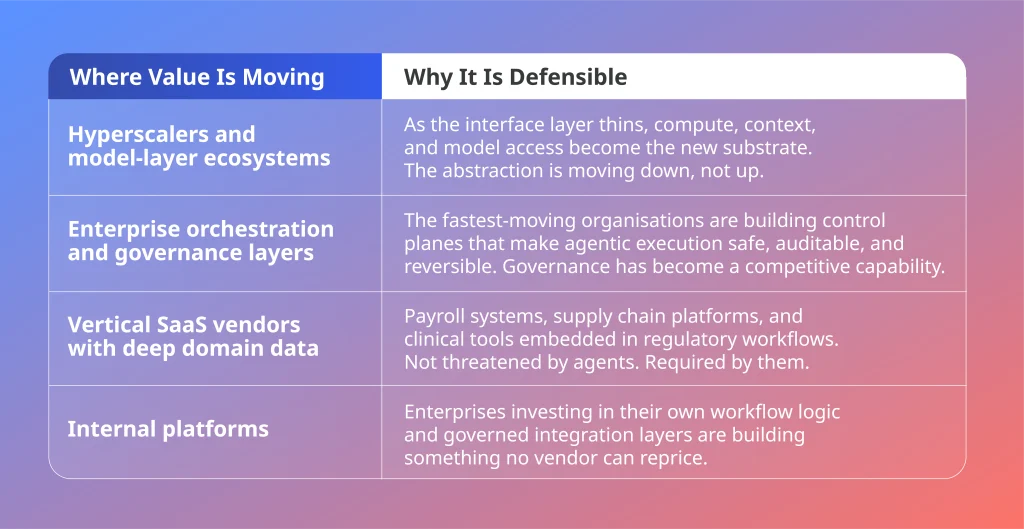
AI agents may not destroy software margins evenly. They are more likely to compress the middle and reward whoever controls context, execution, and trust.
What remains after the repricing is the layer that owns the data, governs the action, and holds the organisation accountable for the outcome.
What CTOs Should Do in the Next 90 Days
The repricing is already underway. The question is whether your stack is being evaluated on your terms or the market’s.
Five Decisions That Cannot Wait for the Next Budget Cycle
- Audit your SaaS spend for interface dependency. If the primary reason a tool exists is for humans to log in, it is a candidate for consolidation. Pull your licence inventory and ask which tools would survive if no one ever opened the UI again.
- Map workflows that are ready for agentic consolidation. Start with high-volume, repeatable tasks that cross more than two systems. These are where agents generate the clearest return and where fragmented tooling is most exposed. If you are unsure which workflows to prioritise, Deployflow’s guide to AI agents and business ROI breaks down where agents create measurable value versus where they become an expensive distraction.
- Harden before you automate. Before any agent touches a critical workflow, review permissions, identity management, audit trails, and rollback capability. Autonomous execution amplifies both efficiency and error. The governance layer comes first.
- Classify your vendors by defensibility. Four categories matter now: system of record, control layer, execution environment, or convenience tool. Convenience tools without a migration plan are a liability.
- Build a governed adoption roadmap. The risk is not moving too slowly on AI. It is accumulating automation debt through ungoverned tool sprawl. A deliberate roadmap with clear ownership is what separates infrastructure from experiment.
The $2 Trillion Correction May Turn Out to Be a Design Brief
The correction has forced a question most enterprise teams were not ready for: what does the stack look like when AI is the operator and not the user?
The platforms that win the next era will govern action, secure context, and hold up under real operational scrutiny.
What the Next 90 Days Look Like for Enterprise Architecture
For most enterprises, the 90-day window is where assessment becomes a decision. The tools that survive will be the ones that still matter when no human is logging in. The rest will be renegotiated, consolidated, or replaced.
From Slide Deck to Running System: Where the Real Work Starts
Most engineering teams already know where the friction is. The assessments have been done. The roadmaps exist. What stalls is the move from a slide deck to a system that actually runs.
Deployflow’s agentic AI development team works with scaling enterprises to close that gap with AI agents that own execution across pipelines, infrastructure, and operations, end-to-end. No handoffs between strategy, build, and run. No fragmented delivery model where accountability gets lost between teams.
Up to 70% less manual operational effort. Incidents resolved in minutes. Delivery that scales without scaling the team. Get a free consult with Deployflow’s agentic AI team.
Frequently Asked Questions: AI Agents and SaaS Disruption
Will AI agents completely replace SaaS software?
No, but they will replace a significant portion of it, specifically the tools that exist to mediate workflows rather than own data.
The tools most at risk are those built around process convenience rather than proprietary data. Systems of record, governance layers, and platforms with deep domain data are far more defensible. Most analysts expect the shift to take several years, even at the current pace of investment. The outcome will be selective unbundling, not total replacement.
What is the SaaSpocalypse?
It is the term used to describe the mass repricing of software stocks in early 2026, triggered by the realisation that AI agents could replace entire categories of SaaS tooling.
The selloff was not driven by macroeconomic conditions but by a structural question: if agents can perform the same tasks without dedicated software interfaces, what justifies the per-seat licence? Investors began pricing in that risk across the entire software sector simultaneously. The term has stuck because it captures something real, not a crash, but a reckoning with how much of the SaaS model was built on access rather than value.
How should CTOs renegotiate SaaS contracts in this environment?
Start by auditing which contracts are tied to seat volume rather than data access or outcome delivery, and use that as your negotiating baseline. Vendors under repricing pressure are more open to renegotiation than they have been in years. The strongest position is a clear map of which tools in your stack agents can already bypass, paired with a credible consolidation plan. That combination shifts the conversation from renewal to restructuring.
What SaaS categories are most at risk from AI agents?
The most exposed categories are those built around workflow mediation, project management, CRM, document automation, customer support ticketing, and business intelligence tools that sit on top of data stored elsewhere.
Tools in these categories are increasingly being replicated by agent workflows at a fraction of the cost. The categories most likely to survive are those embedded in regulated processes, those with proprietary operational data, and those that serve as the source of truth rather than a view on top of it.
How is agentic AI different from traditional automation or RPA?
Traditional automation and RPA follow fixed, predefined rules and break the moment a workflow deviates from the expected path.
Agentic AI can plan, adapt, use tools, and make decisions across systems without a human defining every step in advance.
The practical difference for CTOs is that RPA requires careful scripting and constant maintenance, while agents can handle ambiguity and changing inputs. That flexibility is what makes them powerful, and also what makes governance, permissions, and observability non-negotiable before deploying them in production.
Explore our BLOG
Recent articles

How can a DevOps team leverage the power of AI?
Your CI/CD pipeline is automated, but it still can’t see trouble coming. Alerts land after...
read full article

Why Regulated Industries in the UK Are Getting AI Wrong
Your pilot works. It has worked for months. It still cannot go live, and every...
read full article

What Is AI Foundry, and Why Should CTOs Care?
Somewhere in your Azure tenant, an AI workload is running that nobody formally approved. It...
read full article