



Operational efficiency is under pressure from every angle. Costs remain high, delivery expectations keep rising, and technical teams are already stretched across cloud, security, support, integration, and product delivery.
So the appeal of AI agents for operational efficiency is obvious. The right one can remove repetitive work, speed up internal processes, and help teams get more value from the systems they already use.
That said, many businesses are still asking the wrong question. The question is not simply which AI agent is the most advanced.
The better question is which AI agent can improve business efficiency in a way that is measurable, controllable, and relevant to the business.
What CTOs Must Know
- The best AI agent solves a defined business bottleneck.
- AI agent ROI comes from measurable gains such as faster execution, less manual work, and fewer operational delays.
- Start with one high-friction workflow instead of a broad AI implementation.
- System fit matters more than feature depth across integration, permissions, reliability, and oversight.
- Controlled deployment usually delivers value faster than aggressive automation.
A tool that looks impressive in isolation can create operational noise, governance issues, or new bottlenecks if it does not fit the way the company works. Real ROI comes from solving the right problem, in the right workflow, with the right level of control.
What Makes an AI Agent Best for Business Efficiency?
There is no single best AI agent for every business. The right choice depends on the job it needs to do, the systems it must work with, and the level of control required.
The key question is which tool fits the business best.
In practice, that means four things:
- It can act inside real workflows
- It understands enough context to be useful
- It works within clear controls and integrates with existing systems
The best AI agent is the one that delivers reliable business value.
Why More Businesses Are Using AI Agents for Operational Efficiency
Technical leaders are exploring AI agents for operational efficiency because the business is asking for more output without a proportional rise in headcount, operational overhead, or delivery risk:
- Engineering teams lose time to repetitive coordination.
- Support teams spend too many hours answering predictable internal requests.
- Managers chase updates across disconnected systems.
- Valuable internal knowledge is buried in documentation, tickets, chat history, or fragmented tools.
- Senior technical staff end up doing work that should have been handled earlier, faster, and at lower cost.
AI agents are not a replacement for leadership or engineering judgment, but a way to reduce friction in operational workflows that are slowing the business down.
In practical terms, AI agent development can help businesses handle repetitive requests, retrieve internal information more efficiently, support workflow execution, and reduce the amount of manual coordination required across teams.
For a CTO, that means less wasted effort and more room for technical teams to focus on work that moves the business forward.
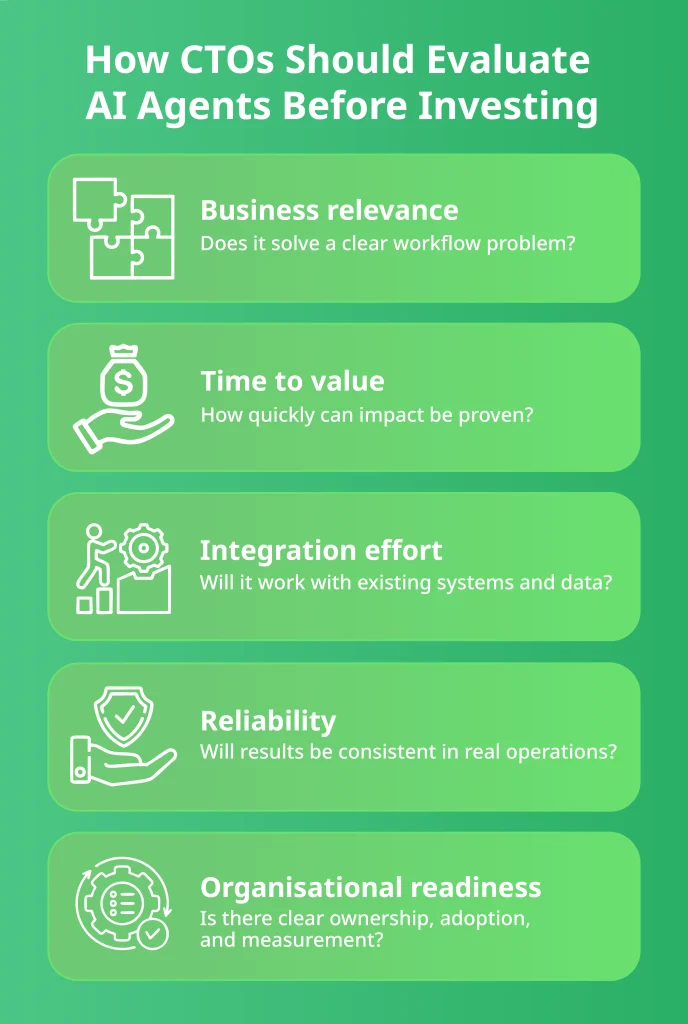
How CTOs Should Evaluate AI Agents Before Investing
A good AI agent investment is easier to justify when the workflow is clear, the path to value is short, and the business can trust how the system operates.
The real advantage comes when an AI agent can improve execution without adding new risk, complexity, or operational drag. That is the point where investment starts to make commercial sense.
What to Look for in an Enterprise AI Agent Consulting Firm
Leadership teams want productivity from AI agents without introducing unnecessary operational risk. The firm you appoint decides which of the two you get, and the expected business outcomes should be evaluated before the investment is made rather than after the pilot reports. Four things should be evidenced before you sign.
- Production delivery. Agent workloads running live today, in named systems, with a named owner after handover. Pilots are not evidence.
- Depth in your stack. Agents fail at the integration layer, so identity, cloud, CI/CD and data access controls matter more than model choice.
- Governance in the statement of work. Access limits, approval points, audit trails, and human oversight agreed before build, not after go-live.
- A defined handover. Your team should be able to run, retune, and switch the agent off without the supplier in the room.
Three questions surface most of this early: which agent workloads are in production now, how permissions are scoped and revoked, and which success metric gets agreed before the build starts. A firm that answers in commercial terms and not model terms is usually the safer investment.
On expected outcomes, ask the firm to build the case from your own operational data, workflow volume, handling time, and loaded cost, then agree on a payback threshold before the build starts. The ROI models below show what that arithmetic looks like in practice.
That is how Deployflow approaches enterprise AI agent implementation, starting from the workflow and the guardrails.
How to Measure AI Agent ROI in Business
A narrow view of ROI can lead to the wrong decision. If AI investment is judged only by headcount reduction, many strong use cases will look weaker than they are.
In practice, the better question is whether an AI agent improves how work gets done. That can mean reducing manual effort in a measurable workflow, speeding up routine responses, cutting delays in handoffs and approvals, or giving skilled teams more time for higher-value work.
AI value often shows up in faster task completion, lower manual effort, and more capacity for higher-value work, not just headcount reduction. OECD-reviewed studies found average productivity gains ranging from 5% to over 25% in roles such as customer support, software development, and consulting.
For CTOs, that makes the commercial test more useful. Does the agent remove low-value work from expensive teams? Does it shorten cycle time? Does it improve responsiveness without adding operational overhead? Those are often better indicators of business value than asking whether the tool can replace jobs.
In many organisations, the stronger outcome is not a smaller team. It is a team that spends less time on repetitive operational drag and more time on work that moves the business forward.
ROI Models for Agentic AI Investments
Most ROI models for agentic AI investments come down to four numbers: monthly workflow volume, average handling time, loaded hourly cost, and the share the agent completes without escalation.
Annual net value = (hours removed per year x loaded hourly cost) – (build + run + oversight cost)
A service desk handling 400 requests a month at 12 minutes each, at £45 an hour, spends £3,600 a month on that workflow. An agent resolving 60% without escalation removes roughly £25,900 a year. Against a £40,000 build and £1,200 a month to run, it does not pay back on labour alone in year one.
That outcome is the model’s value. It tells you to pick a higher-volume workflow or to count a second measurable gain, such as resolution time, before the money is committed rather than after.
ROI concentrates in internal support, sales operations, and engineering coordination. AI sales agents return the most on qualification and CRM admin, where errors are recoverable, rather than on customer-facing selling.
Common Reasons AI Agent Investments Fail
Most AI agent projects fail for familiar reasons. The problem usually lies in how the project is set up.
- A common mistake is choosing the tool before defining the workflow problem. That often leads to a forced use case instead of a useful solution.
- Another is trying to scale too early. Broad rollouts make ownership, risk, and measurement harder to manage before value is proven.
- Lack of clear ownership also causes problems. If no one is accountable for the workflow, adoption, and success criteria, the project quickly loses direction.
- Poor access to data and systems is another blocker. Without the right context, the agent produces weak output that users stop trusting.
- Governance matters too. If permissions, review points, and escalation paths are unclear, the business may add risk instead of reducing friction.
A sensible CTO should treat these as warning signs. AI does not fix a weak operating model. It usually exposes it faster.
A Safer Rollout Model That Leads to Faster ROI
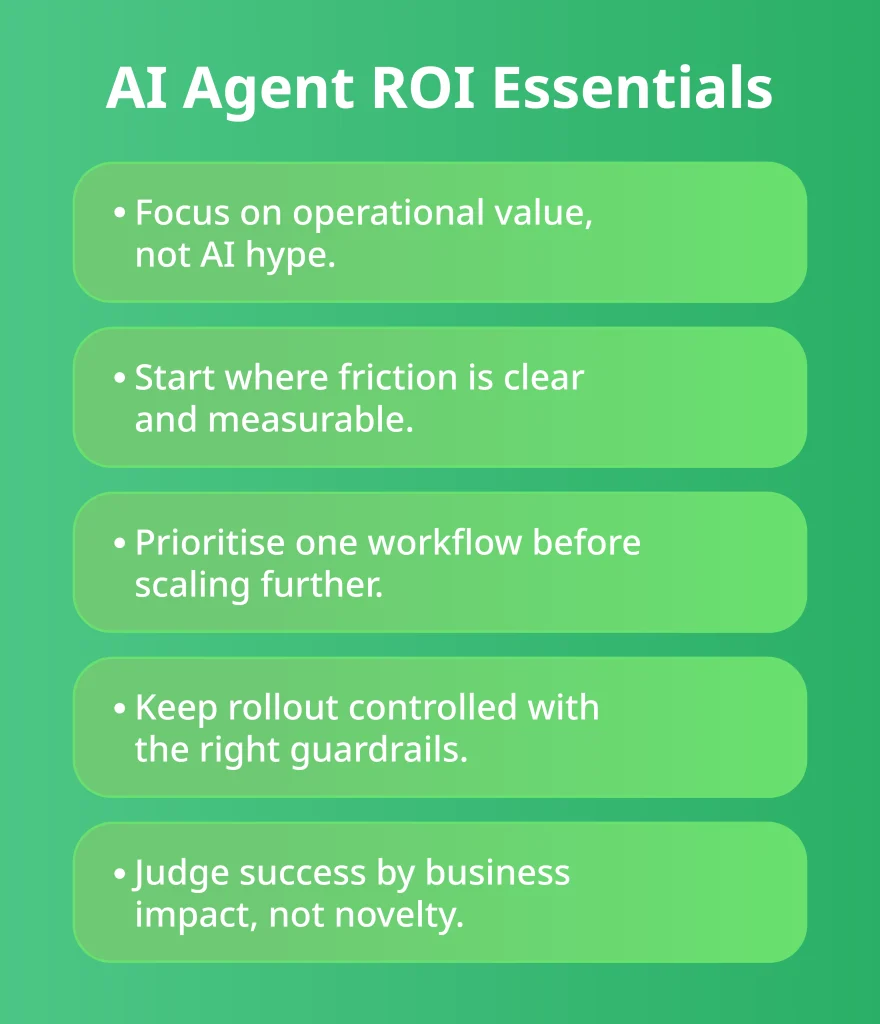
The safest way to roll out AI agents is often the fastest way to prove value.
Start with one workflow where friction is already visible, volume is high enough to matter, and results can be measured clearly.
Define success before launch, whether that means less manual effort, faster response times, shorter cycle times, or better service levels.
That approach also aligns with current governance guidance for AI agents. The World Economic Forum recommends sandbox or controlled pilot testing with non-production data before deployment to validate behaviour and reduce unintended outcomes.
Keep human oversight where it is needed. The goal is not maximum autonomy. It is controlled automation that improves execution without creating avoidable risk.
Once one use case proves value, expansion becomes easier. At that point, scaling is based on evidence, clearer guardrails, and a better understanding of where the agent can operate safely.
For organisations exploring controlled AI adoption in other high-stakes workflows, this guide on generative AI in ESG reporting shows how stronger governance and practical rollout thinking apply beyond day-to-day operational automation as well.
The Best Next Step for AI Agent Adoption in Business
The next step is finding the point where the business is wasting skilled time on work that should move faster, route better, or require less manual effort.
That could be repeated internal queries, slow handoffs, weak workflow visibility, scattered knowledge, or routine reporting overhead.
The right starting point is usually the one that creates the most friction, often enough to matter and can be improved without disrupting the wider business.
Deployflow can add real value. Instead of pushing a broad AI programme, Deployflow helps organisations identify the workflow worth fixing first, define the guardrails around it, and build agentic automation that works inside real operational conditions.
What Businesses Must Understand First
AI agents improve efficiency when they solve a clear operational problem. The value is not in the technology itself, but in removing friction from work that already wastes time, slows delivery, or pulls skilled teams into repetitive tasks.
The right starting point is usually narrow. Focus on one workflow, define the problem clearly, and assess where controlled AI support could improve speed, consistency, or capacity. That creates a stronger path to ROI than broad experimentation.
The Practical First Step in AI Agent Adoption
If AI agents are now part of the conversation, the next move should be to identify one workflow where time is being lost, ownership is blurred, or skilled teams are stuck doing work that should be easier to handle.
That is where the first real opportunity sits, in a specific operational problem that is visible, measurable, and worth fixing.
Deployflow helps companies turn those problems into a business case. That can mean pinpointing the right starting use case, assessing where agentic AI can safely add value, and shaping a rollout model that is controlled from the start.
Book a focused workflow review with Deployflow to identify where agentic AI can reduce manual effort, remove delays, and uncover a use case that is strong enough to justify investment.
Frequently Asked Questions About AI Agents for Business Efficiency
What is the difference between an AI agent and generative AI?
An AI agent can take action, while generative AI usually focuses on producing content or answers.
Generative AI is often used for drafting, summarising, or responding to prompts. AI agents go further by following goals, working through steps, and interacting with systems or workflows. That is why agentic AI is more relevant when the goal is operational efficiency. The difference matters because execution creates a different level of value and risk than content generation alone.
Which business processes are best for AI agents?
The best processes are usually repetitive, structured, and slowed down by manual effort.
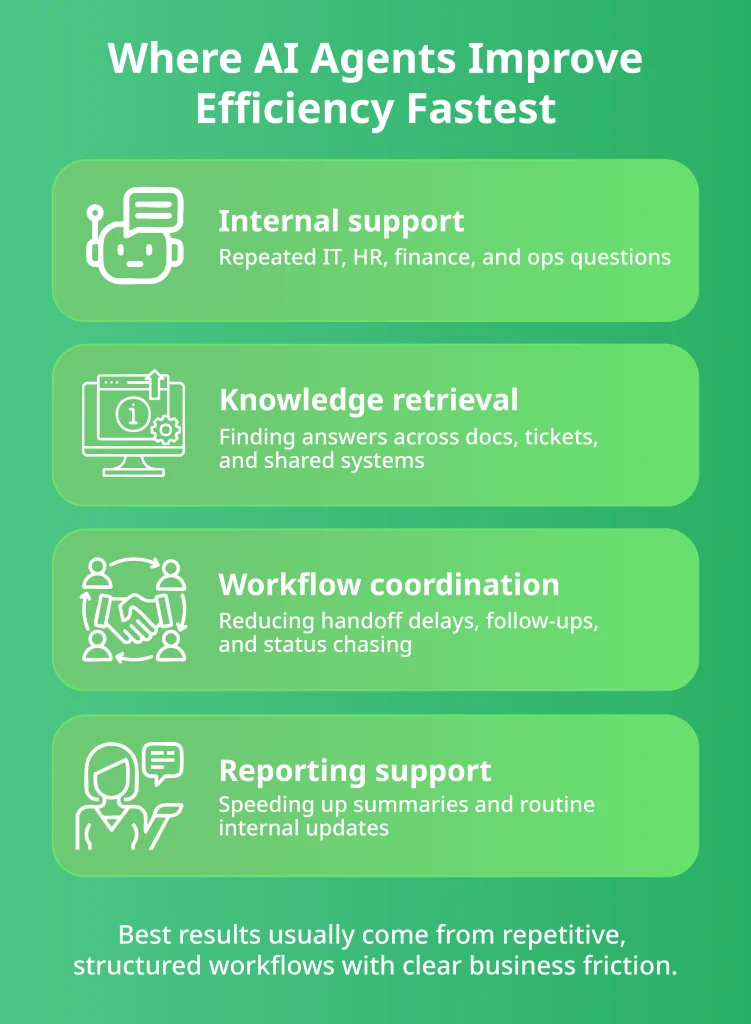
Common examples include internal support, knowledge retrieval, workflow coordination, and routine reporting support. These areas tend to have clear friction, enough volume to matter, and measurable outcomes. That makes them easier to test and justify commercially. If a process is rare, unclear, or heavily dependent on judgment, it is usually a weaker starting point.
How do you measure AI agent ROI?
AI agent ROI is usually measured through time saved, lower manual effort, faster cycle times, and better use of skilled teams.
In some cases, service levels, response times, or throughput improvements are also useful measures. The important point is to track value in a real workflow rather than relying on vague promises. A strong use case should show a visible operational improvement after rollout. If the gain cannot be measured clearly, the investment is harder to defend.
Are AI agents safe for business use?
Yes, but only when they are introduced with the right controls.
Safety depends on access limits, approval rules, system boundaries, auditability, and clear human oversight where needed. The risk is usually not with the concept of AI agents themselves, but with weak governance around their deployment. That is why controlled rollout matters so much. Businesses that treat governance as part of the design, not an afterthought, are in a much stronger position.
How do you choose the right AI agent for your business?
The right AI agent is the one that fits a real business workflow and can deliver value without adding unnecessary complexity.
That means looking at the problem it solves, how quickly value can be proven, how well it integrates with existing systems, and how much control the business keeps. The most advanced-looking tool is not always the best choice. Fit, reliability, and operational relevance matter more than hype. A good decision starts with the workflow, not the product demo.
What tools help build an AI agent ROI business case?
Your own operational systems are the strongest source.
Ticket volumes from the service desk, cycle times from the project tool, and loaded cost from finance give you a baseline you can defend in a board review. Vendor ROI calculators assume the vendor’s own results, so they are useful for framing and weak as evidence.
Explore our BLOG
Recent articles

ISO 42001 Explained: Requirements, Certification and What Your Engineering Team Must Build
ISO 42001 is the international standard that demonstrates your organisation governs AI properly, and enterprise...
read full article

Is Claude Down? Anthropic Outage: Protect Your Cloud Infrastructure
Claude went down across every surface on 29 September 2026. From 14:00 to 14:59 UTC,...
read full article

Top 10 Healthtech Companies in 2026: What Their Growth Means for AI and DevOps
Every software change that reaches a hospital has to clear regulatory, legacy system, and clinical...
read full article