



Somewhere in your estate, AI-generated code is running in production right now, and nobody signed it off. The vulnerability record behind that sentence worsens every month, and the analysts tracking enterprise software expect the practice to dominate new builds within two years.
Banning it will fail, so this article gives you six controls that maintain speed without inheriting the risk.
Executive Summary
- Gartner: 40% of new enterprise software will be vibe-coded by 2028
- Three liabilities to track: security debt, comprehension debt, compliance exposure
- Allow it for prototypes and scaffolding; block it for regulated, production-bound systems
- The fix: six controls, from an approved tool list to mandatory review of AI-generated commits
What Is Vibe Coding, and Why Does It Concern You Now?
Vibe coding means generating production-bound software from natural-language prompts, with limited line-by-line review. A developer describes the outcome. The AI writes the code. Increasingly, an autonomous agent also tests it, fixes it, and commits it.
Keep the distinction between AI-assisted autocomplete and vibe coding clear, because the two carry different risks. With autocomplete, a human writes and reads every line, and your existing review process still works. With vibe coding, the human shifts from author to director, and code can reach production that nobody in your organisation has actually read. Accountability for that code still sits with you.
Gartner projects that 90% of enterprise software engineers will use AI code assistants by 2028, up from under 14% in early 2024.
Stack Overflow‘s 2025 survey adds a sharper point: 72% of developers say vibe coding plays no part in their professional work, and a further 5% reject it emphatically.
Read the remainder, though. Roughly one developer in eight is already shipping software they direct rather than write, a large enough population to guarantee the practice exists somewhere in your estate.
How Did Unapproved AI Code Reach Your Production Estate?
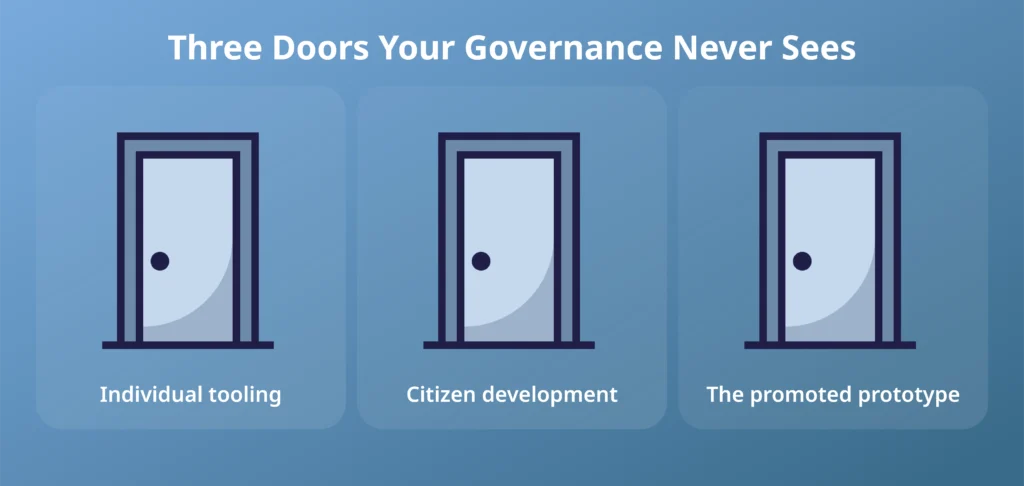
Shadow adoption arrives through three doors, and none of them involves a sign-off.
- The first door is individual tooling. A developer installs an agentic coding assistant on a personal licence. Within a month, they ship faster than the rest of the team, and colleagues follow.
- The second door is citizen development. A product manager builds an internal tool with a prompt-to-app platform. The tool quietly acquires users. Then it acquires production data access.
- The third door is the promoted prototype. Something built in an afternoon gets demonstrated to a stakeholder. Three months later, it underpins a live workflow, and nobody ever reviewed the code.
All three doors share the same mechanics. Code volume rises sharply while review capacity stays flat, and the gap becomes defect debt. By the time an issue surfaces, the prompt author has moved on, and the code looks familiar to nobody.
What Are the Real Risks to Your Organisation?
Three distinct liabilities build up when AI-generated code ships unreviewed. Each deserves its own line on your risk register.
1. Security Debt
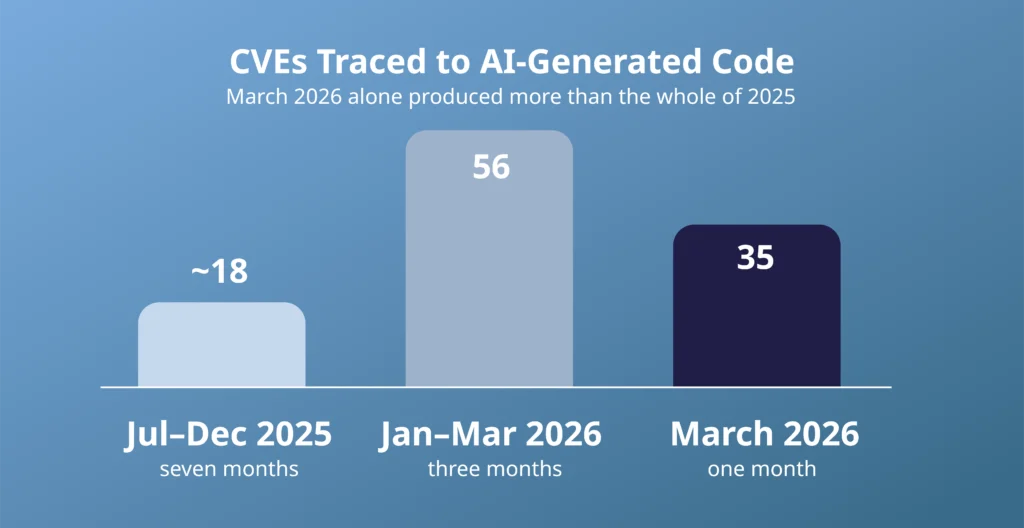
Georgetown University’s CSET tested five leading models against prompts designed to surface known weakness classes and found that almost half of the generated code snippets contained bugs severe enough to be exploitable.
AI also invents software that does not exist. Research covered by the Cloud Security Alliance analysed 576,000 AI-generated code samples from 16 models and found that 19.7% of suggested package dependencies were fictional, and 43% of those phantom names recurred on every run.
Attackers register the predictable names, publish malicious code under them, and wait. The technique now has a name: slopsquatting. The trajectory of confirmed cases makes the direction unambiguous.
Source: Georgia Tech
2. Comprehension Debt
Every codebase carries some inherited logic. Vibe coding industrialises the problem. When intent lives in a discarded prompt rather than a design document, ownership fragments across the prompt author, the AI agent, the reviewer and the service owner. A minor fix becomes an archaeology exercise. Your maintenance burden grows in direct proportion to how fast you ship.
3. Compliance Exposure
UK technology leaders answer to frameworks that assume accountable, auditable software change. Cyber Essentials Plus expects demonstrable control over what runs in your estate. ISO 42001 asks you to evidence governance of AI systems specifically. Public sector CTOs face GovAssure on top. Unreviewed generated code undermines all three, because you cannot audit what nobody understands.
Where Should You Allow Vibe Coding, and Where Should You Block It?
Banning it outright would be the comfortable decision and the wrong one. The productivity gains are real, your best engineers know it, and a rule nobody respects is worse than no rule at all. What you need instead is a boundary so clear that every engineer can recite it in the lift.
Here is a test that fits on a sticky note: Could you throw this code away tomorrow without anyone noticing? If yes, let the AI run. If no, the code goes through the gate.
Three contexts pass the test.
A prototype built to kill or confirm an idea by Friday.
Scaffolding around battle-tested libraries, where the AI assembles proven parts rather than inventing critical logic.
An internal tool that touches zero production data, where the worst-case outcome is an annoyed colleague rather than an apology to the regulator.
Three contexts fail it, and they fail expensively.
Generated cryptography that nobody on your team can verify is a risk you cannot price, and an unpriceable risk has no business in your estate.
A system touching regulated or personal data needs only one careless endpoint to become a reportable incident with your name on the notification.
And an entire production codebase built from prompts is a bet that the code will never need to be understood by a human, which is a bet every codebase eventually loses.
Where Vibe Coding Belongs, and Where It Doesn’t
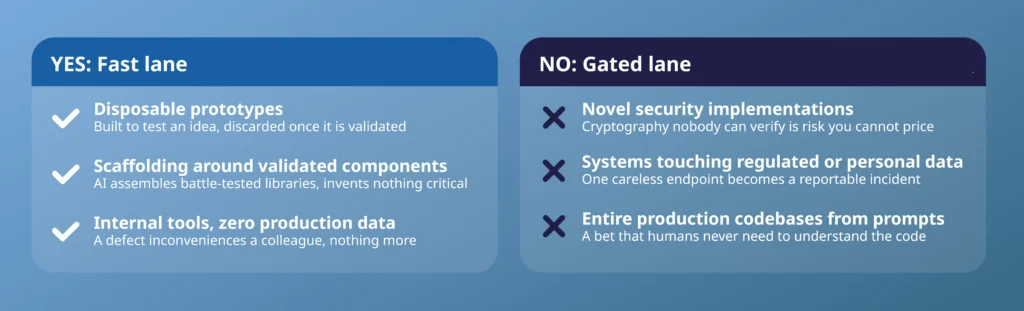
Publish the boundary, and your engineers get a fast lane and a gated lane. Leave it ambiguous, and everything travels in the fast lane, because ambiguity always resolves in favour of whatever ships quickest.
How Do You Govern AI-Generated Code Without Losing the Speed?
Six controls close most of the gap. None of them requires new headcount, none noticeably slows a sprint, and all six can be mandated this quarter. Between them, they retire the three debts on your risk register.
- Publish an approved tool list. Sanctioned tools can be configured, monitored and audited. Unsanctioned tools become shadow AI, and shadow AI is where secrets leak. Start here, because every other control assumes you know which tools are in play.
- Mandate review for AI-generated commits. Treat generated code exactly as you would code from an unknown third party, because that is what it is. Read it, test it, and run static analysis before merging. Anything related to authentication, authorisation, or data storage is non-negotiable.
- Scan for secrets and phantom dependencies in CI/CD. Automated checks catch hardcoded credentials and hallucinated package names before they reach a repository. Every credential caught at commit is one your security team never has to rotate under pressure.
- Separate environments properly. Prototypes must be structurally unable to reach production data. Any platform that deploys straight to production with no staging step should fail your procurement criteria on that basis alone.
- Assign ownership at generation. Every piece of generated code needs a named human owner who can explain it, maintain it and answer for it. The question “whose code is this?” is free at creation and very expensive at 2 am.
- Require an audit trail. Record which tool generated what, from which prompt, reviewed by whom. Your compliance posture depends on answering those questions faster than a regulator can ask them.
The first three controls attack security debt. Review and named ownership stop comprehension debt before it starts. Environment separation and the audit trail are what Cyber Essentials Plus and ISO 42001 assessors will ask to see. Run all six, and the practice your teams adopted informally becomes a capability you can defend to a board.
Review requirements, approval thresholds and decision rights all deserve more space than one section can give them, and a guide to governed AI engineering covers how UK CTOs match the level of scrutiny to the level of risk.
When well governed, vibe coding also becomes far more valuable than fast prototyping. Agentic systems that build, test and deploy software inside defined guardrails are the production-grade version of what your developers already do informally. Purpose-built AI agent development applies these review gates, security controls, and ownership structures from the first sprint onward.
What Does Governed Delivery Look Like in Practice?
Frameworks on paper change nothing without a delivery model behind them. Engineers and business users reach for prompt-to-app tools because the official route to new software feels slow. Give them a governed route that is nearly as fast, and shadow adoption loses its appeal.
Structured, sprint-based delivery achieves exactly that. Scope is fixed. Security review is built into each iteration. The in-house team owns and understands the code at handover, and the audit trail satisfies a regulator. Outcomes become predictable rather than hopeful, which is the one quality ungoverned experimentation can never offer, however quickly it ships.
Little Journey: Faster Deployments in a Regulated Sector
Deployflow’s work with Little Journey, a healthcare platform serving paediatric patients, shows what that balance looks like under real regulatory pressure. The engagement rebuilt their cloud infrastructure with centrally managed security controls in a sector where compliance is non-negotiable.
The results:
- Deployment time for new environments cut from several days to two hours, an 80% reduction.
- Complete data segregation, with full compliance against medical technology mandates.
- 70% less manual work across infrastructure management.
Governance made the platform faster by replacing the ad hoc approach with centrally managed rules. As their CTO Azim Palmer put it, the engagement delivered scalability, efficiency and security together rather than trading one for another.
Deployflow runs every engagement this way: dedicated teams working in fixed sprints, with security review and ownership handover built into the cadence, not bolted on at the end. Speed and governance stop being a trade-off for your next build.
Three Moves to Make This Quarter
In priority order, and all three can start this month. The first one costs nothing but honesty.
- Audit what is already there. Commission a review of your production estate to find the AI-generated code you did not know you had. Start with anything touching customer data or authentication, because that is where an unpleasant surprise costs the most. You cannot govern an inventory you have never taken.
- Publish the policy this quarter. Approved tools, review requirements, the fast lane and the gated lane. Keep it to two pages. A short, consistently enforced document beats a comprehensive one nobody reads, and your engineers will respect a rule they can actually remember.
- Choose one build to do properly. Pick an upcoming project that genuinely warrants agentic development and run it through a governed, sprint-based delivery process. A working reference implementation persuades sceptical engineers faster than any mandate, and it gives you the internal case study every future budget conversation will need.
The difference between a reference build that persuades and one that embarrasses is the deployment discipline behind it, and a breakdown of how CTOs deploy agentic AI systems safely walks through the phased structure that keeps the first project clean.
The organisations that come out ahead in 2027 will be the ones that governed early, while competitors were still debating whether the trend was real. The code is already in your stack. The only open question is whether it answers to you.
Not sure where to start? Start with the audit. Book your free consultation to scope a governance review of your estate: what is already AI-generated, where the exposure sits, and which of the six controls to stand up first.
Vibe Coding: Frequently Asked Questions from Technology Leaders
Who coined the term vibe coding?
Andrej Karpathy, the AI researcher and former Tesla AI director, coined the term in early 2025.
He described a workflow where developers “fully give in to the vibes,” trusting AI to handle implementation while they steer through natural language. The phrase started as a half-joke about hobby projects and became the industry shorthand for prompt-driven development at every scale, which is precisely why the governance question now sits with enterprise leaders rather than weekend builders.
Which tools are used for vibe coding?
The most common are agentic coding assistants such as Claude Code, Cursor and GitHub Copilot, alongside prompt-to-app platforms such as Replit, Lovable and Bolt.
The two categories carry different risk profiles. Assistants operate within your existing development pipeline, where review gates can catch their output, whereas prompt-to-app platforms often deploy straight to production with no staging step. This is why your approved tool list should treat them separately.
Will vibe coding replace software developers?
No, but it is changing what they do. Developers are shifting from writing every line to directing, reviewing and validating generated code, a move from author to editor. Demand is actually rising for senior engineers who can architect systems and judge AI output, while routine implementation work shrinks. For your hiring plan, the practical implication is that review skill and system design matter more than raw coding speed.
Can vibe coding help with legacy system modernisation?
Yes, within limits, and it is one of the stronger enterprise use cases. AI tools are effective at reading and explaining undocumented legacy code, generating test coverage for systems that never had any, and drafting migration scaffolding. What they cannot do safely is regenerate a critical legacy system wholesale, because the business logic buried in old code is exactly what an AI is most likely to silently drop. A structured legacy modernisation programme uses AI to accelerate understanding while keeping humans accountable for what changes.
How do you review AI-generated code effectively?
Review it as you would a pull request from a contractor you have never met: read the logic, run the tests, and run static analysis before merging.
Pay particular attention to input handling, authentication and dependency choices, since those are the areas where generated code fails most often. The review load is real, which is why teams that adopt AI generation at scale usually pair it with stronger DevOps practices, so automated scanning absorbs the volume and human reviewers focus on logic and intent.
Explore our BLOG
Recent articles

ISO 42001 Explained: Requirements, Certification and What Your Engineering Team Must Build
ISO 42001 is the international standard that demonstrates your organisation governs AI properly, and enterprise...
read full article

Is Claude Down? Anthropic Outage: Protect Your Cloud Infrastructure
Claude went down across every surface on 29 September 2026. From 14:00 to 14:59 UTC,...
read full article

Top 10 Healthtech Companies in 2026: What Their Growth Means for AI and DevOps
Every software change that reaches a hospital has to clear regulatory, legacy system, and clinical...
read full article