



Agentic process automation hands off entire business processes to AI agents that read, decide and act across your systems, calling in people only when the stakes require it.
Done well, it clears the exception queues RPA left behind. Done badly, it joins the more than 40% of agentic AI projects that Gartner expects to be cancelled by the end of 2027. A few early decisions separate the two outcomes, and this guide sets them out.
Agentic Process Automation in 60 Seconds: The CTO Briefing
- Best fit: high-volume work with messy inputs and frequent exceptions. Stable, rule-bound tasks stay with RPA.
- Main failure points: rising run costs, unclear value and weak risk controls.
- Production essentials: least-privilege access, full audit trails and testing before every release.
- Autonomy: granted in stages, each one earned with accuracy evidence.
- Hard deadline: EU AI Act high-risk obligations apply from 2 December 2027 to agents that make decisions in areas such as hiring or credit, where outputs reach the EU.
- First move: score candidate processes and run the strongest one in shadow mode before it touches live operations.
What Is Agentic Process Automation, and What Does It Do for Your Business?
Agentic process automation (APA) gives an AI agent a business goal, the system access to pursue it and the limits it must respect. Scripted automation repeats fixed steps. An agent decides which steps the case in front of it needs.
A supplier invoice, handled by an agent:
- Reads the invoice, whatever its layout.
- Pulls the matching purchase order from the ERP.
- Finds a price mismatch.
- Corrects the record within its permissions, or escalates with a one-paragraph summary.
The Four Building Blocks of an AI Agent
| Component | What It Does | What Breaks Without It |
| Goal and Instructions | Defines the outcome, the limits and the finish line | The agent stops early or oversteps |
| Tools | APIs, databases and bots the agent may call | The agent can reason but can’t act |
| Memory | Keeps case history across steps | Repeated work and lost context |
| Orchestration | Sequences steps, enforces permissions, logs actions and pauses for approval | No audit trail and no control |
The model provides judgement. Orchestration makes that judgement safe to use in production.
Agentic Process Automation vs RPA: Which One Should Run Your Workflows?
RPA suits stable, rule-bound work. Agentic process automation suits work where inputs vary, and exceptions pile up.
RPA replays recorded steps. When a supplier changes an invoice layout, the bot halts and the case drops into a manual queue. Over time, maintenance erodes the savings. An agent reads each input on its merits, so a new layout is simply another document to interpret. The price is predictability. Identical inputs can produce slightly different reasoning, which is why agent output needs testing, logging and hard limits.
A Quick Rule for Choosing
Keep RPA when systems, fields and rules rarely change. Typical examples are data transfers between fixed systems, scheduled reports and form filling from structured records. Bots are deterministic, cheaper per transaction and easy to audit.
Bring in an agent when the work depends on reading, comparing and judging. Free-text requests, variable documents and policy checks all qualify.
Replacing a dependable bot with an agent only adds cost and uncertainty.
The Hybrid Pattern Most Enterprises Adopt
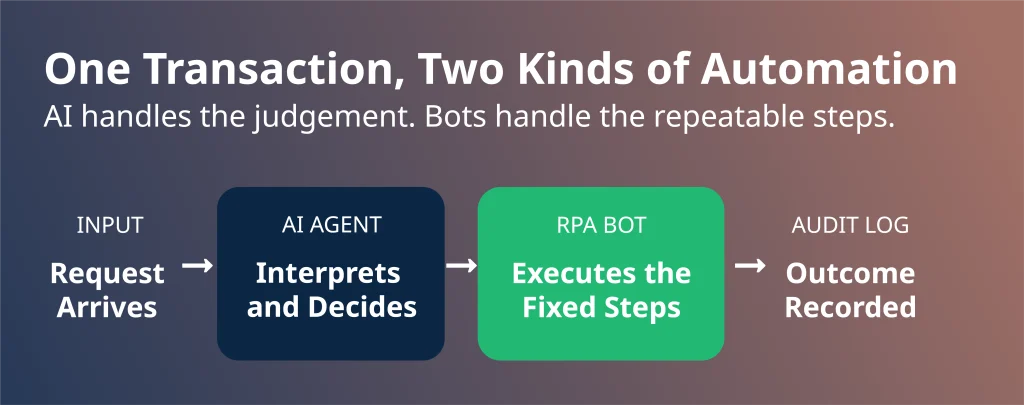
Model reasoning stays confined to the decision point. Execution keeps the audit trail your bots already produce.
A practical test for dividing the work: if a step can be written as an if-then rule, give it to the bot.
Why Agentic Process Automation Belongs on the 2027 CTO Agenda
Three pressures converge in 2027, and each calls for a decision this year.
Agents Are Arriving Through Your Existing Licences
Gartner expects 33% of enterprise software applications to include agentic AI by 2028, up from less than 1% in 2024. It also predicts at least 15% of day-to-day work decisions will be made autonomously by then. Many of those agents will switch on inside tools you already pay for.
Your move: inventory which suppliers are adding agentic features, and decide who approves them before they go live.
Vendor Claims Need Hard Scrutiny
Gartner calls the trend “agent washing”: assistants, chatbots and RPA tools relabelled as agentic AI. By its estimate, only about 130 of the thousands of vendors in the market offer genuine agentic capability.
Your move: ask every vendor to demonstrate an agent completing a multi-step task on your data, with its permissions and audit log on screen.
The EU AI Act Sets a December 2027 Deadline
The EU AI Omnibus moved the main high-risk obligations under Annex III to 2 December 2027. Annex III covers uses such as recruitment, creditworthiness assessment and access to essential services. UK organisations fall in scope if they use AI systems or outputs in the EU.
Your move: check whether any process you plan to automate touches an Annex III use case, and build documentation and human oversight into it from the start.
Four Agentic Process Automation Use Cases That Pay Back First
Start where volume is high, and mistakes are cheap to undo. Each use case below keeps a person in charge of the high-risk decision.
| Use Case | What the Agent Handles | What People Keep | Metric to Watch |
| IT Operations and Incident Response | Triages alerts, correlates logs and metrics, runs approved runbook steps, drafts the incident summary | Approval of any production change | Time to acknowledge and resolve |
| Finance Operations and Month-End Close | Three-way matching, reconciliation exceptions assembled with evidence | Sign-off on every adjustment | Days to close |
| Customer Operations | Classifies requests, pulls account history, proposes a resolution, issues refunds below a set value | Sensitive and high-value cases | Cost per resolved case |
| Compliance Evidence Collection | Gathers evidence from cloud, identity and ticketing systems, maps it to controls, flags gaps | Control interpretation and auditor responses | Open control gaps before audit |
The compliance row deserves a closer look for any organisation running ISO 27001 or SOC 2. Evidence that once arrived as manual screenshots before each audit becomes a continuous, reviewable record.
Not sure whether a process qualifies? Score it before anyone writes a line of code.
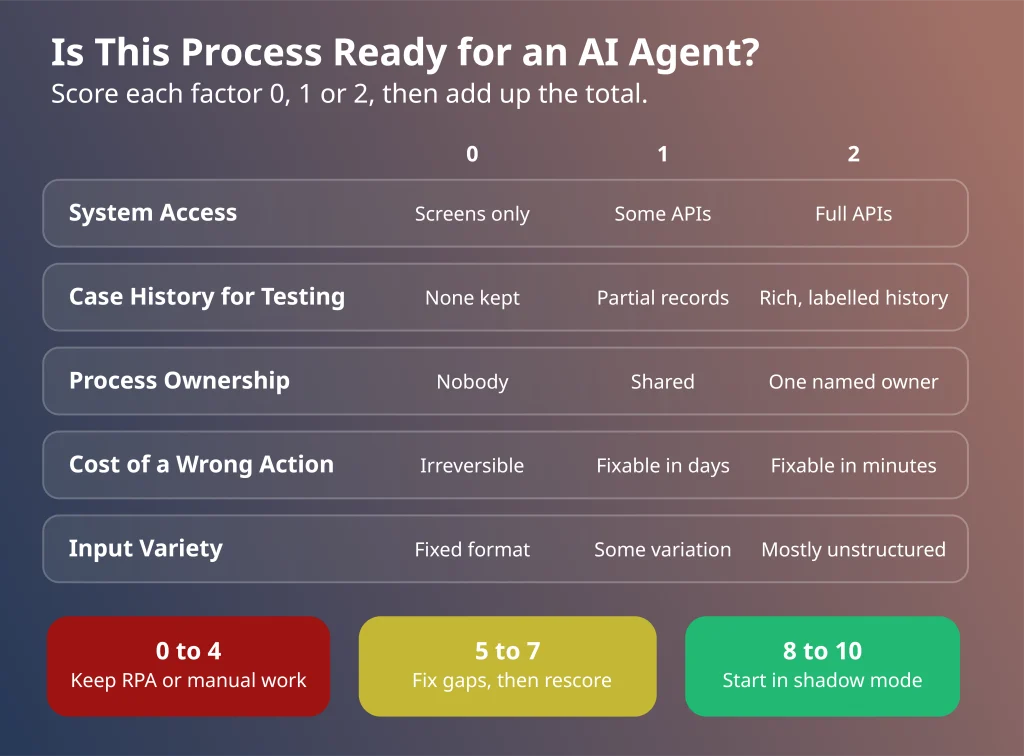
Agentic Process Automation Architecture: What Your Pilot Is Probably Missing
A pilot survives on clean data, narrow scope and someone watching every step. Production adds legacy systems, partial records, concurrent workloads and a finance team asking about the bill. Three layers absorb that load.
Orchestration: Split the Work Across Specialised Agents
A single agent handling everything is hard to test and expensive to run. Complex processes work better as a small team: intake, research, action and review, with an orchestrator managing hand-offs and shared state. Each agent can then be tested on its own, and simpler steps can run on smaller, cheaper models.
Access: Treat Every Agent Like a New Contractor
- A scoped service account for each agent
- Read-only access by default
- Every write action routed through a validated API
- Legacy systems without APIs wrapped in an integration layer or reached through an existing bot
Broad credentials turn one reasoning error into a security incident. Integration work also sets the delivery timeline, which is why AI engineering and automation expertise shapes outcomes more than the choice of model.
Observability: Know What Every Agent Did and What It Cost
- Trace each step: input, tool call, output and approval.
- Test every release against real cases from your own history.
- Track inference and infrastructure spend per process and per transaction.
- Cap budgets with alerts, because run costs climb quietly as volume grows.
Agentic AI Governance: Keeping Autonomous Processes Under Control
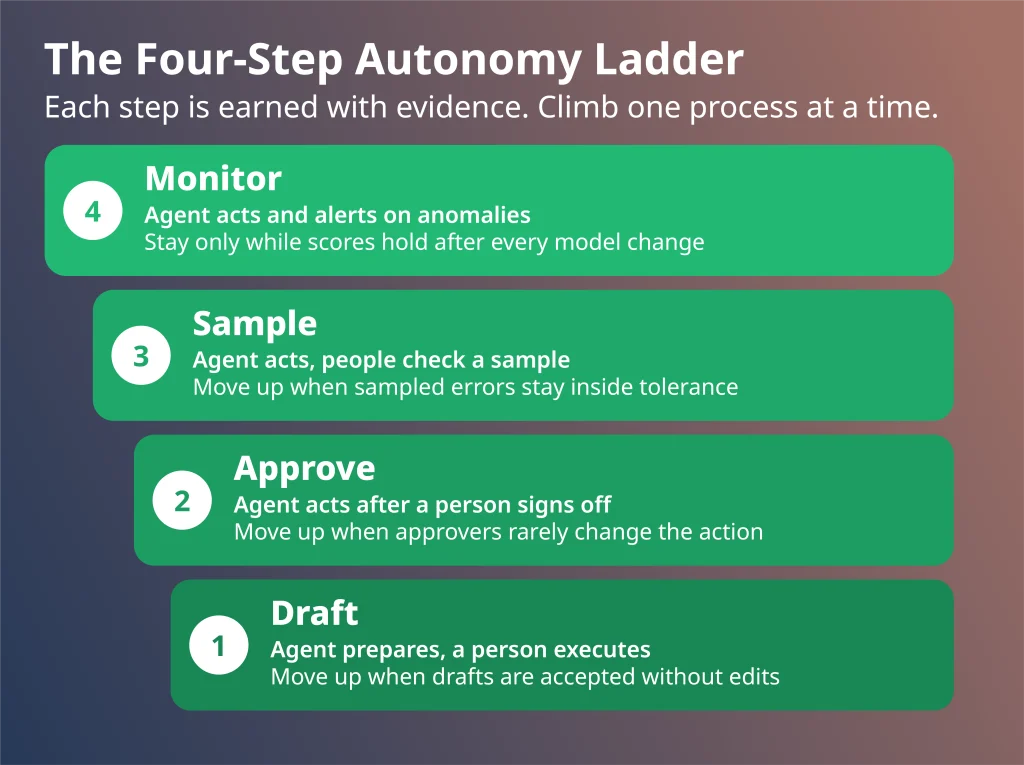
Approval Limits That Grow With Evidence
Every agent action needs a ceiling, set by three factors: financial value, data sensitivity and how easily the action can be reversed. Each category also needs a named person who signs off. Autonomy then expands one step at a time, once accuracy data justifies it. Deployflow’s agentic AI governance guide explains how to set those thresholds.
UK GDPR and ISO 42001: The Compliance Baseline
Start with a tamper-evident log of inputs, reasoning summaries, tool calls and approvals. Two frameworks then shape what that log must prove.
- UK GDPR, as amended by the Data (Use and Access) Act 2025, requires safeguards for significant decisions made solely by automated means. People must be told, must be able to contest the decision and must be able to request human review.
- ISO/IEC 42001 gives auditors and boards a recognised structure for governing AI across the organisation, from risk assessment to ongoing monitoring.
Three Failure Modes to Design Out Before Launch
| Failure Mode | What Happens | Control |
| Runaway Actions | An agent loops and repeats the same step | Rate limits, idempotent operations and a kill switch |
| Prompt Injection | Hostile instructions arrive hidden in emails or documents | Treat external content as untrusted data and restrict each agent’s tools |
| Silent Drift | Accuracy slips as models, data or processes change | Continuous evaluation against a fixed test set |
| Permission Creep | Access granted to fix one issue is never removed, and agent accounts grow broader each month | Quarterly access review for every agent service account, with unused permissions revoked |
How to Prove the ROI of Agentic Process Automation
Record a baseline before anyone writes a prompt. Without one, no savings can be proven to a finance director.
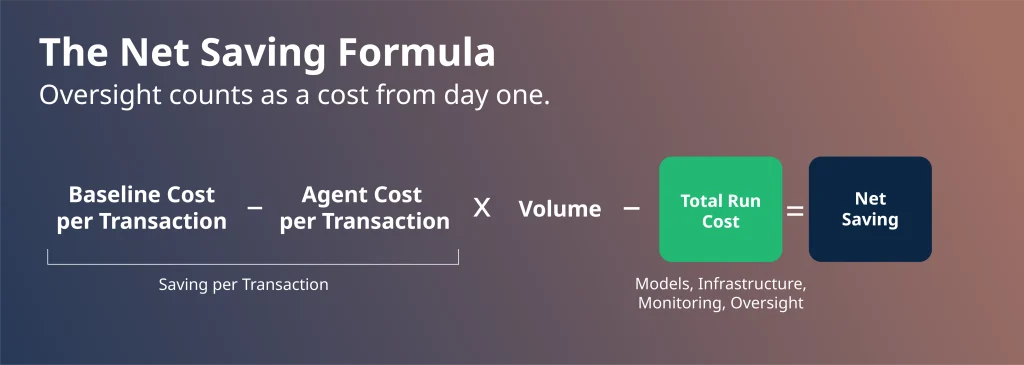
Total run cost covers models, infrastructure, monitoring and the time people spend reviewing agent work. Leaving oversight out is the most common way agentic business cases overstate their return.
Alongside the calculation, watch four operational signals: cycle time, exception rate, error and rework rate, and human review rate. The last one tells you the most. A falling review rate shows the agent is earning trust. A flat one after several months means the process belongs with simpler automation.
For a fuller treatment of the business case, see this guide to AI agent ROI.
Shadow Mode: Launch Agentic Process Automation Without Touching Live Operations
Before an agent drafts anything for your team, let it work in the shadows. It receives the same live cases as your staff, makes its own decisions and changes nothing. Each week, compare its choices with what your people actually did.
Read the Disagreements, Then Sort Them
Every mismatch belongs in one of four groups:
- Agent wrong: a gap in its tools, data or instructions. Fix it and retest.
- Person wrong: evidence for the business case. Review it with the team privately and without blame.
- Both defensible: policy allows more than one outcome. Decide which one you prefer.
- Nobody sure: an unwritten rule. Document it before the agent goes near production.
The last group is frequently the most valuable output of the whole exercise. Each entry is a rule that existed only in someone’s head, and an agent cannot follow a rule nobody wrote down.
The Go-Live Gate
Move the agent onto the first rung of the autonomy ladder only when all five answers are yes:
- Has it met the agreed accuracy target across a full business cycle, including month-end or peak periods?
- Is every “nobody sure” case now written into policy?
- Can one named person stop the agent within minutes?
- Is the cost per transaction known at production volume?
- Has the process owner signed off the results?
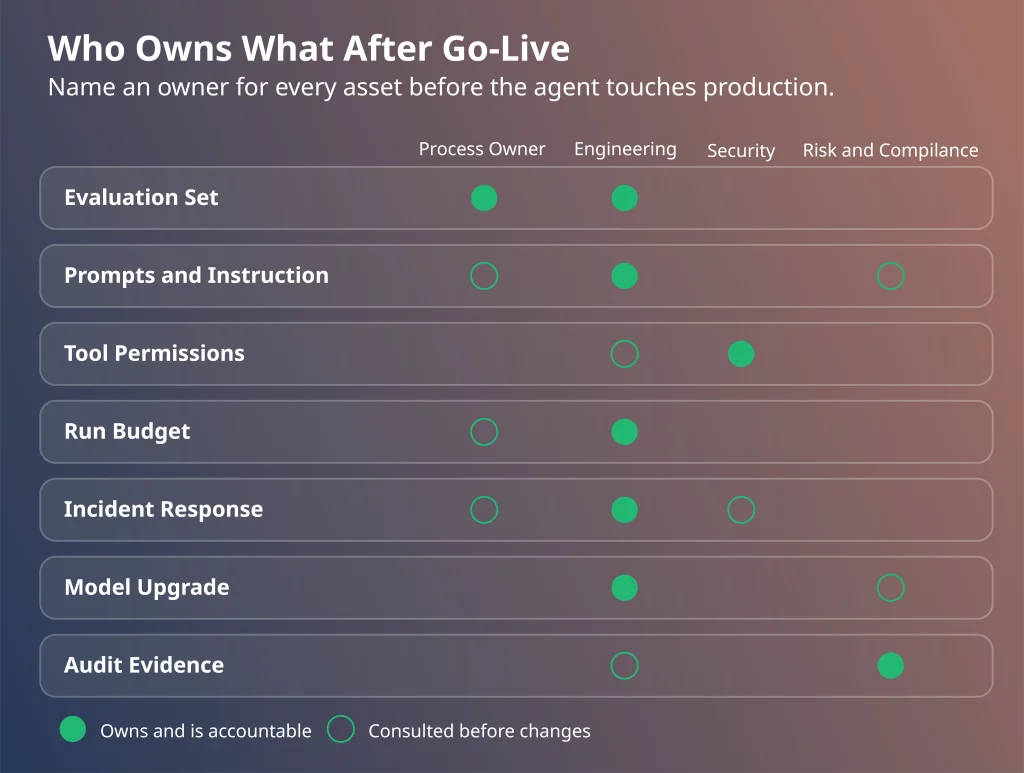
Agentic Process Automation After Go-Live: Who Answers When Things Change?
Launch is the easy week. The harder ones look like this:
- Monday: the model provider ships an update, and accuracy on credit notes slips.
- Wednesday: a security review narrows a service account, and the agent starts failing quietly.
- Friday: quarter-end volume arrives, and inference spend jumps with it.
None of these is a technical surprise, and each becomes an incident only when nobody owns it.
Three Clauses That Keep Ownership Yours
Whether agents come from a platform vendor, an external delivery team or your own engineers, write these into the contract or the internal charter:
- Your repositories from day one. Code, prompts, evaluation sets and integration logic are stored where your team controls access.
- Run cost by process, every month. Spend is reported at the same level of detail as your own cloud dashboards.
- A handover test before final payment. Your engineers ship one change to the agent without help from whoever built it.
The evaluation set deserves the most protection. It records how your processes actually behave, and whoever holds it can rebuild the agent on any platform.
Take Your First Agentic Workflow From Shadow Mode to Production
One well-chosen process, governed from the start and measured against a baseline, gives your board the evidence to fund the next five.
Deployflow’s sprint-based teams run discovery in two to three weeks and reach production in six to twelve. Every engagement ends with your engineers holding the code, prompts and evaluation sets, ready to run the agent without outside help.
Have a process in mind? Book an agentic AI assessment and leave with a scored shortlist, a reference architecture and a cost path to go-live.
Agentic Process Automation: Frequently Asked Questions
Is Model Context Protocol (MCP) required for agentic process automation?
No, but it makes integration simpler to standardise.
Model Context Protocol is an open standard, introduced in late 2024, that defines how AI agents connect to tools and data sources. Teams expose each system once through an MCP server, and any compatible agent can then use it without a custom connector. Major AI providers and many enterprise platforms now support it. The protocol does not handle security on its own. Each MCP server still needs authentication, scoped permissions and logging, because it gives agents a direct route into business systems.
Is agentic process automation the same as hyperautomation?
Agentic process automation is one part of hyperautomation, the wider strategy.
Gartner uses hyperautomation to describe a business-driven approach that identifies, vets and automates as many processes as possible, using several technologies together. Those technologies include RPA, process mining, low-code platforms and AI. Agentic process automation adds the decision-making layer to that toolkit. In practice, a hyperautomation programme might use process mining to find candidates, RPA for fixed steps and AI agents for exceptions. Treat APA as a capability inside the programme, and plan its governance alongside the tools it coordinates.
Will agentic process automation replace jobs?
Agentic process automation changes jobs more often than it removes them outright.
Agents absorb repetitive triage, data gathering and routine decisions. People move towards exception handling, approvals, process design and quality checks. The effect on headcount depends on how each organisation redeploys that time. Teams that plan reskilling early tend to keep valuable process knowledge in-house. Under UK employment law, any change that puts roles at risk of redundancy still requires proper consultation. Involving staff in process design also improves results, because they know the exceptions to no document records.
What skills does an IT team need for agentic process automation?
Most organisations need four skill sets to run agentic process automation well.
AI engineers design agents, prompts and evaluation tests. Platform and DevOps engineers handle deployment, observability, permissions and cost control. Integration specialists connect agents to ERP, CRM and legacy systems. Process owners define what a correct outcome looks like and approve changes. Security and risk teams also need working knowledge of how agents use credentials and data. Few teams have every skill on day one, so many start with external support and transfer knowledge during the first deployment.
Can agentic process automation run on-premises or in a private cloud?
Yes, agentic process automation can run on-premises or in a private cloud.
You can host open-weight language models in your own infrastructure, and orchestration frameworks run on standard container platforms. Many hosted models are also available inside major cloud regions, including UK regions, which helps with data residency. The trade-offs are capacity and upkeep. Self-hosted models need GPU infrastructure, patching and performance monitoring. Choose the deployment model based on data sensitivity, regulatory requirements and expected volume, and confirm where every component processes data before going live.
Explore our BLOG
Recent articles
Agentic Process Automation Explained: A Complete Guide for 2027
Agentic process automation hands off entire business processes to AI agents that read, decide and...
read full article

Is Claude Down? Anthropic Outage: Protect Your Cloud Infrastructure
Every current Claude model failed at once on 25 October 2026, the worst of five...
read full article

The SOC 2 Remediation Roadmap: From Compliance Dashboard to Passed Audit
This SOC 2 remediation roadmap takes you from a red compliance dashboard to a clean...
read full article