

A board-ready AI roadmap takes six weeks if you rank, cost and sequence use cases with the people who will use them. Boards reject AI plans that can’t state cost, return and risk for every item.
Below are the structure, scoring model, and answers to the five questions every board asks.
AI Roadmap in Brief: Six Weeks to Board Approval
- Every use case needs a rank, cost, success measure, data rating, risk view and place in the sequence.
- A weighted score, set with the people who will use each agent, decides what goes first.
- Data residency, CBUAE rules and Arabic content can reorder UAE priorities.
- Fund one use case fully, prove it on real data, then release the next budget.
AI Business Case for the Board: What to Show for Each Use Case
| Element | What it answers |
| Rank | Why this one first? |
| Cost | What does it take to build and run? |
| Success measure | How will you know it worked? |
| Data rating | Can your current data support it? |
| Risk view | What could go wrong, and who signs off? |
| Sequence position | What does it unlock next? |
A use case missing any row goes on a watch list. When several use cases fail on the same row, such as data readiness or ownership, the gap is organisation-wide, and no single build will fix it. Put that shared fix at the top of the roadmap, because every use case behind it depends on it.
Six-Week AI Roadmap: What to Deliver at Each Stage
Each stage ends with an output and a filter. Ideas that fail the filter are parked, so the board sees only candidates that passed all six stages.
| Stage | Key Question | Output | Park the Idea If |
| 1. Collect | Which problems cost the most time, money or risk? | A long list, each item a problem with a measurable outcome | Nobody can name the number it would move |
| 2. Score With Users | Would the people doing the work use it and trust it? | A shortlist grounded in daily work | Users feel no real pain or would work around it |
| 3. Check Data | Can today’s data support it? | A readiness rating per use case | Core data is missing, inaccessible or off-limits for AI |
| 4. Cost and Risk | What will it cost to build and run, and what could go wrong? | Build cost, running cost and risk level | Running cost outweighs the value it creates |
| 5. Sequence | Which use case proves value fastest? | A delivery order with a clear first build | It depends on an unproven item ahead of it |
| 6. Board Pack and Bootcamp | Can the board approve it, and can the team own it? | An approvable plan and a team ready to run it | No business owner will put their name to it |
Once the shortlist is fixed, stages 3 and 4 can run in parallel, which keeps six weeks realistic. Keep the parked list as well. Ideas often return as data improves or regulations change.
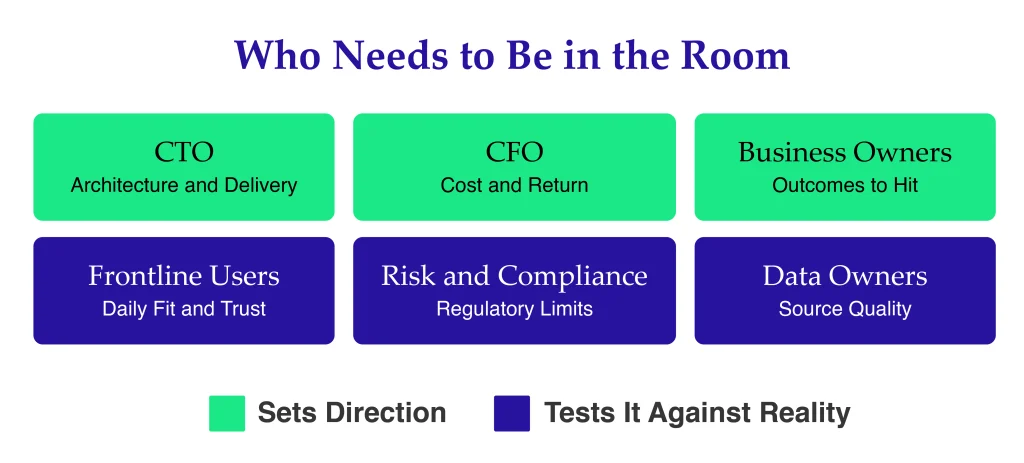
How to Prioritise AI Use Cases With a Scoring Model
Score each idea from 1 to 5 on every criterion. A 5 always means “better candidate to go first”, so effort and regulatory exposure score high when they are low. Multiply each score by its weight, then add the results to get the total.
| Criterion | Starting Weight | Scores 1 | Scores 5 |
| Business value | 30% | Marginal gain | Material, measurable gain |
| Data readiness | 25% | Major clean-up | Ready to use |
| Adoption | 15% | Resistance expected | Users asking for it |
| Effort | 15% | Many systems, new controls | Few systems, existing controls |
| Regulatory exposure | 15% | Heavily scrutinised | Low scrutiny |
Three rules keep the scores honest:
- Score on evidence. Value comes from the business owner’s own figures, data readiness from the Stage 3 sample, and adoption from the user sessions.
- Set a floor. An idea that scores 1 on data readiness or adoption is parked, whatever its total.
- Break ties on data. When two totals match, the one with the higher data readiness goes first because it reaches production sooner.
Adjust the weights to fit your priorities, then lock them before scoring starts.
Worked Example: Why the Highest-Value Idea Can Go Second
Invoice matching in finance
Value 3, data 5, adoption 4, effort 4, regulatory 4.
Weighted total: 3.95
AI-assisted credit decisions for retail customers
Value 5, data 2, adoption 3, effort 2, regulatory 1.
Weighted total: 2.90
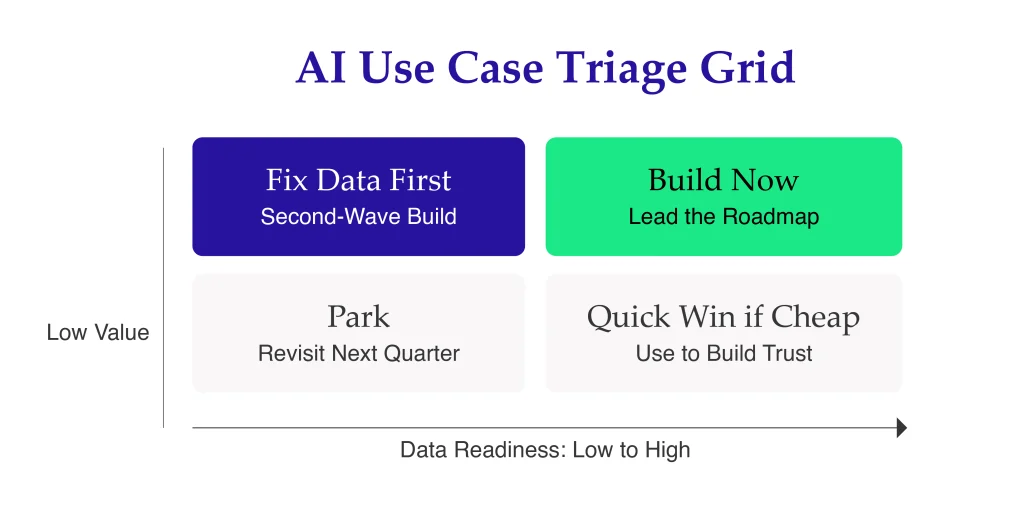
Credit decisions promise more value, yet invoice matching goes first. Its data is ready, finance teams want it, and it carries little regulatory exposure. Credit decisions join the second wave once their data and controls are in place.
UAE AI Strategy: Five Factors That Reorder Your Roadmap
Each factor below changes a score in the weighted model. Check each one at the stage shown so it can’t surprise you after approval.
| Factor | How It Moves a Use Case | Check At |
| Data residency | Rules out hosting and models that process data abroad, which can delay a use case until in-country hosting is ready | Stage 3 |
| CBUAE AI and ML guidance (Feb 2026) | Lowers the regulatory score for customer-facing decisions in licensed financial institutions, as set out in the CBUAE’s AI guidance note | Stage 4 |
| DIFC and ADGM regimes | Adds effort when a use case spans mainland and free zone entities under different data rules | Stage 4 |
| Arabic content | Lowers data readiness until a model passes tests on your own Arabic documents | Stage 3 |
| UAE National Strategy for AI 2031 | Raises the value score for government use cases that support the national strategy’s priority sectors | Stage 1 |
A residency constraint found after approval costs credibility and time.
Board Questions About AI: Five Answers Every CTO Needs
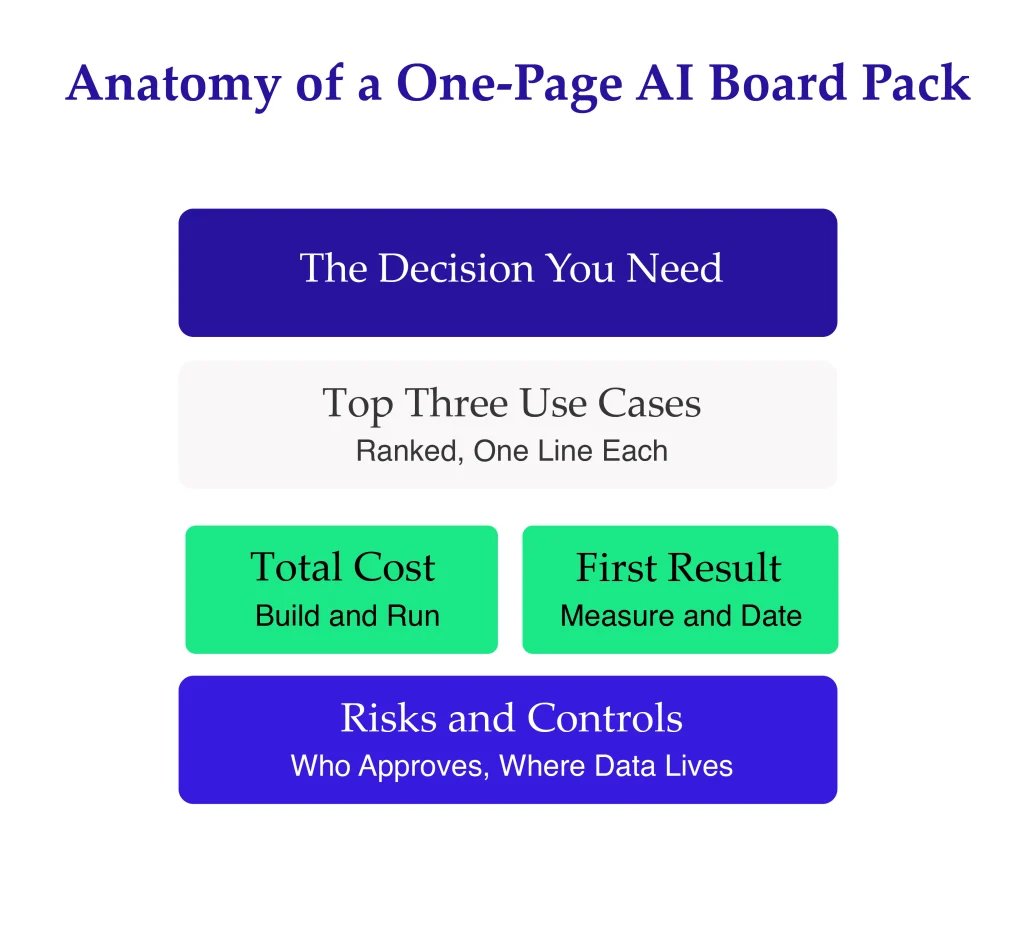
Boards rarely ask about models. Bring evidence for these five questions, and the meeting ends in a decision.
- “What will it cost?”
Show: build and running costs separately, including model usage.
Avoid: one blended figure that hides the running cost.
- “When do we see value?”
Show: the first use case, its success measure and a target date.
Avoid: value that only arrives once the whole roadmap is delivered.
- “What if it fails?”
Show: a small first build on real data, with a stop rule if it misses its number.
Avoid: a large upfront commitment with no exit point.
- “Who is accountable?”
Show: a named business owner per use case and a named approver for consequential decisions.
Avoid: “the AI team” as the owner.
- “Are we compliant?”
Show: where data lives, who approves actions and how every decision is logged.
Avoid: pointing to the vendor. Regulators such as the CBUAE hold you accountable for AI you buy.
AI Implementation After Approval: The Gates From Roadmap to Live Use Case
Board approval starts the clock. Aim to get the first use case in front of real users while the decision is still fresh in the board’s mind.
- Measure the baseline. Record today’s value of the success metric before sprint one. Without a “before” number, nobody can prove the “after”.
- Prove it on real data. Build in two-week sprints, and at the end of each sprint, check one metric agreed at the start, such as time per case. If the number isn’t moving after a few sprints, you’ll know early and can change course before the budget runs out. Gate: the use case hits its success measure in live use.
- Hand over. Train the team that will run the agent, and transfer the code, documentation and knowledge. Gate: your team can operate it without the delivery partner.
- Fund the next use case. Spend follows proof, so the roadmap moves forward one earned step at a time.
A baseline does more than prove value later. It shows where each new investment should go before you spend.
“Deployflow supported us with a full audit of our enterprise infrastructure… where it made more sense for cost, performance, and operational control.”
John Adegoke, MTN
How Often Should You Update an AI Roadmap?
- Every quarter, as a fixed review
- When a use case beats or misses its number, since both change what comes next
- When a model provider changes pricing or capability
- When new regulation or guidance lands
Why AI Programmes Stall: Four Roadmap Mistakes to Avoid
- Letting a vendor shape the roadmap: When a vendor drafts your roadmap, its own product usually ends up at the top. Treat vendor ideas like any other candidate and run them through the same scoring model.
- Funding pilots everywhere: Ten small pilots feel like progress, yet none of them gets enough backing to reach production. Put the full budget behind your first use case, and release money for the next one once it delivers.
- Leaving governance for later: Approval gates, access rules and logging are much harder to add once a pilot is built. Teams that try often end up rebuilding and missing their go-live date. Design these controls into the first sprint, especially in regulated sectors.
- Tying every use case to one model provider: Model prices and capabilities shift every few months, and Arabic performance varies widely between providers. Choose the best model for each use case, while keeping the freedom to switch.
How Deployflow AI Builds AI Roadmaps in the UAE
Deployflow delivers an AI roadmap in six weeks, ready for the board, with an agent bootcamp for your team. The same team then builds on your real data in two-week sprints, so nothing is lost between the plan and the first live agent. Handover covers code, documentation and knowledge, with 24/7 support afterwards.
AI Roadmap Case Study: A National-Scale AI Platform for a UAE Public Sector Organisation
A multi-billion-dollar UAE public sector organisation monitors the social and economic wellbeing of the communities it serves. Its data was spread across surveys, spreadsheets and regional platforms. Leadership had no single view of community signals and little visibility of how policy changes affected outcomes over time.
Deployflow’s senior solution engineers, whose previous roles include Vodafone and Lloyds Banking Group, designed a three-phase roadmap:
- Data Foundations. Consolidate scattered historical data and route surveys and spreadsheets through AI pipelines, so the history becomes reliable and usable.
- AI Pipelines. Feed incoming survey and regional data into pipelines where AI classifies each record into comparable indicators.
- Executive Intelligence Layer. Give leadership a master dashboard with regional breakdowns. Combine many inputs into a few indices, such as family health, economic health and social cohesion, with policy milestones plotted on the trends.
The indices follow the logic of financial market indices: many complex inputs condensed into a small set of measures leadership can track. The platform shows correlations between policy milestones and indicator changes, leaving judgement on cause to decision-makers.
Outcome: the organisation approved a proof of concept covering data preparation and early pipeline development. The organisation plans a full rollout as a multi-phase programme over roughly 6 to 12 months.
What This UAE AI Case Study Shows
- Data readiness set the order. Fragmented data was the gap every later phase depended on, so it went first. That’s the shared fix the board table section says to put at the top.
- A bounded first step won approval. Leadership signed off on a defined proof of concept with no upfront commitment to the full programme. That’s the answer to the board’s “What if it fails?” question.
- Leaders need a few measures. Three indices are easier to govern than dozens of separate reports.
Are you ready to take your board to a plan it can approve? Book a discovery session with Deployflow AI. In a few weeks, you’ll have your first use case sized, a success measure agreed, and the build priced.
AI Roadmap and AI Strategy: Frequently Asked Questions
What is the difference between an AI strategy and an AI roadmap?
An AI strategy explains why and where your organisation will use AI. An AI roadmap explains what gets built, in what order, at what cost and by when.
Strategy sets direction, such as improving customer service or reducing operational risk. The roadmap turns that direction into ranked use cases with owners, budgets and success measures. You need both. A strategy without a roadmap stays on slides, and a roadmap without a strategy becomes a list of unrelated pilots. Keep the strategy to one page so the roadmap can trace every item back to it.
Who should own AI strategy: the CTO or a Chief AI Officer?
Either can, as long as one person is accountable.
In many organisations, the CTO or CIO owns AI because delivery, data and security already report to them. Larger organisations increasingly appoint a Chief AI Officer to coordinate AI across business units.
In 2024, Dubai appointed Chief AI Officers across 22 government entities. Whoever owns it, AI strategy fails when it stays inside technology alone. Business owners must own the outcomes of their use cases, and risk and compliance must be involved from the first scoring session.
How do you measure AI ROI?
Measure AI ROI against one business number agreed before the build starts, such as time per case, cost per transaction or error rate.
Compare that number before and after go-live, using the same method both times. Then subtract the full cost: build, model usage, hosting, monitoring and the staff time to run and improve the system. Avoid measuring activity, such as prompts sent or users onboarded, because activity does not prove value. Track results monthly for the first quarter. Early numbers often move as users adapt and the agent is tuned.
What is the difference between an AI proof of concept, a pilot and production?
A proof of concept tests whether an idea works technically, usually on sample data with no real users.
A pilot runs the system with real users and real data, but at limited scale and with close supervision.
Production means the system is live, supported, monitored and part of normal operations.
Many AI projects stall between pilot and production because nobody planned for security, integration or ownership. Shorten that gap by testing on real data from the start and agreeing who will run the system before the pilot begins.
Should you build or buy AI solutions?
Buy when the task is common across industries and a product already does it well, such as meeting transcription or code assistance.
Build when the task depends on your own data, processes or regulatory obligations, or when it creates a competitive advantage.
Some organisations end up with a mix. They buy commodity tools, build differentiating agents and use a partner to speed up the builds. Whichever route you choose, check three things first: where the data will be processed, whether you can switch providers later, and who will own and maintain the system.
Explore our BLOG
Recent articles
AI Roadmap: How to Get Board Approval for Your AI Strategy in Six Weeks
A board-ready AI roadmap takes six weeks if you rank, cost and sequence use cases...
Read full article

Is Claude Down? Anthropic Outage: Protect Your Cloud Infrastructure
Every current Claude model failed at once on 25 October 2026, the worst of five...
Read full article

Agentic Process Automation Explained: A Complete Guide for 2027
Agentic process automation hands off entire business processes to AI agents that read, decide and...
Read full article