


The UK Visa Portal security lapse was preventable at three separate points before it became a breach. None of those points was reached.
TL;DR
- UK Visa Portal exposed over 100,000 passports, selfies, and location data through a misconfigured Amazon S3 bucket.
- Misconfigured cloud storage is the most preventable category of data exposure, and the most revealing about an organisation’s engineering culture.
- The ICO and UK GDPR create legal exposure for any UK-adjacent business that cannot demonstrate accountability.
- Five structural questions every CTO should answer before a researcher or the ICO does.
Most CTOs who read this will recognise at least one of those gaps in their own organisation.
What the UK Visa Portal Security Lapse Involved
On 27 May 2026, TechCrunch reported that UK Visa Portal, a third-party immigration services site with no official UK government affiliation, had publicly exposed over 100,000 identity documents through a misconfigured Amazon S3 bucket.
The bucket was not openly listed. Each file was, however, directly accessible via URL to anyone who knew the address. A bug in the site’s back end made it possible to retrieve the full file list.
The exposed data included passports, selfie photographs, and geolocation metadata precise enough, in several cases, to reveal a person’s home address. The exposure was fixed only after the story was published.
The bucket was where the failure surfaced. The cause sits several layers deeper.
One Misconfigured Bucket Away: How Exposed Is Your Organisation?
Before answering that question with “no,” consider how the UK Visa Portal bucket was exposed in the first place. Not through an external cyberattack or a sophisticated exploit. Through a routine misconfiguration that no internal process caught.
Misconfigured Cloud Storage Does Not Happen by Accident
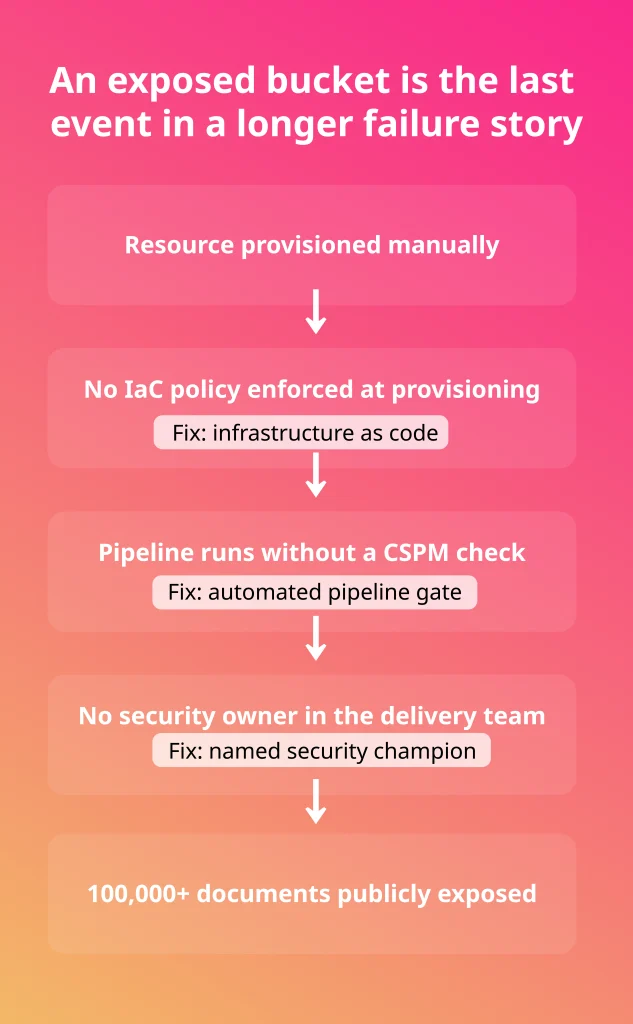
Every exposed S3 bucket represents at least three prior failures:
- A provisioning process without privacy enforcement
- A pipeline without automated compliance checks
- An organisation where nobody owns the security outcome of what gets deployed
In mature engineering organisations, infrastructure-as-code and environment-level access policies make an exposed bucket the exception that triggers an alert. In organisations without those controls, it is the rule that nobody notices until someone external finds it.
The UK Visa Portal incident fits a documented, recurring pattern. Misconfigured cloud storage is the most preventable category of data exposure, which makes it the most revealing. If it happens, it tells you exactly what the organisation lacks.
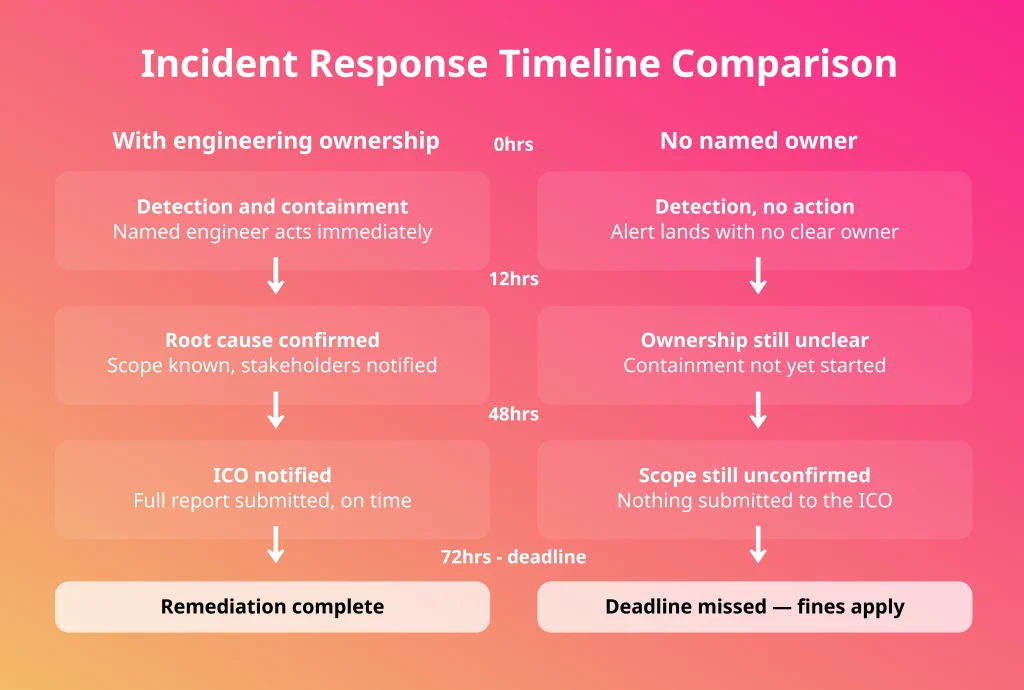
The ICO 72-Hour Window: Two Organisations, One Breach, One Deadline
DevSecOps Is Not Optional in a UK GDPR Environment
For any business operating under UK GDPR, the implications extend well beyond reputational risk. The Information Commissioner’s Office (ICO) requires that personal data breaches be reported within 72 hours of discovery when the breach is likely to pose a risk to individuals. Exposed passport data, combined with geolocation metadata that can identify home addresses, is in the highest-risk tier.
An organisation that discovers a breach without a clear engineering-led response is not in a position to meet that 72-hour window. It is also not in a position to demonstrate the “appropriate technical and organisational measures” that UK GDPR requires as a baseline defence.
The legal exposure from failing to notify the ICO promptly is real. So is the reputational cost of a disclosure that a functioning pipeline would have prevented entirely.
What Happens When No One Inside the Organisation Owns the Incident
A misconfigured bucket can be secured in minutes. The structural conditions that allowed it to exist in the first place take considerably longer to address, and they begin with incident ownership.
In most organisations that experience a preventable data exposure, the root problem is the absence of a clearly defined accountability chain.
Nobody was named as the owner of that outcome. Nobody had a documented plan to follow. Nobody had the authority to act without first seeking approval from outside the engineering function.
That vacuum does not appear on a security audit report. It does not show up in a penetration test. It shows up when something goes wrong, and the organisation discovers, in real time, that it has no internal mechanism to respond.
Incident Response Without Engineering Ownership Fails at the First Step
A properly structured incident response sequence covers detection, containment, root cause analysis, stakeholder notification, remediation, and ICO notification where required. Each stage has a named owner with the authority to act.
The critical word is authority. Detection and containment are engineering actions. They require someone inside the organisation who can make decisions quickly and act without waiting for sign-off from functions that are not equipped to assess technical risk in real time.
When that person does not exist (or exists without documented authority), the sequence stalls at the first step. Containment is delayed. The ICO’s 72-hour notification window is closing. And the gap between when the exposure was discovered and when it was fixed becomes both a compliance and a reputational liability.
The Cost of an Accountability Vacuum
Organisations without named incident ownership do not just respond slowly. They respond inconsistently. Different incidents get handled differently depending on who happens to notice, who has the capacity, and who feels responsible that day.
That inconsistency is itself a UK GDPR risk. Demonstrating “appropriate technical and organisational measures” to the ICO requires evidence of a repeatable, documented process.
The cost is measured in ICO fines, in the time it takes to contain a breach that should have been caught at the pipeline level, and in the reputational damage that follows.
Three Engineering Accountability Gaps That No Security Audit Will Find
UK Visa Portal’s exposure was caused by the absence of three structural conditions that mature engineering organisations treat as non-negotiable.
Gap One: No Security Ownership Inside Delivery
Ask who owns the security outcome of a feature once it ships. “The security team” is not an answer. It is a sign that nobody in delivery owns the outcome. Security integrated in delivery means engineers are responsible for the security posture of what they build and deploy. Security bolted on at the end of a release cycle means nobody catches the misconfigured bucket before it reaches production.
Security integrated in delivery means engineers are responsible for the security posture of what they build and deploy, a model covered in detail in Deployflow’s guide to DevSecOps implementation practices.
A security champion inside a delivery team does not need to be a dedicated security engineer. Someone needs to ask the security questions at planning, check the answers before deployment, and own what ships. Without it, security checks that should happen at planning get skipped at deployment and are discovered by researchers.
Gap Two: Pipelines Without Security Guardrails
Cloud security posture management starts at the pipeline level. If your CI/CD process does not include automated misconfiguration checks (bucket policies, access controls, encryption enforcement), those checks are not happening. Manual configuration at the provisioning stage is where errors are introduced. Automation at the pipeline stage is where they are caught.
Automation at the pipeline stage is where misconfigurations are caught, and increasingly, AI-assisted DevOps tooling is accelerating how quickly those checks can be configured and enforced across complex cloud environments.
Infrastructure-as-code with enforced security policies removes the human decision point that creates exposure. It also creates an audit trail. In a UK GDPR context, that audit trail is evidence of the “appropriate technical measures” the ICO will want to see.
Gap Three: Third-Party Vendors With Unverified Security Postures
UK Visa Portal’s customers paid a fee, uploaded government-issued identity documents, and assumed the company had basic controls in place. None of those assumptions was warranted. For any enterprise relying on third-party infrastructure or SaaS vendors, that asymmetry is a direct liability.
Your vendor’s security posture is your risk. If your procurement process does not include enforceable security requirements (verified), that gap belongs on your risk register.
Five Questions Every CTO Should Answer This Week
Each question maps directly to a failure mode that the UK Visa Portal incident made visible.
- Are your cloud storage resources private by default, enforced at the pipeline level rather than set manually at provisioning?
- Do your CI/CD pipelines include automated cloud security posture checks before any resource reaches production?
- Is security ownership named and embedded within your delivery teams, or siloed in a function that reviews after the fact?
- Does your incident response plan name an engineering lead as the first responder, with authority to contain without legal sign-off?
- Do your third-party vendor agreements include security requirements that are enforced at procurement, not assumed after signing?
If any of those questions produce hesitation, the gap exists. The only question is whether a researcher or the ICO finds it first.
The Engineering Culture That Does Not Need a PR Firm
Organisations that have built genuine DevSecOps maturity do not avoid incidents entirely. They contain them quickly, disclose them within ICO timelines, and learn from them structurally. Their incident response is owned by engineering, documented before an incident occurs, and rehearsed well before it is needed.
One secured bucket does not make an engineering culture. It happens through building the conditions that catch misconfigurations before they reach production: embedded security ownership, automated pipeline guardrails, named incident response leads, and vendor security standards that are enforced rather than assumed.
The UK Visa Portal security lapse is a public record of what the absence of those conditions produces. For UK CTOs and IT leaders reading this, the relevant question is whether your organisation has the structural conditions that would have prevented the same ones.
Build the Engineering Accountability Your Organisation Needs Before the ICO Does
The three gaps this article covers – no security ownership in delivery, pipelines without guardrails, and unverified vendor postures are not uncommon. They are the default state of organisations that have scaled faster than their engineering practices.
Deployflow works differently from a standard managed services provider. Rather than monitoring problems after they occur, Deployflow embeds directly into delivery teams to build the structural conditions that prevent them.
The approach is transformation-first: ownership structures, pipeline automation, and security governance built into how engineering works.
Proven DevSecOps Results From Regulated and High-Growth Environments
When Strike lost its internal DevOps team and faced recurring cloud outages, Deployflow delivered a 70% improvement in cloud environment stability and a 60% reduction in downtime.
At Little Journey, a regulated healthcare platform, Deployflow’s DevSecOps work achieved 100% data segregation and security compliance while cutting deployment time by 80%.
For Zilch, now a $2 billion fintech, Deployflow built and automated an entire delivery pipeline that allowed complex API integrations in under a month, the condition on which the company’s survival depended.
“Managing IT infrastructure and meeting vendor security requirements in a rapidly growing tech startup is not an easy job.
I enjoy working with the Deployflow team and appreciate their adaptiveness and responsiveness – they offer strategic advice and do a good job at balancing the need to put security first whilst also developing and maintaining our services in a way that meets our users’ needs.”
Ian Knott, Regulatory and Governance Lead, Little Journey
Deployflow’s DevSecOps managed services put named security ownership inside your delivery teams, so accountability exists before an incident occurs.
DevOps CI/CD services replace manual provisioning with automated compliance checks at the pipeline level, the point where misconfigurations are caught rather than discovered.
Cloud security covers posture management: access controls, bucket policies, encryption enforcement, and the audit trail the ICO will want to see.
The ICO’s Timeline Is Not Yours to Control: Your Security Posture Is
Manual configuration, unnamed incident owners, unverified vendor agreements. None of those is a permanent condition. They are fixable, but only once they are identified.
If your organisation has not audited those conditions recently, a discovery call with Deployflow is the most direct way to identify where the exposure lies before a researcher or the ICO does so for you.
Frequently Asked Questions: Cloud Security and Engineering Accountability
What is the most common cause of cloud data breaches in UK organisations?
Misconfiguration is the leading cause, not external attacks. According to the Thales Cloud Security Study, human error and misconfigurations are the top root cause of cloud breaches, occurring in 31% of incidents, ahead of known vulnerability exploitation and zero-day attacks. In practice, this means publicly accessible S3 buckets, overly permissive IAM roles, and unencrypted data at rest. Most of these misconfigurations are introduced during manual provisioning and go undetected because no automated check exists at the pipeline level to catch them before deployment.
What are the ICO’s requirements for reporting a data breach under UK GDPR?
Organisations must report a personal data breach to the ICO within 72 hours of becoming aware of it, provided the breach is likely to result in a risk to individuals’ rights and freedoms. The notification must include the nature of the breach, the categories and approximate number of individuals affected, the likely consequences, and the measures taken or proposed to address it. Failure to notify within the window (or failing to notify at all) can result in fines of up to £17.5 million or 4% of global annual turnover under UK GDPR, whichever is higher.
What is DevSecOps, and how does it differ from traditional security practices?
DevSecOps integrates security responsibilities directly into the software delivery process rather than treating security as a separate review stage at the end of a release cycle. In traditional models, a dedicated security team reviews code or infrastructure after development is complete. In a DevSecOps model, security checks are automated into CI/CD pipelines, security ownership sits inside delivery teams, and vulnerabilities are caught at the point they are introduced. The practical result is faster remediation, fewer incidents, and a more defensible compliance posture.
What is cloud security posture management (CSPM), and does my organisation need it?
Cloud security posture management is the continuous monitoring and enforcement of security policies across cloud infrastructure, covering misconfigurations, compliance violations, excessive permissions, and unencrypted resources.
Any organisation running workloads on AWS, Azure, or Google Cloud that handles personal data, operates in a regulated industry, or stores sensitive documents should treat CSPM as a baseline requirement. Without it, misconfigurations accumulate between manual audits, and the first indication of a problem is frequently an external report.
How do you build an effective incident response plan for a cloud environment?
An effective cloud incident response plan names specific individuals as owners of each response stage (detection, containment, root cause analysis, notification, and remediation) and gives them documented authority to act without requiring sign-off from functions outside engineering. The plan should be written before an incident occurs, tested through tabletop exercises at least annually, and updated after every significant change to the cloud environment.
For UK organisations, the plan must also account for the ICO’s 72-hour notification requirement, which means that containment and initial assessment must occur within hours.
Explore our BLOG
Recent articles

ISO 42001 Explained: Requirements, Certification and What Your Engineering Team Must Build
ISO 42001 is the international standard that demonstrates your organisation governs AI properly, and enterprise...
read full article

Is Claude Down? Anthropic Outage: Protect Your Cloud Infrastructure
Claude went down across every surface on 29 September 2026. From 14:00 to 14:59 UTC,...
read full article

Top 10 Healthtech Companies in 2026: What Their Growth Means for AI and DevOps
Every software change that reaches a hospital has to clear regulatory, legacy system, and clinical...
read full article