



Six months into a DevOps engagement, you should have faster deployments, cleaner infrastructure, and engineers who aren’t firefighting at 2 am. What most companies actually have is a Confluence full of documentation, a vendor who invoices monthly and delivers quarterly, and a contract that’s harder to exit than it was to sign.
TLDR for CTOs
- 10 DevOps service companies assessed, from UK security boutiques to Fortune 500 systems integrators
- Every entry includes an honest caveat and a pricing signal
- Includes a decision framework and 7 questions that expose weak vendors fast
- The 2023 vendor landscape is obsolete; we cover what changed and why it matters
The gap between teams that get this right and those that don’t is measurable. According to the DORA State of DevOps Report, elite teams deploy multiple times per day, recover from failed deployments in under an hour, and maintain a change failure rate of 5% or lower. Low performers take between one and six months to deploy the same change.
The DevOps services segment alone is forecast to grow at 23.1% annually through 2031 (Mordor Intelligence). There’s no shortage of providers; the shortage is in providers worth hiring.
The Top DevOps Service Companies in 2026
1. Deployflow
What Makes Them Different
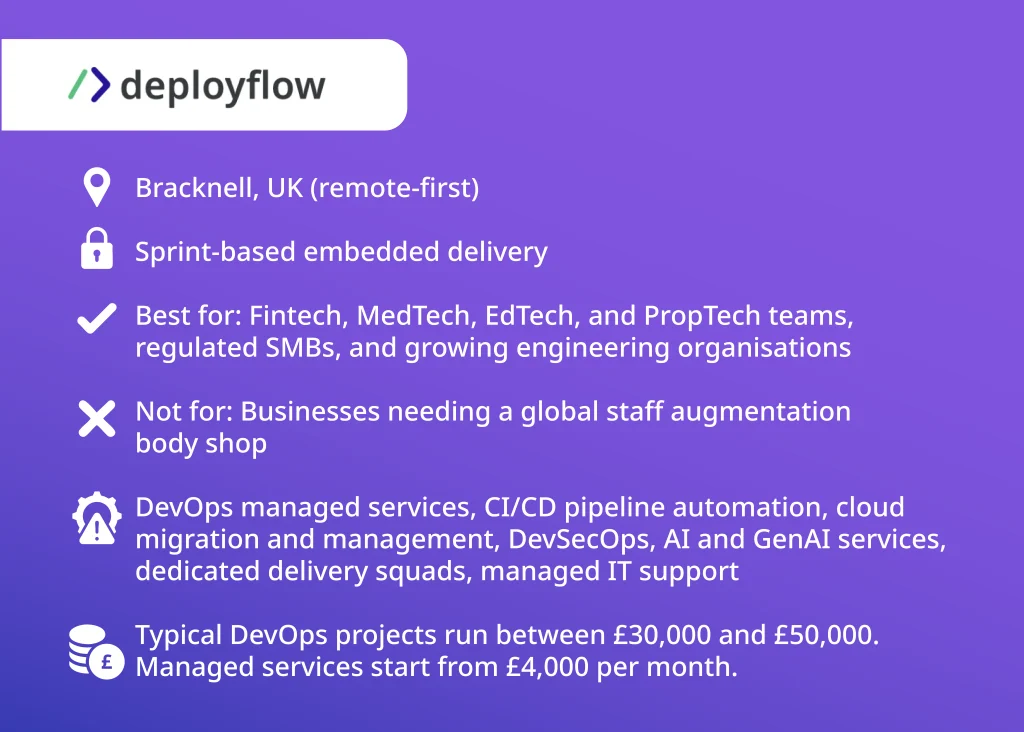
Deployflow was founded in 2018 by Prakash Pilley and Thomas Radosh and has grown from a two-person agency into an 80+ person digital transformation partner.
The model is built around sprint-based delivery: a full-stack squad of DevOps engineers, architects, testers, and project managers embedded directly into your workflows. Every sprint ends with defined, measurable outcomes.
The proprietary AI-powered CloudChecker tool runs a deep-dive infrastructure assessment and produces a detailed cloud migration or modernisation plan, including projected costs, before any work begins.
The Little Journey case study puts numbers to it. The digital health platform needed critical improvements to scalability, efficiency, and security within a compressed timeline. The result was an 80% reduction in deployment time, 50% increase in infrastructure scalability, 100% data segregation and security compliance, and a 70% reduction in manual labour.
Deployflow holds Microsoft Solutions Partner, AWS, and Google Cloud partner status alongside ISO 27001 and Cyber Essentials Plus certifications. For businesses operating under FCA Operational Resilience requirements or similar frameworks, compliance is embedded from day one.
Deployflow operates remote-first and on-site, with delivery across the UK and internationally.
“They were able to give us another vision, another way of doing things. It took only a couple of days for them to understand the whole methodology. I can see Deployflow as a long-term technological partner that will bring a lot of innovation.”
Marta Juega, PhD, MBA, Co-Founder, PI Concept
Where They Fall Short
If you’re looking to hire 50 contractors to sit inside your team with no delivery accountability, that’s not the model. Deployflow operates as an embedded delivery partner, not a staff augmentation body shop.
2. Capgemini
What Makes Them Different
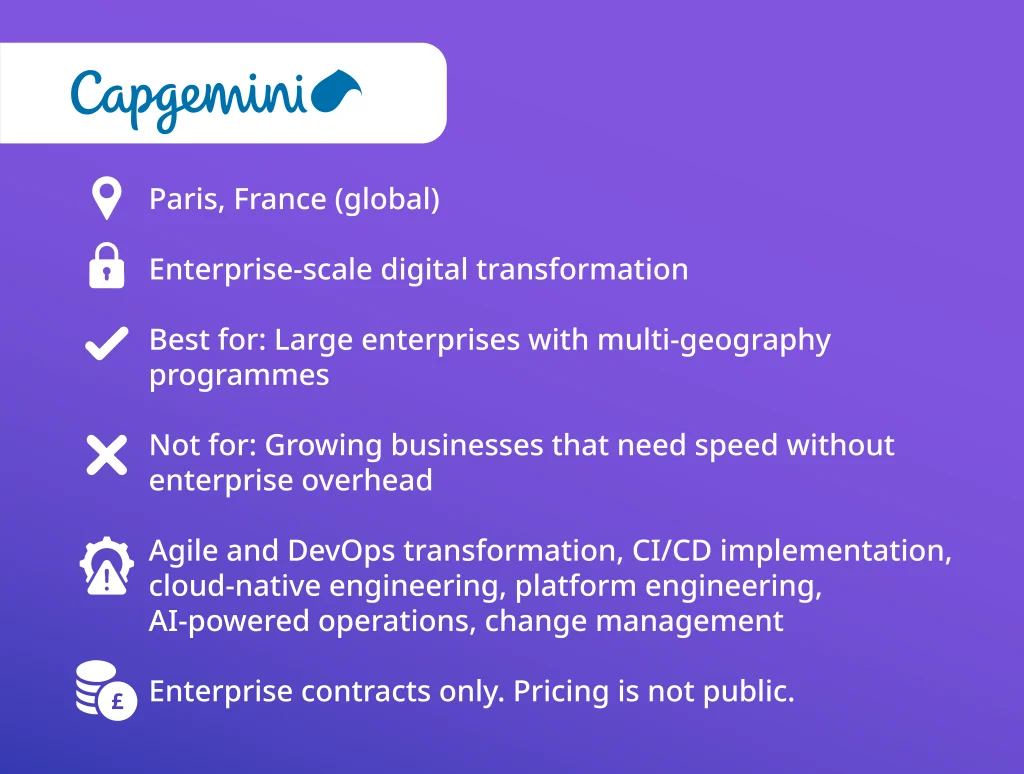
With 350,000 employees across 50 countries and €22.1 billion in 2024 revenue, Capgemini operates at a scale few firms can match. Their DevOps offering is part of the ADMnext portfolio, combining Agile and DevOps practices with cloud-native engineering, platform engineering, and AI-driven operations.
They bring deep industry vertical knowledge across financial services, manufacturing, public sector, and energy, and can staff large multi-geography programmes with domain expertise already in place.
In 2026, their stated focus areas are cloud-native DevOps, automation, and platform engineering, with AI agents increasingly embedded in operational workflows.
Where They Fall Short
Engagement models skew toward large enterprise contracts. Agility at the team level varies significantly by programme and by geography. For growing businesses that need speed and flexibility without enterprise overhead, a more focused partner will deliver better outcomes at lower cost.
3. Thoughtworks
What Makes Them Different
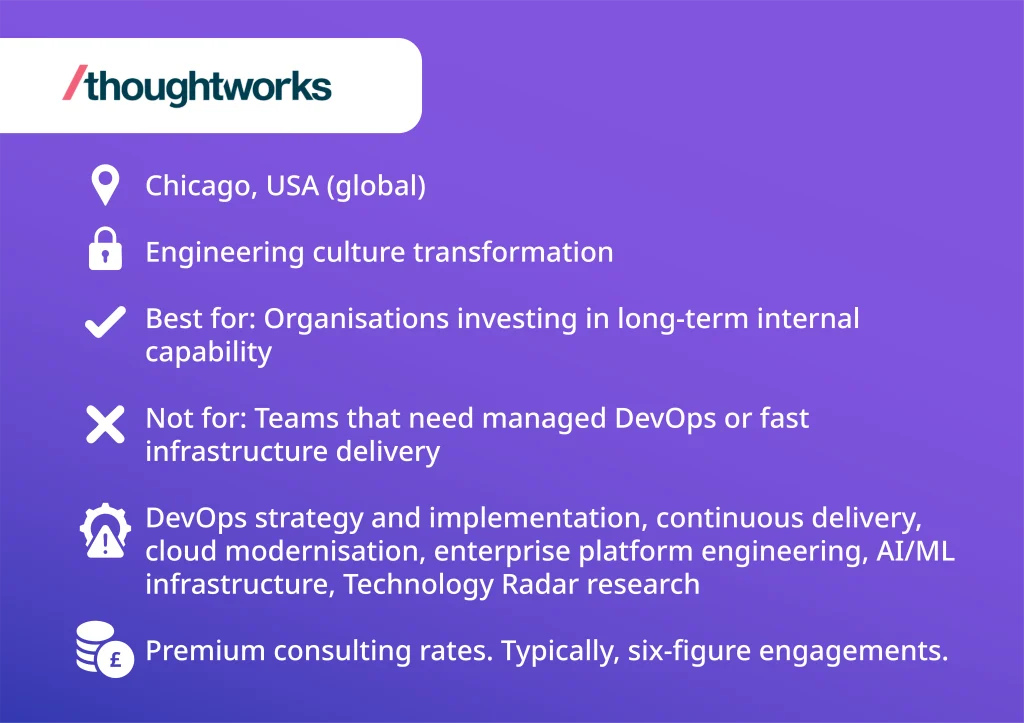
Thoughtworks operates across 49 offices in 18 countries with approximately 12,000 professionals. Their DevOps philosophy runs deeper than tooling: they treat it as a cultural and organisational discipline first, and architecture is designed to enable deployment flow rather than block it.
Their Technology Radar remains one of the most authoritative ongoing assessments of emerging technology in the industry. Their work with British Airways on digital transformation illustrates how they combine strategy, design, and engineering into a single cohesive practice.
Thoughtworks holds a Visionaries position in the 2025 Gartner Magic Quadrant for Custom Software Development Services. In early 2026, they launched AI/works™ Agile, positioning AI assistance at the centre of software delivery.
For organisations that want to build genuine internal engineering capability rather than create long-term vendor dependency, Thoughtworks is one of the few firms that actively works toward making itself less necessary over time.
Where They Fall Short
Thoughtworks consultants operate at a premium price point, and the model is built for engagements where engineering culture transformation is the goal. If you need a managed DevOps service, fast infrastructure delivery, or a partner to run your pipelines day-to-day, the investment won’t match the outcome.
4. Kainos
What Makes Them Different
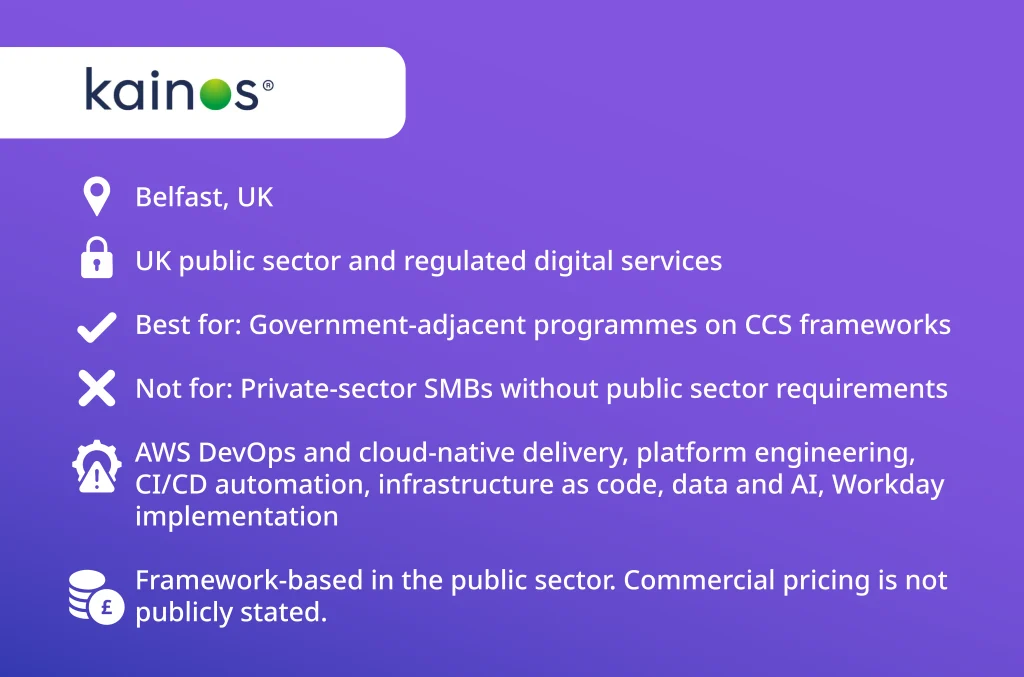
Kainos has been delivering digital services for over 30 years and is listed on the London Stock Exchange. They are the fifth-largest AI supplier to the UK public sector since 2018, with more than £61 million in data and AI contracts delivered.
As an approved supplier across 15 lots and 8 Crown Commercial Service frameworks, they are one of the most credentialled public sector technology partners in the UK.
The HMCTS engagement is a useful reference point. Kainos built a platform engineering model on Microsoft Azure, integrating GitHub Copilot, CI/CD orchestration, and AI-governed security. The result was 74% of platform operations service-desk demand handled autonomously. That kind of outcome, in a regulated government context, is what they are built for.
Where They Fall Short
Kainos’s depth in the public sector and Workday are both their strength and their boundary. Private-sector SMBs without public-sector-adjacent needs will find more flexible and cost-effective partners elsewhere.
5. Punk Security
What Makes Them Different
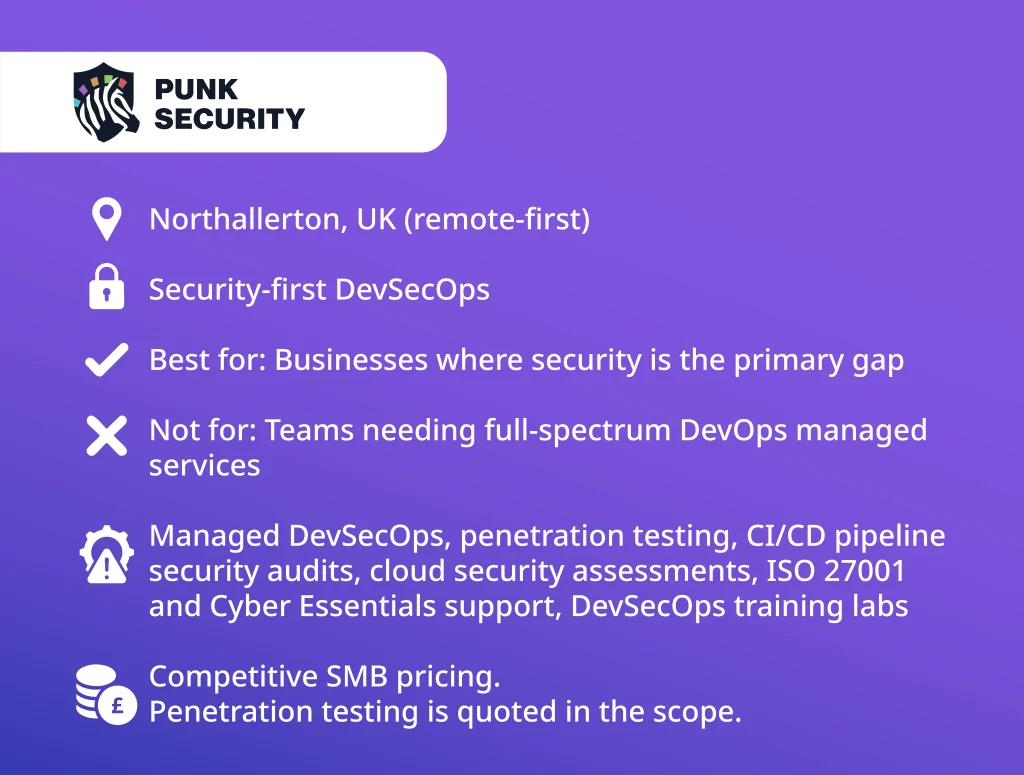
Punk Security is a CREST-registered penetration testing company that also builds and manages DevSecOps programmes end-to-end. The distinction matters: they don’t just find vulnerabilities, they fix them.
Their Managed DevSecOps Service, launched in late 2024, monitors and analyses all code changes in real time, with expert consultants reviewing results and managing remediation. It scales down to teams of five or six developers, making enterprise-grade security accessible without an enterprise budget.
Their open-source tools, dnsReaper, pwnSpoof, and SMBeagle, have thousands of supporters on GitHub and reflect genuine credibility in the security research community. They are regulars at Blackhat and BSIDES, and their DevSecOps training labs are used by organisations including Sage.
Where They Fall Short
Punk Security is a security-first company. If your primary need is broader DevOps managed services, cloud migration, CI/CD pipeline build, or managed IT, you will need to supplement their offering or look at a full-spectrum partner.
6. Accenture
What Makes Them Different
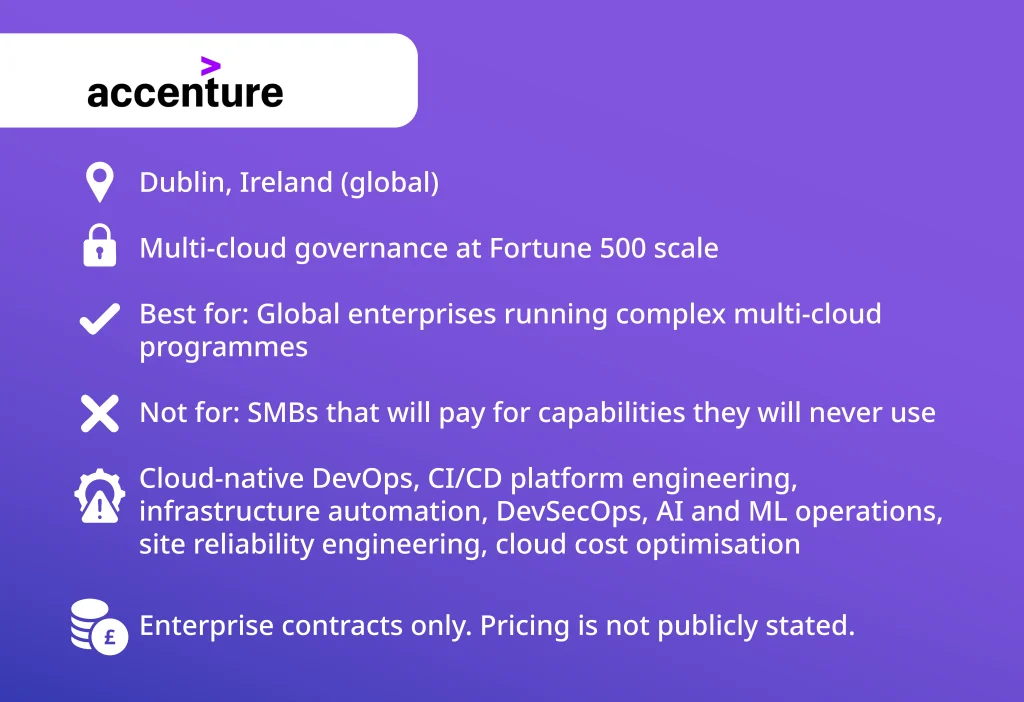
Accenture is a Leader in the inaugural 2026 Gartner Magic Quadrant for Digital Technology and Business Consulting and a Leader in the Forrester Wave for Digital Transformation Services.
Q1 2026 revenues came in at $18.04 billion. At that scale, they bring capabilities few firms can match: multi-cloud governance, AI-powered operational monitoring, and the programme management depth to run global transformations across hundreds of developers in multiple geographies.
Their Accenture DevOps Platform is a cloud-hosted, pre-configured continuous delivery environment covering automated testing, environment creation, quality gates, and security. Their recently launched Cyber.AI, powered by Anthropic’s Claude, embeds AI-driven cybersecurity directly into their delivery model. They bring over 20 years of automation experience to complex delivery programmes.
Where They Fall Short
Accenture’s model is built for global complexity. The commercial structure, engagement overhead, and minimum programme scale make it a poor fit for SMBs and scaling tech teams. You will pay for capabilities you will not use.
7. Optimising IT
What Makes Them Different
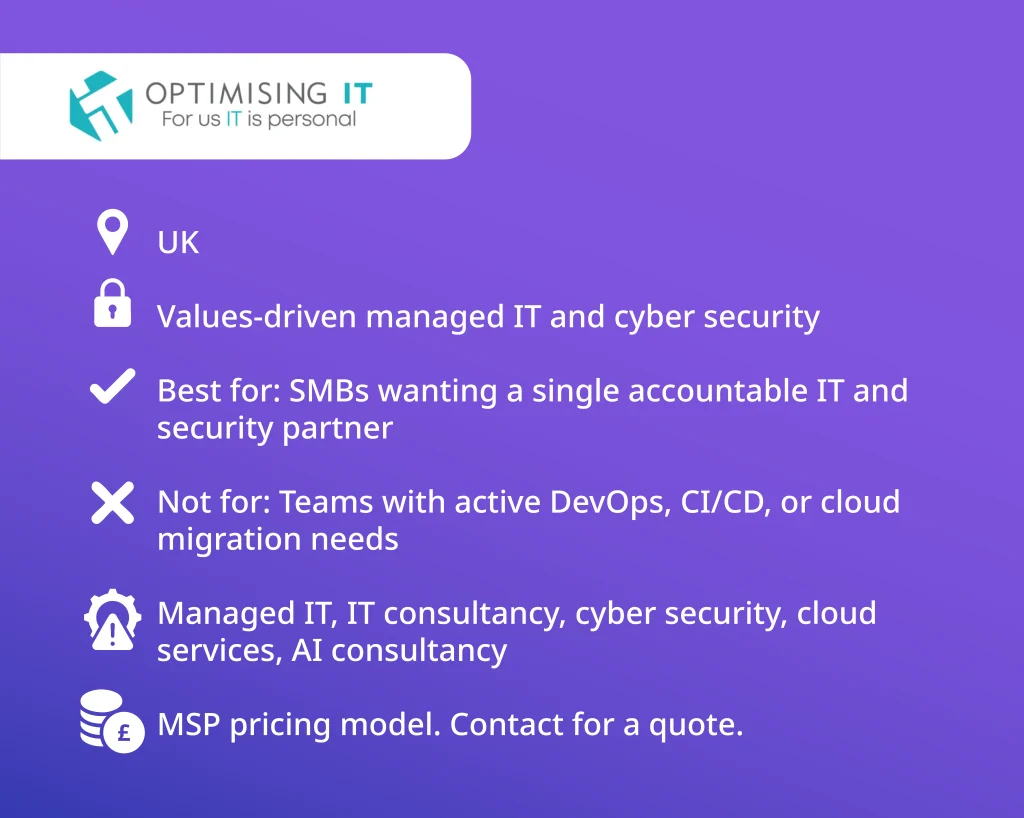
Optimising IT is a B Corp Certified, cyber-first managed service provider built around three stated values: trust, simplicity, and respect.
Their offering spans fully managed IT, cyber security, cloud infrastructure, and IT consultancy, making them a practical choice for organisations that want a single accountable partner across their technology estate.
B Corp certification means they operate to verified social and environmental standards, which matters for businesses where procurement decisions factor in ESG commitments. Client H.R. Owen Group describes the partnership as strategically aligned to business growth objectives rather than simply renewing contracts year on year.
Where They Fall Short
Optimising IT’s focus is on managed IT and cybersecurity. Businesses that need hands-on DevOps managed services, CI/CD automation, or active cloud migration will find the offering incomplete for those specific needs.
8. Ambiscale
What Makes Them Different
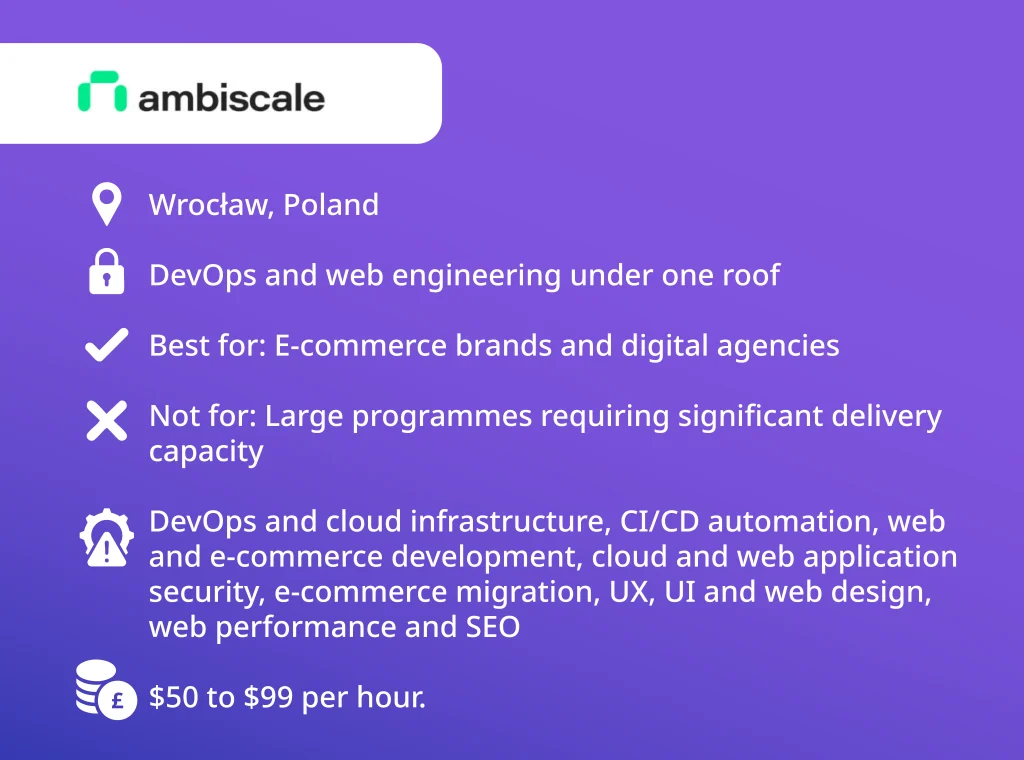
Formerly known as Cut2Code, Ambiscale rebranded in 2024 to reflect a significantly expanded service portfolio.
Founded in 2016, the company serves clients including Żabka, Jerónimo Martins, and Brand24, and operates its own Ambiscale Cloud Datacenter. Their DevOps practice covers Docker, Kubernetes, AWS ECS, Terraform, Ansible, and CI/CD automation.
What makes them distinctive is the tight integration of DevOps and web engineering. When a client needs both a new headless CMS and the infrastructure to run it reliably, Ambiscale owns the problem end-to-end.
That combination of cloud security, web performance, e-commerce migration, and DevOps support under one roof is genuinely useful for web-native businesses that don’t want to manage multiple vendors.
Where They Fall Short
Their team of 10 to 49 specialists means capacity constraints are real for large or fast-scaling programmes. Pure-play DevOps or enterprise cloud transformation is outside their core strength.
9. Plavno
What Makes Them Different
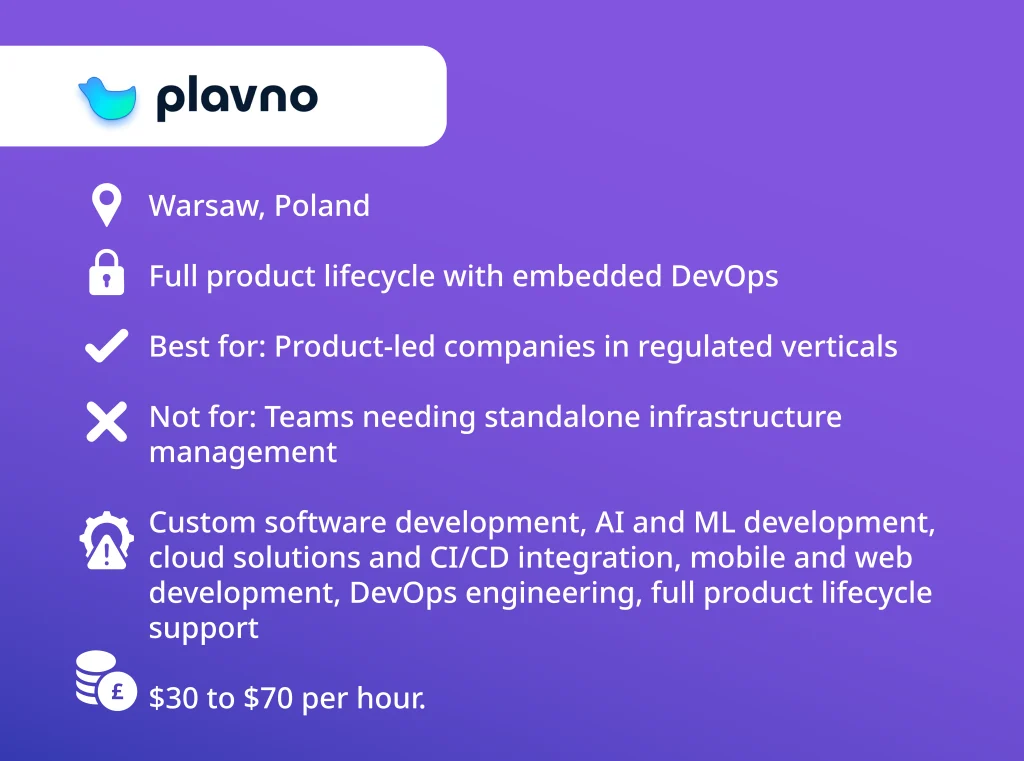
Founded in 2007 with over 800 projects delivered, Plavno’s model is built around domain-specific pre-formed teams that work exclusively within their specialist vertical.
Healthcare, fintech, edtech, and e-commerce each have dedicated teams with existing domain expertise, which shortens the time to get up to speed on regulatory requirements and industry-specific constraints.
Their AI and ML capabilities are strong and growing, spanning agents, chatbots, and ML pipelines. DevOps is built into the full product lifecycle from discovery and UX design through development, testing, deployment, and ongoing support.
For product-led companies that want one partner accountable for both the software and the infrastructure it runs on, that end-to-end ownership is the core value proposition.
Where They Fall Short
Plavno is a product engineering house with DevOps built in, not a DevOps-first provider. If your primary need is infrastructure management, platform engineering, or managed DevOps services without a broader product build, the model is unlikely to be the right fit.
10. Aegasis Labs
What Makes Them Different
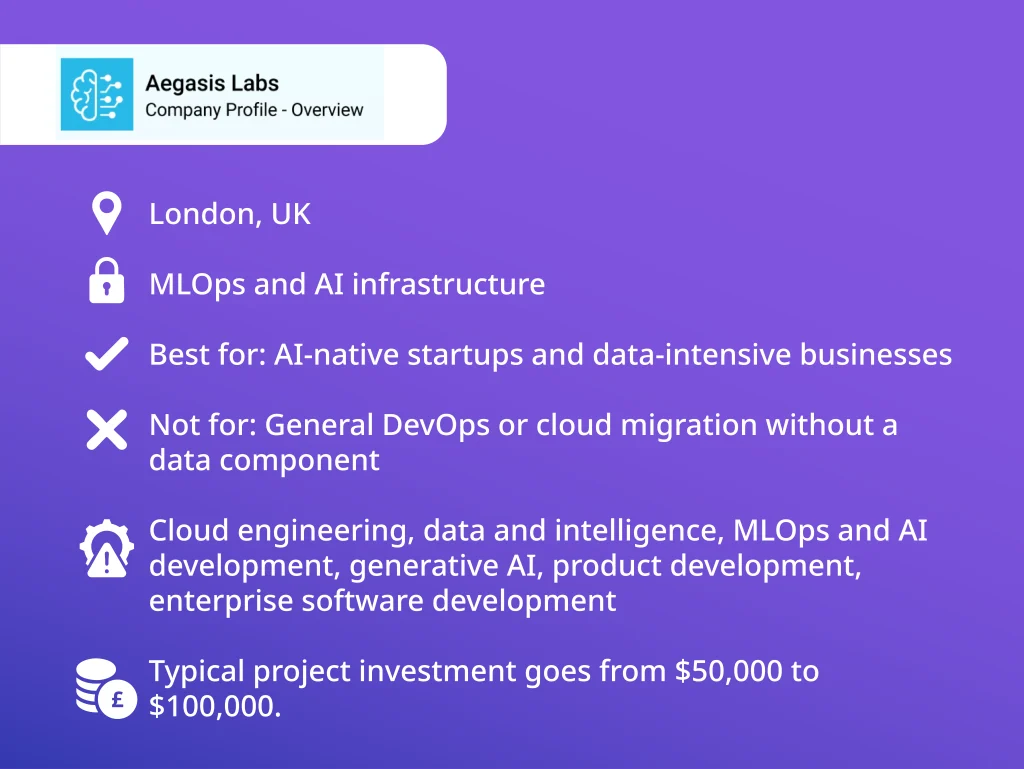
Aegasis Labs is based in London and operates at the intersection of cloud engineering, data science, and machine learning. Their team brings together data engineers, data scientists, and ML experts under one roof, which means clients are not stitching together separate vendors for data infrastructure and AI productionisation.
Their cloud engineering practice covers pipeline automation and infrastructure optimisation on AWS and other major clouds. Aegasis Labs’s MLOps work is particularly strong: end-to-end ML solutions using Docker, Kubernetes, and NVIDIA GPU-optimised infrastructure, alongside serverless data applications that remove the overhead of managing costly servers.
Clients across financial services, healthcare, manufacturing, and retail have used Aegasis Labs to build identity verification systems, performance analytics platforms, and AI-powered SaaS products. They hold Clutch awards recognising high-impact AI and data science delivery.
Where They Fall Short
Aegasis Labs is a specialist. Their sweet spot is ML infrastructure and AI productionisation. For general DevOps managed services, CI/CD pipeline build, or cloud migration without a data or ML component, a broader provider will serve you better.
What Changed in DevOps in 2026 and Why Your Vendor Map Is Outdated
Your vendor pitching Kubernetes and Jenkins as headline capabilities is already behind.
Predictive monitoring, automated incident response, and self-healing infrastructure; these are baseline expectations in 2026. Ask any prospective partner to show you AI-assisted operations running in a live client engagement. If they reach for a slide deck, you have your answer.
Setting up CI/CD is no longer the job.
The real work in 2026 is building internal developer platforms; golden paths, self-service infrastructure, standardised pipelines that entire engineering organisations can build on. Partners who can’t operate at that level of abstraction are solving a problem that was already solved three years ago.
Security embedded at sprint zero is now a legal requirement.
SOC 2, ISO 27001, FCA Operational Resilience, DORA, HIPAA, the cumulative weight of regulatory frameworks across the UK, US, and EU has made security-by-design a compliance obligation. Any partner who treats it as a separate workstream or a phase-two consideration is creating liability.
Cloud cost optimisation belongs in every sprint.
The best partners wire cost visibility directly into the delivery pipeline, so engineering teams see the financial impact of architectural decisions in real time. If your vendor isn’t doing this, you are finding out what things cost after you have already paid for them.
Before diving into which companies are doing this well, here is how to work out which type of partner you actually need.
How We Evaluated These 10 DevOps Companies
We reviewed over 40 providers before narrowing this list to ten, drawing on public case studies, certification databases, and client review platforms including Clutch, G2, and Gartner Peer Insights.
To make the cut, a company needed named case studies with verifiable outcomes. Percentages without context, press releases without clients, and logos without references didn’t cut it.
We independently verified certifications: cloud tier status, ISO 27001, and Cyber Essentials Plus. Where a company specialises in a specific industry or region, we looked for evidence that the specialisation is real.
We excluded generic outsourcing directories, companies with no verifiable case studies, and firms that resell other vendors’ platforms without adding proprietary IP.
One disclosure: Deployflow commissioned this article and appears on the list. The same evaluation criteria are applied to them as to every other company here.
Which DevOps Company Is Right for You?
By now, you have seen what each of these companies actually does, who they serve well, and who they are not for. If you are still deciding between two or three, the table below is a useful final filter. Match your situation to the column on the right, then go back to those entries and read the caveats side by side.
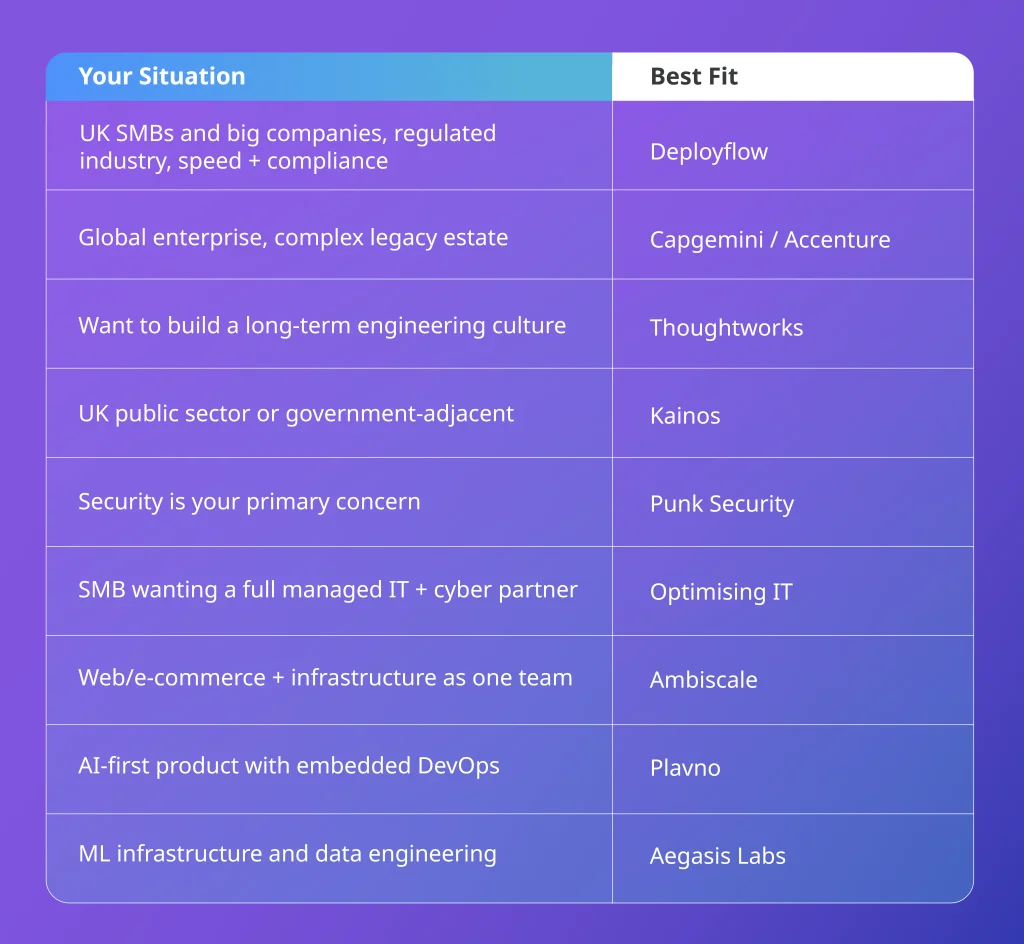
If you fit more than one row, read those entries side by side and let the caveats decide.
7 Questions to Ask Any DevOps Vendor Before Signing
These questions are designed to surface the answers that tell you whether a partnership will work before you have signed anything and started finding out the hard way.
- Can you show me a case study from my industry with named outcomes?
A vendor who has done this work in your industry can name the client, describe the problem, and tell you what changed after they fixed it. If the best they can offer is a percentage and a logo, keep looking.
- What does your delivery cadence look like, and how do I measure progress?
A good answer names a specific sprint length, defines what a deliverable looks like at the end of each cycle, and explains how you sign off on it. A bad answer sounds confident but commits to nothing. Watch for words like “iterative” and “agile” that describe a way of working without telling you what you will actually have at the end of week two.
- Who specifically will be working on my account?
Don’t accept answers like “a team of senior engineers.” You want named individuals, their experience, and their availability. Also, ask what happens if one of them leaves mid-engagement. Staff turnover is one of the most under-discussed risks in vendor selection.
- How do you handle knowledge transfer?
The goal of a good DevOps partner is to make your team more capable, and not more dependent. Ask them to describe how a client has successfully reduced reliance on them over time. If they struggle to answer, that tells you something.
- What is your incident response SLA, and what happens when you miss it?
Anyone can promise 24/7 support. Ask what the contractual consequence is when that promise isn’t met. Silence or vagueness here is a red flag.
- How do you price, and what does scope creep look like in your contracts?
Ask them to walk you through a real example of how a project changed scope and how the commercial conversation went. The answer reveals more about the partnership than any rate card will.
- Which certifications do you currently hold, and can I verify them?
Ask for certification dates. ISO 27001, Cyber Essentials Plus, and cloud partner tiers all require renewal. A lapsed certification is not a credential.
The Best DevOps Partner Is the One You Forget About
The right DevOps partner is one you stop noticing after six months because deployments are boring, incidents are rare, and your engineers are building instead of firefighting.
The companies on this list represent the best of what the market offers in 2026, each for a specific type of buyer. The decision framework in this guide will point you in the right direction. The 7 questions will tell you whether the partner you’re considering can actually back up what they’re pitching.
If you’re a UK SMB or a scaling tech team that wants measurable progress without the overhead of a large systems integrator, Deployflow is worth a look. Sprint-based delivery, transparent billing, and a dedicated team that integrates directly into how you work.
If Deployflow sounds like the right fit, get a free assessment and find out exactly where your infrastructure stands and what it would take to improve it.
Frequently Asked Questions About DevOps Service Companies
What is the average cost of hiring a DevOps service company?
It depends heavily on scope and provider size. Boutique UK providers typically start around £4,000 per month for managed services or £30,000 to £50,000 for a defined project. Global systems integrators like Accenture or Capgemini operate on enterprise contract models with no public pricing and significant minimum thresholds. Offshore providers in Poland or Eastern Europe tend to charge $30 to $99 per hour, depending on seniority and specialisation. The most important thing to establish upfront is what the pricing model looks like when scope changes, because it always does.
What is the difference between DevOps and DevSecOps?
DevSecOps is DevOps with security built into every stage of the delivery pipeline rather than added at the end.
In a standard DevOps setup, security testing often happens after development is complete. DevSecOps embeds vulnerability scanning, secrets management, and compliance checks directly into the CI/CD pipeline, so issues are caught before they reach production.
In 2026, any DevOps provider worth hiring embeds security by default. The distinction between DevOps and DevSecOps should be invisible to you as a buyer.
How long does a DevOps transformation typically take?
A focused engagement with a defined scope, such as CI/CD pipeline setup or cloud migration, can deliver measurable outcomes within six to twelve weeks.
A broader transformation involving platform engineering, cultural change, and organisation-wide adoption typically runs six to eighteen months.
Be cautious of any vendor who quotes a timeline without first understanding your current state. The gap between where you are and where you need to be is what determines the timeline.
What should a DevOps managed service include?
At minimum: CI/CD pipeline management, infrastructure monitoring, incident response with a defined SLA, security scanning, and regular reporting against agreed metrics.
In 2026, a strong managed service should also include cost visibility across your cloud spend, proactive recommendations rather than reactive fixes, and a clear knowledge transfer model so your internal team is getting stronger over time. If a managed service proposal reads like a list of tools rather than a set of outcomes, push back.
What is platform engineering, and how is it different from DevOps?
Platform engineering is the next evolution of DevOps at scale. Where DevOps focuses on the practices and culture of delivering software reliably, platform engineering is about building the internal infrastructure that makes those practices repeatable across an entire organisation. That means internal developer platforms, golden paths, self-service environments, and standardised pipelines that hundreds of engineers can build on without reinventing the wheel.
If your engineering organisation has grown beyond a single team, platform engineering is likely the conversation you should be having with prospective partners, not CI/CD setup.
Explore our BLOG
Recent articles

ISO 42001 Explained: Requirements, Certification and What Your Engineering Team Must Build
ISO 42001 is the international standard that demonstrates your organisation governs AI properly, and enterprise...
read full article

Is Claude Down? Anthropic Outage: Protect Your Cloud Infrastructure
Claude went down across every surface on 29 September 2026. From 14:00 to 14:59 UTC,...
read full article

Top 10 Healthtech Companies in 2026: What Their Growth Means for AI and DevOps
Every software change that reaches a hospital has to clear regulatory, legacy system, and clinical...
read full article