


Your AI pilot works in the demo. Getting it to production is where it dies, and in 2026, that gap is what separates the teams pulling ahead from the ones falling behind.
Almost every stalled project is missing the same three things, working as one system: RAG to ground answers in real data, agents to take action, and MLOps to keep both reliable and affordable. Leave one out and the other two take the blame: the agent trusts bad data, the good data goes unwatched, and it buckles the moment real traffic hits.
This guide covers all three layers, where teams go wrong, and the order to fix them.
Executive Summary:
- Adoption is nearly universal, yet few organisations see real returns. Inference is cheap now, so the real cost is weak operations and stalled delivery.
- RAG is your fastest fix for the “almost right” answers your developers already distrust.
- Agents pay off only with guardrails, controlled access, and human oversight.
- MLOps and LLMOps turn raw model power into trustworthy, cost-controlled production. Treat the three as one stack, and start with an honest readiness assessment.
The AI Pilot-to-Production Gap: Why Most Projects Never Scale
Adoption is easy, and production is where the money leaks away. The headline numbers look strong. Around 88% of organisations report regular AI use, according to McKinsey’s latest State of AI survey. Look past the adoption figure, though, and the confidence drains. Just 23% are scaling an agentic system in even one business function. Only 39% report any measurable impact on earnings, and most of those say AI accounts for less than 5% of profit.
The same research carries a warning. More than half of organisations using AI have already hit at least one negative consequence.
Inaccuracy is the most common problem of all. Confident, wrong output is not a rare edge case. It is the main reason production rollouts lose trust and stall.
Buying a capable model is trivial. Running it safely, at scale, against real business processes is where most programmes fail. The teams pulling ahead share one habit. They redesign workflows around AI instead of bolting it onto old ones. That work is engineering, and it rests on the three layers below.
RAG in 2026: How Retrieval-Augmented Generation Fixes AI Accuracy
Your developers already know this problem. An answer looks correct, then quietly falls apart on inspection. Stack Overflow’s 2025 survey puts numbers on it: 84% of developers use or plan to use AI tools, yet only 29% trust the output, down from 40% a year earlier. Two-thirds now lose more time fixing “almost right” answers than the tools save them.
Retrieval-augmented generation fixes this at the source. Rather than trusting what a model half-remembers from training, RAG feeds it current facts pulled straight from your own systems. Ground the model in data you control, and the confident errors largely disappear.
Naive RAG no longer clears the bar. A production-grade setup in 2026 does four things:
- Searches for meaning and keywords, then re-ranks for relevance.
- Lets the agent decide what to retrieve, and when.
- Maps how facts connect with knowledge graphs, catching relationships plain search misses.
- Scores its own retrieval quality as a first-class metric, besides accuracy and latency.
RAG quality is a data problem long before it is a model problem. Scattered, stale, or poorly structured knowledge cannot be prompted into shape. Fix the knowledge layer first. It is the single biggest lever on whether everything above it earns trust.
Agentic AI in 2026: What Makes an AI Agent Production-Ready
Every agent demos well. The cracks only show in production, and they always trace back to one thing: control.
The difference from a copilot is action. A copilot suggests and waits. An agent plans, uses tools, remembers across steps, and acts with little oversight. Chain a few together, and they can run a whole workflow between them.
The hype outruns the reality. McKinsey found that in any single business function, no more than one in ten organisations has actually scaled agents. Developers say much the same: around half report agents have changed how they work, but mostly as a personal productivity gain rather than autonomous delivery.
The gap comes down to four things a demo lets you ignore and production will not:
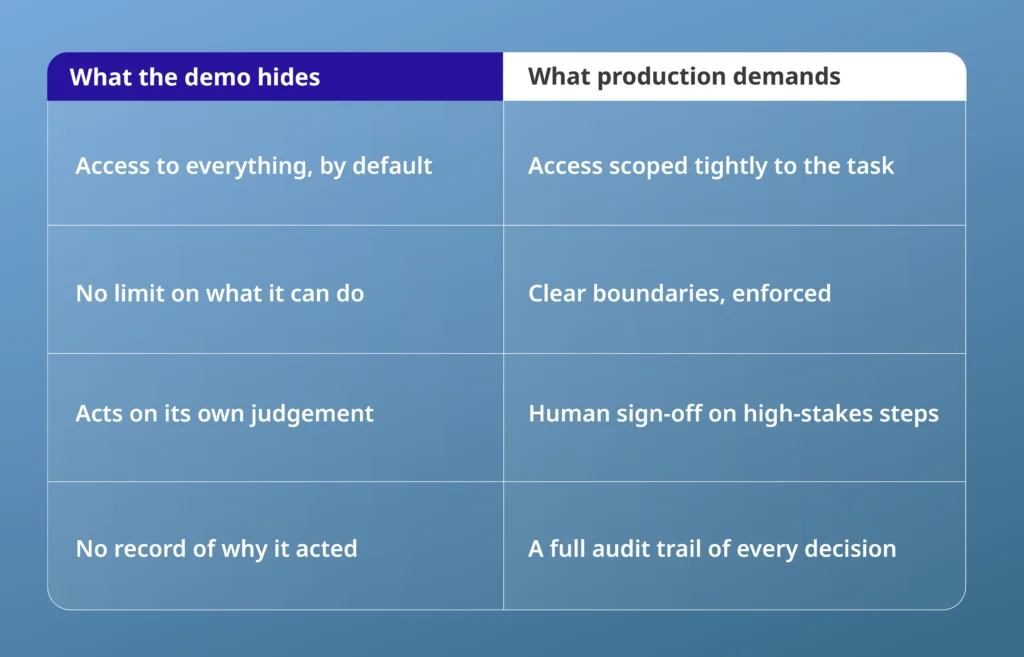
Give an agent broad access and no audit trail, and failure is only a matter of time. One wrong action at scale can stop the whole project: a mistaken batch of refunds, a config pushed to the wrong environment. It is why so many agent pilots die in security review, long before they reach a single user.
Deployflow’s AI agent development covers this stage: scoping an agent to one workflow, wiring in the access limits and logging, then running it after launch.
For a deeper look at where agent programmes fail and how to keep control as they scale, read the guide to agentic AI risk and governance.
Start small. Pick a workflow where the payoff is measurable, prove the guardrails hold under real load, then extend the agent’s remit.
MLOps and LLMOps: The Layer That Keeps AI Trustworthy
The model is now the cheap part, and that’s what catches finance teams out. Per-token prices keep falling, yet AI bills keep climbing.
Ramp’s 2026 spending data, drawn from over 70,000 businesses, shows token usage up 1,001% between January 2025 and April 2026. Cheaper tokens simply invited far heavier use.
Ramp found the biggest driver of surprise costs has nothing to do with price. It is teams quietly switching to a pricier frontier model, or an agent looping through budget before anyone notices.
Controlling that spend is one job among several once a system goes live, and all of them fall to operations.
MLOps has run production machine learning for years. LLMs and agents stretch it into LLMOps, and the work splits into three jobs:
- Keep quality honest: evaluation to catch regressions, drift monitoring as inputs change.
- Stay accountable: versioning for prompts and models, tracing to reconstruct why an agent acted.
- Contain risk and spend: security against prompt injection and data leakage, plus cost controls that flag runaway spend early.
None of this means a new stack. Most teams extend what they already run: the same Stack Overflow survey shows Grafana and Prometheus covering observability for 43% of agent builders, and Sentry for about a third. The tooling is familiar. The discipline is the new part.
AI Governance in 2026: What Applies Now, and What’s Coming
Governance is where an agent’s access and your data handling stop being engineering questions and become board-level ones. If you build AI into products used in the EU, or sell to firms that do, the AI Act now sets the floor.
Some of it already binds you. Banned uses have been in effect since February 2025, and rules for general-purpose AI models since August 2025.
From August 2026, transparency obligations apply: you have to tell people when they are dealing with an AI system and label AI-generated content.
The headline deadline, though, moved. The high-risk obligations most teams had circled for August 2026 were deferred by the Digital Omnibus, in force since July 2026.
Standalone high-risk systems, covering hiring, credit scoring, biometric identification, and health, among others, now have until December 2027. AI embedded in regulated products has until August 2028.
That extra time is runway, and it is best spent now. High-risk compliance means conformity assessment, technical documentation, human oversight and full logging, and none of that is quick to retrofit. The teams that spend 2026 building the evidence will not be scrambling in 2027.
Here is the part that should reassure you. Almost everything the rules ask for, you should be doing anyway. Logging every action, keeping a human on high-stakes steps, versioning prompts and models, monitoring in production: these are the same controls that make AI reliable, and frameworks like ISO/IEC 42001 give you a way to show them.
Build the operations layer properly, and compliance stops being a separate project and becomes a report you can already run.
Production AI Architecture: The RAG, Agents, and MLOps Stack
Run RAG, agents, and operations as three separate projects, and they stall. They are one system, and the dependency runs one way:
RAG grounds the answer → the agent acts on it → operations keep both honest.
Pull out any layer, and the one above it degrades. An agent is only as reliable as the data feeding it. RAG is only as trustworthy as the evaluation and monitoring beneath it.
Fund the three together, and a pile of experiments becomes one roadmap with shared controls, so three teams stop rebuilding the same plumbing.
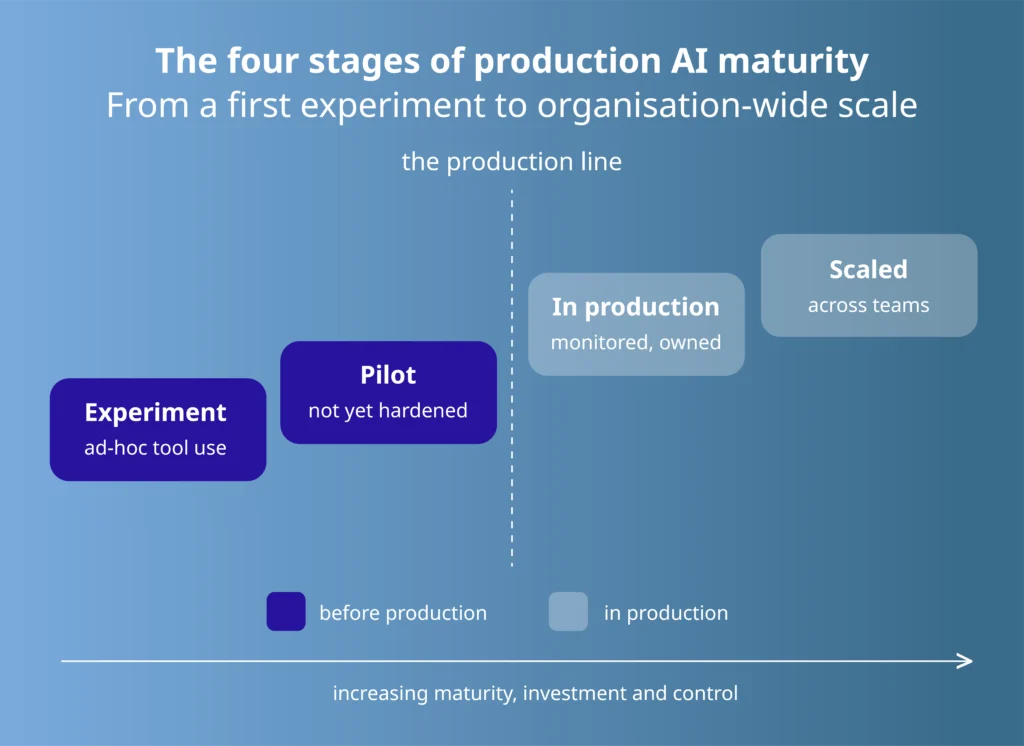
The question is where you sit: experiment, pilot, governed production, or scale. Most organisations place themselves a stage or two ahead of the evidence. Knowing your real position is the fastest way to move.
Closing the AI Delivery Gap: From Pilot to Production
In 2026, the blocker is delivery: the capability to turn a working prototype into something that survives production. The failure patterns barely change from one company to the next. Pilots that never harden. No evaluation, no monitoring, no clear owner. Costs nobody spots until the invoice lands.
Closing that gap starts with an understanding of your real position. A readiness or cost review shows which of these failures you have and which to fix first.
If your programme demos well but ships slowly, the breakdown of what a mature AI engineering function looks like sets out the practices that move teams from pilot to production.
Deployflow’s AI engineering services cover this route across DevOps, cloud, and legacy modernisation. The engagement is scoped to a defined result, with knowledge transfer so your own team can run the system once the work is done.
Three Enterprise AI Case Studies: From Experiment to Production
Three engagements show what this looks like once the delivery gap closes: a national-scale AI platform, a public-sector data programme, and a production estate rescued mid-failure.
An energy sector AI platform had to move from experimental models to industrial-grade operations inside a locked-down critical-infrastructure network.
Deployflow was embedded in the platform engineering team and built a governance-first environment on Kubernetes, ArgoCD, and Terraform, with GitOps tracking every change and infrastructure-as-code so each new environment inherits its security and networking rules automatically. One backend now serves both chat and 3D visualisation.
RESULTS: 1PB+ data processed in real time | 100% air-gapped access | 0 manual steps per environment | 1 shared platform for new AI workloads
A UAE public-sector organisation needed to turn scattered data into decisions. The signals lived in surveys, spreadsheets, and regional systems, but no one could see them together.
Deployflow designed a decision-intelligence platform in phases: reliable data foundations first, then AI pipelines that classify and structure incoming data, then an executive layer of high-level indices with policy milestones laid over the trends.
RESULTS: Automated AI pipelines replace manual classification | 24/7 real-time ingestion at national scale | 1 unified data layer | 6 to 12 months from POC to full production
Strike (now Purplebricks) lost its internal DevOps team, and a failing production environment came with it.
Deployflow stepped in on demand, took a full handover, and went straight at the database outages and release problems, hardening the CI/CD pipeline as it went.
RESULTS: 70% more stable cloud environment | 60% less downtime, nearly every outage gone | 55% more reliable releases | 25% lower cost
In every case, the client walked away owning a system their own team could run and extend, not a dependency on the people who built it.
“Their expertise in streamlining our development and operations processes has significantly improved our efficiency and productivity.”
Dan Rafferty, CTO at Strike
How to Get AI Into Production in 2026: A Practical Roadmap
Skip the twelve-month strategy. One workflow taken all the way to production teaches you more than a year of pilots. Choose one where the payoff lands in cost or revenue, then respect the order of operations.
- Fix the data before you build RAG, since scattered or stale knowledge breaks retrieval long before the model does.
- Instrument before you scale, so quality and spend show up from day one, not in a later invoice.
- Add guardrails before autonomy, scoping access, and requiring sign-off on high-stakes steps before an agent runs alone.
- Measure cost per finished task instead of per token, because a cheap token that fires ten calls is not cheap.
What to Measure Once Your AI Is Live
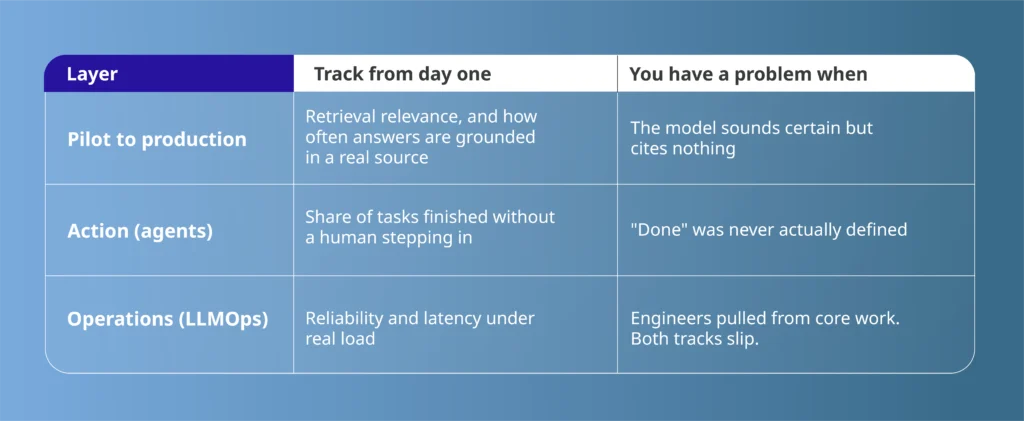
Two things weigh as much as tooling.
- Name who owns evaluation, the knowledge layer, and cost before work starts, because an unclaimed layer is where a system quietly rots.
- Then filter every candidate through three questions: is it worth doing, can your systems support it, and can you undo it if it goes wrong?
Get Your Stalled AI Pilot Into Production
One proven workflow in production changes the question from “can AI work here” to “where next.” Getting there is a scoping problem.
The first step is cheap and specific: a review that maps where your RAG, agents, and operations actually stand, then names the two or three gaps keeping your pilot out of production. You leave knowing what to fix first and roughly what it will take.
Book a review with Deployflow and turn one stalled pilot into a system real users can rely on.
Frequently Asked Questions: RAG, Agents, and MLOps
Should I use RAG or fine-tuning?
Use RAG when the model needs current or private facts, and fine-tuning when you need to change how it writes or behaves.
RAG retrieves information at the moment of the query, so it stays current as your data changes and needs no retraining. Fine-tuning adjusts the model itself on your examples, which suits a fixed tone, format, or narrow task. The two solve different problems and often pair well: RAG for knowledge, fine-tuning for behaviour. As a rule of thumb, start with RAG, since it is cheaper, faster to change, and easier to audit.
Do I still need RAG if the model has a huge context window?
Usually yes, because feeding everything into a large context window is slower, costlier, and less precise than retrieving only what matters.
Costs rise with every token you send, so loading a full knowledge base into each request gets expensive quickly. Models also attend less reliably to facts buried in the middle of a very long prompt, which hurts accuracy. Retrieval keeps each request small, cheap, and precise, and it tells you exactly which source produced an answer. Long context and RAG work best together, each covering the other’s weak spots.
Will my company’s data be used to train the AI model?
Usually not, if you use a paid enterprise API tier and check the provider’s terms, though free consumer tools are a different matter.
Reputable API and enterprise plans generally do not train their models on the data you send, and many offer contracts or zero-retention settings that put this in writing.
Free consumer chat tools often reserve the right to use your inputs, so they suit low-sensitivity work only.
For sensitive data, choose a provider with clear data-processing terms, or run a model inside your own environment. Always confirm the terms for the exact plan you are on, since defaults vary between providers.
How long does it take to move an AI system from pilot to production?
A focused first system usually takes weeks rather than months, while scaling it across the business takes longer. A single, well-scoped workflow can often reach production in roughly six to twelve weeks.
Three things move that timeline: how clean and accessible your data is, how many systems the AI must connect to, and how much governance the use case demands. A short proof of concept first is the cheapest way to test feasibility before you commit to a full build. Rolling the result out across teams is a separate effort, with its own planning, controls, and change management.
What team do I need to run AI in production?
You need data and software engineers who can build and operate real systems more than you need dedicated AI researchers.
The core skills are data engineering to prepare the knowledge layer, software engineering to integrate and ship, and MLOps or platform skills to keep things running once live. A product owner and a domain expert hold the work to real business value. You rarely need to train models from scratch, so a large research team is optional for applied use cases. A small, cross-functional group that owns evaluation, data, and cost can take a first system a long way.
If building that team in-house is not the goal, Deployflow’s AI engineering and automation team brings the data, MLOps, and platform skills as one unit.
Explore our BLOG
Recent articles
ISO 42001 Explained: Requirements, Certification and What Your Engineering Team Must Build
ISO 42001 is the international standard that demonstrates your organisation governs AI properly, and enterprise...
read full article

Is Claude Down? Anthropic Outage: Protect Your Cloud Infrastructure
Claude went down across every surface on 29 September 2026. From 14:00 to 14:59 UTC,...
read full article

Top 10 Healthtech Companies in 2026: What Their Growth Means for AI and DevOps
Every software change that reaches a hospital has to clear regulatory, legacy system, and clinical...
read full article