



Your AI programme probably demos well and ships slowly. That gap is not a technology problem, and treating it as one is why most fixes fail.
The numbers are blunt. More than 80% of AI projects fail to deliver their intended value, roughly twice the failure rate of conventional IT projects, according to the RAND Corporation’s estimate.
MIT’s Project NANDA found 95% of enterprise generative AI pilots delivered no measurable P&L impact. The models work, but the engineering functions around them do not. No evaluation discipline. No cost visibility. No tested route from pilot to production.
Here is the useful part. Maturity is visible. An outsider can inspect it within a week, and none of it turns on headcount, model choice or a platform purchase.
You can test your own function in a single meeting: five questions, five artefacts, no consultants.
Executive Summary
- Four in five AI projects miss their intended value; 95% of generative AI pilots show no measurable P&L impact.
- Maturity scores measure ambition and paperwork. Delivery floors reveal the truth.
- Seven observable signals separate functions that ship from labs that demo. Each pairs with an artefact you can ask to see.
- Five questions expose all seven signals in a single meeting. The test sits below.
- A 90-day, evidence-led plan closes most of the gap. No new hires required.
Why Your AI Maturity Score Means Nothing
Your maturity level predicts nothing about delivery. Five-level frameworks dominate the consultancy decks. Each invites you to self-assess your way from exploratory to transformational. The scores flatter ambition. They reward documentation.
The spending data shows how little those levels protect you. Gartner forecasts worldwide generative AI spending of $644 billion in 2025, a 76% rise on the prior year. Over the same period, S&P Global Market Intelligence found 42% of companies abandoned most of their AI initiatives, up from 17% a year earlier. Budgets climbed, but abandonment climbed faster.
Data readiness is where the scores collapse first. Gartner expects 60% of AI projects unsupported by AI-ready data to be abandoned through 2026. Organisations that score themselves at level three routinely fail the data test in week one of delivery.
The fix: Forget levels. Ask what an auditor would find. Every section below answers that.
The Seven Signals Your AI Function Is Actually Mature
The evidence base comes from the DevOps Research and Assessment (DORA) programme. Its 2025 State of AI-assisted Software Development report drew on nearly 5,000 technology professionals.
One caution for regulated readers: the research programme shares an acronym with the EU’s Digital Operational Resilience Act and has no connection to it.
DORA’s central finding deserves a place on your wall. AI acts as an amplifier, magnifying an organisation’s existing strengths and weaknesses. Amplification is why the same tools compound returns in one company and compound technical debt in its competitor.
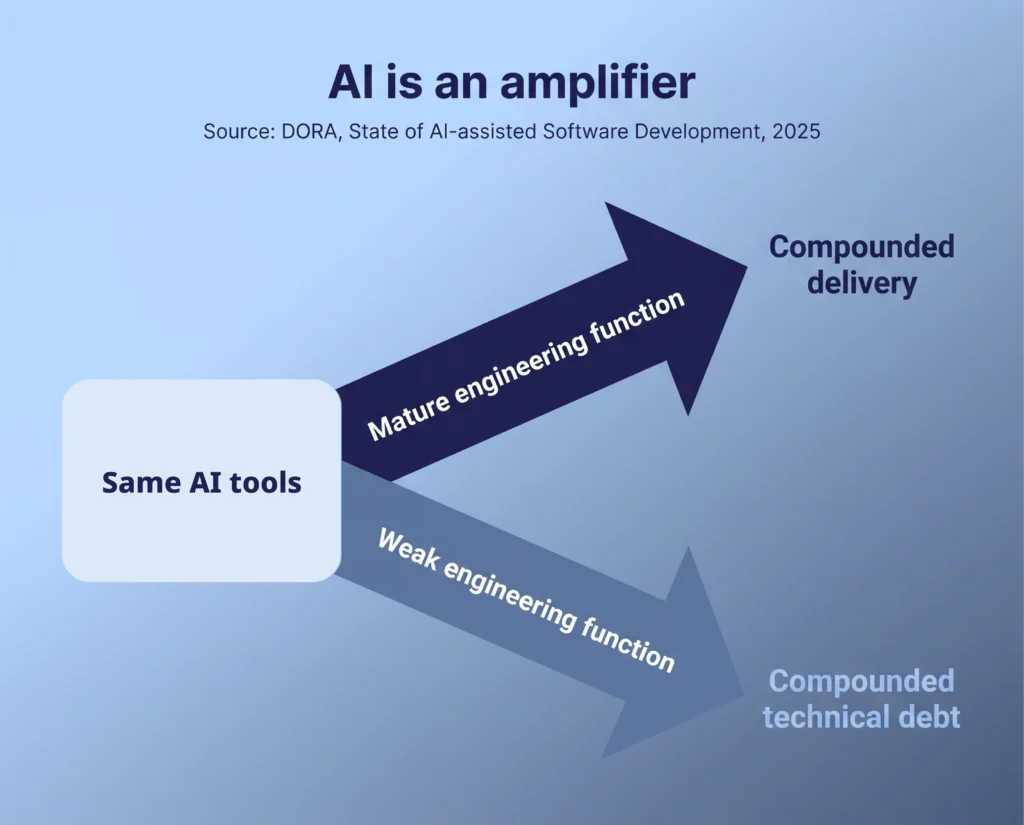
The signals below show what an amplification-ready system looks like on the delivery floor.
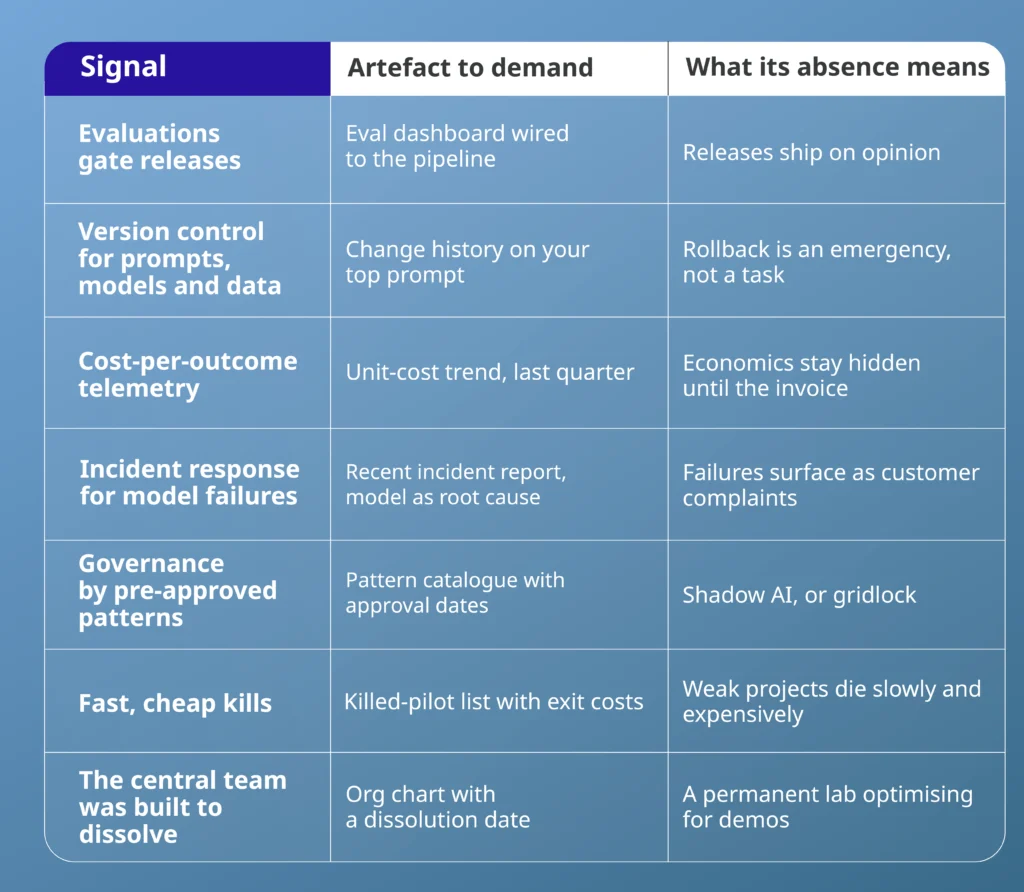
1. Evaluations Gate Every Release
Evaluations are the unit tests of AI. Weak functions ship on instinct. Mature ones maintain golden datasets for each use case. They run regression suites on every prompt, model or retrieval change. Scores below the threshold automatically block deployment. DORA found 30% of developers place little or no trust in AI-generated code. Evaluations replace that missing trust with evidence.
The fix: Wire evaluations into the pipeline so no release ships on opinion alone.
Ask for the evaluation dashboard inside your deployment pipeline, with thresholds visible.
2. Prompts, Models and Data Live Under Version Control
Every production output should trace to an exact prompt version, model version and data snapshot. Traceability turns debugging from archaeology into a diff. Rollback becomes a five-minute task. Strong version control is one of the seven capabilities DORA links to amplified AI benefits.
The fix: Give prompts the same repository discipline as code, with review and history.
Ask for the change history of your highest-traffic prompt. Who changed it, when, and why?
3. Telemetry Reports Cost Per Outcome
Aggregate cloud bills hide AI economics. Cost per outcome reveals them. Track cost per resolved ticket, per underwriting decision, per document processed. Finance and engineering then argue from the same numbers. Quiet degradation surfaces months before the quarterly review. The discipline extends the FinOps practice you may already run for the cloud.
The fix: Attach a unit cost to every production AI feature and trend it weekly.
Ask for the cost-per-outcome trend for your highest-volume feature last quarter.
4. Model Failures Trigger Incident Response
Speed without control systems creates instability. DORA found that AI now improves delivery throughput, yet instability keeps rising alongside it: teams adapted for speed, but their underlying systems did not. Mature functions close that gap by treating model failures as production outages. Runbooks name the rollback path, on-call engineers own the response, and postmortem findings feed back into the evaluation suite.
The fix: Give every AI feature a runbook and a rehearsed rollback before launch.
Ask for the most recent incident report naming a model or prompt as the root cause.
5. Governance Runs on Pre-Approved Patterns
Slow governance breeds shadow AI, and absent governance breeds incidents. Mature functions avoid both by running two lanes: pre-approved patterns clear a fast lane, while novel or high-risk work passes through gated review. Speed and safety stop competing.
The fix: Publish a pattern catalogue and route approvals by risk rather than queue position.
Ask for the pattern catalogue with approval dates.
6. Weak Projects Die Fast and Cheap
Abandonment headlines mislead, because timing tells the real story. A pilot killed in week six for a five-figure sum is a working filter. A pilot that limps through four quarters, consuming engineers and political capital before dying quietly, is the expensive version of the same decision.
The fix: Set kill criteria at the pilot gate and review them monthly. Treat an early exit as proof that the system works.
Ask for last quarter’s list of killed pilots, with the exit cost of each.
7. The Central AI Team Is Built to Dissolve
Labs optimise for demos because demos justify labs. Product teams optimise for shipped outcomes because outcomes keep products alive. Mature organisations resolve the tension with an expiry date. The central team builds the platform, embeds engineers in product teams, and then dissolves according to a published schedule. What remains is a small platform group, with the capability sitting where the value lives.
The fix: Put a dissolution date on the AI lab and hold to it.
Ask for the AI team’s organisation chart, including the expiry date.
Turn The Seven Signals Into An Audit
Every signal reduces to one artefact you can demand in a review. If it cannot be produced on the spot, the gap in the third column is what you have.
How to Structure Your AI Engineering Team
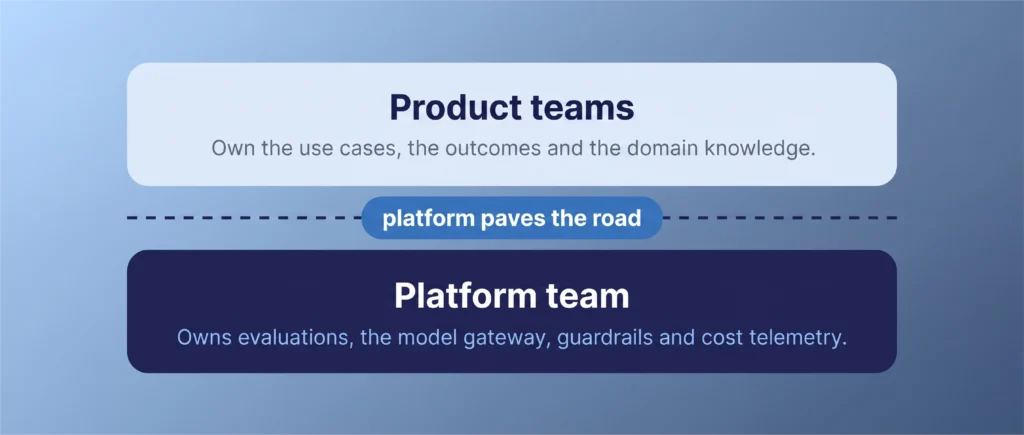
The structure that ships has two cleanly separated layers. A platform team owns the shared infrastructure: evaluation harnesses, the model gateway, guardrails and cost telemetry. Product teams own the use cases, the outcomes and the domain knowledge no platform can supply.
The evidence backs the split on both sides. DORA found that where internal platform quality is low, AI has a negligible effect on organisational performance, and where it is high, the effect turns strong and positive. Build-versus-buy points the same way: MIT’s Project NANDA found externally sourced builds reach successful deployment about twice as often as internal-only ones, 67% against 33%.
The fix: Partner for the platform and the delivery patterns, keep product knowledge in-house, and judge any partner on outcomes shipped rather than engineers supplied.
The Five Questions That Expose Your AI Maturity in One Meeting
Put these five to your team and award one point per artefact produced on the spot. Policies, roadmaps and promises score zero.
- Show me the evaluation dashboard for our highest-volume AI feature.
- Show me the last prompt or model rollback, and how long it took.
- What does one transaction on that feature cost today, and what did it cost three months ago?
- What did we kill last quarter, and what did the kill cost us?
- Who approved the last prompt change into production, and where is the record?
Four or five points means a function is ready to scale. Two or three means partial discipline with predictable gaps. Zero or one means a lab, whatever the organisation chart calls it. If the score stings, the 90-day plan below is the response.
The Compliance Cost of Immature AI in UK Financial Services
Immaturity now carries a price with a regulator’s letterhead on it. The Treasury Committee reported in January 2026 that more than 75% of UK financial services firms now use AI, with the heaviest take-up among insurers and international banks.
Roughly a third of use cases are third-party implementations, so one supplier’s model failure becomes your operational incident.
The same report accused the Bank of England, the FCA and the Treasury of a wait-and-see approach that risks serious harm, and called on the FCA to publish guidance on senior manager accountability under the Senior Managers and Certification Regime (SMCR) by the end of 2026. Accountability is arriving on a deadline, whether you can evidence it or not.
The forward risk keeps growing. Gartner forecasts that over 40% of agentic AI projects will be cancelled by the end of 2027, citing escalating costs, unclear business value and inadequate risk controls. Private equity diligence teams already ask versions of the five questions above, and functions that cannot answer them are quietly discounting their own valuations.
The fix: Treat the seven artefacts as your compliance evidence. An evaluation dashboard, a rollback record and a cost-per-outcome trend are exactly what an SMCR accountability review, a regulator or a diligence team will ask to see. Build them once, and they serve all three.
Your 90-Day Route From AI Pilots To Production
Ninety days closes most of the gap, provided the work stays evidence-led.
Weeks 1 to 2: AUDIT. Assess your function against the seven signals. Review artefacts, don’t run workshops.
Output: a gap list with a named owner against each signal.
Weeks 3 to 6: INSTRUMENT. Take your single highest-value use case and wire it up properly. Evaluations in the pipeline, cost-per-outcome telemetry live, and a rollback path tested under load.
Output: one use case that can produce its artefacts on the spot.
Weeks 7 to 12: GOVERN. Stand up the two governance lanes, agree on kill criteria for every running pilot, and prioritise the platform backlog. Publish the central team’s dissolution date.
Output: a repeatable path for every future use case.
Nothing here needs new hires or a platform procurement. Everything here needs decisions.
Build the Evidence With a Partner Who Has Done It
Start with the test. Run the five questions at your next engineering review and see what surfaces. The gaps will point you to the one or two signals worth fixing first.
Where an Outside Team Helps
Some of this work you will do in-house. Where an outside team earns its place is in the platform layer: the evaluation infrastructure, the governance lanes, and the cost telemetry that every product team then builds on. Getting that layer right is the difference between AI that amplifies your delivery and AI that amplifies your technical debt.
Proven In a Critical-Infrastructure Environment
Deployflow builds that platform layer: the shared evaluation, governance and cost infrastructure your product teams run on. For one national-scale energy client operating under critical-infrastructure security controls, the brief was to move from experimental AI to industrial-grade operations across petabytes of data.
The outcome was a repeatable platform that delivers:
- Automatic policy inheritance. Every environment spins up with its security, networking and governance controls already applied.
- Regulator-ready change tracking. Every change is logged through GitOps, satisfying audit requirements by default.
- Reusable infrastructure. New AI use cases land without re-engineering the core, so the capability lives with product teams rather than a permanent central lab.
Those are signals two, five and seven, running in production, in one of the most restricted environments there is.
The same pattern holds across regulated and PE-backed clients: audit first, instrument the platform, make the discipline repeatable.
Deployflow’s AI engineering services are built around that sequence, and the entry point is deliberately low-commitment.
Book a free consultation. Bring your five answers, or none, and Deployflow experts will map your function against the seven signals and show you where the fastest gains sit. No procurement, no platform lock-in, just a clear read on what an auditor, a regulator or a buyer would find, and what to fix first.
Frequently Asked Questions About AI Engineering
What is AI engineering?
AI engineering is the discipline of designing, building and operating AI systems in production. It applies software engineering rigour to machine learning and generative AI, covering data pipelines, model integration, testing, deployment, monitoring and cost management across the full lifecycle.
The term separates production work from research and experimentation. Data scientists explore what a model can do; AI engineers make it do so reliably, at scale, within budget and under governance. That distinction between AI engineering and data science is also the most expensive to get wrong at the hiring stage, since the two roles reward opposite skill sets. Since foundation models became available through APIs, the differentiator has shifted from building models to engineering the systems around them, which is where most delivery problems now live.
What is the difference between MLOps and LLMOps?
MLOps covers the practices for deploying and maintaining machine learning models in production: training pipelines, versioning, deployment, monitoring and retraining.
LLMOps adapts those practices to large language models, adding prompt management, output evaluation, guardrails and token-level cost tracking.
The split exists because the operating problems differ. A traditional ML model is trained in-house on your data and monitored against defined accuracy metrics. A large language model usually arrives through a third-party API and produces non-deterministic outputs, so quality control depends on evaluation suites rather than a single accuracy score, and costs move with every request rather than with training runs. Most engineering functions now run both stacks side by side.
What is model drift?
Model drift is the gradual decline in an AI model’s accuracy as the real-world data it processes moves away from the data it was trained or configured on. The system keeps running, and nothing visibly breaks, but outputs become steadily less reliable.
Drift arrives in two main forms. Data drift means the inputs change: customer behaviour shifts, new products appear, and market conditions move. Concept drift means the relationship between inputs and correct answers changes, as when fraud patterns evolve faster than the model screening for them. Generative AI adds a third source, since a provider can update the underlying model and change your system’s behaviour overnight. Uptime monitoring never catches drift; only continuous evaluation against known-good test data does.
What is the difference between a proof of concept and a pilot in AI?
A proof of concept tests whether a technical approach works at all, typically in isolation, on sample data, over a few weeks.
A pilot tests whether the approach delivers business value under real conditions: live data, real users, a defined success threshold and a fixed budget. Production means the system runs as an operational service, with monitoring, support and named ownership.
Each stage answers a different question, so skipping one usually surfaces later as a cost. A common pattern is the proof of concept relabelled as a pilot, running indefinitely with no success criteria and no exit plan, which is how organisations end up paying production money for experiment-grade systems.
How do you measure the ROI of AI projects?
Measure AI return by setting a baseline before deployment, then tracking the movement in the specific business metric the system was built to change: cost per case handled, resolution time, conversion rate, and error rate. ROI is the measured improvement minus the full running cost of the system, assessed over a defined period rather than at launch.
Three traps account for most inflated ROI claims. Usage gets counted as value, though adoption proves nothing about outcomes. Individual productivity gains get counted as enterprise return, even though time saved per employee rarely reaches the P&L without a workflow change around it. And running costs get ignored, even though inference, monitoring and maintenance accumulate long after the build budget closes. A credible ROI figure names its baseline, its metric and its cost base.
Explore our BLOG
Recent articles

ISO 42001 Explained: Requirements, Certification and What Your Engineering Team Must Build
ISO 42001 is the international standard that demonstrates your organisation governs AI properly, and enterprise...
read full article

Is Claude Down? Anthropic Outage: Protect Your Cloud Infrastructure
Claude went down across every surface on 29 September 2026. From 14:00 to 14:59 UTC,...
read full article

Top 10 Healthtech Companies in 2026: What Their Growth Means for AI and DevOps
Every software change that reaches a hospital has to clear regulatory, legacy system, and clinical...
read full article