


Mixing up Agile and DevOps is like confusing a chef with the kitchen. One creates and adapts the recipe, the other makes sure every dish is served hot, consistent, and ready for a crowd. Both are essential, but they’re not the same.
Agile is a way of building software step by step. Teams work in short cycles (sprints), gather feedback quickly, and adjust as they go instead of sticking to a rigid plan.
DevOps is about getting that software into the real world smoothly and reliably. It uses automation, continuous testing, and close collaboration between developers and operations teams to make sure updates are deployed faster, with fewer errors, and at scale.
And then there’s Lean, the mindset that keeps waste low and value high. Together, they form a toolkit every growing organisation should understand.
Here’s what you’ll take away from this guide:
- The key differences between Agile and DevOps, explained simply
- Where each approach shines, and where they struggle
- How Lean methodology ties everything together
- Practical examples of using all three in real-world projects
- A framework to decide which one fits your organisation best
If you’ve ever wondered whether you should choose Agile, DevOps, or Lean (or how to make them work together), this post gives you the clarity (and examples) you need to make smarter decisions.
Agile Methodology Explained: A Framework for Adaptive Project Delivery
Agile is best understood as a way to build software in small, manageable steps instead of one long, rigid process. Work is broken into sprints (usually two to four weeks) where teams plan, deliver, review, and adjust.
Daily stand-ups keep everyone aligned, and retrospectives make sure lessons are applied in the next cycle. This rhythm gives organisations the ability to respond quickly instead of being locked into a plan that may be outdated before it’s finished.
The real strength of Agile lies not in speed, but in adaptability. In 2025, an impressive 95% of professionals say Agile remains critically relevant to their operations. (source: Forrester)
By delivering in iterations, teams can gather user feedback faster, test ideas with less risk, and pivot when customer needs or regulations shift. That makes Agile particularly valuable in industries where uncertainty is high or competition moves quickly.
Another misconception is that Agile is only for developers. In practice, it empowers cross-functional teams, from product managers and designers to marketers and customer-success leads. Everyone contributes to the sprint goals, creating a shared sense of ownership and accountability. The result is products that get built faster and are more aligned with real customer needs.
Where does Agile shine?
Startups use it to launch new products quickly, SMBs lean on it to test and refine features without wasting resources, and scale-ups rely on it to keep momentum while growing headcount.
Frameworks like Scrum and Kanban provide structure, but the principle is the same: frequent delivery, constant feedback, and a culture that embraces change.
Agile has moved far beyond software. Today, it’s applied in marketing, operations, and even HR, proof that it’s not just a developer’s framework but a globally recognised methodology for adaptive project delivery.
86% of marketers say they plan to move some or all of their teams to Agile methodologies, proof of how widely it’s being adopted across entire organisations. (source: Notta)
For organisations at any stage of growth, Agile provides the foundation to stay responsive when markets, customers, and technologies evolve faster than expected.
What DevOps Brings to the Table: Bridging Development and Operations
If Agile helps teams build the right product, DevOps makes sure it actually reaches users smoothly. At its core, DevOps is about removing the walls between development and operations, so software isn’t just written but delivered, tested, monitored, and kept running reliably.
The principles are straightforward but powerful: automation, continuous integration and delivery services (CI/CD), proactive monitoring, and close collaboration across dev, ops, and QA.
Instead of code being thrown over the wall for someone else to deploy, DevOps creates a shared pipeline where delivery is fast, repeatable, and secure.
The results speak for themselves.
Elite DevOps teams deploy code 182× more often than low performers, enjoy 8× lower change‑failure rates, have 127× faster lead‑times, and recover from failures 2,293× faster. (source: Octopus)
That’s the difference between a business that struggles with downtime and one that treats delivery as a competitive advantage.
According to Spacelift, 99% of organisations report that DevOps has had a positive impact on their business, evidence that it’s no longer just a trend but a proven driver of results.
The real power of this approach is how well it scales. Manual handoffs and bottlenecks might work for a 10-person startup, but at 50 engineers or more, they become a drag on innovation.
DevOps helps teams release updates multiple times a day, reduce downtime, and scale infrastructure across complex cloud environments, all without compromising security or stability.
It’s important to be clear: this isn’t Agile vs DevOps.
Agile shapes how you plan and iterate, while DevOps ensures what’s built can be shipped consistently and safely. The two reinforce each other; Agile makes teams adaptive, and DevOps makes them operationally strong.
For organisations growing quickly, the challenge often is putting DevOps into practice without losing momentum. DevOps service company can help, giving teams ready-made pipelines, automation, and expertise so they can focus on building rather than firefighting.
Agile vs DevOps: Which One Solves Which Problem?
Imagine a startup building a new healthcare app. The product team uses Agile to plan short sprints, gather feedback from early users, and adjust the features quickly. But when it’s time to roll those updates into production (handling patient data, uptime, and compliance), Agile alone isn’t enough. DevOps fills this gap by making deployments automated, secure, and consistent.
The mistake many organisations make is thinking they need to choose between Agile and DevOps. In reality, they solve different challenges and often work best side by side: Agile keeps development adaptive, while DevOps keeps delivery dependable.
Here’s a side-by-side view of how they differ:
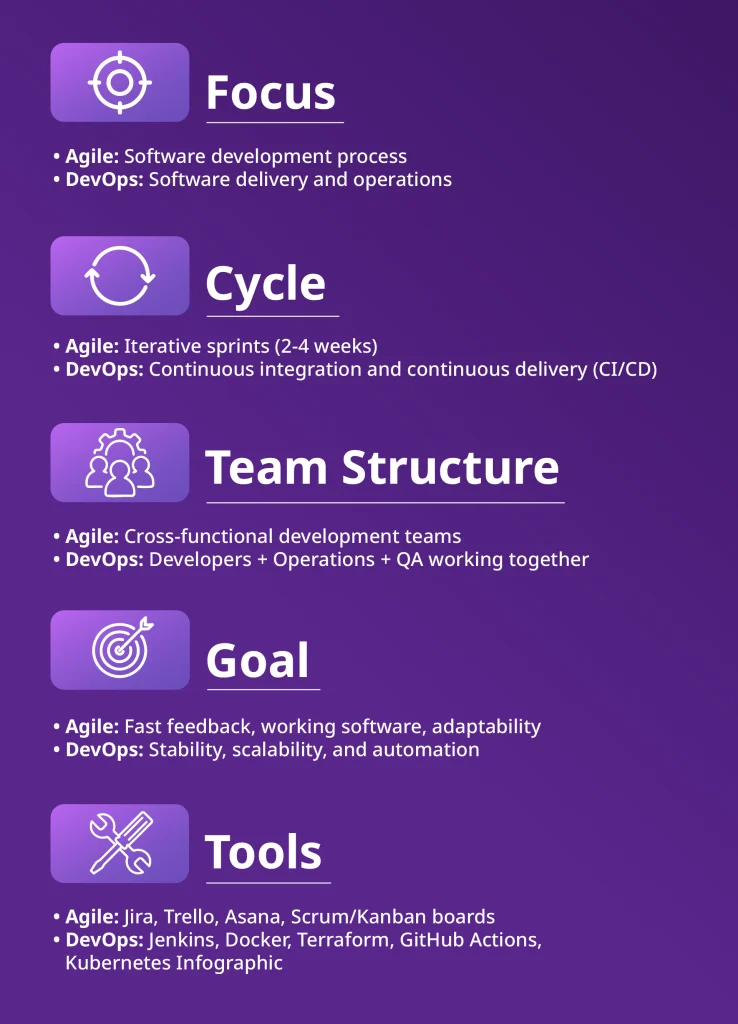
For teams comparing Agile vs DevOps, this graphic makes the distinction clear. Agile brings adaptability, while DevOps ensures reliable delivery and scalability. Used together, they give organisations the ability to innovate quickly without sacrificing stability.
If you want to take this comparison further, you can read the article on what a scalable DevOps setup looks like in a 50-person health tech team, where the balance of Agile and DevOps becomes critical.
What About Lean? Minimising Waste While Scaling Delivery
If Agile is about adaptability and DevOps is about reliable delivery, Lean is the discipline that keeps both honest.
Born in Toyota’s factories, Lean was designed to cut out anything that didn’t add value to the customer. Decades later, the same principles are transforming how tech teams build and ship software.
The philosophy is simple: eliminate waste, optimise flow, and improve quality.
In practice, that means fewer unnecessary steps, faster handoffs, and clearer priorities.
A feature that nobody uses? That’s a waste. An approval process that takes two weeks instead of two hours? Also waste. Lean gives teams the lens to spot those bottlenecks and strip them away.
What makes Lean especially attractive is its versatility. While Agile helps teams adapt and DevOps ensures smooth delivery, Lean keeps resources in check, something SMBs and scale-ups can’t afford to ignore. By cutting waste in infrastructure, training, or even meetings, Lean helps smaller organisations compete with larger rivals without burning through budgets.
From SaaS startups to enterprise cloud migrations, more and more tech teams are applying Lean to reduce costs, speed up decision-making, and focus on what really matters: delivering value to customers.
Think of Lean as the glue between Agile and DevOps. It doesn’t replace but sharpens them.
Agile keeps you fast, DevOps keeps you stable, and Lean makes sure you don’t waste time or money on the way.
Lean delivers the biggest impact when it’s supported by the right cloud setup. Through cloud consulting, organisations can uncover where efficiency gains overlap with infrastructure modernisation, turning Lean principles into measurable savings and smoother delivery.
How Agile, DevOps, and Lean Work Together in Real Projects
On their own, Agile, DevOps, and Lean each solve important challenges. But in real projects, the value comes from how they intersect. Used together, they create a delivery model that can scale without sacrificing quality or burning through budgets.
Let’s look at how this plays out in practice:
Building a SaaS Product
- Agile drives iteration: teams test features with early users, pivot quickly, and avoid building the wrong product.
- DevOps keeps deployment smooth: continuous integration and delivery (CI/CD) pipelines ensure every update reaches production safely.
- Lean cuts waste: teams prioritise only what adds value, avoiding over-engineering and trimming unnecessary meetings or approvals.
Of course, even the best setups face bottlenecks. If deployments are slowing you down, this deep dive on what’s slowing down your CI/CD pipeline and how to fix it highlights common issues and practical solutions from engineering teams.
Modernising Infrastructure
- DevOps takes the lead: automation with Infrastructure as Code (IaC) replaces fragile, manual processes.
- Lean keeps costs in check: scaling cloud resources on demand, reducing overprovisioning, and eliminating redundant tools.
- Agile supports change management: shorter sprints reduce risk during migration and keep progress visible.
Real-World Example: Strike
When UK proptech company Strike shifted to sprint-based delivery squads, the impact was immediate. Previously, the team struggled with frequent outages, slow release cycles, and misalignment between engineering and business priorities.
By embedding Agile practices into their squads (shorter iterations, tighter feedback loops, and clearer ownership), they were able to react faster to customer needs. Layering in DevOps automation eliminated manual deployment errors, introduced consistent CI/CD pipelines, and brought real-time monitoring into the workflow.
The results were a 70% improvement in platform stability, significantly reduced downtime during peak usage, and faster turnaround on new features.
Perhaps more importantly, the cultural shift was just as strong as the technical one. Developers, operations staff, and product managers were no longer working in silos but shared responsibility for outcomes. That alignment kept Strike’s teams focused on both technical performance and business growth, making their platform more resilient as user demand scaled.
This is proof that blending these approaches works, and it’s the kind of outcome that explains why more CTOs are moving toward sprint-based DevOps instead of traditional IT projects.
Deployflow’s P-Suite puts this combination into practice. By using Agile squads, DevOps automation, and Lean efficiency into two-week delivery cycles, it gives organisations a framework to grow without slipping into chaos. The result is faster releases, fewer incidents, and a structure that scales with the business.
Which Approach Should You Prioritise in Your Organisation?
Every organisation has growing pains, but not all of them come from the same place. Some teams wrestle with release delays, others struggle to keep pace with constant change, and many find themselves weighed down by rising costs or fragile infrastructure.
The question isn’t “Agile or DevOps or Lean?” It’s the challenge you need to solve first.
Ask yourself:
- Are release delays slowing down customer value, or is change management your bigger headache?
- Are you scaling a product team that needs adaptability, or stabilising infrastructure that demands reliability?
- Do you already have internal DevOps expertise, or would outside support help you move faster with fewer risks?
The answers point the way:
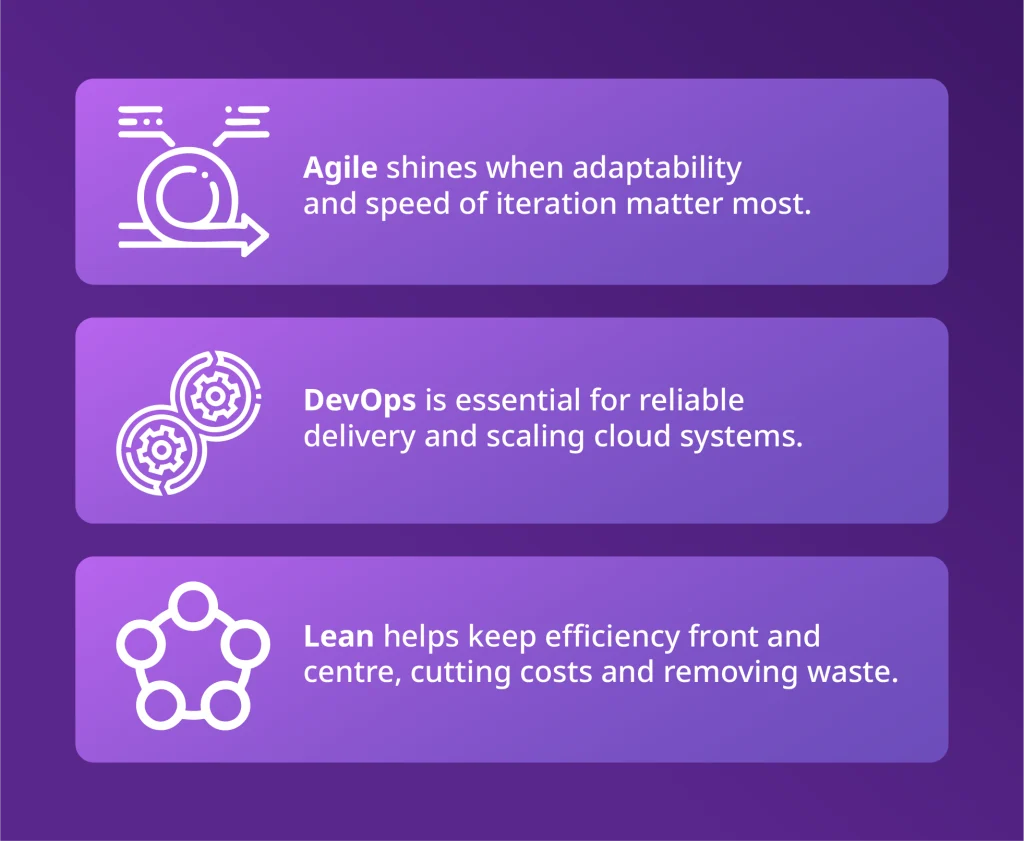
Success doesn’t come from choosing one, but from sequencing them wisely. Start where the pressure is greatest, then layer in the other approaches as your organisation matures.
In regulated industries, moving fast isn’t enough. Every release must also stand up to scrutiny. This guide on aligning DevOps with compliance shows how teams can stay agile without sacrificing audit readiness.
And if you’re not sure where to begin, exploring structured solutions like DevOps as a Service or Cloud App Modernisation Services can provide a practical starting point. Both are designed to give teams clarity, speed, and the ability to grow without losing control.
Speak with Deployflow experts today and turn your next project into a platform for lasting success.
You’ll walk away with a clearer sense of priorities, a roadmap for scaling delivery, and practical next steps that fit your organisation’s needs.
Frequently Asked Questions: Agile, DevOps, and Lean
What is the main difference between Agile and DevOps?
Agile is a development methodology. It focuses on breaking work into short, iterative cycles (sprints) so teams can adapt quickly to changing requirements, gather customer feedback early, and reduce the risk of building the wrong solution.
DevOps, on the other hand, is a delivery and operations model. It automates testing, integration, deployment, and monitoring to ensure that the software built through Agile practices can be delivered to production reliably and at scale.
Can Agile and DevOps be used together?
Not only can they be used together, but they are most effective when combined. Agile provides the planning and adaptability framework: product teams run sprints, prioritise backlogs, and iterate based on feedback. DevOps provides the execution framework: automated CI/CD pipelines, infrastructure as code, and monitoring ensure that what Agile teams produce can be deployed safely and repeatedly.
Without DevOps, Agile teams may build quickly but struggle to deliver at the same pace. Without Agile, DevOps pipelines risk being efficient but misaligned with customer needs. In practice, organisations that blend both approaches deliver updates more frequently, resolve issues faster, and maintain closer alignment between business and technology.
How does Lean methodology fit with Agile and DevOps?
Lean originates from manufacturing but translates directly into software by emphasising value delivery and waste reduction. Waste in tech can take many forms: features that customers never use, duplicated tools, manual approval processes, or overprovisioned infrastructure.
When combined with Agile and DevOps, Lean ensures that teams stay focused on what truly matters:
- Agile drives responsiveness to customer needs.
- DevOps ensures software reaches production reliably.
- Lean prevents organisations from spending time and money on activities that don’t add value.
For example, in a cloud migration project, Lean practices might eliminate redundant environments, Agile would help the team adapt to evolving requirements, and DevOps would automate deployments and monitoring. The result is a faster, cheaper, and more resilient delivery pipeline.
What are the benefits of adopting DevOps in a growing organisation?
As organisations expand, manual processes and siloed teams quickly become roadblocks. DevOps provides structure and automation that not only speeds up delivery but also improves the way teams work together.
- Cost efficiency: Automated pipelines and infrastructure as code reduce the need for manual intervention, lowering both cloud spend and staffing overhead.
- Stronger collaboration: By bringing development, operations, and QA into the same workflow, DevOps builds a culture of shared responsibility instead of blame.
- Compliance readiness: With audit trails, automated security checks, and standardised environments, teams can meet regulatory requirements without slowing releases.
- Business agility: Faster, more reliable releases mean product teams can respond quickly to customer feedback and market shifts without being blocked by technical debt.
For a growing business, the real benefit of DevOps is that it creates a delivery system that scales with the organisation, keeping innovation fast while protecting stability and compliance.
Explore our BLOG
Recent articles

ISO 42001 Explained: Requirements, Certification and What Your Engineering Team Must Build
ISO 42001 is the international standard that demonstrates your organisation governs AI properly, and enterprise...
read full article

Is Claude Down? Anthropic Outage: Protect Your Cloud Infrastructure
Claude went down across every surface on 29 September 2026. From 14:00 to 14:59 UTC,...
read full article

Top 10 Healthtech Companies in 2026: What Their Growth Means for AI and DevOps
Every software change that reaches a hospital has to clear regulatory, legacy system, and clinical...
read full article