


UK enterprises are currently overspending on cloud provisioning due to manual infrastructure inertia, a leak that DevOps automation instantly plugs.
In one infrastructure modernisation project, Deployflow helped a UK organisation reduce IT costs by approximately 30% after migrating to an automated, cloud-based environment, while also improving deployment speed and operational reliability.
TL;DR for CTOs and Founders
- Fiscal: Target a 30% reduction in OpEx via automated scaling.
- Velocity: Shift from days to minutes for environment provisioning.
- Risk: Eliminate the ‘human-error’ variable in UK compliance-heavy sectors.
Industry benchmarks from DORA confirm that teams leaning into high-maturity automation see 2.5x faster delivery cycles, making DevOps as a managed service a force multiplier for market responsiveness, not just a cost centre.
Read the full guide because DevOps automation isn’t only about faster deployments. Done properly, it transforms how infrastructure is built, governed, and optimised.
See how DevOps automation works in practice, which tools power automated cloud operations, and how modern engineering teams use automation to build scalable, cost-efficient infrastructure.
Why Modern Cloud Infrastructure Needs DevOps Automation Services
DevOps automation services replace manual infrastructure work with automated, repeatable systems that deploy, scale, and manage environments programmatically.
Instead of engineers configuring infrastructure by hand, environments are built and maintained through code, pipelines, and automated monitoring.
For growing cloud environments, this shift delivers three immediate advantages:
- Lower operational overhead: Automation removes repetitive infrastructure tasks and reduces manual intervention.
- Faster, safer deployments: Standardised pipelines ensure releases happen consistently without configuration errors.
- Predictable infrastructure scaling: Programmatic environments eliminate configuration drift and inconsistent environments.
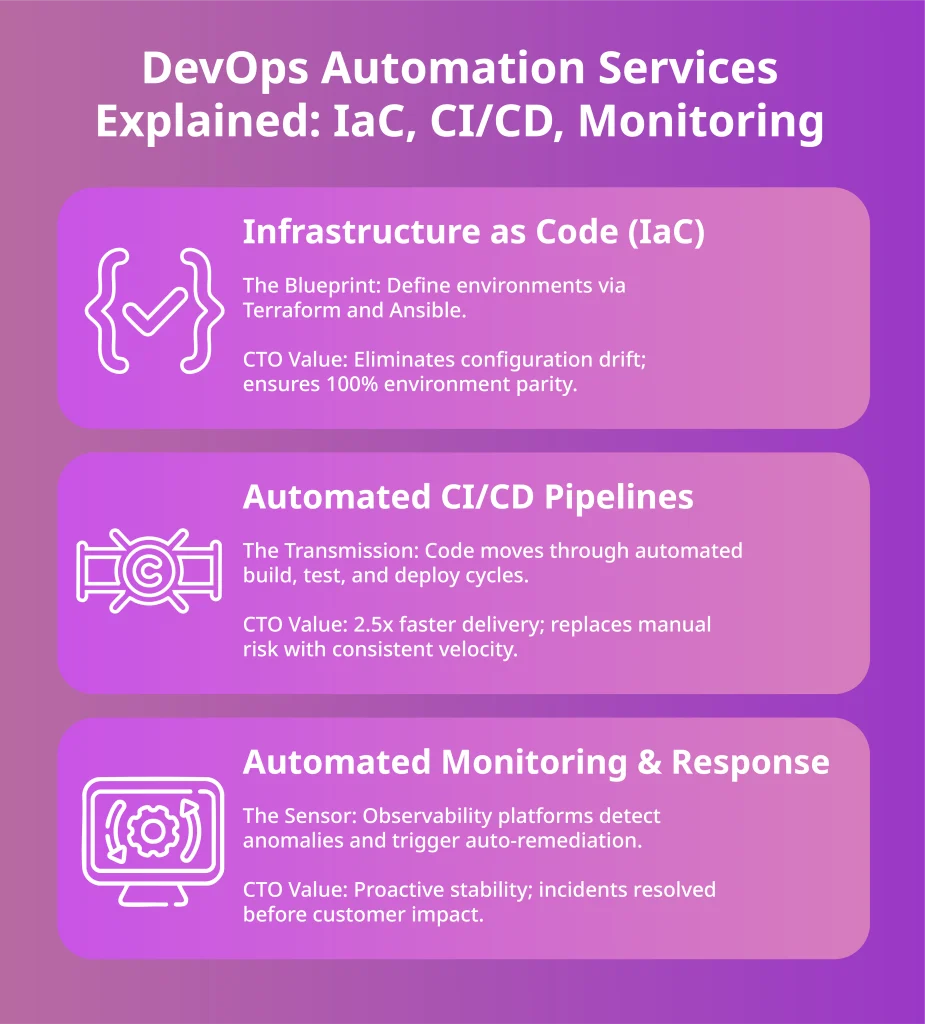
While the principles of IaC and CI/CD provide the framework, the actual cost-efficiency is realized through the specific implementation of the following industry-standard tools.
How DevOps Eliminates Cloud Infrastructure Waste
The industry is currently facing an efficiency scandal: IDC research shows average CPU utilisation in the cloud is stuck at 15–20%. Essentially, UK enterprises are paying for 100% capacity while using barely a fifth of it. DevOps automation fixes this by ensuring you only pay for the compute you actually consume.
The Efficiency Gap: How Automation Plugs Cloud Budget Leaks
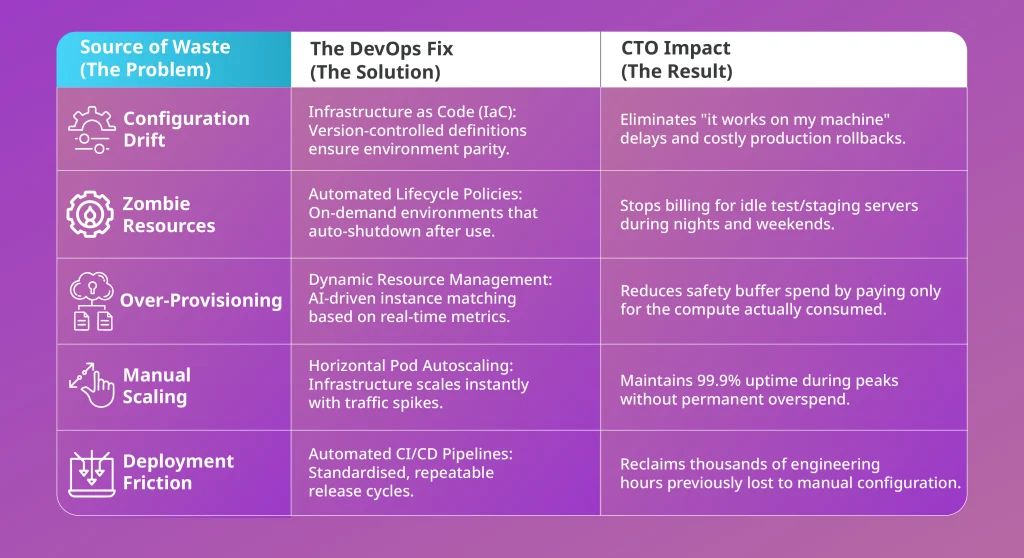
The Operational Impact:
When these inefficiencies accumulate, cloud environments typically suffer from:
- Wasted compute capacity from idle services and unused environments
- Duplicate infrastructure was created to compensate for inconsistent environments
- Longer incident recovery times due to manual troubleshooting and inconsistent deployments
DevOps automation addresses these issues by turning infrastructure management into a predictable, programmatic system that scales efficiently as the organisation grows.
Proof in Practice: How Hall Hunter Cut IT Costs by 30%
To see these cost-reduction principles in action, look at Hall Hunter, a leading UK soft fruit grower. Despite their market dominance, their legacy on-premises infrastructure was plagued by manual processes, unreliable forecasting, and high supplier costs.
By partnering with Deployflow to migrate to Microsoft Dynamics 365 Business Central and an automated cloud-based environment, they achieved a total transformation of their cost profile:
- 30% Reduction in IT Costs: Achieving immediate fiscal relief by eliminating expensive legacy hardware and manual maintenance.
- Automated Workflows: Replacing manual data entry with AI-driven yield predictions and automated ERP processes.
- Operational Stability: Supporting over 150 staff with a stable, managed service that significantly reduced support ticket volume.
- Documentation & Governance: Transitioning from unstructured data lakes to a well-documented, secure, and flexible cloud architecture.
This 30% saving was directly tied to the decommission of oversized legacy hardware in favour of a right-sized, auto-scaling Azure environment.
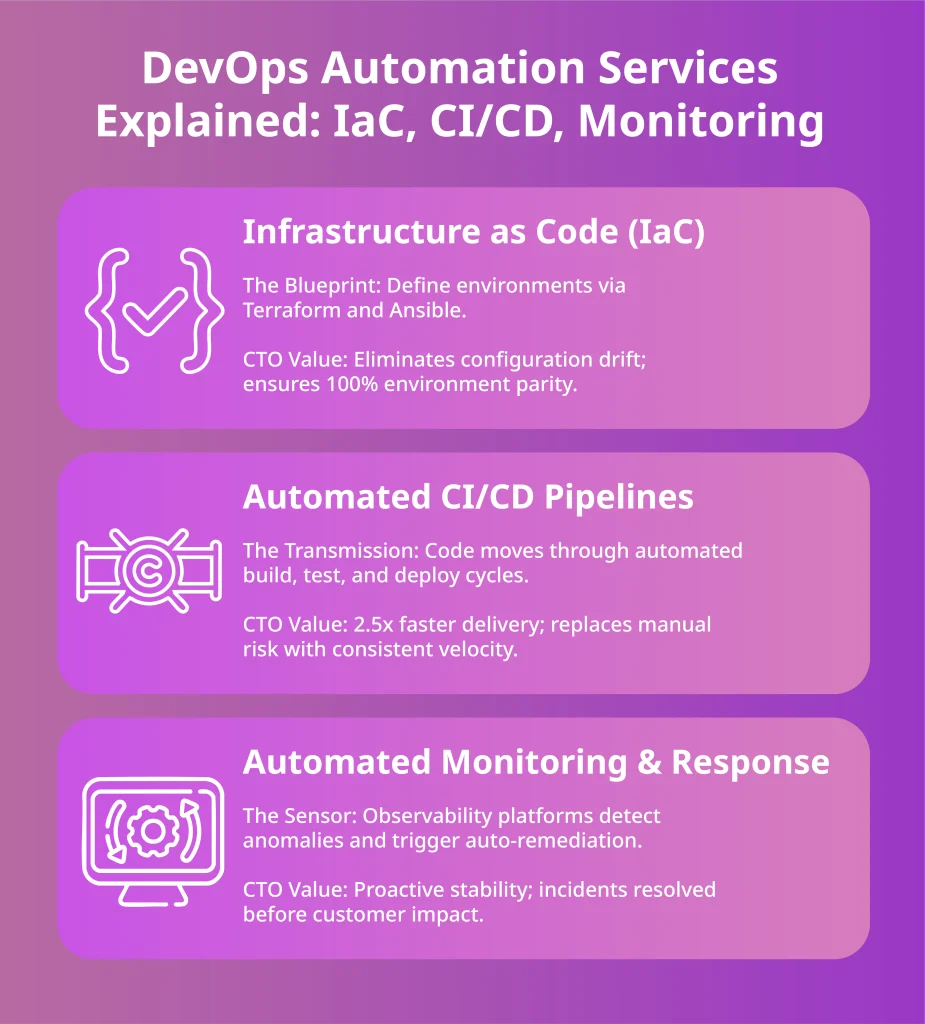
DevOps Automation Tools That Enable Cloud Cost Optimisation
DevOps automation relies on a stack of tools that standardises infrastructure, automates deployments, and optimises resource usage. When integrated into a single workflow, these tools ensure environments are created, deployed, and monitored automatically.
Below are several widely used tools and their contributions to cloud cost control.
Terraform (Infrastructure as Code)
Terraform allows teams to define infrastructure in code and deploy it automatically. Instead of manually creating resources in a cloud console, environments are generated from version-controlled configuration files.
Example Terraform configuration for AWS infrastructure:
provider “aws” {
region = “eu-west-2”
}
resource “aws_instance” “web_server” {
ami = “ami-0abcdef1234567890”
instance_type = “t3.micro”
tags = {
Name = “web-server”
Environment = “production”
}
}
This approach ensures infrastructure remains consistent across environments while enabling faster environment provisioning and simpler lifecycle management.
Because infrastructure is defined programmatically, unused environments can also be removed automatically, preventing idle resources from running unnecessarily.
GitLab CI/CD or GitHub Actions
CI/CD platforms automate how code moves from development to production.
Example GitHub Actions deployment workflow:
name: Deploy Application
on:
push:
branches: [ main ]
jobs:
deploy:
runs-on: ubuntu-latest
steps:
– name: Checkout code
uses: actions/checkout@v3
– name: Build application
run: npm install && npm run build
– name: Deploy infrastructure
run: terraform apply -auto-approve
The main benefits include automated builds and deployments, fewer manual release processes, and infrastructure changes being deployed alongside application code.
Automated pipelines remove the need for manual deployment steps that often require additional infrastructure capacity as a safety buffer.
Ansible (Configuration Management)
Ansible automates server configuration and application setup across multiple environments.
Example Ansible playbook:
– hosts: webservers
become: yes
tasks:
– name: Install Nginx
apt:
name: nginx
state: present
– name: Start Nginx
service:
name: nginx
state: started
This approach allows consistent server configuration, faster environment setup, and fewer configuration errors.
Automated configuration keeps environments aligned across systems without requiring ongoing manual maintenance.
Kubernetes Automation
Kubernetes manages containerised workloads and automatically adjusts infrastructure based on application demand.
Example auto-scaling configuration:
apiVersion: autoscaling/v2
kind: HorizontalPodAutoscaler
metadata:
name: web-app
spec:
scaleTargetRef:
apiVersion: apps/v1
kind: Deployment
name: web-app
minReplicas: 2
maxReplicas: 10
metrics:
– type: Resource
resource:
name: cpu
target:
type: Utilization
averageUtilization: 60
Applications scale automatically with traffic, ensuring compute resources are added only when demand requires it.
When workloads decrease, unused containers shut down automatically, preventing infrastructure from remaining permanently oversized.
Cloud Monitoring Platforms
Monitoring tools track infrastructure usage and performance in real time.
Common platforms include:
- Prometheus + Grafana
- AWS CloudWatch
- Datadog
- New Relic
Continuous monitoring allows engineering teams to identify abandoned resources and pinpoint inefficient workloads in real-time. By maintaining this level of observability, organisations can implement logic that automatically triggers scaling adjustments or initiates shutdown policies to eliminate waste the moment it occurs.
For example, alerts can automatically trigger scaling rules when CPU usage exceeds thresholds.
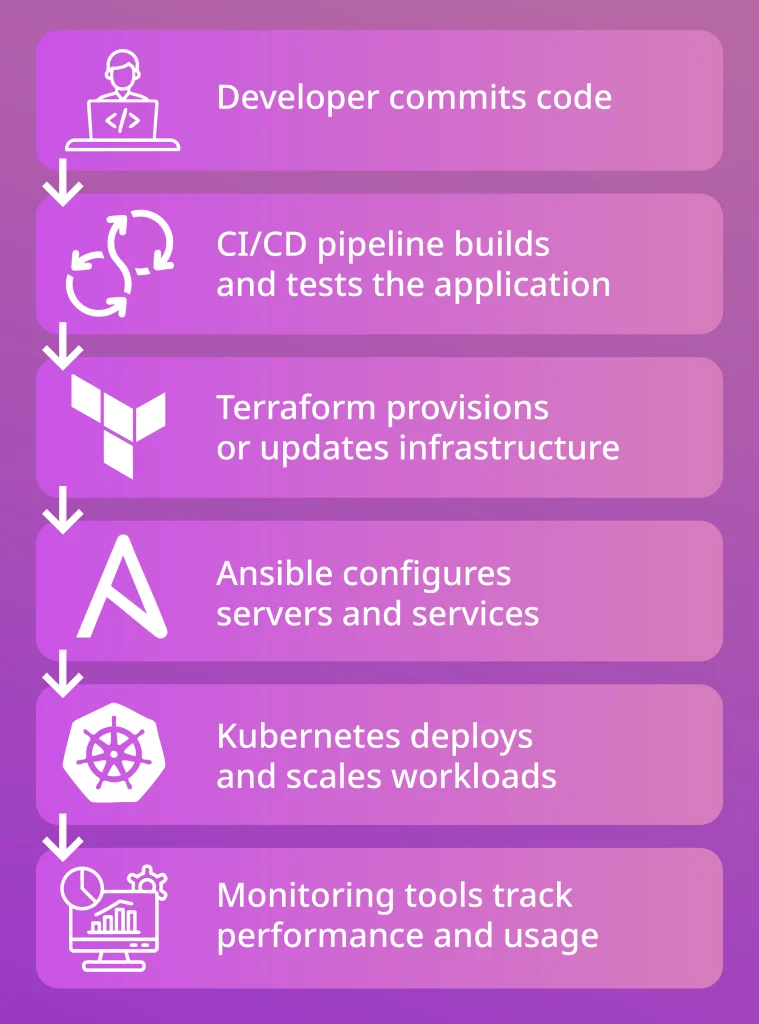
How DevOps Automation Tools Work Together
Modern DevOps pipelines combine these tools into an automated workflow.
Typical automation flow:
In this integrated stack, Ansible manages the foundational configuration and server hardening of the base nodes, while Kubernetes provides the high-level orchestration required to deploy, scale, and manage containerised workloads across that infrastructure.
AI-Driven DevOps Automation: The Next Step for Cloud Efficiency
For UK organisations looking to operationalise these shifts, understanding how the DORA AI capabilities model boosts AI adoption for SMBs is critical to ensuring that ‘agentic’ AI tools actually deliver measurable ROI rather than just adding technical debt.
DevOps automation already standardises infrastructure and deployments. AI-driven DevOps automation takes it further by analysing telemetry, predicting demand, and automatically adjusting infrastructure behaviour.
Instead of engineers manually reviewing dashboards or scaling resources, AI systems analyse infrastructure metrics and optimise environments continuously.
AI-Assisted Infrastructure Optimisation
AI models analyse historical infrastructure metrics such as CPU utilisation, memory usage, container density, and storage throughput. Based on this data, AI systems can recommend or automatically apply resource right-sizing to improve efficiency.
Example scenario:
If a cluster consistently runs at 15% CPU utilisation, the system recommends:
- Smaller instance types
- Fewer nodes
- Workload consolidation
Example recommendation output:
Workload: payment-api
Current instance type: m5.2xlarge
Average CPU utilisation: 18%
Recommendation:
Scale down to m5.large
Estimated monthly savings: $1,200
This type of analysis is already implemented in platforms such as AWS Compute Optimizer, Google Cloud Recommender, and Datadog Cloud Cost Management, which continuously analyse infrastructure usage and recommend more efficient resource configurations.
Predictive Scaling
Traditional auto-scaling reacts after demand increases.
AI models analyse historical traffic patterns to predict demand before it occurs.
Signals used for these predictions include request rates, seasonal traffic patterns, time-of-day usage trends, and event-based spikes.
Example predictive scaling logic:
Traffic spike predicted: 08:45–09:30
Expected increase: 250%
Action:
Pre-scale Kubernetes nodes from 5 → 12
This prevents performance degradation during spikes and unnecessary over-provisioning during quiet periods.
Automated Anomaly Detection
AI models monitor infrastructure metrics continuously and detect behaviour that deviates from normal patterns.
Instead of relying on static thresholds, anomaly detection uses baseline learning.
Example anomaly signal:
Service: checkout-api
Normal latency: 80ms
Current latency: 260ms
Detected anomaly: abnormal latency increase
Suggested action: Investigate the database connection pool
Modern platforms implementing this approach include Datadog Watchdog, New Relic AI, and Dynatrace Davis AI, all of which analyse infrastructure behaviour continuously and identify anomalies before they escalate into operational incidents.
AI-Supported CI/CD Pipelines
AI also improves build and deployment pipelines by analysing pipeline execution data and identifying performance bottlenecks. By examining stage durations and resource usage, AI systems can detect inefficiencies and recommend optimisations that shorten build and deployment times.
Example:
Pipeline stage: integration tests
Average runtime: 14 minutes
Recommendation: parallelise test groups
Expected improvement: 45% faster pipeline
Deployment risk detection:
Deployment risk detection is another area where AI supports DevOps pipelines. AI models analyse deployment patterns and flag releases that show signs of elevated risk. Signals such as unusually large commits, failed tests in recent builds, or infrastructure changes affecting critical services can indicate a higher probability of deployment issues.
By identifying these risks before a release proceeds, teams can prevent failed deployments and reduce rollback events.
Where AI Delivers the Biggest Operational Gains
AI brings its biggest value in areas where human monitoring and decision-making become too slow or complex. By analysing operational data continuously, AI systems can identify inefficient workloads, detect abnormal behaviour, and recommend infrastructure adjustments before performance or cost issues escalate.
In large cloud environments, this capability allows teams to move beyond reactive operations. Instead of investigating problems after they occur, engineering teams gain earlier visibility into resource usage patterns, workload behaviour, and system anomalies, allowing them to make faster and more informed operational decisions.
What to Look for in a DevOps Automation Services Partner
The right DevOps partner operates as an extension of your engineering strategy, not just a service provider. When evaluating a DevOps consultancy for your UK operations, prioritise these five pillars:
- Multi-Cloud Architecture: Deep expertise across AWS, Azure, and GCP to prevent vendor lock-in and ensure cross-platform resilience.
- IaC Governance: Advanced Terraform-driven management that ensures environment parity across development, staging, and production.
- Embedded DevSecOps: Security policies and compliance checks (such as DORA or ISO27001 standards) integrated directly into the deployment pipeline.
- Operational Observability: Advanced monitoring architectures that provide real-time visibility into system health and anomaly detection.
- Engineering Elasticity: The ability to scale your internal team’s capabilities with senior architectural guidance and full-squad delivery.
To move beyond ad-hoc automation, leadership must align technical execution with a structured DevOps roadmap and scaling strategy that prioritises long-term resilience over quick fixes.
Deployflow approaches DevOps automation as an engineering partnership rather than a one-off implementation. The company’s experienced and award-winning engineers work through a full-squad delivery model, combining DevOps specialists, cloud architects, and software engineers into integrated teams that operate as an extension of the client’s organisation.
This approach allows companies to access deep technical expertise quickly, accelerate infrastructure modernisation, and scale engineering capabilities without the delays and costs of building large internal DevOps teams.
DevOps Automation Services: Building a Cost-Efficient Cloud Strategy
DevOps automation transforms how cloud infrastructure is managed. Instead of relying on manual processes, organisations operate through standardised systems that control how environments are deployed, scaled, and maintained.
The impact is practical. Automation reduces operational complexity, infrastructure becomes predictable and easier to scale, and engineering teams deploy faster with fewer incidents. As cloud environments grow, this approach keeps infrastructure efficient while maintaining reliability.
For organisations looking to modernise their infrastructure or optimise cloud spending, experienced guidance can accelerate the process.
Book a short consultation with Deployflow’s engineers to review your current cloud infrastructure and identify opportunities to automate operations, reduce cloud costs, and build a more scalable DevOps environment.
Frequently Asked Questions About DevOps Automation Services
How do companies identify where cloud costs can be reduced?
Most organisations identify cloud cost optimisation opportunities through infrastructure usage analysis.
Monitoring platforms and cloud optimisation tools analyse metrics such as CPU utilisation, memory consumption, storage throughput, and container density to detect inefficient workloads. When services consistently run far below capacity, infrastructure can often be resized or consolidated. These insights allow teams to reduce waste without affecting application performance.
Should DevOps automation start with infrastructure, deployments, or monitoring?
Most successful implementations start with Infrastructure as Code because it establishes a consistent foundation for all environments.
Once infrastructure is defined programmatically, deployment pipelines and configuration management can be automated more safely. Monitoring and observability are then integrated to provide visibility into how systems behave after automation is introduced. This staged approach allows teams to modernise operations without disrupting production systems.
How do organisations avoid over-automating DevOps environments?
Over-automation usually happens when teams introduce tools without a clear operational strategy.
Mature DevOps automation focuses on automating repeatable operational tasks such as infrastructure provisioning, deployment pipelines, and environment scaling. Processes that require architectural decision-making or complex troubleshooting should remain human-driven. The goal is to reduce operational friction, not remove engineering oversight.
What skills are typically required to implement DevOps successfully?
Successful DevOps automation usually requires expertise in cloud architecture, Infrastructure as Code, CI/CD pipeline design, and infrastructure monitoring.
Teams must also understand security practices such as access control, secrets management, and compliance automation. Many organisations combine internal engineering teams with external DevOps specialists to accelerate implementation and avoid operational mistakes during the transition to automated infrastructure.
How does DevOps automation support a FinOps framework?
DevOps is the primary engine of FinOps; it moves cost management from a monthly bill shock to a real-time engineering discipline.
By automating resource tagging, setting programmatic budget alerts, and implementing right-sizing logic into CI/CD pipelines, organisations gain total financial visibility. Deployflow helps bridge this gap between engineering output and financial governance, ensuring that every pound spent on cloud infrastructure is mapped directly to business value and operational necessity.
Explore our BLOG
Recent articles

ISO 42001 Explained: Requirements, Certification and What Your Engineering Team Must Build
ISO 42001 is the international standard that demonstrates your organisation governs AI properly, and enterprise...
read full article

Is Claude Down? Anthropic Outage: Protect Your Cloud Infrastructure
Claude went down across every surface on 29 September 2026. From 14:00 to 14:59 UTC,...
read full article

Top 10 Healthtech Companies in 2026: What Their Growth Means for AI and DevOps
Every software change that reaches a hospital has to clear regulatory, legacy system, and clinical...
read full article