


You can scale AI delivery speed without spiking your change failure rate if you treat AI as a delivery capability rather than a standalone tool.
Right now, you’re being pushed to move faster with AI. But the real question is stability. Will AI improve your DORA metrics, or increase your change failure rate, deployment risk, and compliance exposure?
The DORA AI Capabilities Model links AI adoption directly to delivery performance, deployment frequency, lead time, MTTR, and change failure rate, so you can scale AI without destabilising production.
TL;DR: What You’ll Gain
- Clarity on what the DORA AI Capabilities Model actually measures
- A practical way to move from AI pilots to production
- Lower deployment risk while increasing delivery speed
- Stronger governance and compliance as AI scales
This guide is about adopting AI to strengthen delivery, maintain stability, and drive measurable performance.
Who This Model Is Designed For
This model is particularly relevant for UK SMBs operating in regulated or high-availability environments:
- FCA-supervised FinTech firms
- NHS DSPT-aligned HealthTech providers
- ISO 27001-certified SaaS companies
- Scale-ups under investor scrutiny for operational resilience
If you are accountable for delivery performance, regulatory posture, and engineering efficiency simultaneously, AI cannot be treated as an experiment. It must prove operational value.
The DORA AI Capabilities Model exists to give you that proof.
Why AI Adoption Is Stalling in UK SMBs
You’ve probably trialled Copilot. You’ve seen AI-generated pull requests. Maybe ticket triage is partially automated. On the surface, adoption looks healthy.
But here’s the practical reality: AI hasn’t changed your deployment risk profile. That’s why progress feels slow.
The Real Risk of AI Adoption for UK SMBs
You’re trying to introduce AI while avoiding:
- An increase in change failure rate
- Slower approvals under FCA or UK GDPR scrutiny
- Black-box decisions that cannot be audited
- Overloading an already stretched DevOps capability
- Hiring additional engineers just to manage automation
AI adoption stalls when it’s layered on top of delivery systems that weren’t designed to absorb acceleration safely.
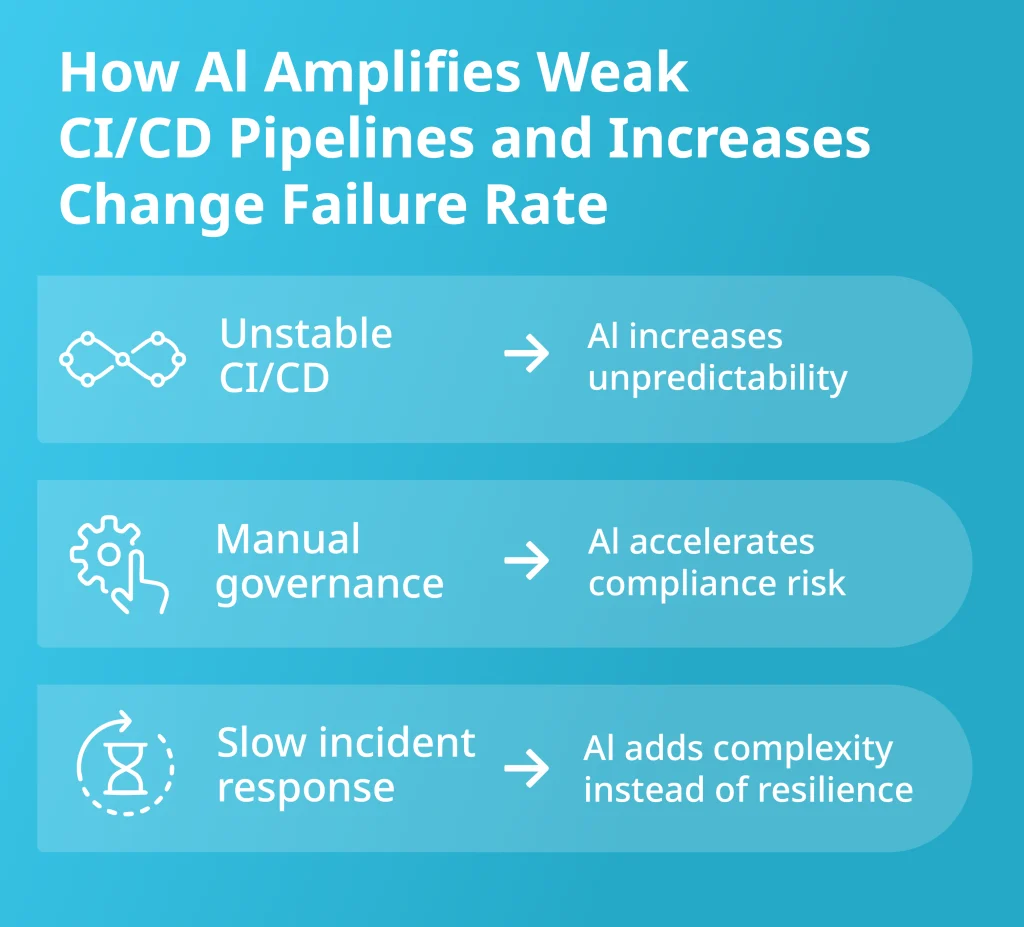
AI will amplify the system you already have, which is why pilots often fail to translate into safe production rollout.
What Enables Safe AI Adoption in DevOps
AI scales when it improves delivery performance. That means tying AI adoption directly to:
- Lower change failure rate
- Faster, safer deployment frequency
- Reduced MTTR
- Stronger audit trails and governance
This is where the DORA AI Capabilities Model becomes practical. It reframes AI from an innovation initiative to a delivery performance lever. That shift turns AI into a controlled performance upgrade.
If you’re reading this, you’re not looking for hype. You’re looking for a way to scale AI without destabilising production. The rest of this guide shows you how to do exactly that with measurable impact, controlled risk, and a delivery-first mindset.
What Is the DORA AI Capabilities Model and How Does It Improve DevOps Performance
The DORA AI Capabilities Model is a way to judge AI by one thing:
Does it make your delivery better, or not?
It builds on the traditional DORA metrics you already know and trust. But instead of measuring DevOps maturity alone, it measures how AI impacts that maturity.
The Shift From AI Interest to AI Capability
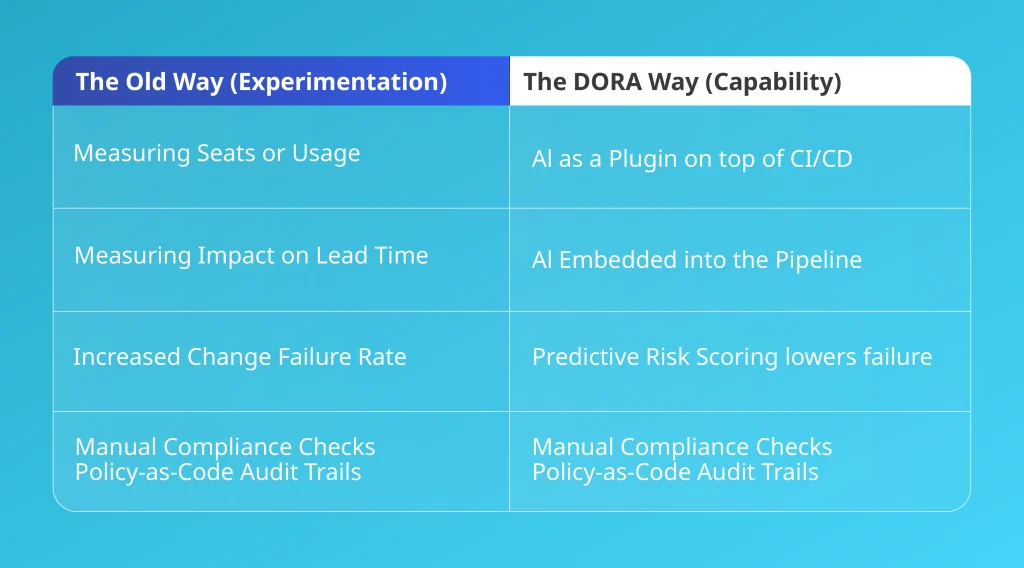
The Four DORA Metrics That Determine Whether AI Is Working
When you look at AI through this model, you’re really asking:
- Are we deploying more frequently and safely?
- Has the lead time from commit to production improved?
- Has our change failure rate gone down?
- Are we resolving incidents faster (lower MTTR)?
If AI doesn’t positively move at least one of these, that’s not capability but experimentation.
Why Traditional AI Frameworks Fail UK SMBs Without DevOps Alignment
Most AI frameworks weren’t built for you. They focus on data maturity, model governance, ethics, and infrastructure readiness. All important. But they ignore the one layer that determines whether AI survives contact with reality:
Your delivery system.
You’re operating with small engineering teams, limited automation, no dedicated platform squad, and rising audit pressure, especially under FCA and UK GDPR expectations. Operational resilience is no longer optional, as the FCA has made clear in its guidance on building operational resilience.
For many UK organisations, internal platform engineering maturity is limited. That creates a structural gap between AI ambition and delivery capability.
A Practical Operating Model for Safe AI Adoption
One way forward that fits this environment is to work through full-stack delivery squads.
When the same cross-functional team owns code, infrastructure, security considerations, and production outcomes, things change.
- Fewer handovers.
- Fewer misunderstandings.
- Clear accountability for deployment quality and recovery speed.
- Security and compliance become part of daily delivery, not a late-stage checkpoint.
Hiring an experienced external delivery team can make AI adoption safer by reducing handovers, tightening feedback loops, and keeping governance close to delivery.
There’s shared context. Faster feedback. Decisions happen closer to the work. You don’t need a separate AI oversight layer because governance lives inside the squad.
For a UK SMB, the delivery squad model is practical. It reduces coordination overhead, keeps costs controlled, and makes it far easier to answer the question that really matters:
Is this AI capability improving delivery, or increasing risk?
How the DORA AI Capabilities Model Accelerates Safe AI Adoption
AI adoption accelerates once it is safe in production.
Embedding AI in CI/CD Pipelines to Improve Deployment Frequency Safely
When AI is built into governed CI/CD pipelines, supported by structured CI/CD automation services, it strengthens traceability, release control, and deployment stability.
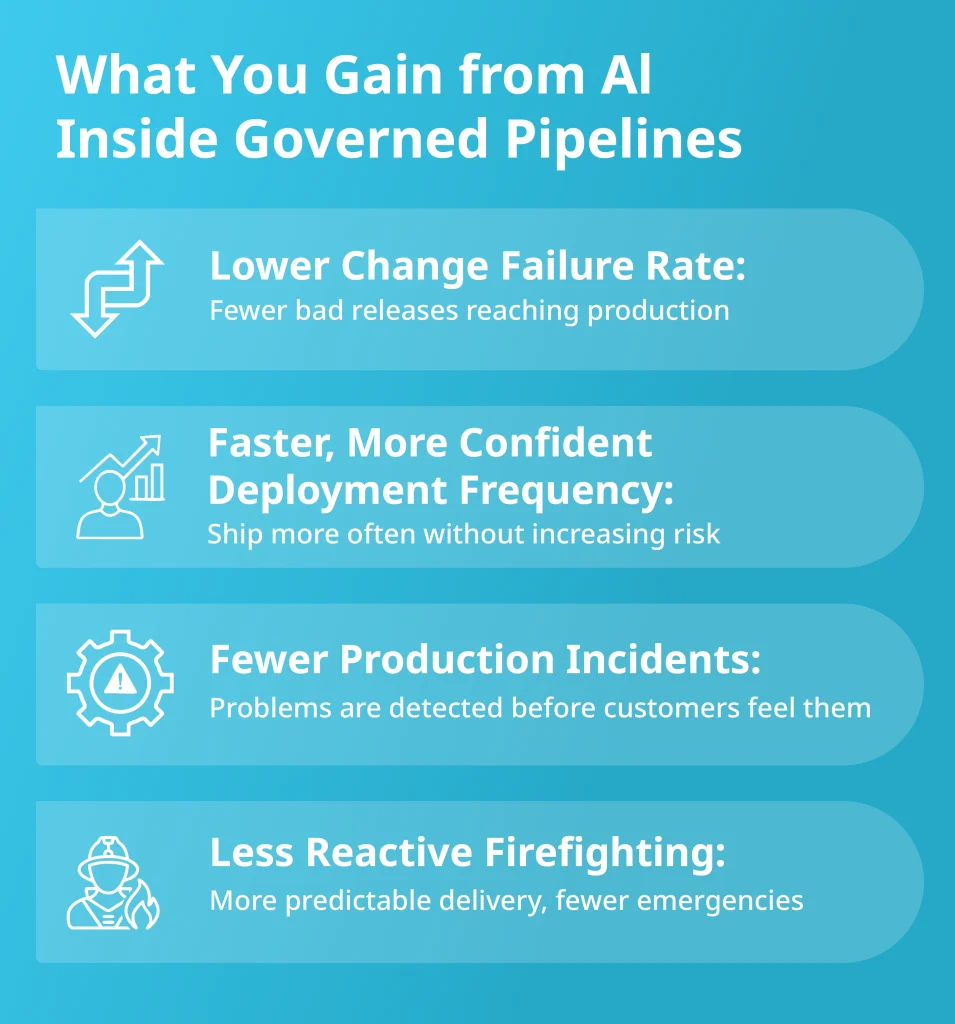
Think about AI-assisted pull request reviews that highlight risky changes before they’re merged. Risk scoring that flags high-impact releases before they go live. Anomaly detection that spots unusual deployment behaviour early. Intelligent rollback triggers that activate when production signals deviate from normal patterns.
Now you’re not experimenting with AI. You’re reducing exposure before customers feel it.
Using AI to Reduce MTTR and Strengthen Incident Response
The real test of resilience isn’t how often you deploy, but how quickly you recover.
AI becomes valuable when it reduces cognitive load during incidents. Log anomaly detection surfaces unusual behaviour earlier. Pattern clustering links current issues to past failures. Suggested remediation steps reduce guesswork. Alert filtering cuts through noise so engineers focus on what matters.
For a lean UK SMB team, that matters immediately.
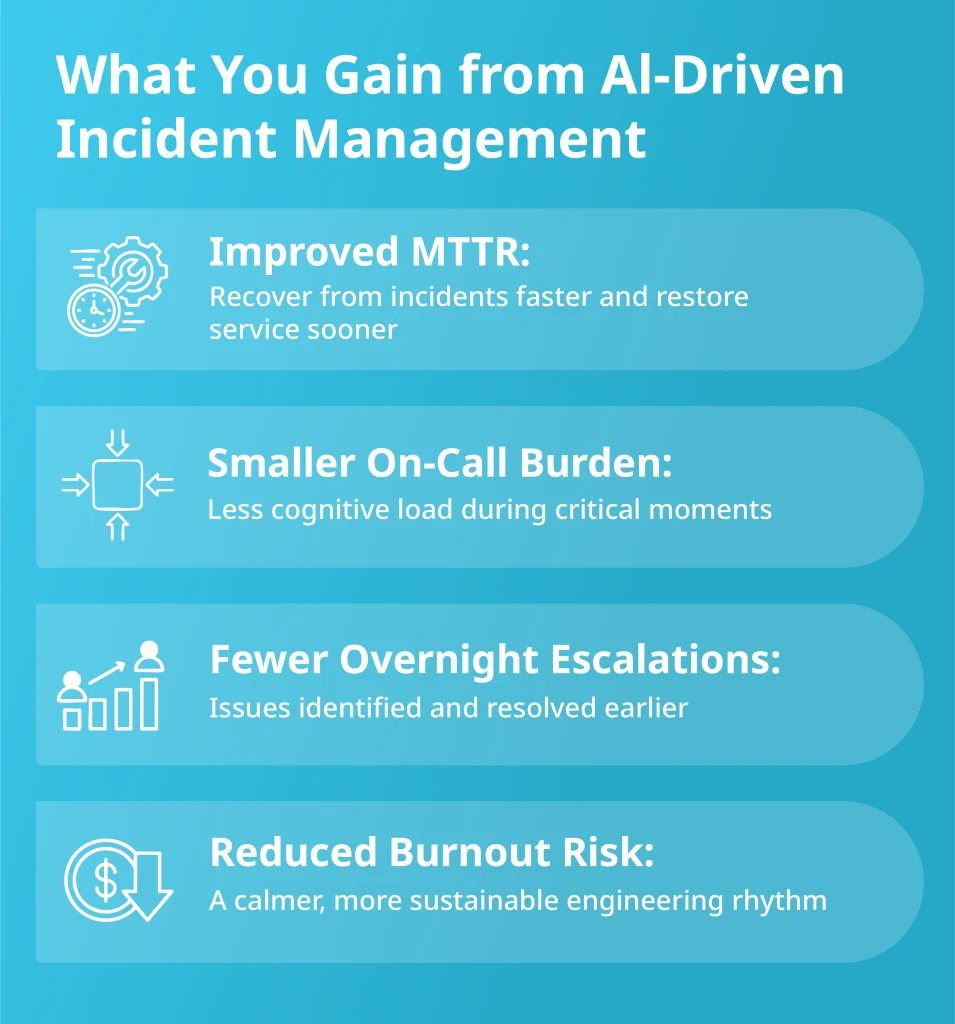
Operational stability improves. Trust improves. Board-level anxiety drops.
AI Governance for FCA, ISO 27001 and UK GDPR Compliance
If you operate under FCA scrutiny, align with NHS DSPT, or maintain ISO 27001 standards, AI must be auditable.
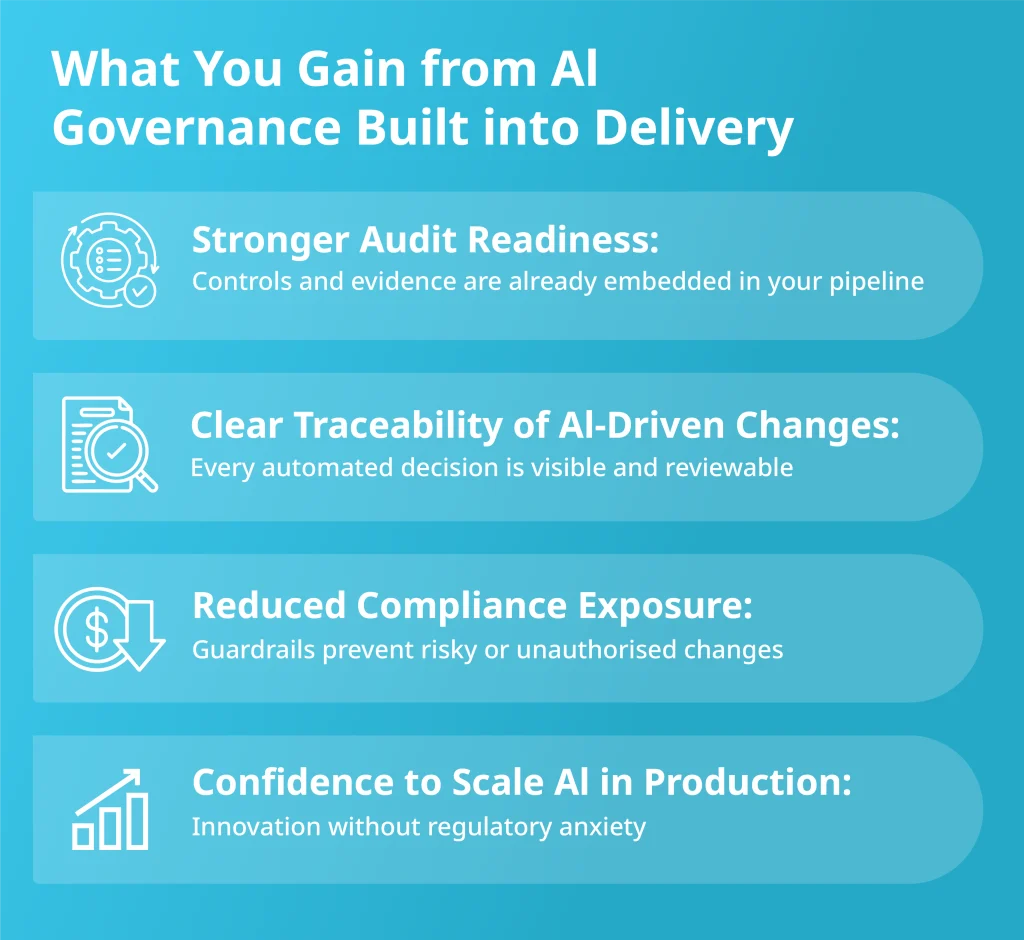
When AI runs within controlled pipelines, traceability follows. AI-generated code is visible. Review checkpoints stay intact. Policy-as-code enforces guardrails automatically. Accountability remains clear.
You’re not slowing innovation. You’re controlling it.
The DORA AI Capabilities Model works because it removes ambiguity.
Instead of debating whether AI is advanced enough or strategic enough, you measure it against delivery performance. If it improves stability, speed, and recoverability, it scales. If it increases risk, it stops. That clarity is what makes adoption practical.
✔️ Safer releases: AI identifies risk before customers feel it.
✔️ Faster recovery: Incidents are detected and resolved with less guesswork.
✔️ Lower operational risk: Automation is embedded inside controlled pipelines, not floating outside them.
✔️ Stronger compliance posture: Traceability and governance are built into how AI operates.
When AI improves how you ship, recover, and prove control, it stops being a side experiment. It becomes a measurable performance advantage, one that strengthens delivery.
Step-by-Step: Implementing the DORA AI Capabilities Model in an SMB
Here’s how to introduce the DORA AI Capabilities Model in a way that improves delivery without destabilising what’s already working.
Step 1: Start With Your Baseline, Not With AI
Begin by clarifying where you stand today. Look at your current DORA metrics: deployment frequency, lead time for changes, change failure rate, and MTTR.
If you don’t know these numbers, you won’t know whether AI improved performance or quietly made things worse. This is about having a reference point so decisions are grounded in evidence.
Step 2: Find the Friction That’s Actually Slowing You Down
Next, examine where time and stability are leaking inside your delivery process.
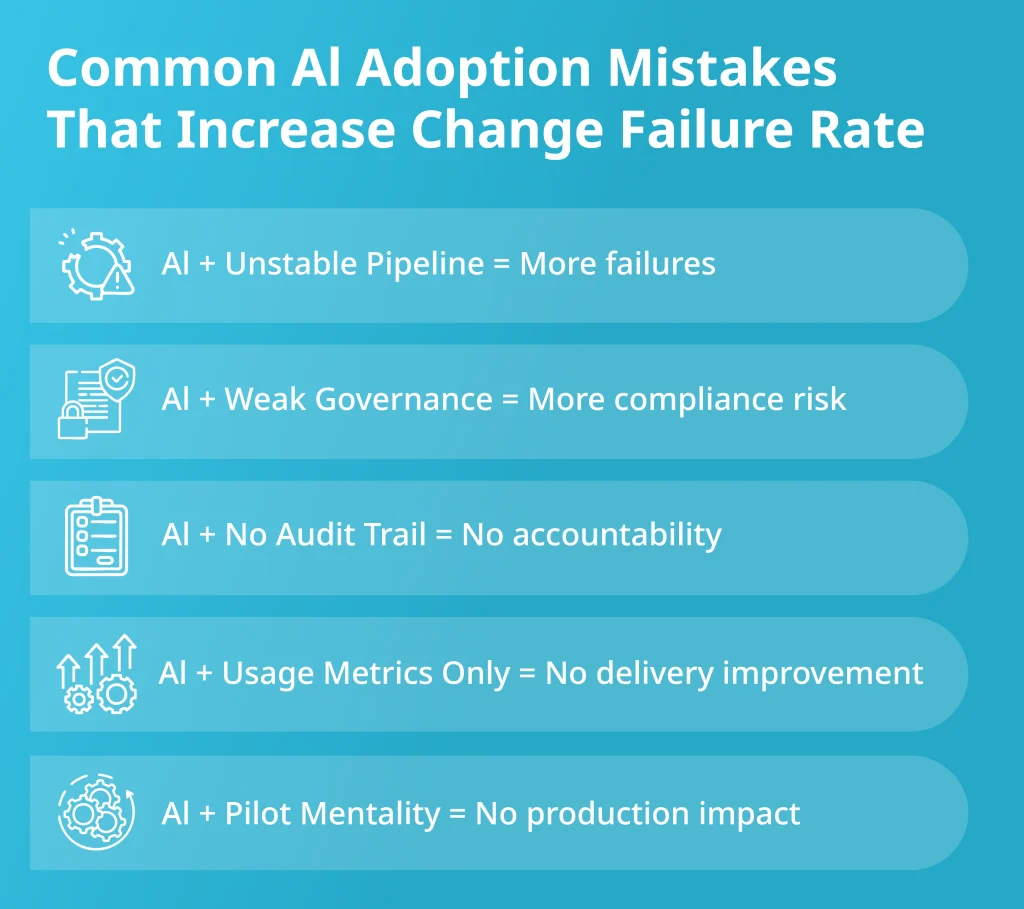
In many UK SMBs, it shows up as pull requests sitting unreviewed for days, repeated rollbacks after release, noisy alerts that engineers start ignoring, or manual compliance checks that slow approvals.
Resist the urge to introduce AI everywhere. Focus only on measurable, costly friction. If a bottleneck doesn’t meaningfully affect delivery speed or stability, it doesn’t deserve your first AI investment.
Step 3: Introduce AI Where It Reduces Risk or Time
Now introduce AI carefully and deliberately.
Use it to assist with pull request reviews so standards remain high, but approvals move faster.
- Apply risk scoring before release to catch high-blast-radius changes.
- Filter alert noise so incident response becomes clearer.
- Strengthen test coverage with intelligent suggestions before deployment.
Apply one clear principle:
If it reduces friction while protecting stability, keep it.
If it introduces uncertainty or new complexity, remove it.
Step 4: Build Governance In From the Start
This is not the stage to add controls later. Every AI capability should sit inside your existing controlled workflows. That means audit logs are visible, approval gates remain intact, model versions are tracked, and security review stays integrated into CI/CD.
When AI operates inside governed pipelines, it inherits your controls. When it operates outside them, it creates exposure. There’s no middle ground here.
Step 5: Measure Impact Quarterly
Finally, the numbers. Review performance quarterly rather than reacting to short-term monthly fluctuations.
Track deployment frequency, change failure rate, MTTR, and lead time. Look for sustained improvement and not temporary spikes.
If the metrics don’t move in the right direction, AI isn’t delivering value. Adjust it or remove it.
Why the DORA AI Capabilities Model Makes AI Justifiable at the Board Level
AI budgets must prove measurable value. Boards approve AI when it improves delivery performance and strengthens risk control.
When AI adoption demonstrably reduces change failure rate, shortens recovery time, strengthens audit readiness, and lowers operational risk, it becomes defensible.
The DORA AI Capabilities Model translates AI into operational metrics that CFOs and non-technical directors understand, reframing it from experimentation to controlled performance improvement.
Why the DORA AI Capabilities Model Is a Competitive Advantage in 2026
Nearly every business will be using AI soon.
What will separate leaders from the rest is operational discipline, the ability to ship faster, fail less, recover quickly, and prove control under scrutiny.
While others are still experimenting, disciplined teams are compounding delivery gains inside governed pipelines. AI alone can’t create an advantage, but predictable execution can.
For a practical breakdown of regulatory obligations and control requirements, Deployflow’s DORA Compliance Checklist helps you identify gaps and prepare your environment for audit scrutiny.
2026 Focus: Predictable Execution is the Only Edge
By the end of 2026, the competitive advantage for UK businesses will be the operational discipline to deploy AI safely under scrutiny.
Next Step for your Roadmap:
If you want to understand how AI would affect your current DORA metrics, and whether it would reduce risk or increase it, start with an objective baseline review.
Don’t let AI become another technical debt centre.
Book a DORA Metrics & AI Readiness Assessment with Deployflow
Frequently Asked Questions About the DORA AI Capabilities Model
Is the DORA AI model suitable for regulated UK industries?
Yes, particularly in regulated environments such as FCA-supervised FinTech, NHS DSPT-aligned HealthTech, or ISO 27001-certified SaaS.
The DORA AI model embeds AI into governed CI/CD pipelines with traceability, approval gates, audit logs, and policy-as-code controls. That ensures AI-generated changes remain reviewable and compliant. It strengthens operational resilience rather than introducing regulatory exposure.
What are the four DORA metrics, and why do they matter for AI adoption?
The four DORA metrics are deployment frequency, lead time for changes, change failure rate, and mean time to recovery (MTTR).
They matter because they objectively measure delivery performance. When AI improves these metrics, it proves that automation is increasing stability and speed rather than adding complexity. Without these benchmarks, AI adoption becomes subjective and difficult to justify at the board level.
How can UK SMBs reduce change failure rate using AI?
UK SMBs can reduce change failure rate by embedding AI into pre-deployment workflows.
Practical examples include AI-assisted pull request reviews, risk scoring before release, smarter test coverage suggestions, and anomaly detection in deployment patterns. These controls identify high-risk changes earlier in the pipeline. Fewer bad releases mean fewer emergency sprints and more predictable delivery.
How do I measure AI maturity in a DevOps environment?
AI maturity in DevOps is measured by performance impact. A mature AI implementation consistently improves DORA metrics over time, increasing deployment frequency, reducing change failure rate, shortening lead time, and lowering MTTR.
It also operates inside governed pipelines with traceability and audit controls. If AI usage grows but delivery metrics remain flat or worsen, maturity hasn’t been achieved. Real AI maturity shows up in stable, predictable delivery performance.
What is the biggest risk of AI adoption in software delivery?
The biggest risk is increasing delivery instability without realising it.
When AI is layered onto immature CI/CD pipelines, it can amplify weak testing practices, bypass governance controls, or introduce unpredictable changes into production.
That often leads to higher change failure rates and slower incident recovery, the opposite of what AI was meant to achieve. The risk isn’t the technology itself; it’s introducing it without measurable safeguards. Aligning AI adoption to DORA metrics reduces that risk by ensuring performance improves rather than deteriorates.
How long does it take to see a measurable impact from AI aligned to DORA metrics?
In mature environments, early improvements can appear within one to two quarters, particularly in deployment frequency and lead time. Change failure rate and MTTR improvements may take longer, as they depend on pipeline stability and incident process maturity.
The key is disciplined measurement. When AI is introduced in controlled stages and evaluated quarterly against DORA metrics, impact becomes visible and defensible.
Rapid gains without measurement are often unstable. Sustainable gains require structured adoption.
Explore our BLOG
Recent articles
ISO 42001 Explained: Requirements, Certification and What Your Engineering Team Must Build
ISO 42001 is the international standard that demonstrates your organisation governs AI properly, and enterprise...
read full article

Is Claude Down? Anthropic Outage: Protect Your Cloud Infrastructure
Claude went down across every surface on 29 September 2026. From 14:00 to 14:59 UTC,...
read full article

Top 10 Healthtech Companies in 2026: What Their Growth Means for AI and DevOps
Every software change that reaches a hospital has to clear regulatory, legacy system, and clinical...
read full article