


Healthcare providers need to scale operational throughput without compromising clinical safety or data integrity.
While standard LLMs offer general assistance, developing AI agents represents a shift toward goal-oriented execution.
By using an orchestration layer to manage complex, multi-step tasks, these agents move beyond simple chat to active participation in workflows, reducing administrative burnout and bridging legacy interoperability gaps.
Core Takeaways for Healthcare IT Leaders
- The best AI agent solutions for healthcare providers solve real workflow problems.
- Strong early use cases usually sit in patient communication, documentation support, coordination, and operational admin.
- In healthcare, value depends on control, auditability, and integration.
- The right solution should reduce friction without creating new risk, complexity, or governance gaps.
- Your best starting point is one workflow where the operational benefit is clear and measurable.
The promise, though, is not in autonomy alone. It is in choosing the right use case, applying the right controls, and making sure the solution fits the reality of your systems and workflows.
The best AI agent solutions for healthcare providers are the ones that solve a specific problem clearly, safely, and at scale.
This guide looks at where Agentic AI services can create real operational value in healthcare, which types of solutions deserve closer attention, and what you should actually evaluate before moving forward.
Why AI Agents Are Becoming Relevant in Healthcare Operations
Healthcare providers are turning to Agentic AI because operational pressure is rising in the places that matter most. Administrative work keeps expanding, workflows still break across disconnected systems, and service expectations are rising without matching increases in headcount.
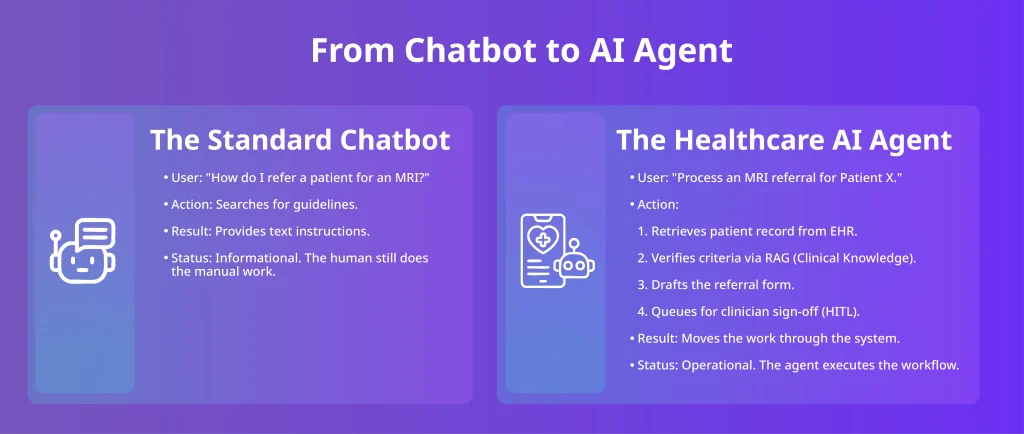
Standard AI tools can fall short. They can assist with content or answers, but they do not do enough to move the work through a process.
AI agents are getting attention because they can help reduce friction in repetitive, time-sensitive, and operationally expensive workflows. For healthcare leaders, that makes them worth assessing as a practical way to improve execution.
The Architecture of Trust: RAG and Agentic Frameworks
For an IT leader, the underlying plumbing determines the solution’s viability. Reliable healthcare agents are not built on raw model outputs alone; they leverage Retrieval-Augmented Generation (RAG).
By anchoring the agent to internal SOPs and clinical guidelines, RAG ensures the model pulls from a verified source of truth rather than risking hallucinations.
Whether built on enterprise-grade frameworks such as LangChain or data-indexers such as LlamaIndex, these solutions provide the necessary scaffolding to securely and deterministically connect AI models to private data.
Where Agentic Solutions Can Deliver the Most Value in Healthcare
The best AI agent solutions tend to create value where operational friction is already visible. In healthcare, that usually starts with patient access, documentation flow, and back-office execution rather than high-risk clinical autonomy.
Patient access and communication are one of the clearest areas. AI agents can help with appointment preparation, intake support, reminders, routing, and common patient queries. That can reduce pressure on front-line teams while improving response speed and consistency.
Documentation and coordination support is a high-ROI entry point for automation. However, the goal is rarely total autonomy. The most effective deployments utilise a Human-in-the-Loop (HITL) architecture. Here, the agent assists with summarisation, referral drafting, and information flow, but a clinician or administrator remains the final arbiter. This maintains a clear audit trail and reduces clerical drag without removing professional accountability.
Operational and back-office workflows often offer some of the safest early value. Revenue cycle support, internal service requests, ticket triage, and process coordination can all benefit from more structured automation. These use cases often have clearer ROI, lower implementation risk, and a more direct path to measurable improvement.
The best AI agent solution is the one applied to a workflow where delays, repetition, and manual effort are already easy to spot.
What Makes a Healthcare AI Agent Solution Useful Rather Than Risky
A strong healthcare AI agent has to fit the control environment you already operate in.
In the UK, that means handling health data as special category data under UK GDPR, meeting NHS data security expectations through the DSPT where relevant, and, for digital health systems that affect care, accounting for clinical safety standards such as DCB0129 and DCB0160.
Prioritising Integration and Human Oversight
- Integration quality comes first. If the solution cannot work cleanly with your core systems and workflow layers, its value will fall apart quickly.
- Permission design and human control matter just as much. The more action an agent can take, the more tightly that authority needs to be scoped, reviewed, and recorded.
- Auditability and traceability are also essential. In healthcare, a black-box workflow is a weak one. You need to know what the agent did, what data it used, and where human oversight stayed in place.
- Operational reliability is the final test. If a solution looks efficient in a demo but creates exceptions, confusion, or escalation issues in production, it is not a strong solution.
The same logic applies outside the UK. In the US, HIPAA sets clear expectations around protecting health information, including electronic protected health information.
While UK GDPR, DSPT, and HIPAA are non-negotiable, a high-performing agent should operate within an environment backed by HITRUST or SOC2 Type II certifications.
The point is not to turn every AI project into a compliance exercise. It is to recognise that, in healthcare, the best AI agent solution is the one that improves a real workflow without weakening control, visibility, or reliability.
Where to Start With Healthcare AI Agents
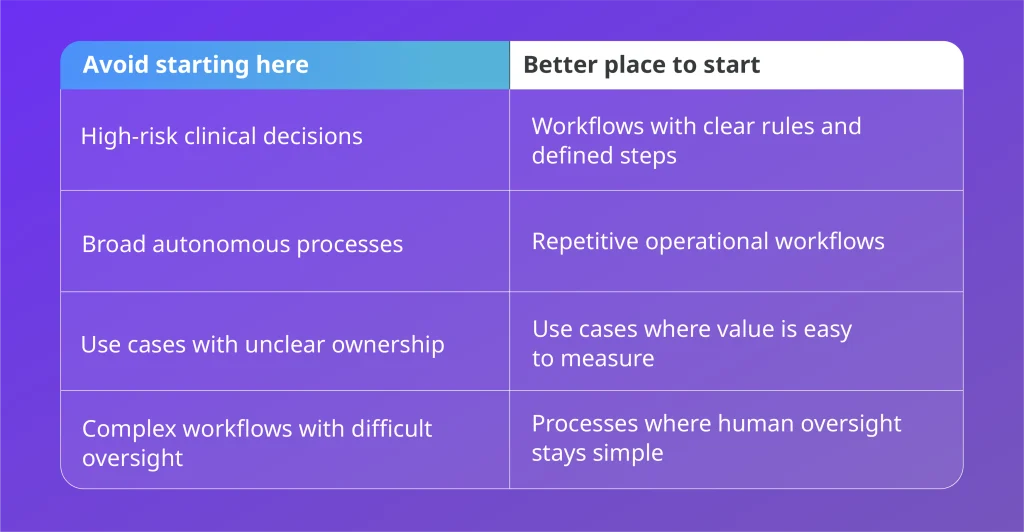
The strongest first move is usually the one that improves a clear, repeatable workflow without adding unnecessary risk. In healthcare, that often leads to faster proof of value, easier governance, and a more credible case for wider adoption.
How CTOs Should Evaluate AI Agent Options for Healthcare Providers
Start With Workflow Value Instead of Product Claims
A useful evaluation begins with the workflow itself. The first question is whether the solution reduces friction in an area that already matters to your organisation. If the underlying process is unclear, inconsistent, or low priority, adding an AI agent will not create much value.
Test Control, Fit, and Operational Reality
The next question is whether the solution can operate inside your real environment. That includes data boundaries, access controls, governance requirements, and the practical fit with your existing architecture. If the agent adds fragile integrations, extra process overhead, or new points of failure, the value can disappear quickly.
Measure Outcomes and Pressure-Test the Rollout
The final test is whether success can be measured clearly and whether the rollout model is realistic. Useful indicators might include time saved, backlog reduced, faster handling, or better service responsiveness. A strong solution should not just look promising in principle. It should be capable of delivering practical improvement in a healthcare environment without creating a larger operational problem.
Build, Buy, or Adapt? Choosing the Right Route
Buy When the Workflow Is Common and the Need Is Clear
Off-the-shelf AI agent tools can make sense when the workflow is common, the process is already well understood, and the organisation needs speed more than deep customisation. That route can work well for standard use cases, especially where the integration burden is limited and the control model is straightforward.
Build or Adapt When Complexity Starts to Matter
A more tailored route becomes attractive when the workflow requires a sophisticated orchestration layer. As agents begin to interface with multiple legacy systems (scheduling, billing, and EHRs), the complexity of managing state and logic increases.
If the organisation requires deep integration with specialised data boundaries or custom approval gates, building a modular agentic framework enables tighter control over task sequencing and execution across the stack.
The structural challenges of managing these healthcare data boundaries often mirror the coordination required for agentic AI in DevOps and software development, where reliability depends on a strictly governed orchestration layer.
What the Best AI Agent Rollout Looks Like in Practice
The strongest rollouts usually start small and stay controlled. First, pick one workflow with visible friction. Then set success metrics early so the outcome is clear. Before deployment, define data boundaries and approval logic to keep control in place. After that, run a controlled pilot to test the solution in a live setting without unnecessary exposure. Only then should you expand after value and controls are proven.
That approach is often the fastest way to reach safe, credible ROI in healthcare. Deployflow helps organisations take that route with secure implementation, clear control design, and rollout plans grounded in real operational and compliance constraints.
How to Roll Out AI Agents in Healthcare
- Pick one workflow with visible friction. Start where the operational need is already clear.
- Set success metrics early. Make value easier to prove in time, cost, or service impact.
- Define data boundaries and approvals. Keep control, security, and accountability in place.
- Run a controlled pilot. Test the solution without creating unnecessary risk.
- Expand only after proof. Scale only when the value and controls hold up in practice.
Deployflow for Healthcare AI Agents: Safe, Practical, and Workflow-Focused
Healthcare providers do not need the most ambitious AI agent. They need one that fits a real workflow, stays inside clear controls, and delivers measurable operational value without creating governance problems. That is the standard worth using when deciding what to adopt.
Deployflow helps healthcare organisations with custom AI development. Agentic AI services are built around workflow design, secure implementation, and controlled rollout.
By deploying full-stack delivery squads, the focus stays on practical use cases, clean integration, and delivery models that hold up in live clinical environments.
A successful rollout also requires long-term sustainability. That is why the process prioritises knowledge transfer, ensuring your internal teams have the architectural understanding to manage and govern these agentic systems as they scale.
A logical next step is to examine a workflow in which delays, manual effort, or coordination issues are already visible.
Claim a free AI agent workflow review to see where agentic AI could create operational value, what governance requirements need to be addressed, and whether the workflow is ready for a controlled rollout.
Frequently Asked Questions About AI Agent Solutions for Healthcare Providers
What is the difference between an AI agent and a healthcare chatbot?
An AI agent can take structured action across a workflow, while a chatbot mainly responds to prompts or questions.
In healthcare, that difference matters because the goal is often not just to answer a patient or staff member, but to move work forward. That could include routing a request, triggering the next step in a process, or helping information move between systems. A chatbot may improve access to information, but an AI agent is more useful when the organisation needs controlled workflow execution. That is also why AI agents require stronger oversight, clearer permissions, and better integration design.
Can healthcare AI agents work with existing EHR or EMR systems?
Yes, but the quality and safety of that integration usually determine whether the solution will work in practice.
A weak connection to core systems can create delays, duplicate work, and unreliable outputs. In healthcare, the real question is whether the agent can operate cleanly within your architecture, data boundaries, and workflow logic. That is why integration planning, AI engineering and automation services should be treated as a core part of the rollout, not a detail to solve later.
Are AI agents suitable for smaller healthcare providers or only large organisations?
AI agents can be useful for smaller providers if they are applied to the right workflow and introduced with clear controls.
A smaller organisation does not need an enterprise-scale AI programme to get value from workflow automation. In fact, tightly scoped use cases can often be easier to evaluate in leaner environments because operational pain points are more visible. The key is not organisational size, but whether there is a clear process problem, measurable value, and a realistic path to implementation. Smaller providers should still be disciplined about governance, especially where patient data or service quality is involved.
How long does it take to see value from a healthcare AI agent rollout?
Early value usually appears fastest in workflows that are repetitive, admin-heavy, and already causing visible delays.
That is because success is easier to measure when the starting problem is clear. A provider may begin to see gains in handling time, backlog reduction, or coordination speed relatively early if the rollout is tightly scoped.
Broader transformation takes longer because it depends on the quality of integration, governance maturity, and operational readiness. The fastest route to value is usually a controlled pilot built around one clear workflow.
What should healthcare providers measure after deploying an AI agent?
Healthcare providers should measure operational outcomes. Useful indicators include admin time saved, faster response times, reduced backlog, fewer handoff delays, and more consistent workflow handling.
In some environments, error reduction and improved visibility into process execution also matter just as much as speed. The point is to judge whether the agent has improved a workflow in a meaningful way. If the rollout creates more exceptions or more complexity, high usage alone does not mean success.
Explore our BLOG
Recent articles

ISO 42001 Explained: Requirements, Certification and What Your Engineering Team Must Build
ISO 42001 is the international standard that demonstrates your organisation governs AI properly, and enterprise...
read full article

Is Claude Down? Anthropic Outage: Protect Your Cloud Infrastructure
Claude went down across every surface on 29 September 2026. From 14:00 to 14:59 UTC,...
read full article

Top 10 Healthtech Companies in 2026: What Their Growth Means for AI and DevOps
Every software change that reaches a hospital has to clear regulatory, legacy system, and clinical...
read full article