


On March 31, 2026, Anthropic shipped a Claude Code release that exposed internal source code because of a packaging error. Anthropic said the issue was caused by human error, not a breach, and that no customer data or credentials were exposed.
Executive Summary:
- A Claude Code release accidentally exposed internal source code on March 31, 2026.
- Anthropic said it was a packaging error caused by human error, not a breach.
- No customer data or credentials were exposed.
- The real lesson for CTOs is about release controls, vendor maturity, and governance around AI coding tools.
The real value in this story is the clearer view it gives into release discipline, vendor maturity, and AI tooling risk.
It also shows why AI engineering needs a strong delivery model, especially as AI begins to influence real engineering workflows.

For engineering leaders, the key question is whether a delivery-adjacent AI tool was released with controls that were too weak for the level of trust being placed in it.
Why This Matters Even If No Customer Data Was Exposed
Anthropic said no customer data or credentials were exposed, but that does not make the incident low-risk from an enterprise perspective. A release still exposed a large portion of Claude Code’s internal source through a packaging error, giving outsiders a detailed view into the tool’s structure and capabilities.
What matters here is not just that internal code was exposed, but that a release process failed around a tool designed to sit close to software delivery. That raises a much bigger question about operational maturity and trust.
The Bigger Risk Is Weak Release Governance Around AI Tools
The bigger problem is that a public release process appears to have allowed a code leak to happen.
When an AI coding tool ships with the wrong package contents, the issue becomes a question of release discipline, validation, and how much operational trust the vendor has really earned.
That is the bigger lesson for engineering leaders. AI coding tools need the same release governance as production software because they are closely tied to code generation, developer workflows, and delivery decisions. A missed artefact check, weak packaging validation, or poor approval flow can turn a routine release into a high-impact failure very quickly.
Where Release Governance Tends to Break Down
Weak release governance usually shows up in familiar places: package content is not inspected closely enough before publishing, source maps or debug artefacts are left in production releases, build outputs are not reproducible, and approval gates are too light for tools that influence engineering work.
Why AI Coding Tools Increase the Risk
The risk is higher with AI coding tools because they are not passive. They shape how code is written, reviewed, and shipped. That means a release failure around an AI coding tool is not just a vendor embarrassment. It raises questions about the controls around a tool that may already sit inside real delivery workflows.
What Mature Release Discipline Should Include
Mature release discipline means checking exactly what is being published, validating package contents before release, enforcing approval gates, using reproducible builds, and having rollback and containment steps ready when something slips through. None of that is glamorous, but it is what separates a manageable mistake from a wider trust problem.
One packaging error should not be enough to create this level of exposure. That is why the real issue is the release process that allowed the mistake to pass through.
What CTOs Should Ask Any AI Coding Vendor Now
Most evaluations of AI coding tools focus on speed, model quality, and developer experience. That is not enough. Tools that influence how code is written and shipped should be assessed with the same rigour as any other part of the delivery stack. The right questions are operational.
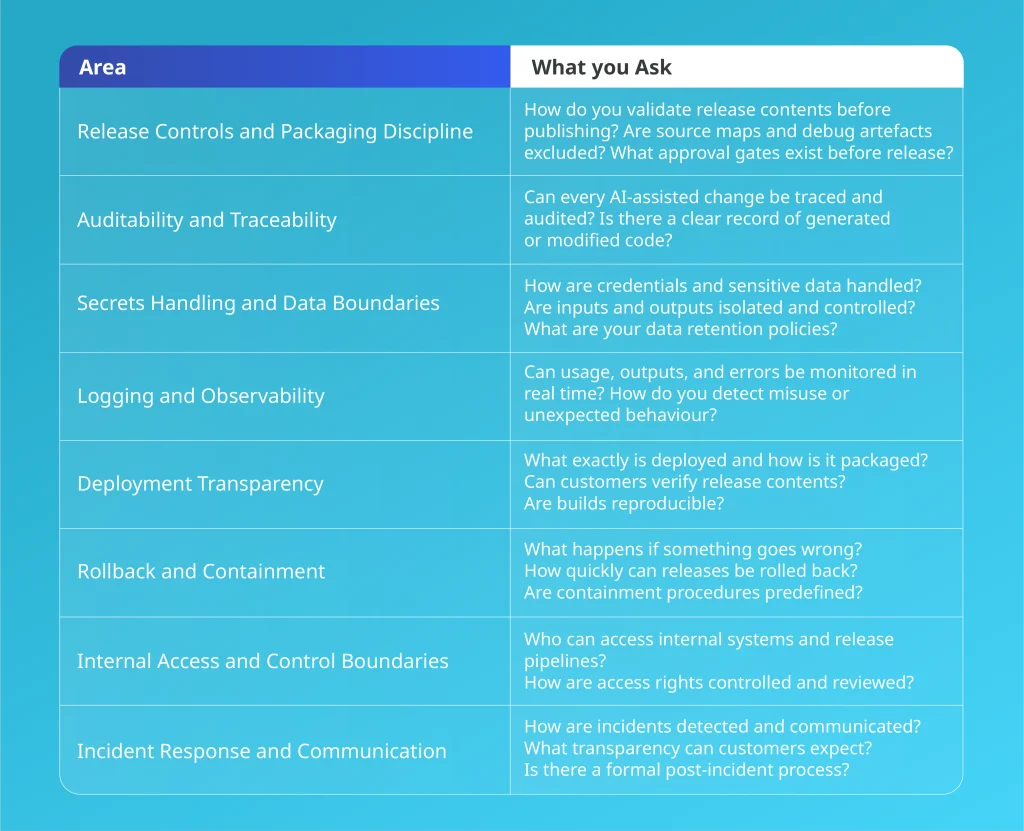
An AI coding tool should be evaluated as part of the engineering system that shapes how software is built, reviewed, and released.
AI Coding Assistants Are Part of Your Software Supply Chain
AI coding assistants belong in software supply chain risk thinking because they shape what gets written, how it is reviewed, and how quickly it reaches production. That puts them closer to building systems, package managers, and CI/CD tools than to simple productivity software.
When the Pentagon designated Anthropic a supply-chain risk in March 2026, Microsoft told a federal court that the move would directly affect offerings it provides to the U.S. military because those solutions rely on Anthropic’s products and services. Microsoft also said contractors would have to rebuild offerings quickly if the designation took effect without a restraining order.
That is what supply chain dependence looks like in practice: one vendor decision or disruption can ripple into other organisations’ delivery environments and customer commitments.
The Claude Code leak matters because it showed how much insight a single release mistake could give outsiders into a delivery-adjacent tool. That raises a bigger question about dependency risk, vendor trust, and the level of scrutiny these tools deserve.
There is also a standard angle here. NIST’s Secure Software Development Framework now includes an AI-specific community profile, and SSDF 1.1 explicitly added guidance on collecting and sharing provenance data for software release components. Provenance, release integrity, and secure development environments are exactly the kinds of controls that matter when a vendor tool starts influencing production code and delivery decisions.
That level of scrutiny matters most when an AI coding tool touches production-bound code, infrastructure workflows, shared repositories, or release processes.
If an AI coding assistant can shape production code, engineering behaviour, or delivery workflows, it should be reviewed like a software dependency. Model quality still matters, but it is not enough on its own. Operational controls, release discipline, auditability, provenance, and contingency planning belong in the evaluation, too.
What Good Internal Controls Look Like Before Wider Rollout
Rolling out AI coding tools across more teams should start with control. The real test is whether the organisation can define where the tool should be used, how its output is reviewed, who owns the risk, and when trust should be withdrawn.
Strong internal controls make rollout measurable, easier to govern, and much safer to scale. They also reduce the chance that a useful tool becomes a hidden source of weak review standards, unclear ownership, or delivery risk.

Good rollout discipline keeps AI adoption controlled, visible, and reversible before speed or enthusiasm pushes it into areas the organisation is not ready to govern.
For teams trying to turn AI tooling into something operationally safe, this guide to governed AI engineering shows what it takes to build clear controls, ownership, and review standards into day-to-day delivery.
A Practical Checklist for Teams Already Using AI Coding Tools
If AI coding tools are already in use, the priority is control. Use this checklist to review where the tool affects delivery, where risk is building, and which safeguards need to be tightened before usage expands.
✔️Review the vendor’s controls. Check release discipline, auditability, logging, data handling, rollback processes, and incident response expectations.
✔️Map where the tool touches delivery. Identify where it influences coding, review, testing, documentation, infrastructure changes, or deployment preparation.
✔️Tighten release governance. Make sure AI-assisted workflows still sit inside package checks, approval gates, validation steps, and rollback procedures.
✔️Test for secret exposure. Review whether prompts, generated code, logs, or integrations could expose credentials, tokens, internal paths, or sensitive logic.
✔️Document approval paths. Define who signs off on AI-assisted changes, when escalation is required, and which teams own exceptions.
✔️Set clear human review boundaries. Decide which workflows always require human review and which outputs should never be trusted without deeper validation.
✔️Validate output quality properly. Check whether the generated code is being tested against engineering, security, and compliance standards.
✔️Improve visibility across teams. Make sure usage, outputs, exceptions, and error patterns can be seen clearly, not buried inside individual teams.
✔️Define fallback rules. Set clear conditions for limiting, pausing, or removing the tool from a workflow when trust drops.
✔️Reassess before wider rollout. Review all of the above before extending usage into more teams, repos, or delivery-critical workflows.
A tool becomes production-ready when its use is visible, governed, reviewable, and easy to contain when trust drops.
AI Coding Tool Governance Needs a Controlled Delivery Model
Once AI coding tools enter engineering workflows, the real challenge is making sure they improve delivery without weakening review standards, creating hidden risk, or spreading faster than governance can keep up. That’s why a controlled delivery model matters most.
A more practical path is to accelerate AI delivery without sacrificing governance, so speed gains do not come at the cost of weaker review, poor visibility, or avoidable delivery risk.
Deployflow is best suited when AI needs to move from experimentation to real operational use. The focus shifts from trying tools to making them work within production systems, where output must be reliable, observable, and aligned with existing engineering workflows.
Dedicated teams integrate AI directly into day-to-day work, automate repetitive tasks and support faster decisions, without stepping outside controlled delivery processes. The real value shows when AI reduces manual effort and speeds up delivery while staying governed and predictable.
The practical advantage is a clearer path to using AI in places where it creates real value, while keeping engineering standards intact and making rollout easier to govern as adoption grows.
The Real Lesson for CTOs: Treat AI Coding Tools Like Engineering Infrastructure
The real risk with AI coding tools is normalisation without enough control. Once these tools become part of daily engineering work, weak oversight begins to affect how software is built, reviewed, and trusted.
That is why the standard should be higher.
Before any AI coding tool earns a wider role in delivery, it should be clear where it adds value, where human review remains non-negotiable, and what controls are strong enough to keep adoption from creating new risk.
A free AI opportunity and readiness assessment can help identify where AI belongs in your delivery environment, which risks need control first, and what needs to be in place before rollout expands.

Frequently Asked Questions About AI Coding Tools and Governance
What is an AI coding assistant?
An AI coding assistant is a tool that generates, suggests, or reviews code based on prompts and existing context.
These tools can help with writing functions, debugging, refactoring, and documentation, often integrating directly into IDEs or CI/CD workflows. Their influence goes beyond productivity because they shape how code is written and reviewed.
Are AI coding tools safe to use in production environments?
AI coding tools can be safe in production when used with proper controls, review processes, and governance.
Safety depends less on the tool itself and more on how it is used inside engineering workflows. Teams need clear validation standards, defined ownership, and visibility into how AI-generated code moves through the delivery process. Without that, small issues can scale quickly and become harder to detect or roll back.
Do AI coding assistants replace software developers?
AI coding assistants do not replace developers but change how they work and what they focus on.
They reduce time spent on repetitive or well-defined tasks, allowing engineers to focus more on architecture, problem-solving, and validation. However, responsibility for code quality, system design, and production outcomes still sits with developers, which makes oversight even more important as AI usage grows.
Can AI coding tools introduce security vulnerabilities?
AI coding tools can introduce vulnerabilities if the generated code is not properly reviewed and validated.
They can produce insecure patterns, misuse libraries, or overlook edge cases, especially when prompts are vague or context is limited. Strong review processes, automated security checks, and clear boundaries on where AI is used are essential to prevent these risks from reaching production.
How should teams start using AI coding tools?
Teams should start with controlled use cases, clear guidelines, and defined review processes before expanding usage.
A phased rollout helps teams understand where AI actually improves delivery and where it creates friction or risk. Starting small also makes it easier to set standards for validation, access, and monitoring before AI becomes embedded in critical workflows. For teams that need a more structured path, AI engineering and automation services can help bring that rollout into a controlled delivery model.
Explore our BLOG
Recent articles
ISO 42001 Explained: Requirements, Certification and What Your Engineering Team Must Build
ISO 42001 is the international standard that demonstrates your organisation governs AI properly, and enterprise...
read full article

Is Claude Down? Anthropic Outage: Protect Your Cloud Infrastructure
Claude went down across every surface on 29 September 2026. From 14:00 to 14:59 UTC,...
read full article

Top 10 Healthtech Companies in 2026: What Their Growth Means for AI and DevOps
Every software change that reaches a hospital has to clear regulatory, legacy system, and clinical...
read full article